From 18 to 20 November 2026, the 14th Indian Fisheries and Aquaculture Forum is meeting at the ICAR-Central Institute of Freshwater Aquaculture (CIFA) in Bhubaneswar. More than 1,000 participants from India and six other countries are discussing the theme "Transforming Aquaculture and Fisheries: Bridging Science and Society". The agenda includes genome editing, precision aquaculture, breeding technology and aquatic animal health. The country they are meeting in matters: India is the second-largest fish producer in the world, with about 8% of global output, and most of that fish is farmed, not caught. For the exam, this is a Class 9 and Class 12 biology topic: what a fish is, how it lives in water, and how farmers use that biology to raise more of it.
Built for Water: What Makes a Fish a Fish
By Akanksha Kumari · Science faculty, The Cavalier · B.Tech, 15 years teaching Science
Fishes belong to the class Pisces, within the phylum Chordata and the vertebrates. They are exclusively aquatic. The body is streamlined, covered with scales or plates, and driven by a muscular tail. They breathe dissolved oxygen through gills, they are cold-blooded, and the heart has only two chambers (one atrium and one ventricle). Blood therefore passes through the heart once per circuit: from the heart to the gills, then to the body, then back. Humans have four chambers and two separate loops.
Silverfish is an insect. Jellyfish is a cnidarian. Cuttlefish is a mollusc, and starfish is an echinoderm. Crayfish is an arthropod. None of them is a vertebrate with gills and fins. Flying fish, seahorse, climbing perch (Anabas) and dogfish are true fishes despite their names. UPSC reuses this trap, as the past papers below show.
Fishes split into two main groups, and the split is a favourite exam table.
| Feature | Cartilaginous (Chondrichthyes) | Bony (Osteichthyes) |
|---|---|---|
| Examples | Dogfish (Scoliodon), sharks, rays, skates | Rohu, catla, mrigal, hilsa, tuna, seahorse |
| Skeleton | Cartilage | Bone |
| Gill cover | None: 5 to 7 gill slits open directly | A bony flap, the operculum, covers the gills |
| Swim bladder | Absent | Present |
| Fertilisation | Internal | Mostly external, in water |
| Mouth | Usually on the underside | At the front |
The gill. Water holds far less oxygen than air, and what it holds is only a few milligrams per litre, so a fish must extract it very efficiently. Its gills are thin feathery filaments packed with blood capillaries. Water flows over them in one direction while blood flows through them in the opposite direction. This counter-current exchange keeps the oxygen gradient steep along the whole length of the filament. A bony fish pumps water in through the mouth and out under the operculum. Compare it with air breathing on our respiratory system page.
The swim bladder is a gas-filled sac that lets a bony fish hover at any depth without effort. By adding or removing gas it changes its overall density, which is the same Archimedes principle that makes a submarine dive and rise. Sharks have no bladder. They rely on an oily liver and on constant swimming. The lateral line, a row of pores along each flank, senses water movement and pressure and helps a school of fish turn together. Growth rings on the scales of bony fishes let scientists estimate age.
Breeding. Most bony fishes shed eggs and sperm into the water, so fertilisation is external. Many eggs are lost to predators and currents, so a female rohu releases lakhs of eggs in one season. Sharks and rays, in contrast, fertilise internally and produce far fewer, better-protected young. Some fishes break these rules in interesting ways: the male seahorse carries the eggs in a brood pouch, and lungfishes breathe air through a lung.
Oxygen in Water: Why Ponds Fail at Dawn
Dissolved oxygen (DO) is the number every fish farmer checks first. Three things control it. Temperature: warm water holds less oxygen, while a fish's metabolism speeds up and demands more. Light: algae and water plants release oxygen by photosynthesis in daylight, but at night they only respire and use oxygen up. Decay: uneaten feed and dead plankton are broken down by bacteria, which also consume oxygen.
Put these together and a classic failure appears. A pond is fertilised heavily and overfed. Algae multiply into a thick green bloom, which is eutrophication. By day the oxygen is plentiful. Through the night the bloom respires and the bacteria work, and by just before dawn DO can fall low enough to suffocate the stock. This is why fish kills are found at sunrise and why farmers use aerators. For bioaccumulation and eutrophication in a wider setting, see our pollutants page.
| Type of water | Typical fishes | Condition that matters |
|---|---|---|
| Warm freshwater ponds, tanks and reservoirs | Catla, rohu, mrigal, common carp | Plankton supply and DO through the night |
| Cold water (snow-fed streams, lakes, reservoirs) | Rainbow trout, golden mahseer, snow trout | Temperature of 5 to 25 °C, DO above 6 mg per litre, pH between 6.5 and 8.0 |
| Brackish water (estuaries, lagoons) | Shrimp (tiger prawn), mullets, bhetki | A mix of salt and fresh water |
| Sea (marine) | Pomfret, mackerel, tuna, sardine, Bombay duck | Capture fishing; mariculture of mullets, mussels, oysters and seaweed |
Fishes that cross between waters. The hilsa lives in the sea and swims up large rivers to spawn, a habit called anadromous migration. Eels do the reverse, living in rivers and breeding in the sea (catadromous). Hilsa is the national fish of Bangladesh, a point UPSC has asked directly. Our pages on Himalayan trout farming and the organic fisheries cluster at Soreng show the cold-water side in practice.
The Composite Pond: Six Carps, Six Dining Tables
A pond is not one habitat. It has a sunlit surface rich in plankton, a middle layer, a muddy bottom and weedy margins. A single species would use only one of these layers and leave the rest of the food wasted. Composite fish culture stocks five or six compatible species in the same pond, each feeding in a different zone, so that they do not compete and the whole pond's food is used.
| Species | Origin | Where it feeds | What it eats |
|---|---|---|---|
| Catla | Indian major carp | Surface | Zooplankton |
| Silver carp | Exotic (Chinese carp) | Surface | Phytoplankton (algae) |
| Rohu | Indian major carp | Middle zone | Mixed plankton and plant matter |
| Grass carp | Exotic (Chinese carp) | Margins and weedy areas | Aquatic weeds |
| Mrigal | Indian major carp | Bottom | Decaying matter and bottom organisms |
| Common carp | Exotic | Bottom | Detritus, worms and insect larvae |
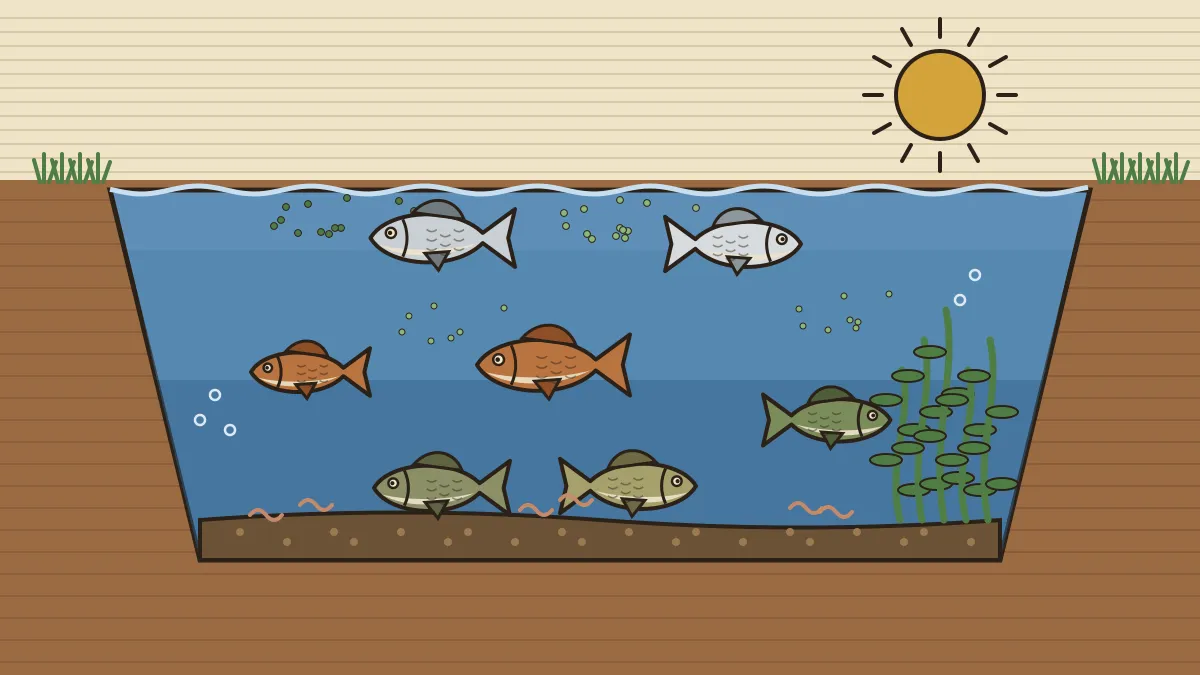
The three Indian major carps are catla, rohu and mrigal. The other three came from outside India; silver carp and grass carp are Chinese carps that reached India in the late 1950s. The trick is to choose species whose diets do not overlap. Grass carp has a second use: by eating weeds it keeps the pond clear. Its droppings fertilise the water, which in turn feeds plankton, and the plankton feed catla and silver carp. This is a miniature food web, run by the farmer. Pond fertiliser such as cow dung is used to grow the plankton in the first place. Our page on the role of microbes in human welfare explains how bacteria recycle that waste.
"Indian major carps" means exactly catla, rohu and mrigal. Silver carp, grass carp and common carp are exotic. A statement that "all species in composite culture are Indian" is wrong.
Breeding on Demand: Hormones and Seed
Composite culture had a problem. Carps breed naturally only in the monsoon, in flooded rivers, and do not breed on their own in still ponds. Farmers once collected fish seed from rivers, and the seed arrived mixed with unwanted species. The shortage of good-quality seed held back fish farming.
The solution came from endocrinology. In 1957 (the year usually cited for the first success), H. Chaudhuri and K.H. Alikunhi in Cuttack reported that Indian major carps could be made to spawn by injecting an extract of the pituitary gland. The pituitary releases gonadotropic hormones that tell the ovary to ripen and release eggs. In a natural river the signal comes from flood, temperature and day length. In a pond, the hormone injection supplies it. Today scientists use synthetic hormone preparations (a GnRH analogue) in place of pituitary extract. The hormone chain is described on our endocrine glands page.
| Stage | What it means |
|---|---|
| Brood fish | Mature adults, kept in ponds and selected for good growth |
| Induced breeding | Hormone injection, then the eggs are fertilised and incubated in a hatchery |
| Spawn | Newly hatched young, still living on their yolk |
| Fry, then fingerlings | Reared in nursery ponds until they are big enough to stock |
| Grow-out pond | Fingerlings raised to market size in the composite pond |
The same logic as crop breeding applies to fish: select the best fish, then breed them for faster growth and disease resistance. Our plant breeding article covers the crop version, and the forum in Bhubaneswar is discussing genome editing as the next step.
India's Fisheries in Numbers
| Year | Fish production (lakh tonnes) |
|---|---|
| 2020-21 | 147.25 |
| 2021-22 | 162.48 |
| 2022-23 | 175.45 |
| 2023-24 | 183.93 |
| 2024-25 | 197.75 |
Output rose by about a third in four years. India is the second-largest fish producer (around 8% of the world total), the second-largest aquaculture producer and the largest producer and exporter of shrimp. Inland fisheries, dominated by fish farming, now supply nearly three-fourths of the total (about 151.6 of 197.75 lakh tonnes in 2024-25), so the farmed pond has overtaken the net. Frozen shrimp alone accounts for nearly two-thirds of seafood export earnings.
Government effort has two strands. The Blue Revolution, named in parallel with the Green Revolution, pushed fish production in the 2010s. The Pradhan Mantri Matsya Sampada Yojana (PMMSY), running from 2020-21, funds ponds, hatcheries, cold chains, fishing harbours and welfare for fishers. For the milk equivalent of this story, see Operation Flood. India has also joined the WTO fisheries subsidies agreement and mapped its deep-sea fishery resources. For the geography of the world's fishing grounds, read our fishing grounds article.
The nutrition case is simple. Fish is a cheap source of animal protein and of the long-chain omega-3 fatty acids that few other foods give. Marine fish are also a source of iodine. See the nutrition page for the balanced-diet context.
How UPSC Has Asked It: Past Papers Solved
UPSC asks about fish mostly as true fish or not, features of Pisces and fisheries facts.
Which one of the following is a true fish as per the biological system of classification?
(a) Silverfish (b) Jellyfish (c) Cuttlefish (d) Flying fish
Answer: (d). The flying fish is a bony fish with gills and fins. Silverfish is an insect, jellyfish a cnidarian and cuttlefish a mollusc.
Which one of the following belongs to 'Pisces'?
(a) Dogfish (b) Jellyfish (c) Silverfish (d) Starfish
Answer: (a). Dogfish (Scoliodon) is a cartilaginous fish. The other three have "fish" in the name only.
Which of the following organisms show external fertilization? I. Pigeon II. Frog III. Fish IV. Lizard
(a) II, III and IV (b) II and III only (c) I and IV only (d) I, II and III
Answer: (b). Frogs and (most) fishes shed gametes in water. Birds and reptiles fertilise internally and then lay shelled eggs, so pigeon and lizard are out.
Which one of the following pairs of animals is warm-blooded?
(a) Crocodile and Ostrich (b) Hagfish and Dogfish (c) Tortoise and Ostrich (d) Peacock and Camel
Answer: (d). Peacock is a bird and camel a mammal, and both are warm-blooded. Crocodile and tortoise are reptiles, and hagfish and dogfish are fishes, so all four are cold-blooded.
Hilsa is the national fish of
(a) Pakistan (b) India (c) Bangladesh (d) Nepal
Answer: (c). Hilsa is Bangladesh's national fish. It is also an anadromous migrant, living in the sea and entering rivers to spawn.
Animals which are marine, bilaterally symmetrical, have a coelom and a notochord, but never form a vertebral column are placed under which one of the following groups?
(a) Chordata (b) Protochordata (c) Vertebrata (d) Mammalia
Answer: (b). Protochordates, for example Balanoglossus, have a notochord but no vertebral column. Vertebrata (c) is the tempting wrong choice, since it needs a vertebral column.
Every question tests classification: know the animal groups by feature (backbone, heart chambers, blood temperature, fertilisation). The fisheries-scheme and aquaculture questions appear in the GS economy section instead, so link the biology to the scheme.
Practice MCQs (with answers)
- The heart of a fish has
- one chamber
- two chambers
- three chambers
- four chambers
- Which of the following is a cartilaginous fish?
- Rohu
- Catla
- Hilsa
- Dogfish (Scoliodon)
- In composite fish culture, which species is the main surface feeder?
- Catla
- Rohu
- Mrigal
- Grass carp
- Which of these is NOT an Indian major carp?
- Catla
- Rohu
- Silver carp
- Mrigal
- Indian major carps were first induced to spawn artificially, in the 1950s, using an extract of the
- pituitary gland
- thyroid gland
- pancreas
- adrenal gland
- Fish kills in an over-fertilised pond are most often found at dawn mainly because of
- excess oxygen from photosynthesis
- acid rain
- cold water
- depletion of dissolved oxygen overnight
- India's share of the world's fish production is about
- 2%
- 4%
- 8%
- 20%
- A fish that lives in the sea but swims up rivers to spawn, such as the hilsa, is called
- catadromous
- anadromous
- sessile
- planktonic
1-b, 2-d, 3-a, 4-c, 5-a, 6-d, 7-c, 8-b. Q3: catla is the surface feeder; rohu feeds in the middle zone and mrigal at the bottom. Q4: silver carp is a Chinese (exotic) carp. Q6: algae stop producing oxygen at night and both they and bacteria use it up. Q8: sea to river is anadromous; river to sea (eel) is catadromous.
Quick Revision
- Pisces: aquatic, gills, scales, fins, two-chambered heart, cold-blooded. Not fish: silverfish (insect), jellyfish, cuttlefish, starfish, crayfish. True fish: flying fish, seahorse, dogfish.
- Cartilaginous (dogfish, shark, ray): cartilage, no operculum, no swim bladder, internal fertilisation. Bony (rohu, hilsa): bone, operculum, swim bladder, mostly external fertilisation.
- Gill = counter-current exchange. Swim bladder = buoyancy. Lateral line = senses water movement.
- Low dissolved oxygen at night and before dawn; eutrophication; cold-water species need 5 to 25 °C, DO above 6 mg/L.
- Composite culture: catla (surface), silver carp (surface), rohu (middle), grass carp (weeds), mrigal and common carp (bottom). Indian major carps = catla, rohu, mrigal.
- Induced breeding by pituitary extract: Chaudhuri and Alikunhi, 1957. Hilsa: anadromous; Bangladesh's national fish.
- India: 197.75 lakh tonnes (2024-25); 2nd-largest producer, about 8% of world; inland fisheries (mostly farmed) nearly three-fourths; PMMSY from 2020-21; largest shrimp producer and exporter.
Frequently asked questions
What is the difference between cartilaginous and bony fishes?
Cartilaginous fishes such as dogfish and sharks have a skeleton of cartilage, uncovered gill slits and no swim bladder, and they fertilise internally. Bony fishes such as rohu and hilsa have a bone skeleton, a gill cover called the operculum and a swim bladder, and most fertilise externally in the water.
What is composite fish culture?
Composite fish culture means raising five or six compatible fish species in one pond, each feeding in a different layer. Catla and silver carp feed at the surface, rohu in the middle, mrigal and common carp at the bottom, and grass carp on weeds. Because the species do not compete for food, the whole pond's food is used and yield rises.
Why did carp breeding need hormone injections?
Indian major carps breed naturally only in the monsoon, in flooded rivers, and do not spawn in still ponds. In 1957, scientists in Cuttack showed that injecting an extract of the pituitary gland, which carries gonadotropic hormones, made them spawn. This gave farmers pure fish seed in the quantities they needed.
How much fish does India produce?
India produced 197.75 lakh tonnes of fish in 2024-25, up from 147.25 lakh tonnes in 2020-21. India is the world's second-largest fish producer with about 8% of global output, and inland fisheries, mostly farmed fish, supply nearly three-fourths of it.
What is the Indian Fisheries and Aquaculture Forum?
It is a scientific conference on fisheries and aquaculture. The 14th edition is being held from 18 to 20 November 2026 at ICAR-CIFA in Bhubaneswar, on the theme "Transforming Aquaculture and Fisheries: Bridging Science and Society", with over 1,000 participants from India and six other countries.
Related CDS / OTA Science topics
Biology is the largest block of the science questions in CDS and NDA
Cavalier's CDS/OTA batches teach biology from diagrams and PYQs, so classification and food-production questions become easy marks.