Every year, from late October, a brown haze settles over the Indo-Gangetic plain, and Delhi-NCR's Air Quality Index slides from "poor" to "very poor" and sometimes "severe". A nationwide Green Diwali Campaign is running from 20 October to 8 November 2026, and on 2 December India observes National Pollution Control Day, in memory of the Bhopal gas tragedy of 1984. UPSC asks about this topic nearly every year: which pollutant is primary, what causes smog, what is acid rain, which gas poisons the blood. This article builds the picture and ends with the standards India measures it against.
Primary and Secondary Pollutants
By Akanksha Kumari · Science faculty, The Cavalier · B.Tech, 15 years teaching Science
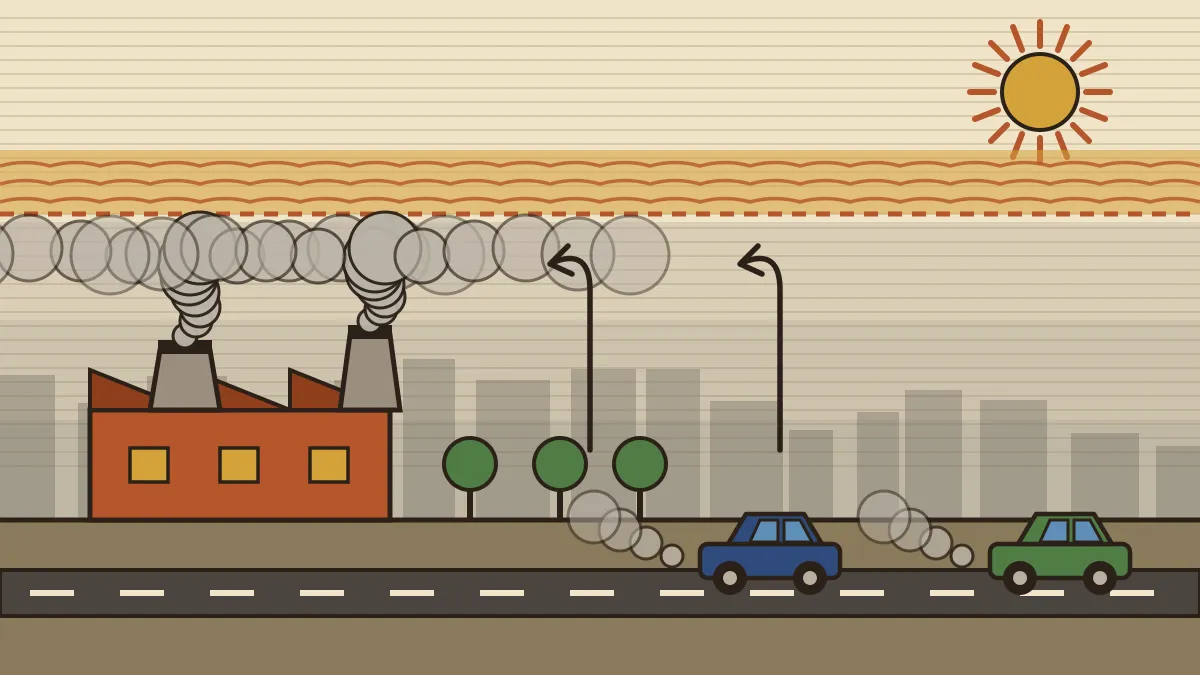
A pollutant is any substance added to the environment in an amount large enough to harm it. Pollution means the unwanted change in air, water or soil beyond a safe limit. Volcanoes and forest fires are natural sources, but the trouble comes from burning fossil fuels, industry, farming and waste. Air pollutants fall into two families.
- Primary pollutants are added to the air directly in a harmful form: CO and CO2 from burning fuel, SO2 from coal, soot, dust, lead.
- Secondary pollutants are not emitted. They form when primary pollutants react with each other or with air, often helped by sunlight.
Sulphur dioxide is primary, but it oxidises and dissolves in moisture to give secondary pollutants:
| Pollutant | Type | Main sources | Main harm |
|---|---|---|---|
| PM2.5, PM10 | Primary (also forms secondary from gases) | Vehicles, coal, crop burning, construction dust | Lungs, heart, blood vessels |
| SO₂ | Primary | Coal-fired power plants, smelters, refineries | Irritates airways; acid rain |
| NO, NO₂ (NOx) | NO primary, NO₂ secondary | Vehicles (diesel especially), power plants | Lung irritation; smog; acid rain |
| CO | Primary | Incomplete burning: petrol engines, defective furnaces | Blocks oxygen transport in blood |
| Ozone (O₃) near the ground | Secondary | NOx + hydrocarbons + sunlight | Coughing, damaged lungs and crops |
| Lead | Primary | Leaded petrol (now phased out), battery recycling, paints | Anaemia, kidney and nerve damage |
Ozone is a pollutant at ground level but a shield in the stratosphere. Our notes on the atmosphere cover the shield.
Particulate Matter: PM10 and PM2.5
Particulate matter (PM) is a mixture of solid specks and liquid droplets hanging in the air: soot, fly ash from thermal power plants, cement dust, smoke from burning crop residue. It is named by size. PM10 is particles of diameter 10 micrometres or less. PM2.5 is 2.5 micrometres or less, about one-thirtieth the width of a human hair. PM2.5 is a subset of PM10, not a separate group.
Size decides how deep the particle goes. PM10 reaches the lungs and lodges along the airways, causing asthma and bronchitis. PM2.5 slips past the body's defences into the deepest air sacs and then the bloodstream, raising the risk of heart disease, stroke and lung cancer. The WHO's 2021 guideline for PM2.5 is only 5 µg/m³ as an annual average; India's standard is 40.
Winter makes it worse: a temperature inversion (explained below) and low wind trap crop-residue smoke, exhaust, dust and firecracker smoke in one layer. Our report on the Green Diwali campaign and the 130 NCAP cities explains why festival fireworks are only a small part of the annual load.
The Gases: SO2, NOx, CO, Ozone and Lead
Sulphur dioxide comes mainly from burning coal and oil, which contain a little sulphur, and from smelting sulphur ores. It irritates the eyes and airways, damages leaves, and turns into sulphuric acid in moisture. Nitrogen oxides form when air is heated so strongly in an engine or furnace that nitrogen and oxygen combine; diesel engines are a leading source, and so are power plants. Nitrogen dioxide is a brown gas, a key ingredient of photochemical smog and a source of nitric acid in acid rain. NO2 is the oxide of nitrogen that dimerises (2NO2 ⇌ N2O4), turning from brown to colourless on cooling.
Carbon monoxide is colourless, odourless and deadly. It forms when carbon burns with too little oxygen: petrol engines, wood or coal burnt in a closed room, badly ventilated furnaces. Haemoglobin carries oxygen from the lungs to the tissues. CO binds to haemoglobin about 200 times more strongly than oxygen does, forming carboxyhaemoglobin, so the blood can no longer deliver oxygen. Victims feel headache and drowsiness, and the lips turn dark red. Our notes on blood explain the haemoglobin side.
Ground-level ozone is not released by any chimney. It forms when nitrogen oxides and hydrocarbons (vapours from petrol, solvents and paints) react in strong sunlight. With peroxyacetyl nitrate (PAN) it forms the "photochemical oxidants" that sting the eyes and scar lungs and crops. Lead was once added to petrol as tetraethyl lead to stop engine knock. It is a cumulative poison that interferes with red blood cell formation and harms the kidneys and the developing brain of children. India completed the phase-out of leaded petrol in 2000.
Bhopal 1984: When the Chemical Itself Is the Pollutant
On the night of 2–3 December 1984, a storage tank at the Union Carbide India Limited pesticide plant in Bhopal released methyl isocyanate (MIC), an intermediate used to make the pesticide carbaryl. Water entered the tank, a violent reaction followed, and tens of tonnes of toxic vapour escaped into the cool night air, which kept it low over crowded neighbourhoods. More than 5 lakh people were exposed. The Madhya Pradesh government has confirmed 3,787 deaths, and many more suffered lasting lung and eye damage.
The tragedy shaped Indian law. The Environment (Protection) Act, 1986 was enacted in its wake as the umbrella law under Article 253, giving the Centre power to set emission standards. It joined the Air (Prevention and Control of Pollution) Act, 1981, which created the Central and State Pollution Control Boards' role in air. The Supreme Court's doctrine of absolute liability (M.C. Mehta, 1987) belongs to the same debate, and in 1989 the company settled for US$470 million. Our notes on the judiciary cover the Court's role.
Smog and Acid Rain
Smog is "smoke plus fog", a term from the early 1900s. It comes in two chemical types, and the exam likes to contrast them.
| Feature | Classical (London) smog | Photochemical smog |
|---|---|---|
| Main ingredients | Smoke, soot and SO₂ from burning coal, with fog | NOx and hydrocarbons from vehicles, with sunlight |
| Chemical nature | Reducing smog (SO₂ is a reducing agent) | Oxidising smog (ozone, PAN) |
| Weather | Cold, humid, winter mornings | Warm, dry, sunny afternoons |
| Famous case | London's Great Smog, December 1952, which killed thousands and led to the UK Clean Air Act, 1956 | Los Angeles from the 1940s |
| Effect | Bronchitis, breathlessness | Eye irritation, cough, cracked rubber, damaged crops |
Both need a trapping mechanism, the temperature inversion. Normally air is warmest at the ground and cools as it rises, so warm polluted air floats upward and disperses. In an inversion a layer of warm air sits above cold air near the ground. It acts as a lid: smoke and exhaust rise only until they meet the warm layer, then spread sideways and build up. Delhi's winter smog is neither pure type. It is mainly a particulate haze, trapped by inversion and low winds.
Acid rain forms when SO2 and nitrogen oxides, aided by ozone, are oxidised and dissolved in cloud water:
Pure rain is already slightly acidic, about pH 5.6, because dissolved CO2 makes carbonic acid. Rain is called acid rain only when its pH falls below 5.6. Effects: dying forests, lakes where fish cannot breed (freshwater has little buffering capacity, unlike seawater), and corrosion of marble and limestone monuments. The Mathura refinery's emissions were a worry for the Taj Mahal, and the Supreme Court restricted polluting fuels in the Taj Trapezium Zone in 1996. The pH scale itself is explained in our acids, bases and pH notes.
Standards and Warnings: NAAQS, AQI, GRAP and NCAP
India's yardstick is the National Ambient Air Quality Standards (NAAQS), notified by the Central Pollution Control Board (CPCB) in November 2009 and replacing the 1994 standards. They cover 12 pollutants: SO2, NO2, PM10, PM2.5, ozone, lead, CO, ammonia, benzene, benzo(a)pyrene, arsenic and nickel. Selected limits (residential and rural areas):
| Pollutant | Annual average | Short-term limit |
|---|---|---|
| PM2.5 (µg/m³) | 40 | 60 (24 hours) |
| PM10 (µg/m³) | 60 | 100 (24 hours) |
| SO₂ (µg/m³) | 50 | 80 (24 hours) |
| NO₂ (µg/m³) | 40 | 80 (24 hours) |
| Ozone (µg/m³) | none | 100 (8 hours); 180 (1 hour) |
| CO (mg/m³) | none | 2 (8 hours); 4 (1 hour) |
| Lead (µg/m³) | 0.5 | 1.0 (24 hours) |
The Air Quality Index (AQI), launched in October 2014, turns these readings into one number and one colour. It uses 8 pollutants (PM10, PM2.5, NO2, SO2, CO, O3, NH3, lead), not 12. Each pollutant gets a sub-index, and the worst one decides the AQI. PM2.5 or PM10 is usually the culprit in winter.
| AQI | Category | PM2.5 (24 h, µg/m³) |
|---|---|---|
| 0–50 | Good | 0–30 |
| 51–100 | Satisfactory | 31–60 |
| 101–200 | Moderate | 61–90 |
| 201–300 | Poor | 91–120 |
| 301–400 | Very Poor | 121–250 |
| 401–500 | Severe | 250+ |
For Delhi-NCR, the Commission for Air Quality Management (CAQM), a statutory body created in 2021, uses the AQI to trigger the Graded Response Action Plan (GRAP): Stage I at Poor (201–300), Stage II at Very Poor (301–400), Stage III at Severe (401–450) and Stage IV at Severe+ (above 450). Each stage adds restrictions, from dust control to curbs on construction and vehicles. A revision in November 2025 moved several measures into earlier stages. See our report on CAQM and GRAP.
The national programme is the National Clean Air Programme (NCAP), launched in January 2019 for 130 cities that fail the standards. Its original goal was a 20–30% cut in particulate levels by 2024 against 2017-18; it was later revised to up to 40% in PM10, or meeting the 60 µg/m³ standard, by 2025-26. The government says 108 cities lowered PM10 and 14 met the standard; see our NCAP progress report.
How UPSC Has Asked It: Past Papers Solved
These are actual CDS and NDA questions since 2018. UPSC asks about the chemistry of the pollutants, and about smog and acid rain as processes.
Which one of the following is the main reason of acid rains?
(a) Dissolution of sulphur and nitrogen oxides in rain (b) Dissolution of minerals in rain (c) Dissolution of dust particles in rain (d) Dissolution of soil solution in rain
Answer: (a). SO2 and NOx form sulphuric and nitric acid in cloud water. Dust is usually alkaline and can even neutralise acidity, so (c) is wrong.
Which one of the following is the most important factor for the formulation of smog?
(a) Long winter nights (b) Formation of an 'inversion lid' (c) Presence of many air pollutant resources (d) Rapid fall in temperature with increasing height above the sea level
Answer: (b). Pollutants and cold nights contribute, but without the warm "lid" the polluted air would rise and disperse.
Which one of the following is related to global dimming?
(a) Fall of atmospheric pressure due to increased particulates (b) Raise of atmospheric pressure due to increased particulates (c) Raise of temperature due to increased particulates (d) Fall of temperature due to increased particulates
Answer: (d). Particulates and aerosols reflect and absorb sunlight, so less reaches the ground and surface temperature falls. This "dimming" partly masks greenhouse warming, so (c) is the tempting wrong choice.
The poisonous nature of Carbon monoxide (CO) is due to its
(a) insolubility in water (b) ability to form a complex with haemoglobin (c) ability to reduce some metal oxides (d) property of having one sigma bond
Answer: (b). CO forms carboxyhaemoglobin, which cannot carry oxygen. Option (c) is a real property of CO, but it has nothing to do with its toxicity.
Which one of the following nitrogen oxides may dimerize?
(a) N₂O (b) NO₂ (c) NO₃ (d) N₂O₅
Answer: (b). NO2, with an unpaired electron, joins to form colourless N2O4. N2O has no unpaired electron, and N2O5 is not a radical.
For acid rain, the pH of rain water should be less than
(a) 7.0 (b) 6.6 (c) 5.6 (d) 8.0
Answer: (c). Clean rain is already at about pH 5.6 because of dissolved CO2. Option (a) is the tempting choice, since 7 is neutral, but rain is not called acidic until it drops below 5.6.
UPSC asks mechanisms: what the inversion does, why CO is toxic, which oxide dimerises, what pH defines acid rain.
Practice MCQs (with answers)
- Which of the following is a secondary pollutant?
- Carbon monoxide
- Lead
- Ozone near the ground
- Sulphur dioxide
- PM2.5 refers to particles with a diameter of
- 2.5 micrometres or less
- 2.5 millimetres or less
- 25 micrometres or less
- 0.25 micrometres exactly
- The Bhopal gas tragedy of 1984 was caused by the release of
- hydrogen cyanide
- methane
- sulphur dioxide
- methyl isocyanate
- Classical (London) smog differs from photochemical smog in that it
- needs strong sunlight
- is a reducing smog rich in smoke and SO2, forming in cold, humid air
- is rich in ozone and PAN
- forms mainly on hot, dry afternoons
- India's National Ambient Air Quality Standards of 2009 cover how many pollutants?
- 8
- 12
- 6
- 10
- The Air Quality Index for a city on a given day is decided by
- the average of all pollutants
- PM2.5 alone
- the sum of all sub-indices
- the pollutant with the worst sub-index
- Under GRAP, Stage III applies when the AQI category is
- Severe (401–450)
- Poor (201–300)
- Very Poor (301–400)
- Severe+ (above 450)
- The National Clean Air Programme (2019) originally aimed to cut particulate pollution in its cities by
- 50% within five years
- 5% a year until 2030
- 20–30% by 2024 against 2017-18
- zero by 2030
1-c, 2-a, 3-d, 4-b, 5-b, 6-d, 7-a, 8-c. Q1: ozone is formed in the air from NOx and hydrocarbons, so it is secondary. Q5: remember 12 for NAAQS, 8 for AQI. Q6: the AQI takes the worst sub-index, not an average. Q7: Stage I is Poor, II is Very Poor, III is Severe and IV is Severe+.
Quick Revision
- Primary = emitted directly (CO, SO₂, soot, lead). Secondary = formed in air (ozone, PAN, H₂SO₄, NO₂ from NO).
- PM2.5 ≤ 2.5 µm, reaches blood; PM10 ≤ 10 µm. NAAQS PM2.5: 40 annual, 60 for 24 h; PM10: 60 and 100.
- CO + haemoglobin → carboxyhaemoglobin. NO₂ dimerises to N₂O₄. Lead: tetraethyl lead in petrol, phased out in India by 2000.
- Bhopal: 2–3 Dec 1984, methyl isocyanate; led to the Environment (Protection) Act, 1986; National Pollution Control Day 2 December.
- London smog: SO₂ + smoke, reducing, cold and humid. Photochemical smog: NOx + hydrocarbons + sunlight, oxidising (ozone, PAN). Both need a temperature inversion.
- Acid rain: pH below 5.6; H₂SO₄ and HNO₃; corrodes marble.
- NAAQS 2009: 12 pollutants (CPCB). AQI: 8 pollutants, six categories (0–500), worst sub-index decides. GRAP: Poor, Very Poor, Severe, Severe+ (above 450), run by CAQM (2021). NCAP: January 2019, 130 cities.
Frequently asked questions
What is the difference between primary and secondary air pollutants?
Primary pollutants, such as carbon monoxide, sulphur dioxide and soot, are released directly into the air. Secondary pollutants, such as ground-level ozone, peroxyacetyl nitrate and sulphuric acid, are formed when primary pollutants react with each other or with air, often in sunlight.
Why is PM2.5 more dangerous than PM10?
PM2.5 particles are small enough to pass the body's natural filters and reach the deepest air sacs of the lungs and then the bloodstream. They are linked to heart disease, stroke and lung cancer. Larger PM10 particles lodge mostly in the airways.
What is the difference between London smog and photochemical smog?
London smog forms in cold, humid weather from coal smoke and sulphur dioxide, and is a reducing smog. Photochemical smog forms on warm, sunny days when sunlight acts on nitrogen oxides and hydrocarbons from vehicles, making ozone and PAN, and is an oxidising smog.
Why is 2 December observed as National Pollution Control Day?
It marks the Bhopal gas tragedy, when methyl isocyanate leaked from a pesticide plant on the night of 2-3 December 1984. The day is observed to remember the victims and to promote pollution control and industrial safety.
How many pollutants are in NAAQS and in the AQI?
India's National Ambient Air Quality Standards of 2009 cover 12 pollutants. The Air Quality Index is calculated from eight of them: PM10, PM2.5, nitrogen dioxide, sulphur dioxide, carbon monoxide, ozone, ammonia and lead. The pollutant with the worst sub-index decides the AQI.
Related CDS / OTA Science topics
Science is a third of the CDS GS paper
Cavalier's CDS/OTA batches teach physics, chemistry and biology from first principles, with numericals and weekly PYQ tests.