The world observes World Diabetes Day on 14 November, the birthday of Frederick Banting, who co-discovered insulin. This year the Union Minister of State for Science and Technology, Dr Jitendra Singh, a noted diabetologist, marked the day at the Embassy of India in Rome. According to the Press Information Bureau, he said that for Type 2 diabetes the basic mantra is still lifestyle modification and obesity control, and he pointed out that Indians are especially vulnerable to central obesity. The year's theme was "Early Action on Diabetes". Behind that advice sits plain school biology: what we eat, how much energy it carries and how fast it reaches the blood. Vitamins have their own page, and the hormone side of diabetes is in our insulin and pancreas article.
Carbohydrates: Sugars, Starch and Fibre
By Akanksha Kumari · Science faculty, The Cavalier · B.Tech, 15 years teaching Science
Carbohydrates are compounds of carbon, hydrogen and oxygen, and chemically they are polyhydroxy aldehydes or ketones, or substances that give these on hydrolysis. Chemists sort them by how many sugar units they yield on hydrolysis. Everything in the table below ends up in the blood as glucose, the main fuel of the brain.
| Class | Examples | Made of | Where you meet it |
|---|---|---|---|
| Monosaccharides (one unit) | Glucose, fructose, galactose | Single sugar; cannot be hydrolysed further | Glucose in grapes and honey; fructose in ripe fruit and honey |
| Disaccharides (two units) | Sucrose, lactose, maltose | Sucrose = glucose + fructose; lactose = glucose + galactose; maltose = glucose + glucose | Sucrose in sugarcane and beet; lactose in milk; maltose in sprouted grain |
| Polysaccharides (many units) | Starch, glycogen, cellulose | Long chains of glucose | Starch in cereals, potato; glycogen in liver and muscle; cellulose in plant cell walls |
Monosaccharides and disaccharides are the sugars. They are sweet and dissolve in water. Polysaccharides are non-sugars: not sweet and mostly insoluble. Starch is the plant's store of carbohydrate and glycogen is the animal's, kept in the liver and muscles. Surplus glucose that the liver cannot store as glycogen is converted into fat. Cellulose is also a glucose polymer, but humans have no enzyme to break its bonds, so it passes through undigested and works as dietary fibre.
Starch digestion begins in the mouth with salivary amylase. The full sequence is in our digestive system article.
(1) Lactose is glucose + galactose, not glucose + fructose, which is sucrose. CDS 2025-I asked exactly this. (2) Starch and glycogen are both glucose polymers, but starch is in plant cells and glycogen in animal cells. Starch is a mixture of straight-chain amylose and branched amylopectin, while glycogen is more highly branched and has no amylose.
Fibre is not a nutrient, since it gives no energy, yet it is a necessary part of a balanced diet. It adds bulk to the stool and eases its passage. It also slows the absorption of glucose and helps keep blood sugar and cholesterol in check.
Proteins: Amino Acids and the Complementary Plate
Proteins are long chains of amino acids joined by peptide bonds. They contain carbon, hydrogen, oxygen and nitrogen, and sometimes sulphur, and that nitrogen is what separates them from carbohydrates and fats. About twenty amino acids build almost every protein in living things. Proteins form the keratin of hair and nails, the collagen of connective tissue and the actin and myosin of muscle. All enzymes and many hormones, such as insulin, are proteins, and so are antibodies and haemoglobin.
Amino acids fall into two groups. Essential amino acids cannot be made by the body and must come from food. Non-essential ones can be made from other compounds, so the diet need not supply them. The adult list has nine: histidine, isoleucine, leucine, lysine, methionine, phenylalanine, threonine, tryptophan and valine. Leucine is essential, while alanine is not.
| Type of protein source | Amino-acid profile | Examples |
|---|---|---|
| Complete (first-class) | All essential amino acids in good proportion | Milk, egg, fish, meat, paneer, soya |
| Incomplete | Low in one or more essential amino acid. Cereals are low in lysine; pulses are low in methionine | Rice, wheat, maize; dals, beans |
This is the biology behind the Indian thali. A cereal and a pulse each lack what the other has, so dal with roti, sambar with idli, or khichdi give a mixture that supplies all the essential amino acids even without a drop of milk. A vegetarian thali is therefore not protein-poor if it is planned well. One gram of protein gives about 4 kcal, though the body keeps it mainly for building and repair.
Fats: Energy Store, Good Fats and Trans Fats
Fats (lipids) contain carbon, hydrogen and oxygen, but they have much more hydrogen and carbon and far less oxygen than carbohydrates, so there is more to oxidise. That is why a gram of fat releases 9 kcal (about 37 kJ), more than twice as much as carbohydrate or protein. Chemically, a fat is a triglyceride: one glycerol joined to three fatty acids.
A meal has 70 g carbohydrate, 15 g protein and 20 g fat. Find its energy and the share that comes from fat.
Fat is stored in adipose tissue, cushions organs and insulates the skin. It forms part of every cell membrane and helps absorb the fat-soluble vitamins A, D, E and K. Two fatty acids, linoleic and alpha-linolenic, cannot be made by the body and are called essential fatty acids.
| Type | Chemistry | State at room temperature | Sources and health effect |
|---|---|---|---|
| Saturated | No double bonds in the fatty-acid chains | Solid | Ghee, butter, red meat, coconut and palm oil. Excess raises LDL ("bad") cholesterol |
| Unsaturated | One (mono) or more (poly) double bonds | Liquid oil | Mustard, groundnut, sunflower, olive oil, nuts, fish. Generally protective, so they are preferred |
| Trans fat | Unsaturated fat with hydrogen added artificially (partial hydrogenation); the double bond is in the trans form | Semi-solid | Vanaspati, bakery shortenings, repeatedly fried oil. Raises LDL and lowers HDL, the worst for the heart |
"Fats are solid, oils are liquid" is only a rule of thumb. Coconut and palm oil are plant oils rich in saturated fat, and fish oil is an animal fat rich in unsaturated fat.
Fat digestion needs bile, which breaks fat globules into tiny droplets (emulsification), and the enzyme lipase, which splits the fat into fatty acids and glycerol.
Water, Minerals and the Balanced Plate
A balanced diet contains all the nutrients in the right proportion for age, sex, work and state of health. It has seven components: carbohydrates, proteins, fats, vitamins, minerals, dietary fibre and water. The first three are macronutrients, needed in large amounts. Vitamins and minerals are micronutrients. Water makes up about 60% of an adult's body weight and carries nutrients, regulates temperature and removes waste.
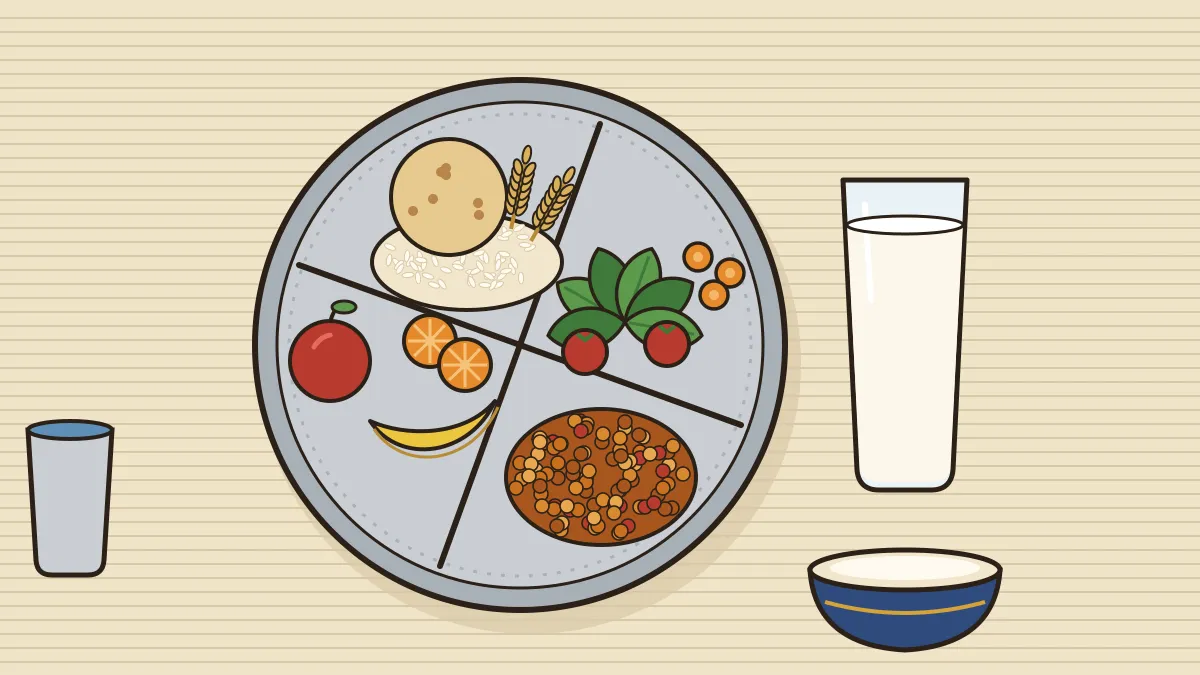
Three minerals carry most exam weight. Iron builds haemoglobin, and its lack causes anaemia. Iodine is needed for thyroxine, and its lack causes goitre, which iodised salt prevents. Calcium, with vitamin D, builds bone, and its lack causes rickets in children and osteomalacia in adults.
Needs rise for growing children, pregnant and nursing mothers and heavy workers. In May 2024 the ICMR-National Institute of Nutrition released revised Dietary Guidelines for Indians, 17 guidelines and the first revision in 13 years. They stress a varied plate, reading food labels, avoiding protein powders as a way to build muscle and daily physical activity. For the country-wide programmes that put this into practice, read our article on the Poshan Maah and the Anganwadi network.
Glycaemic Index, BMI and the Diabetes Link
Two plates with the same calories can affect blood glucose very differently. The glycaemic index (GI) ranks carbohydrate foods from 0 to 100 by how quickly they raise blood glucose, compared with pure glucose, which scores 100. A GI of 55 or below is low, 56 to 69 is medium and 70 or above is high. Refined foods such as white bread, glucose and polished rice digest fast and score high. Most pulses, milk, apples and whole grains, whose fibre and intact structure slow digestion, score low.
A high-GI diet makes the pancreas pump out a large burst of insulin after each meal. Years of that, together with extra body fat, can make cells resistant to insulin, which is the road to Type 2 diabetes. Fat stored around the abdomen is the most harmful kind, which is why the PIB release singles it out for Indians. Prevention means whole grains, more fibre, fewer sugary drinks and regular exercise.
The standard measure of weight status is the Body Mass Index:
Worked example: a person weighs 72 kg and is 1.60 m tall.
WHO bands: below 18.5 underweight; 18.5 to 24.9 normal; 25 to 29.9 overweight; 30 and above obese. Because South Asians carry more body fat at a given BMI, Indian guidelines use lower cut-offs, 23 or more for overweight and 25 or more for obesity. By those, a BMI of 28.1 is obese.
Protein-Energy Malnutrition: Marasmus vs Kwashiorkor
Malnutrition means a diet that lacks, or has too much of, one or more nutrients. Protein-energy malnutrition (PEM) hits children aged 1 to 5 hardest, when growth needs are highest. It shows up as two distinct conditions.
| Feature | Marasmus | Kwashiorkor |
|---|---|---|
| Deficiency | Of all food: energy as well as protein | Mainly of protein, in a child who may still get some carbohydrate |
| Typical age and cause | Infants under one year; early weaning, too little food | Toddlers just after weaning from breast milk onto a starchy, low-protein diet |
| Body look | Severe wasting: skin and bones, sunken eyes, prominent ribs, thin limbs | Oedema: swollen feet and legs, puffy face and a pot belly |
| Skin | Dry and loose; no oedema, no pigmentation | Dark, scaly patches; hair loses colour |
| Other signs | Retarded physical and mental growth | Repeated diarrhoea, irritability |
Marasmus is "wasting without water" and kwashiorkor is "swelling with water". Both can be reversed if the child gets protein-rich and energy-rich food early, and both are prevented by breastfeeding and a proper weaning diet, which is why the Anganwadi and mid-day-meal systems matter.
Food Tests in the Laboratory
School laboratories test food with colour reactions. Each needs a clean test tube and a little of the crushed food.
| Nutrient | Reagent | Positive result |
|---|---|---|
| Starch | Dilute iodine solution | Turns blue-black |
| Reducing sugar (glucose, fructose, maltose, lactose) | Benedict's solution, heated in a water bath | Blue turns green, then yellow, orange and finally brick-red precipitate |
| Protein | Biuret test: copper sulphate plus caustic soda | Turns violet |
| Fat | Rub on paper | Leaves a translucent oily patch |
Sucrose does not respond to Benedict's solution because it is a non-reducing sugar. It turns brick-red only after being boiled with dilute acid, which splits it into glucose and fructose.
How UPSC Has Asked It: Past Papers Solved
These are actual CDS and NDA questions. UPSC tests clean definitions.
Kwashiorkor, a form of malnutrition, is caused by the deficiency of
(a) Minerals (b) Vitamins (c) Fats (d) Proteins
Answer: (d). Kwashiorkor is mainly protein deficiency, shown by oedema and a swollen belly. Marasmus, its sister condition, is a deficiency of all food, not of one nutrient.
Which one among the following combinations most appropriately represent the components of balanced diet?
(a) Carbohydrate, vitamins, proteins, fat, minerals, fibres and water (b) Carbohydrate, vitamins, proteins, fat and minerals (c) Carbohydrate, vitamins, proteins, minerals and water (d) Vitamins, proteins, fat, minerals, fibres and water
Answer: (a). Only this option lists all seven components.
Which one of the following statements about starch and glycogen is correct?
(a) Both starch and glycogen are found in plant cells. (b) Both starch and glycogen are found in animal cells. (c) Starch is present in plant cells and glycogen is present in animal cells. (d) Both starch and glycogen are present in plant cells as well as animal cells.
Answer: (c). Starch is the plant's carbohydrate store and glycogen is the animal's, so each is confined to its own kingdom.
Lactose is made up of:
(a) Glucose only (b) Glucose and Fructose (c) Glucose and Galactose (d) Glucose and Sucrose
Answer: (c). Lactose, the milk sugar, is glucose plus galactose. The tempting (b) is sucrose, and (d) is impossible because sucrose is itself a disaccharide.
Which of the following statements regarding the similarity in glycogen in animal cell and starch in plant cell is/are NOT correct? 1. Both are mixtures of amylose and amylopectin. 2. Starch and glycogen, both represent the storage form of carbohydrate in liver cells.
(a) 1 only (b) 2 only (c) Both 1 and 2 (d) Neither 1 nor 2
Answer: (c). Statement 1 is wrong because glycogen is highly branched and has no amylose. Statement 2 is wrong because starch is a plant store and is not found in liver cells. Both statements are incorrect, which is what the question asks for.
Mostly one-line recall: which sugar, which deficiency, which enzyme, and the balanced-diet list. Learn the table of sugars, the 4-4-9 values and the marasmus/kwashiorkor contrast.
Practice MCQs (with answers)
- Which nutrient gives the most energy per gram?
- Carbohydrate
- Protein
- Fat
- Dietary fibre
- A food sample turns blue-black when dilute iodine solution is added. It contains
- starch
- protein
- reducing sugar
- fat
- Which sugar does NOT give a brick-red precipitate with Benedict's solution when simply heated?
- Glucose
- Fructose
- Maltose
- Sucrose
- A three-year-old child fed mainly on rice gruel has swollen feet, a puffy face, dark scaly skin and a pot belly. The most likely condition is
- marasmus
- kwashiorkor
- goitre
- rickets
- Which pair of foods eaten together gives the best mix of essential amino acids?
- Rice and wheat
- Dal and roti
- Sugar and ghee
- Potato and banana
- A person weighs 80 kg and is 2 m tall. Their BMI is
- 20
- 40
- 16
- 25
- Which statement about trans fats is correct?
- They are essential fatty acids the body needs.
- They are liquid at room temperature in nature.
- They form when vegetable oil is partially hydrogenated, and they raise LDL cholesterol.
- They lower LDL cholesterol.
- Dietary fibre is important in the diet because it
- supplies 4 kcal per gram
- is digested to glucose
- is a protein
- adds bulk to stool and slows the absorption of glucose
1-c, 2-a, 3-d, 4-b, 5-b, 6-a, 7-c, 8-d. Q3: sucrose is a non-reducing sugar and must be hydrolysed first. Q4: oedema and a pot belly point to kwashiorkor, while marasmus shows wasting with no swelling. Q5: rice and wheat have the same amino-acid gap, whereas a cereal and a pulse fill each other's. Q6: BMI = 80 ÷ 4 = 20, which is normal.
Quick Revision
- Energy: carbohydrate 4, protein 4, fat 9 kcal per gram (1 kcal = 4.18 kJ). Fat is the richest and most compact store.
- Sugars: glucose, fructose, galactose (mono); sucrose = glucose + fructose, lactose = glucose + galactose, maltose = glucose + glucose (di). Starch (plants), glycogen (animals, liver and muscle) and cellulose are polysaccharides. Cellulose is fibre in humans.
- Proteins: amino acids joined by peptide bonds; nine essential for adults. Cereals are low in lysine and pulses in methionine, so dal with roti is a complete mix.
- Fats are triglycerides. Saturated and trans fats (vanaspati) are harmful, unsaturated oils preferable. Bile emulsifies, lipase digests.
- Balanced diet = carbohydrates, proteins, fats, vitamins, minerals, fibre and water. Iron: anaemia. Iodine: goitre.
- GI: low 55 or below, high 70 or above. BMI = kg ÷ m²; WHO 25 overweight, 30 obese; Indian cut-offs 23 and 25.
- Marasmus: energy and protein lack, infant, wasting, no oedema. Kwashiorkor: protein lack, toddler after weaning, oedema and pot belly.
- Tests: iodine for starch (blue-black), Benedict's for reducing sugar (brick-red), biuret for protein (violet). Sucrose does not react with Benedict's.
Frequently asked questions
What are the three macronutrients and how much energy does each give?
The three macronutrients are carbohydrates, proteins and fats. Carbohydrates and proteins each give about 4 kilocalories per gram, while fats give about 9 kilocalories per gram, so fat is the most concentrated source of energy.
What are essential amino acids?
Essential amino acids are the amino acids the body cannot make for itself, so they must come from food. Adults need nine of them, including leucine, lysine and tryptophan.
What is the difference between marasmus and kwashiorkor?
Marasmus is caused by a shortage of both energy and protein and shows as severe wasting with no swelling, usually in infants. Kwashiorkor is mainly a protein deficiency in toddlers just after weaning, and it shows as swollen feet, a puffy face and a pot belly caused by oedema.
What is the glycaemic index and why does it matter for diabetes?
The glycaemic index ranks carbohydrate foods by how fast they raise blood glucose, with pure glucose scored at 100. High-index foods such as white bread spike blood sugar and demand a lot of insulin, which over years adds to the risk of Type 2 diabetes.
How is BMI calculated and what is a healthy range?
BMI is weight in kilograms divided by the square of height in metres. The WHO treats 18.5 to 24.9 as normal, 25 to 29.9 as overweight and 30 or more as obese. Indian guidelines use lower cut-offs of 23 for overweight and 25 for obesity.
Related CDS / OTA Science topics
Science is a third of the CDS GS paper
Cavalier's CDS/OTA batches teach physics, chemistry and biology from first principles, with numericals and weekly PYQ tests.