On 12 November 2026, the Protection of Plant Varieties and Farmers' Rights Authority (PPV&FRA) marked its 22nd Foundation Day, and the occasion also completed 25 years of the PPV&FR Act, 2001. Dr P.K. Mishra, Principal Secretary to the Prime Minister, told the gathering that India's National Genebank at ICAR-NBPGR is the second largest in the world, that about 3,000 climate-resilient crop varieties have been developed in the national agricultural research system, and that nearly half of the varieties registered under the Act are farmers' varieties. Behind every one of those numbers is the same craft: plant breeding. It is the purposeful manipulation of crop plants to give better yield, better quality and better resistance. For the exam it is a compact chapter with fixed lists (steps, varieties, resistances), and it connects genetics, agriculture and current affairs.
Variability First: Germplasm and the Seed Bank
By Akanksha Kumari · Science faculty, The Cavalier · B.Tech, 15 years teaching Science
A breeder can only select what already exists. Genetic variability is the root of every breeding programme, and the richest store of it is in wild relatives and old farmers' varieties of a crop. Collecting and preserving all of these, and then testing them for useful traits, is the first job. The entire collection of plants or seeds that holds the different alleles of all the genes of a crop is called its germplasm. (Alleles are the alternative forms of one gene, a point NDA 2021-II tested in the past papers below.) Germplasm is kept as seeds in cold storage in a genebank, and as living plants in field gene banks for crops that do not store well as seed.
Variation also drives evolution: sexual reproduction shuffles alleles, so some offspring survive a drought or a new disease. Breeders speed up that process and choose the winners themselves. A breeder's cross is Mendel's pea experiment at industrial scale (see Mendel's laws and human inheritance).
Breeders get exclusive rights to produce, sell and export a registered variety for a fixed period (15 years for most crops, 18 for trees and vines). Farmers may save, sow, exchange and sell farm-saved seed, but not in a branded package of a protected variety, and may register their own varieties. A National Gene Fund shares benefits with communities that conserved genetic resources. The Authority began work in 2005.
From Wild Relative to Released Variety: The Five Steps
Breeding programmes run in a fixed order in government institutes and seed companies alike. Learn the order, because UPSC asks it directly.
| Step | What happens | Key point |
|---|---|---|
| 1. Collection of variability | Gather wild relatives, local varieties and cultivated lines (germplasm) and evaluate them | Without variability there is nothing to select |
| 2. Evaluation and selection of parents | Find plants with the desired traits, multiply them, make pure lines where possible | A pure line is homozygous, so it breeds true |
| 3. Cross-hybridisation | Pollen from the chosen male parent is placed on the stigma of the chosen female parent | Slow and tedious: often only one cross in a few hundred to a thousand gives the wanted combination |
| 4. Selection and testing of superior recombinants | Pick progeny better than both parents; self-pollinate them for several generations | The aim is homozygosity, so the traits stop segregating |
| 5. Testing, release and commercialisation | Trials in research fields, then in farmers' fields | At least three growing seasons, at several locations in all agro-climatic zones, against a local check variety |
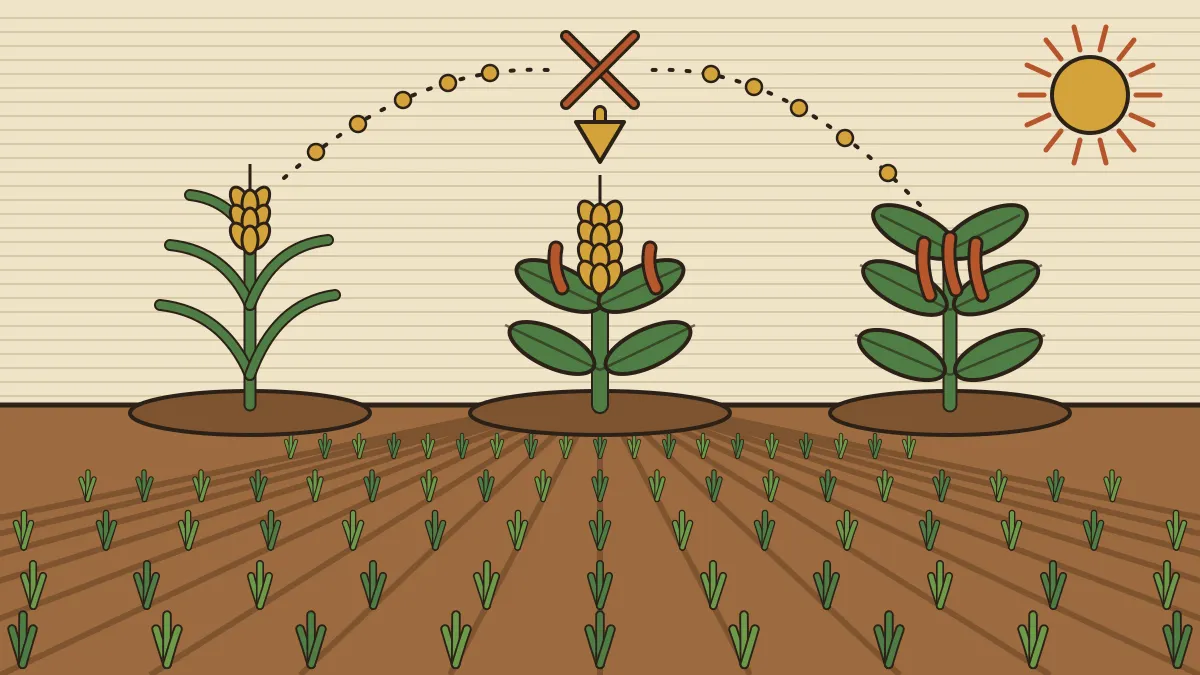
Two words are confused all the time. A hybrid is the result of a cross. A variety (or cultivar) is a line that has been selected and tested until it is uniform. In farm talk, "hybrid seed" has a narrower meaning: the first-generation (F1) seed from crossing two inbred parents, which shows hybrid vigour (heterosis) and out-yields both. That vigour fades in the next generation, because the F2 plants segregate, so growers of hybrid maize, bajra or jowar usually buy fresh seed each season. Seed from a true-breeding wheat or rice variety can be saved and sown again.
Green Revolution Varieties: Who Bred What
India's food crisis of the early 1960s was met by semi-dwarf cereals. Tall plants fall flat when heavily fertilised, whereas a short, stiff plant carries a heavy ear and turns fertiliser into grain. Nobel laureate Norman Borlaug, working at the International Maize and Wheat Improvement Centre (CIMMYT) in Mexico, developed the semi-dwarf wheat. In the early to mid-1960s (NCERT dates it to 1963), high-yielding, disease-resistant wheats such as Sonalika and Kalyan Sona reached India's wheat belt. Rice followed in 1966: semi-dwarf derivatives of IR-8 (from the International Rice Research Institute, Philippines) and Taichung Native-1 (Taiwan), after which Indian breeders produced Jaya and Ratna. M.S. Swaminathan led India's side of the story, and our page on Operation Flood and India's agricultural revolutions covers its policy and economics.
| Crop | Varieties to remember | What the breeding gave |
|---|---|---|
| Wheat | Sonalika, Kalyan Sona | Semi-dwarf, high yield, disease resistance. Output rose from 11 million tonnes (1960) to 75 million tonnes (2000) |
| Rice | Jaya, Ratna (from IR-8 and Taichung Native-1 stock) | Semi-dwarf rice. Output rose from 35 to 89.5 million tonnes over the same years |
| Maize, jowar, bajra | Hybrids | High yield and resistance to water stress |
Sonalika and Kalyan Sona are wheat, not rice. Jaya and Ratna are rice. Borlaug is tied to wheat, and his Nobel was the Peace Prize, not a science prize. High-yielding varieties arrived only in the mid-1960s, so they were not part of the first post-Independence food strategy (CDS 2018-II asked exactly this).
Breeding for Resistance: Disease, Insects and Mutation
Fungi, bacteria and viruses can cut crop yields by 20 to 30 per cent, and sometimes wipe out the crop. A resistant variety is the cheapest cure, since it also reduces the need for fungicides. Resistance is controlled by the host plant's genes, so the method is the same five steps, beginning with a screen of germplasm for resistance sources.
| Crop | Variety | Resistant to |
|---|---|---|
| Wheat | Himgiri | Leaf and stripe rust, hill bunt |
| Cowpea | Pusa Komal | Bacterial blight |
| Chilli | Pusa Sadabahar | Chilli mosaic virus, tobacco mosaic virus, leaf curl |
| Brassica (rapeseed mustard) | Pusa Gaurav | Aphids (insect) |
| Okra (bhindi) | Pusa Sawani, Pusa A-4 | Shoot and fruit borer (insect) |
Insect resistance can be built into the plant's body: hairy leaves resist jassids in cotton, solid stems deter the wheat stem sawfly, and smooth, nectar-less cotton does not attract bollworms.
Where does the resistance gene come from? Often a wild relative that resists the disease but yields little. Resistance to yellow mosaic virus in bhindi was transferred from a wild species by sexual hybridisation and selection, giving Parbhani Kranti. When no resistance gene exists in the germplasm at all, breeders create one by mutation breeding: they treat seeds or plants with chemicals or gamma radiation to produce random changes in the base sequence of genes, screen thousands of plants, and keep the rare useful one. Mung bean resistance to yellow mosaic virus and powdery mildew was produced this way. The radiation link is explained in our article on radioactivity and nuclear energy.
Biofortification and Single Cell Protein
About three billion people cannot afford enough fruit, vegetables, pulses or animal foods, and so go short of protein, iron, vitamin A, iodine and zinc. This hidden hunger shortens lives and weakens minds. Biofortification breeds crops that carry more protein, healthier oil, vitamins or minerals, and the NCERT calls it the most practical way to improve public health. The targets are four: protein content and quality, oil content and quality, vitamins, and micronutrients and minerals.
- Atlas 66, a high-protein wheat, is used as a donor of protein genes for cultivated wheat.
- In 2000, maize hybrids with twice the lysine and tryptophan of earlier hybrids were developed. These are essential amino acids that ordinary maize lacks, and their shortage is linked to protein deficiency such as kwashiorkor.
- An iron-fortified rice with over five times the iron of common rice has been developed.
- IARI vegetables: vitamin A carrot, spinach and pumpkin; vitamin C bitter gourd, bathua and tomato; iron and calcium spinach and bathua.
- Golden Rice, bred abroad by genetic engineering for beta-carotene (the precursor of vitamin A), is the best-known fortified crop, though India has not cultivated it. In August 2024 India's Prime Minister released 109 high-yielding, climate-resilient and biofortified varieties of 61 crops developed by ICAR.
The other route to protein is Single Cell Protein (SCP): microbes grown on a large scale as food. The alga Spirulina grows on waste water, straw, molasses or sewage and yields protein, minerals and vitamins, which also cuts pollution. The bacterium Methylophilus methylotrophus multiplies very fast. It matters because 1 kg of meat takes 3 to 10 kg of grain to produce. Our page on deficiency disorders lists what each missing nutrient causes.
In the Lab: Tissue Culture, Somatic Hybrids and Gene Technology
In the 1950s scientists found that an explant (any piece of a plant) grown on a sterile nutrient medium can regenerate a whole plant. This ability of a cell to give a complete plant is totipotency. The medium needs a carbon source such as sucrose, inorganic salts, vitamins, amino acids and growth regulators, mainly auxins and cytokinins (see our page on plant hormones).
| Technique | What it does | Example |
|---|---|---|
| Micropropagation | Thousands of identical plants (somaclones) from one explant in a short time | Tomato, banana, apple on a commercial scale |
| Meristem culture | Virus-free plants, because the apical and axillary meristem is free of virus even in an infected plant | Banana, sugarcane, potato |
| Somatic hybridisation | Remove the cell wall, fuse the naked protoplasts of two plants, grow the hybrid cell into a plant | Pomato (tomato + potato): a plant, but not commercially useful |
In genetic engineering a gene from another organism is placed in the crop. Bt cotton, with a gene from the soil bacterium Bacillus thuringiensis that makes it resist bollworm, is still India's only commercially cultivated GM crop. GM mustard (DMH-11) was cleared by the regulator in 2022, but the Supreme Court gave a split verdict in July 2024 and asked for a national policy, so it is not in commercial farming. Genome editing alters the plant's own gene without foreign DNA. In May 2025 ICAR released the world's first genome-edited rice: DRR Dhan 100 (Kamala) from IIRR Hyderabad, bred from Samba Mahsuri and maturing earlier, and Pusa DST Rice 1 from IARI, Delhi, for salty and alkaline soils. For the regulatory difference, see our explainer on GM versus gene-edited crops.
Plant breeding = selecting and crossing parents. Mutation breeding = induced changes, then screening. Tissue culture = whole plants from cells. GM = foreign gene added. Gene editing = own gene altered.
How UPSC Has Asked It: Past Papers Solved
These are real CDS and NDA questions.
Which one of the following was not a part of the strategies followed by the Government of India to increase food grain production in India immediately after Independence?
(a) Intensification of cropping over already cultivated land (b) Increasing cultivable area by bringing cultivable and fallow land under plough (c) Using high-yielding varieties (HYV) seeds (d) Switching over from cash crops to food crops
Answer: (c). HYV seeds came only with the Green Revolution of the mid-1960s. Option (d), switching from cash to food crops, was a real early policy.
Which one of the following statements is not correct with regard to genetically modified organisms?
(a) In this technique a gene from one organism is isolated and transferred to the cell of another organism. (b) This technique has applications only in plants. (c) Genes for insect resistance may spread from crop plants to wild plants. (d) To produce a transgenic animal the novel genes are inserted at a very early stage of development.
Answer: (b). Option (d) itself shows animals are included. Option (c) is a recognised biosafety worry, so it is correct.
Recently, ICAR has developed the world's first genome-edited rice varieties. Which of the following statements is/are correct with respect to the developed products? 1. The genome-edited varieties DRR Rice 100 (Kamla) and Pusa DST Rice 1 have been developed by ICAR-IARI, New Delhi. 2. DRR Rice 100 (Kamla), based on Samba Mahsuri, has a shorter duration of maturity.
(a) 1 only (b) 2 only (c) Both 1 and 2 (d) Neither 1 nor 2
Answer: (b). Statement 2 is right: Kamala, derived from Samba Mahsuri, matures earlier. Statement 1 is the trap, since only Pusa DST Rice 1 is from IARI, while DRR Dhan 100 comes from the rice institute at Hyderabad (IIRR).
Different varieties of the same gene are called
(a) Genotypes (b) Sib pairs (c) Alleles (d) Isomers
Answer: (c). Alleles are the alternative forms of a gene. A genotype is the whole allele combination of an individual, so it is the nearest distractor.
Kwashiorkor, a form of malnutrition, is caused by the deficiency of
(a) Minerals (b) Vitamins (c) Fats (d) Proteins
Answer: (d). Kwashiorkor is protein deficiency in children, which is why protein-rich and amino-acid-rich crop varieties are a breeding target.
Two question types repeat: process questions (the order of steps, what technique gives virus-free plants) and statement questions that swap an institute, crop or regulator. Check each clause on its own.
Practice MCQs (with answers)
- The entire collection of plants or seeds holding the diverse alleles of all genes in a crop is its
- clone
- pure line
- germplasm
- somaclone
- Which crop and variety are correctly matched?
- Wheat: Kalyan Sona
- Rice: Sonalika
- Wheat: Jaya
- Rice: Atlas 66
- Fusing the protoplasts of two different plants and growing the hybrid cell into a plant is called
- micropropagation
- mutation breeding
- a test cross
- somatic hybridisation
- Virus-free banana plants can be raised from an infected plant by culturing its
- root cap
- apical meristem
- leaf epidermis
- mature xylem
- The wheat variety Atlas 66 is valued as a donor because it is high in
- vitamin A
- iron
- oil
- protein
- Farmers who grow F1 hybrid maize usually buy fresh seed every season because
- seed saved from the hybrid crop does not breed true
- saving seed is banned for all crops
- hybrid maize cannot germinate twice
- the seed is radioactive
- In mutation breeding, variation is created by
- crossing two pure lines
- chemicals or gamma radiation
- growing explants on a nutrient medium
- fusing protoplasts
- The correct order of the main steps in breeding a new variety is
- hybridisation, collection of variability, release, selection
- selection, hybridisation, collection of variability, release
- collection of variability, hybridisation, selection, testing and release
- release, selection, hybridisation, collection of variability
1-c, 2-a, 3-d, 4-b, 5-d, 6-a, 7-b, 8-c. Q3: micropropagation copies one plant, while somatic hybridisation fuses two. Q4: the meristem is free of virus even in an infected plant. Q6: the F2 generation segregates and loses hybrid vigour, whereas the law lets farmers save seed.
Quick Revision
- Plant breeding steps: collect variability (germplasm) → evaluate and select parents → cross-hybridise → select superior recombinants → test (3 seasons, many locations) and release.
- Germplasm = all alleles of a crop. Hybrid vigour is lost in F2. Pure line = homozygous, breeds true.
- Wheat: Sonalika, Kalyan Sona (early-mid 1960s; Borlaug). Rice: IR-8, Taichung Native-1 → Jaya, Ratna (1966).
- Resistance: Himgiri (rust), Pusa Komal (bacterial blight), Pusa Sadabahar (chilli viruses), Pusa Gaurav (aphids), Pusa Sawani (okra borer), Parbhani Kranti (from a wild relative).
- Biofortification: Atlas 66 (protein), lysine-rich maize, iron-rich rice, vitamin A carrot. SCP: Spirulina.
- Tissue culture: totipotency; auxin + cytokinin; micropropagation; meristem culture for virus-free plants; pomato = somatic hybrid.
- Bt cotton: India's only commercial GM crop. Genome-edited rice (May 2025): DRR Dhan 100 (Kamala, IIRR) and Pusa DST Rice 1 (IARI). PPV&FR Act 2001: breeders' and farmers' rights, National Gene Fund; Authority's 22nd Foundation Day on 12 Nov 2026.
Frequently asked questions
What are the steps of plant breeding?
There are five. Breeders collect genetic variability, evaluate it and select parents, cross them, select and self-pollinate the superior progeny until it is uniform, and finally test the new line for at least three seasons in research and farmers' fields before release.
What is the difference between a hybrid and a variety?
A hybrid is the offspring of a cross. In farming, F1 hybrid seed comes from crossing two inbred parents and shows hybrid vigour, which fades later, so farmers buy fresh seed each season. A variety is a selected, uniform line that breeds true, so its seed can be saved.
What is biofortification?
It is breeding crops to carry more protein, vitamins or minerals, to fight hidden hunger, the lack of micronutrients such as iron and vitamin A. Atlas 66 wheat, iron-rich rice and vitamin A carrots are examples.
How is genome editing different from genetic modification?
A GM crop carries a gene from another organism, as Bt cotton does. Genome editing alters the plant's own gene, usually without foreign DNA. India's genome-edited rice varieties, released in May 2025, are examples.
What does the PPV&FR Act, 2001 protect?
It gives breeders exclusive rights over registered varieties for a fixed period and protects farmers' right to save, use, exchange and sell farm-saved seed. Farmers can register their own varieties, and a National Gene Fund shares benefits with communities that conserve genetic resources.
Related CDS / OTA Science topics
Biology is a steady scoring block in CDS GS
Cavalier's CDS/OTA batches teach life science from first principles, with diagrams, one-liners and weekly PYQ tests.