On 14 November 2026 Union Environment Minister Bhupender Yadav reviewed action against air pollution in Delhi-NCR with Delhi, Haryana, Uttar Pradesh and Rajasthan. The PIB release lists practical steps: dust-generating construction and demolition work was restricted across the NCR from 5 to 20 November under the Commission for Air Quality Management (CAQM), the CPCB was told to seal 191 non-conforming industries, and GRAP is to be enforced strictly. All of it protects one organ, the lung. To see why a particle of 2.5 micrometres matters, you need the machinery it enters. The respiratory system is a steady source of CDS and NDA questions: the air passage, the muscles of breathing, lung volumes, gas transport and common disorders.
The Air Route: Nostril to Alveolus
By Akanksha Kumari · Science faculty, The Cavalier · B.Tech, 15 years teaching Science
Respiration in everyday speech is breathing. Inside the cell, oxygen is used to break down glucose for energy and carbon dioxide appears as waste. The respiratory system keeps both flows going. Air takes this route:
| Part | Job | Facts to remember |
|---|---|---|
| Nostrils, nasal chamber | Filter, warm, moisten | Hairs and mucus trap dust |
| Pharynx | Common passage for food and air | Opens into the larynx |
| Larynx | The "sound box" | Cartilage box; the epiglottis flap covers the glottis while swallowing |
| Trachea | Windpipe | Incomplete (C-shaped) cartilage rings; divides at the 5th thoracic vertebra into two bronchi |
| Bronchi | One to each lung | Branch into secondary and tertiary bronchi, still with cartilage |
| Bronchioles | Fine branches | The finer ones have no cartilage |
| Alveoli | Air sacs for gas exchange | Hundreds of millions, each wrapped in capillaries |
The conducting part, from the nostrils to the terminal bronchioles, only carries air, cleans it and brings it to body temperature. The exchange part, the alveoli and their ducts, is where oxygen and carbon dioxide actually diffuse. So the "actual site of gaseous exchange" is always the alveoli, never the trachea or bronchi.
We have two lungs: the right has three lobes and the left two, since the heart takes room on the left. Each lung is wrapped in a double-layered pleura with pleural fluid between the layers to cut friction. The lungs sit in a closed thoracic chamber: vertebral column behind, sternum in front, ribs at the sides, dome-shaped diaphragm below. A lung has no muscle of its own. It can only follow the chest.
Cartilage keeps the larger tubes open: larynx, trachea, bronchi. It is missing from the fine bronchioles and the alveoli. See NDA 2024-II below.
Other animals use other organs: sponges and flatworms the body surface, earthworms moist skin, insects tracheae, fishes gills, frogs lungs and moist skin, and reptiles, birds and mammals lungs.
How Breathing Works: Pressure, Boyle's Law and Muscles
Air moves because the pressure in the lungs becomes different from the pressure outside. This is Boyle's law: at constant temperature, pressure falls when volume rises. Pull the plunger of a closed syringe and air rushes in. The chest works the same way.
| Inspiration | Expiration | |
|---|---|---|
| Diaphragm | Contracts and flattens | Relaxes, bulges up as a dome |
| External intercostals | Contract, lift ribs and sternum | Relax, ribs drop |
| Chest volume | Rises | Falls |
| Lung pressure | Below atmospheric: air flows in | Slightly above atmospheric: air flows out |
| Effort | Active | Passive in quiet breathing |
A healthy adult breathes 12–16 times a minute at rest. In hard exercise the internal intercostals and the abdominal muscles help to force air out. The diaphragm is the main muscle, and the intercostals are its helpers.
Lung Volumes and Capacities
A volume is one slice of the lungs' air, and a capacity is a sum of slices. A spirometer measures them.
| Term | Meaning | Typical value |
|---|---|---|
| Tidal volume (TV) | One normal breath | about 500 mL |
| Inspiratory reserve (IRV) | Extra air by a forced breath in | 2,500–3,000 mL |
| Expiratory reserve (ERV) | Extra air by a forced breath out | 1,000–1,100 mL |
| Residual volume (RV) | Left in the lungs after the hardest breath out | 1,100–1,200 mL |
| Vital capacity (VC) | IRV + TV + ERV | about 4,000–4,600 mL |
| Total lung capacity (TLC) | VC + RV | about 5,100–5,800 mL |
A student breathes 12 times a minute. Her TV = 500 mL, IRV = 3,000 mL, ERV = 1,000 mL, RV = 1,200 mL.
Air per minute = 500 × 12 = 6,000 mL; in an hour, 6,000 × 60 = 360 litres. At 16 breaths a minute it is 8,000 mL a minute.
VC = 3,000 + 500 + 1,000 = 4,500 mL. TLC = 4,500 + 1,200 = 5,700 mL.
She can never breathe out more than her VC, because the 1,200 mL residual stays behind and keeps the alveoli open.
VC leaves out the residual volume and TLC includes it. VC falls in smokers and in tuberculosis, and is often higher in athletes and singers.
Gas Exchange and Transport in Blood
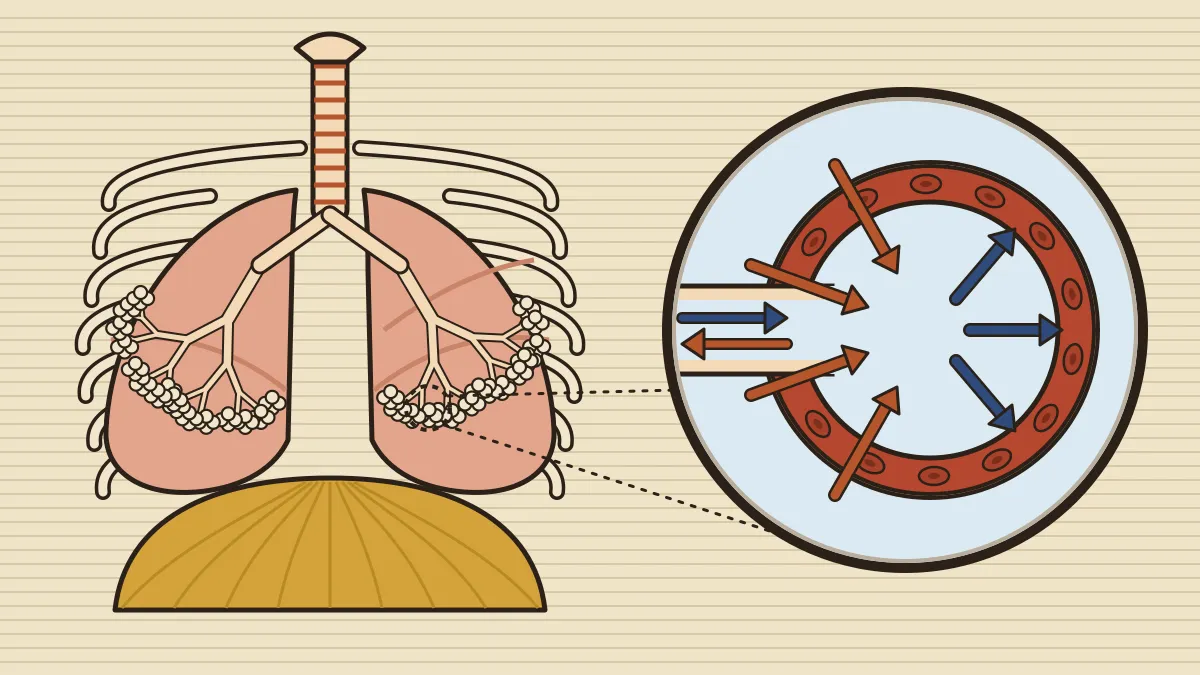
Gases move by simple diffusion, from higher to lower partial pressure (pO2, pCO2). Values in mm Hg:
| Place | pO2 | pCO2 |
|---|---|---|
| Atmospheric air | 159 | 0.3 |
| Alveoli | 104 | 40 |
| Deoxygenated blood | 40 | 45 |
| Oxygenated blood | 95 | 40 |
| Tissues | 40 | 45 |
Oxygen runs downhill from alveoli (104) into blood (40) and from blood (95) into tissues (40). CO2 runs the other way, tissues (45) to blood to alveoli (40). The alveolus is built for this: a membrane of three thin layers, far less than a millimetre thick, a huge total surface, and CO2 that is 20–25 times more soluble than O2.
Oxygen. About 97% travels in red cells on haemoglobin, the iron pigment, as oxyhaemoglobin; 3% is dissolved in plasma. One haemoglobin holds up to four O2 reversibly. High pO2 and low pCO2, acidity and temperature in the alveoli load it; the opposite conditions in working tissue unload it. Every 100 mL of oxygenated blood delivers about 5 mL of O2. Mammalian red cells have no nucleus (see the blood page).
Carbon dioxide. About 70% travels as bicarbonate (HCO3−), made inside red cells with the enzyme carbonic anhydrase; 20–25% rides on haemoglobin as carbaminohaemoglobin; about 7% is dissolved. In the lungs the same enzyme reverses the reaction and CO2 leaves. Haemoglobin therefore carries both gases. Carbon monoxide kills because it grips haemoglobin far more tightly than oxygen does (the air pollutants page has the pollution side). The oxygenated blood then goes to the left atrium, as the circulatory system page explains.
The rhythm centre in the medulla sets it, and the pneumotaxic centre in the pons can shorten inspiration. A chemosensitive area reacts to CO2 and H+. So the gasp after a sprint is triggered by rising CO2, not by lack of oxygen, which plays only a small part.
Where the Oxygen Goes: Aerobic and Anaerobic Respiration
Breathing delivers oxygen. Cellular respiration uses it. Glucose first splits into two pyruvate molecules in the cytoplasm (glycolysis), with no oxygen needed, so this step is common to both routes. The photosynthesis and respiration page has the plant side.
| Aerobic | Anaerobic | |
|---|---|---|
| After glycolysis | Mitochondria, oxygen needed | Cytoplasm, no oxygen |
| End products | CO2 + H2O | Lactic acid (muscle); ethanol + CO2 (yeast) |
| ATP per glucose | about 36–38 | 2 |
In a sprint the muscles outrun their oxygen supply and turn pyruvate into lactic acid, which brings cramps. Heavy breathing afterwards repays this oxygen debt. Yeast ferments pyruvate into ethanol and CO2, which is why dough rises. The cell organelles page covers the mitochondrion.
Disorders and the PM2.5 Problem
| Disorder | What goes wrong | Note |
|---|---|---|
| Asthma | Inflamed, narrowed bronchi and bronchioles; wheezing | Often allergic; dust, pollen, smoke |
| Emphysema | Alveolar walls break down; exchange surface shrinks | Mainly smoking; irreversible |
| Pneumonia | Alveoli fill with fluid | Infection; fever, chest pain |
| Tuberculosis | Lung tissue destroyed; cough, weight loss | Bacterial, spreads by droplets; BCG vaccine |
| Occupational disease | Dust causes fibrosis (scarring) | Stone-breaking, grinding, mining; silicosis, asbestosis |
TB also sits in the infectious diseases chapter (see the diseases page). Each disorder cuts the exchange surface or the airflow, and a spirometer shows it as a lower vital capacity.
Now the pollution link. The airway defends itself in stages: nasal hair and mucus catch big particles, and cilia in the trachea and bronchi sweep mucus upward to be swallowed or coughed out. Smoke paralyses these cilia. Size then decides the depth. PM10 (10 micrometres or less) settles mostly in the airways and triggers wheezing and asthma. PM2.5 (2.5 micrometres or less) slips past to the alveoli, inflames the tissue, and the finest particles can cross into the blood, which links dirty air to heart disease and stroke as well as lung cancer. India's PM2.5 limit is 40 µg/m³ a year (60 for 24 hours), against the WHO's 2021 guideline of 5. The CAQM and GRAP explainer shows how winter curbs are triggered.
Past Papers, Solved
The poisonous nature of Carbon monoxide (CO) is due to its
(a) insolubility in water (b) ability to form a complex with haemoglobin (c) ability to reduce some metal oxides (d) property of having one sigma bond
Answer: (b). CO binds haemoglobin as carboxyhaemoglobin, so the red cells cannot carry oxygen. Poor solubility and reducing power are real but unrelated to its toxicity.
Which one of the following statements regarding haemoglobin is correct?
(a) Haemoglobin present in RBC can carry only oxygen but not carbon dioxide. (b) Haemoglobin of RBC can carry both oxygen and carbon dioxide. (c) Haemoglobin of RBC can carry only carbon dioxide. (d) Haemoglobin is only used for blood clotting and not for carrying gases.
Answer: (b). It carries O2 as oxyhaemoglobin and some CO2 as carbaminohaemoglobin. Option (a) forgets the second job.
In which part or organ of human body cartilage is NOT found?
(a) Nose (b) Trachea (c) Bronchiole (d) Knee joint
Answer: (c). The trachea has C-shaped cartilage rings, so (b) is the tempting wrong answer. The fine bronchioles have none.
A sprinter feels cramps and pain in the thigh muscles after a run. This is due to accumulation of
(a) lactic acid (b) CO₂ (c) pyruvic acid (d) ethanol
Answer: (a). Starved of oxygen, muscle turns pyruvate into lactic acid. Pyruvic acid is only the intermediate, and ethanol is made by yeast.
When yeast cells are O₂ starved, fermentation serves as the source of energy. This results in the production of:
(a) ATP + CO₂ + Ethanol (b) ATP + O₂ + Pyruvate (c) ATP + CO₂ + Lactic acid (d) ATP + O₂ + Acetaldehyde
Answer: (a). Yeast ferments to ethanol and CO2. Option (c) is the animal-muscle product.
Consider the following statements in relation to respiration in animals : I. Glucose breaks down into pyruvate in the cytoplasm of all cells in both aerobic and anaerobic conditions. II. The energy released during anaerobic respiration is greater than the energy released in aerobic respiration. III. Carbon dioxide is released only in aerobic respiration. Which of the statements given above is/are correct ?
(a) I only (b) II only (c) I and III (d) II and III
Answer: (c). I is correct: glycolysis is in the cytoplasm either way. II is reversed (36–38 ATP against 2). III holds for animals, since muscle ends in lactic acid with no CO2.
Short factual questions on the site (alveoli), the carrier (haemoglobin, both gases), the anaerobic product (muscle versus yeast) and one anatomy trap such as cartilage.
Practice MCQs (with answers)
- The volume of air breathed in or out in one normal breath of a healthy adult is about
- 50 mL
- 500 mL
- 1,200 mL
- 5,000 mL
- During swallowing, food is kept out of the larynx by the
- glottis
- pleura
- epiglottis
- uvula
- A person has TV = 500 mL, IRV = 3,000 mL, ERV = 1,000 mL and RV = 1,200 mL. The total lung capacity is
- 5,700 mL
- 4,500 mL
- 4,000 mL
- 3,500 mL
- Which statement about carbon dioxide transport is correct?
- Most of it is carried as carbaminohaemoglobin
- Most of it is dissolved in plasma
- Most of it rides on white blood cells
- About 70% is carried as bicarbonate, formed with carbonic anhydrase
- The breathing rate rises most readily when the blood shows an increase in
- oxygen
- carbon dioxide and hydrogen ions
- nitrogen
- glucose
- Damaged alveolar walls, a reduced exchange surface and cigarette smoking as a major cause describe
- asthma
- pneumonia
- bronchitis
- emphysema
- The net ATP gain from one glucose molecule in anaerobic respiration is
- 2
- 8
- 18
- 36–38
- PM2.5 is more dangerous than coarse dust mainly because it
- is wholly filtered out by nasal hair
- is larger than PM10
- can reach the alveoli, and some of it enters the blood
- dissolves completely in mucus
1-b, 2-c, 3-a, 4-d, 5-b, 6-d, 7-a, 8-c. Q2: the glottis is the opening; the epiglottis is the flap. Q3: VC = 4,500 mL, and adding RV gives 5,700 mL; (b) is only the vital capacity. Q5: oxygen plays a small part; the trigger is CO2 and H+. Q8: PM2.5 is smaller than PM10, which is why it slips past the upper defences.
Quick Revision
- Route: nostril, pharynx, larynx (epiglottis), trachea (C-shaped rings), bronchi, bronchioles (no cartilage), alveoli. Right lung 3 lobes, left 2. Pleura: two layers and fluid.
- Conducting part = no exchange. Exchange part = alveoli.
- Inspiration: diaphragm and external intercostals contract, volume up, pressure down (Boyle). Expiration is passive at rest. Rate 12–16 a minute.
- TV 500 mL. VC = IRV + TV + ERV. TLC = VC + RV. RV 1,100–1,200 mL.
- Alveolar pO2 104, pCO2 40; blood arrives at 40 and 45. CO2 is 20–25 times more soluble than O2.
- O2: 97% on haemoglobin, 3% dissolved. CO2: 70% bicarbonate, 20–25% carbaminohaemoglobin, 7% dissolved.
- Rhythm centre in medulla; pneumotaxic centre in pons; trigger is CO2 and H+.
- Aerobic: mitochondria, 36–38 ATP. Anaerobic: 2 ATP; lactic acid (muscle), ethanol + CO2 (yeast).
- Emphysema: alveolar walls destroyed. TB: bacterial, droplets, BCG. Silicosis, asbestosis: fibrosis.
- PM2.5 (≤ 2.5 µm) reaches alveoli and blood. NAAQS PM2.5: 40 annual, 60 for 24 h.
Frequently asked questions
Where does the actual exchange of gases take place in the lungs?
Gas exchange takes place in the alveoli, the thin-walled air sacs at the ends of the bronchioles. The alveolar wall and the wall of the surrounding capillary are each one cell thick, so oxygen diffuses into the blood and carbon dioxide diffuses out. The trachea, bronchi and larger bronchioles only conduct air.
How does breathing happen?
When the diaphragm and the external intercostal muscles contract, the chest cavity grows and the pressure in the lungs falls below the outside air pressure, so air flows in. When these muscles relax, the chest shrinks, the pressure rises slightly above the outside pressure and air flows out. This follows Boyle's law, which says that pressure falls as volume rises.
What is the difference between tidal volume and vital capacity?
Tidal volume is the air moved in one ordinary breath, about 500 mL in a healthy adult. Vital capacity is the largest volume you can breathe out after the deepest possible breath in. It is the sum of the inspiratory reserve volume, tidal volume and expiratory reserve volume, and it does not include the residual volume.
How are oxygen and carbon dioxide carried in the blood?
About 97 percent of oxygen is carried by haemoglobin in red blood cells as oxyhaemoglobin, and the rest is dissolved in plasma. About 70 percent of carbon dioxide is carried as bicarbonate ions, formed with the help of the enzyme carbonic anhydrase. Another 20 to 25 percent rides on haemoglobin as carbaminohaemoglobin and about 7 percent is dissolved.
Why is PM2.5 more harmful than larger dust?
Particles of 2.5 micrometres or less are small enough to get past the nose and the mucus-and-cilia defence of the airways and reach the alveoli. There they cause inflammation, and the finest can enter the blood. That raises the risk of asthma attacks, chronic lung disease, lung cancer, heart disease and stroke.
Related CDS / OTA Science topics
Human physiology is the most repeated biology block in CDS and NDA
Cavalier's CDS/OTA batches teach the body systems with diagrams, one-line facts and weekly PYQ drills.