India observes National Milk Day on 26 November, the birth anniversary of Verghese Kurien, who was born in Kozhikode in 1921. The Indian Dairy Association proposed the day in 2014, and the government now uses it to release the year's Basic Animal Husbandry Statistics. The 2025 edition put India's milk production at 247.87 million tonnes in 2024-25, about a quarter of the world's milk, and India has been the world's biggest producer since 1998. The story behind that number is not about machines. It is about a village cooperative that grew into a national plan, and it ties into a favourite exam topic: the "colour revolutions". This article explains Operation Flood, then checks the whole colour table, because the standard lists contradict each other. For the wider picture, see our overview of the agriculture economy.
The Anand Pattern: Farmers Own the Dairy
In the 1940s the farmers of Kaira district in Gujarat sold their milk to one private dairy, Polson, which set the price. Led by Tribhuvandas Patel, and advised by Sardar Patel and Morarji Desai, they decided to own the dairy themselves. The Kaira District Cooperative Milk Producers' Union began at Anand on 14 December 1946 and later became known by its brand, Amul (from the Sanskrit amulya, "priceless"). In 1949 the government posted a young dairy engineer, Verghese Kurien, to an experimental creamery at Anand. He stayed to help. With H.M. Dalaya, who worked out how to make milk powder and condensed milk from buffalo milk, the union solved a problem that Western dairies thought unsolvable and could now turn the winter surplus into powder.
| Tier | Body | Job |
|---|---|---|
| Village | Dairy cooperative society | Farmers bring milk daily; it is tested for fat and paid for by quality. Members elect the managing committee. |
| District | Milk union | Collects from societies, runs the dairy plant, and supplies vets, feed and artificial insemination. |
| State | Federation (Gujarat Cooperative Milk Marketing Federation, 1973) | Markets milk and products from all the unions under one brand. |
Farmers own, professionals manage, and the middleman is cut out. This three-tier structure is the Anand Pattern. It is a cooperative model, not just another name for Amul.
In 1964, Prime Minister Lal Bahadur Shastri visited Anand and asked Kurien to repeat the model across India. The National Dairy Development Board (NDDB) was set up in 1965, with Kurien as its chairman until 1998. Its programme was Operation Flood.
Operation Flood: Three Phases
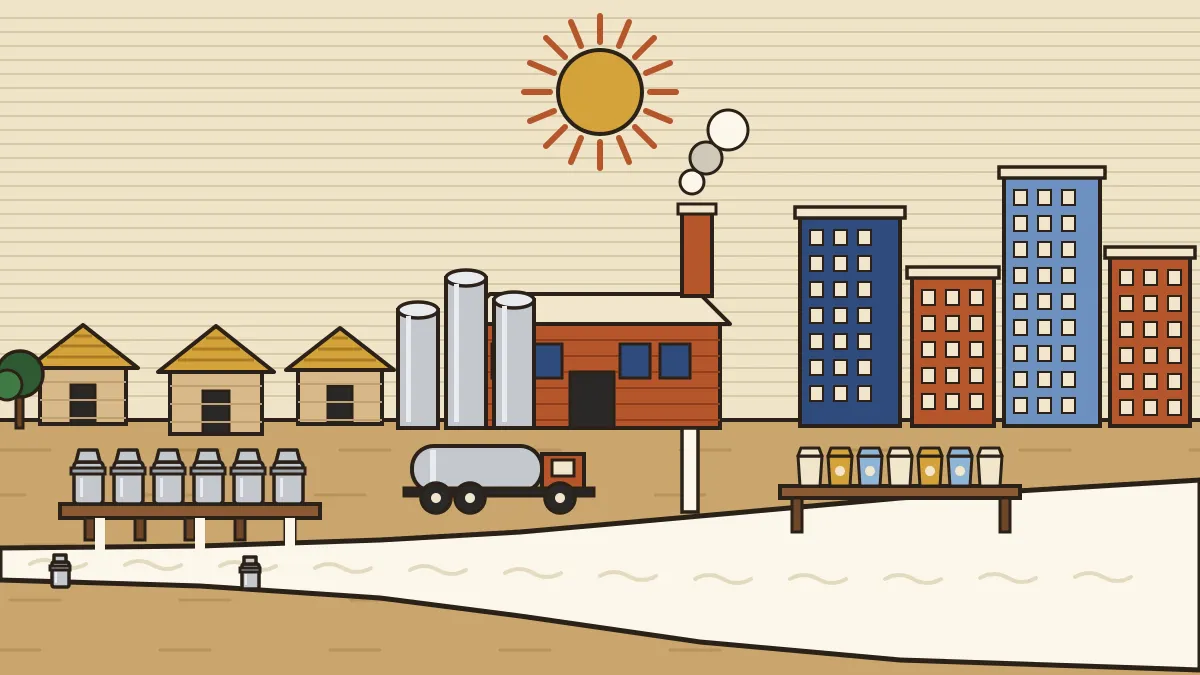
Operation Flood was launched on 13 January 1970 and is called the White Revolution. The idea was a national milk grid: link village producers to consumers in the cities, and let the farmer, not the trader, keep the gain. Money came from an unusual source. Milk powder and butter oil gifted by the European Economic Community through the World Food Programme were sold in India, and the sale proceeds built the dairies.
| Phase | Years | Funding | What it did |
|---|---|---|---|
| I | 1970–80 | Gifted EEC milk powder and butter oil, sold under the World Food Programme | Linked 18 milksheds to Delhi, Mumbai, Kolkata and Chennai; mother dairies in the four metros. |
| II | 1981–85 | EEC gifts plus a World Bank loan | Milksheds rose from 18 to 136; 290 urban markets; about 43,000 village societies with 4.25 million producers by 1985. |
| III | 1985–96 | External aid and loans continued | About 30,000 more societies; milksheds peaked at 173 in 1988-89; veterinary care, feed and artificial insemination were added. |
Books give Phase I as ending in 1979 or 1980, and Phase II as beginning in 1979 or 1981. NDDB's own history gives the table above. Remember 1970, 1981 and 1985–96, and do not confuse 1965 (NDDB) with 1970 (Operation Flood).
India: Number One in Milk
| Year | Milk production | Note |
|---|---|---|
| 1950-51 | about 17 million tonnes | Before the cooperative movement spread |
| 1998 | — | India overtakes the United States as the largest producer |
| 2020-21 | about 210 million tonnes | |
| 2023-24 | 239.30 million tonnes | Growth 3.78%; per-capita availability 471 grams a day |
| 2024-25 | 247.87 million tonnes | Growth 3.58%; per-capita availability 485 grams a day |
The policy tools have shifted since 1996. The Rashtriya Gokul Mission (2014) works on indigenous breeds, and the National Livestock Mission, realigned from 2021-22, now backs breed development, feed and fodder, and extension. UPSC asked about the Mission's objectives in CDS 2026-II (solved below). Livestock and fisheries are also the fastest-growing parts of Indian agriculture: the Economic Survey 2025-26 reports livestock growing at about 7.1% a year and fisheries at 8.8% over 2015-16 to 2024-25, against 3.5% for crops.
The Green Revolution: Wheat First
The Green Revolution answered a food crisis. India produced only about 51 million tonnes of foodgrains in 1950-51 and leaned on American wheat under PL-480 in the 1960s, a "ship-to-mouth" existence that two droughts in 1965-66 and 1966-67 made desperate. The early strategy, as the NCERT geography book lists it, was to switch from cash crops to food crops, to grow more crops on the same land and to extend the cultivated area. The First Plan gave agriculture and irrigation their highest share of the outlay. High-yielding seed was not part of this first strategy, which is exactly what CDS 2018-II asked.
The turn came in 1965–67. The Agricultural Prices Commission (now CACP) and the Food Corporation of India were set up in 1965, which gave farmers a support price and a buyer. In 1966 the government launched a high-yielding varieties programme. Agriculture minister C. Subramaniam, secretary B. Sivaraman and scientist M.S. Swaminathan brought in Mexican semi-dwarf wheat from Norman Borlaug's programme and, for rice, the IRRI variety IR8. Borlaug won the Nobel Peace Prize in 1970. The package was seed, fertiliser, irrigation and a guaranteed price, and it worked first in Punjab, Haryana and western Uttar Pradesh, on wheat before rice.
The costs showed later: gains were regional and crop-specific, richer farmers with irrigation gained most, and groundwater and soil health suffered. Swaminathan's answer was the Evergreen Revolution: higher yields without ecological damage. Maize, now India's third cereal after rice and wheat, followed its own track (see our article on maize crop geography).
The Colour Revolutions: Commodity, Person, and What Is Disputed
Textbooks attach a colour to each farm drive. The first four columns are reliable. The last column tells you how far to trust each row.
| Revolution | Commodity | Person credited | Reliability |
|---|---|---|---|
| Green | Foodgrains (wheat, then rice) | Norman Borlaug (world); M.S. Swaminathan (India) | Safe |
| Evergreen | Productivity without ecological harm | M.S. Swaminathan | Safe |
| White | Milk | Verghese Kurien | Safe |
| Blue | Fish and aquaculture | Hiralal Chaudhuri and Arun Krishnan | Commodity safe; names vary |
| Yellow | Oilseeds (mustard, sunflower) | Sam Pitroda (Technology Mission on Oilseeds, 1986) | Commodity safe; name varies |
| Silver | Eggs and poultry | Indira Gandhi | Commodity safe; "silver fibre" is cotton |
| Golden | Horticulture: fruit and honey | Nirpakh Tutej | Commodity safe; "golden fibre" is jute |
| Pink | Onion and prawns; some lists say meat and poultry | Durgesh Patel | Disputed |
| Black | Petroleum; some lists add biofuel | None agreed | Disputed |
| Red | Meat and tomato | Vishal Tewari | Disputed; rare |
| Round | Potato | None agreed | Disputed; rare |
| Grey | Fertilisers | None agreed | Disputed; rare |
| Brown | Leather, cocoa or non-conventional energy, depending on the list | None agreed | Disputed |
UPSC has asked a four-pair question (CDS 2023-II) with Pink, Yellow, Black and Golden. Yellow means oilseeds and Golden never means eggs, which are Silver. For Pink and Black the textbooks differ, so let the other options decide. Do not spend time on Red, Round, Grey or Brown.
Where do the reliable ones stand now? Blue: India is the world's second-largest fish producer with about 8% of global output, and production has roughly doubled in a decade to nearly 200 lakh tonnes (see our article on the major fishing grounds). Yellow: India still imports more than half its edible oil, so the National Mission on Edible Oils–Oilseeds (2024-25 to 2030-31) aims to raise oilseeds from about 39 million tonnes to 69.7 million. Silver: about 149 billion eggs in 2024-25, with India second in the world. Golden: horticulture, at about 362 million tonnes in 2024-25, has overtaken foodgrains at about 358 million tonnes.
How UPSC Has Asked It: Past Papers Solved
These are actual CDS and NDA questions since 2018. The recent papers favour current schemes and data over old "who started what" facts.
Which one of the following was not a part of the strategies followed by the Government of India to increase food grain production in India immediately after Independence?
(a) Intensification of cropping over already cultivated land (b) Increasing cultivable area by bringing cultivable and fallow land under plough (c) Using high-yielding varieties (HYV) seeds (d) Switching over from cash crops to food crops
Answer: (c). The early strategy was extensive and intensive farming plus a shift to food crops. HYV seeds arrived only with the Green Revolution of 1966 onwards.
Plan allocation in agriculture and irrigation as percentage of total plan outlay was highest in:
(a) Seventh Five-Year Plan (b) Third Five-Year Plan (c) First Five-Year Plan (d) Second Five-Year Plan
Answer: (c). The First Plan (1951–56) put agriculture and irrigation first. The Second Plan then turned to heavy industry, which is why (d) is the tempting wrong answer.
How many of the following pairs of specialized agriculture and its products are correctly matched? 1. Apiculture — Honey 2. Sericulture — Silk 3. Silviculture — Forestry 4. Viticulture — Grapes
(a) 4 (b) 3 (c) 2 (d) 1
Answer: (a). Bee-keeping gives honey, rearing silkworms gives silk, silviculture is the growing of forest trees, and viticulture is grape-growing. All four pairs are right.
Which of the following statements relating to objectives of National Livestock Mission are correct? 1. Promoting risk management measures including livestock insurance for farmers 2. Increase in production of meat, egg, goat milk, wool and fodder 3. Employment generation through entrepreneurship development in small ruminant, poultry and piggery sector & fodder sector
(a) 1 and 2 only (b) 2 and 3 only (c) 1 and 3 only (d) 1, 2 and 3
Answer: (d). All three are listed objectives of the National Livestock Mission as realigned from 2021-22.
Which one of the following major structural trends in agricultural output is highlighted in the Economic Survey 2025-26?
(a) Livestock output declined relative to crop production (b) Production of fruits exceeded production of vegetables (c) Pulses production outpaced both horticulture and food grains production (d) Horticulture production surpassed food grain production
Answer: (d). Horticulture, at about 362 million tonnes in 2024-25, overtook foodgrains. Option (a) is backwards, since livestock is growing faster than crops, and vegetables outproduce fruits by a wide margin.
Consider the following statements with reference to Fisheries Startups Ecosystem in India: 1. Fisheries Startup Grand Challenge was launched to identify start-ups offering solutions related to productivity, sustainability, and market access 2. Matsya Manthan is a knowledge-building lecture series aimed at strengthening the innovation ecosystem in the fisheries sector 3. The Department of Fisheries has supported the establishment of fisheries business incubation centres to provide mentorship and training for developing business models
(a) 1 only (b) 1 and 3 only (c) 2 and 3 only (d) 1, 2 and 3
Answer: (d). The Department of Fisheries launched the Grand Challenge in January 2022, runs the Matsya Manthan series and has backed incubation centres. These are Blue Revolution policy in action.
Recent CDS papers ask about schemes and the latest survey (livestock mission, fisheries start-ups, the Economic Survey), while NDA keeps to basic vocabulary and Plans. Read the current figures in this article, and learn the colour table for the pair-matching format.
Practice MCQs (with answers)
- Operation Flood was launched in
- 1965
- 1970
- 1981
- 1985
- The Kaira District Cooperative Milk Producers' Union, the parent of Amul, began in
- 1946
- 1950
- 1965
- 1973
- The National Dairy Development Board was set up in 1965 at the initiative of Prime Minister
- Jawaharlal Nehru
- Indira Gandhi
- Morarji Desai
- Lal Bahadur Shastri
- Which revolution is associated with egg production?
- Golden
- Blue
- Silver
- Round
- Which pair is correctly matched?
- White Revolution: Verghese Kurien
- Yellow Revolution: fish
- Blue Revolution: oilseeds
- Green Revolution: milk
- Norman Borlaug, whose wheat was used in India's Green Revolution, won the Nobel Prize in
- Chemistry
- Economics
- Peace
- Physics
- Which is NOT a tier of the Anand Pattern?
- Village dairy cooperative society
- District milk union
- State federation
- Agricultural Prices Commission
- India overtook the United States as the world's largest milk producer in
- 1970
- 1998
- 2014
- 1985
1-b, 2-a, 3-d, 4-c, 5-a, 6-c, 7-d, 8-b. Q1: 1965 is the NDDB, 1970 is Operation Flood. Q5: Yellow is oilseeds, Blue is fish and Green is foodgrains. Q7: the Agricultural Prices Commission, set up in 1965, deals with support prices, not dairying. Q8: the overtaking came in 1998.
Quick Revision
- Anand: Kaira union 14 December 1946 (Tribhuvandas Patel); Kurien arrives 1949; Dalaya's buffalo-milk powder; three tiers: village society, district union, state federation (GCMMF 1973).
- NDDB 1965 (Shastri, Kurien chairman 1965–98). Operation Flood 13 January 1970: Phase I 1970–80 (18 milksheds, four metros), II 1981–85 (136 milksheds, World Bank), III 1985–96 (peak 173 milksheds).
- Milk: 17 million tonnes (1950-51) → 239.30 (2023-24) → 247.87 (2024-25). No. 1 since 1998; about a quarter of world output. National Milk Day: 26 November.
- Green Revolution: 1966-67; HYV wheat (Borlaug), IR8 rice; Subramaniam, Swaminathan; APC and FCI 1965; Punjab, Haryana, western UP; Evergreen = Swaminathan.
- Colours: Green foodgrains; White milk; Blue fish; Yellow oilseeds; Silver eggs; Golden horticulture and honey. Disputed: Pink, Black, Red, Round, Grey, Brown.
- Latest: horticulture about 362 million tonnes beats foodgrains about 358 (Economic Survey 2025-26); India second in fish and eggs.
Frequently asked questions
What is Operation Flood?
Operation Flood, launched on 13 January 1970, was the National Dairy Development Board's programme to replicate the Anand cooperative model across India. It built a national milk grid linking village producers to city markets and ran in three phases until 1996. It is also called the White Revolution.
Why is National Milk Day celebrated on 26 November?
It is the birth anniversary of Verghese Kurien, born on 26 November 1921 and known as the father of the White Revolution. The Indian Dairy Association proposed the observance in 2014, and the first National Milk Day was marked that year.
What is the Anand Pattern?
The Anand Pattern is a three-tier dairy cooperative structure. Village societies collect milk from farmers, district unions process it, and a state federation markets it under one brand. Farmers own the cooperatives, professionals manage them, and middlemen are removed.
Which commodity does each colour revolution stand for?
The reliable ones are Green for foodgrains, White for milk, Blue for fish, Yellow for oilseeds, Silver for eggs and Golden for horticulture and honey. Pink, Black, Red, Round, Grey and Brown are listed differently in different textbooks, so they should be treated with caution.
How much milk does India produce and what is its world rank?
India produced 247.87 million tonnes of milk in 2024-25, up from 239.30 million tonnes in 2023-24, according to the Basic Animal Husbandry Statistics 2025. It is the largest producer in the world, with about a quarter of global output, and has held that rank since overtaking the United States in 1998.
Related CDS / OTA Economics topics
Economy questions love "revolution" matches
Cavalier's CDS/OTA batches cover Indian agriculture and the economy with tables, current figures and weekly PYQ tests.