The World Antimicrobial Resistance Awareness Week falls every year from 18 to 24 November. It is a reminder that the medicines we depend on are themselves products of microbes, and that microbes are learning to beat them. The chapter on microbes in human welfare is a favourite of UPSC for exactly this reason: the facts are short, concrete and easy to turn into a one-line question. Both CDS 2026 papers carried one: penicillin in the first, biocontrol agents in the second.
Kitchen Microbes: Curd, Idli, Bread and Cheese
By Akanksha Kumari · Science faculty, The Cavalier · B.Tech, 15 years teaching Science
Your kitchen is a small fermentation plant. A spoon of old curd carries millions of lactic acid bacteria (LAB), mainly Lactobacillus. Added to warm milk, they multiply and turn lactose into lactic acid. The acid coagulates and partly digests the milk proteins, which is why milk sets. Curd also has more vitamin B12 than milk, and LAB in the stomach help check disease-causing microbes.
| Food or product | Microbe | What it does |
|---|---|---|
| Curd, yoghurt | Lactobacillus (LAB) | Lactose to lactic acid; milk proteins coagulate |
| Idli and dosa batter | Bacteria from the air and grains (mainly Leuconostoc) | Produce CO2, so the batter puffs up |
| Bread, naan dough | Baker's yeast (Saccharomyces cerevisiae) | CO2 raises the dough; baking drives off the alcohol |
| Swiss cheese | Propionibacterium sharmanii | A large amount of CO2 makes the big holes |
| Roquefort cheese | A mould (Penicillium roqueforti) | Ripens the cheese and gives its flavour |
| Vinegar | Acetobacter aceti | Turns ethanol into acetic acid |
The puffing in idli, dosa and bread is CO2 from respiration without much oxygen. In yeast, glucose gives ethanol + CO2 + a little ATP. In muscle (and in LAB) the same sugar gives lactic acid and no gas. UPSC set exactly this contrast in NDA 2023-I (see below).
Remember also that yeast is a fungus (kingdom Fungi, not Monera or Protista), and that it is unicellular. Both points appeared in the CDS 2022-I and CDS 2026-II papers.
Fermentors, Penicillin and the Hospital Shelf
For industry, microbes are grown in very large steel vessels called fermentors. Beverages came first. The same Saccharomyces cerevisiae ferments malted cereals and fruit juices to ethanol. Wine and beer are not distilled, while whisky, brandy and rum are distilled after fermentation.
Antibiotics are chemicals made by some microbes that kill or slow the growth of other microbes. The story of the first one is a favourite: in 1928, Alexander Fleming was studying Staphylococcus in London when he found an unwashed culture plate with a mould growing on it, and no bacteria around the mould. The mould was Penicillium notatum, and its chemical was named penicillin. Fleming's find was a chance observation. Howard Florey and Ernest Chain turned it into a usable drug, and it saved wounded soldiers in the Second World War. All three shared the 1945 Nobel Prize in Medicine. India's first antibiotic factory, Hindustan Antibiotics at Pimpri near Pune, was set up in 1954 and began regular penicillin production in 1955.
| Product | Microbe | Use |
|---|---|---|
| Citric acid | Aspergillus niger (fungus) | Soft drinks, food, medicines |
| Acetic acid | Acetobacter aceti (bacterium) | Vinegar |
| Butyric acid | Clostridium butylicum (bacterium) | Chemical industry |
| Lactic acid | Lactobacillus | Food, leather, medicine |
| Lipases | Fungi and bacteria | Remove oily stains in detergents |
| Pectinases, proteases | Fungi and bacteria | Clarify bottled fruit juice |
| Streptokinase | Streptococcus (modified by genetic engineering) | "Clot buster" after a heart attack |
| Cyclosporin A | The fungus Trichoderma polysporum (the NCERT name; modern taxonomy places it as Tolypocladium inflatum) | Suppresses the immune system in organ-transplant patients |
| Statins | Monascus purpureus | Lower blood cholesterol by blocking, competitively, the enzyme that makes it |
How penicillin works. Bacteria have a cell wall and human cells do not. Penicillin stops the bacterium from building its wall, so the cell bursts. Human cells are untouched. Our cell-differences page shows why the wall matters. A virus has no wall and no metabolism of its own, so an antibiotic cannot harm a virus; a vaccine works instead by priming immunity, as explained on our immunity page. Bacteria that survive penicillin usually carry an enzyme, β-lactamase, that breaks the drug down. Every needless course of antibiotics lets such bacteria multiply, and that is the heart of antimicrobial resistance (AMR). India's seafood exporters met it from the other side, as our note on AMR and EU seafood rules shows.
Trichoderma polysporum gives cyclosporin A in the factory, while Trichoderma species in the soil are biocontrol agents against plant fungi.
Sewage Treatment: Let the Microbes Eat the Waste
Sewage is waste water, mostly human excreta, loaded with organic matter and often with pathogens. It cannot go straight into a river. A sewage treatment plant (STP) cleans it in two stages, and the work is done by the heterotrophic microbes already present in the sewage.
- Primary treatment (physical). Floating debris is screened out by filtration. Grit and small stones then settle by sedimentation. The settled solids are primary sludge, and the liquid above is the effluent.
- Secondary treatment (biological). The effluent flows into large aeration tanks, where air is pumped in and the liquid is stirred. Aerobic microbes grow into flocs, which are masses of bacteria bound with fungal threads. They eat most of the organic matter, and the BOD falls sharply.
- Settling and sludge digestion. The flocs settle as activated sludge. A small part goes back to the aeration tank as a starter. The rest goes to anaerobic sludge digesters, where anaerobic bacteria digest it and release biogas (methane, hydrogen sulphide and carbon dioxide).
BOD, biochemical oxygen demand, is the oxygen that microbes would use to break down all the organic matter in one litre of water. More organic matter means more oxygen used, so a higher BOD means more polluted water.
Three samples (untreated sewage, secondary-treated effluent, and a relatively clean river) have BOD values of 20, 2 and 400 mg per litre. Which is which?
Because the number of plants has not kept pace with urban growth, untreated sewage still reaches rivers. The Ganga and Yamuna Action Plans were started to build treatment capacity, and our article on how the Ganga's sewage is treated shows the modern technologies used.
Gobar Gas: Methanogens at Work
Certain bacteria that grow without oxygen on cellulose-rich material produce a lot of methane, with CO2 and some hydrogen. They are called methanogens, and a common one is Methanobacterium. You can find them in anaerobic sludge and in the rumen of cattle, where they help break down the cellulose in fodder. Cattle dung (gobar) therefore comes loaded with them.
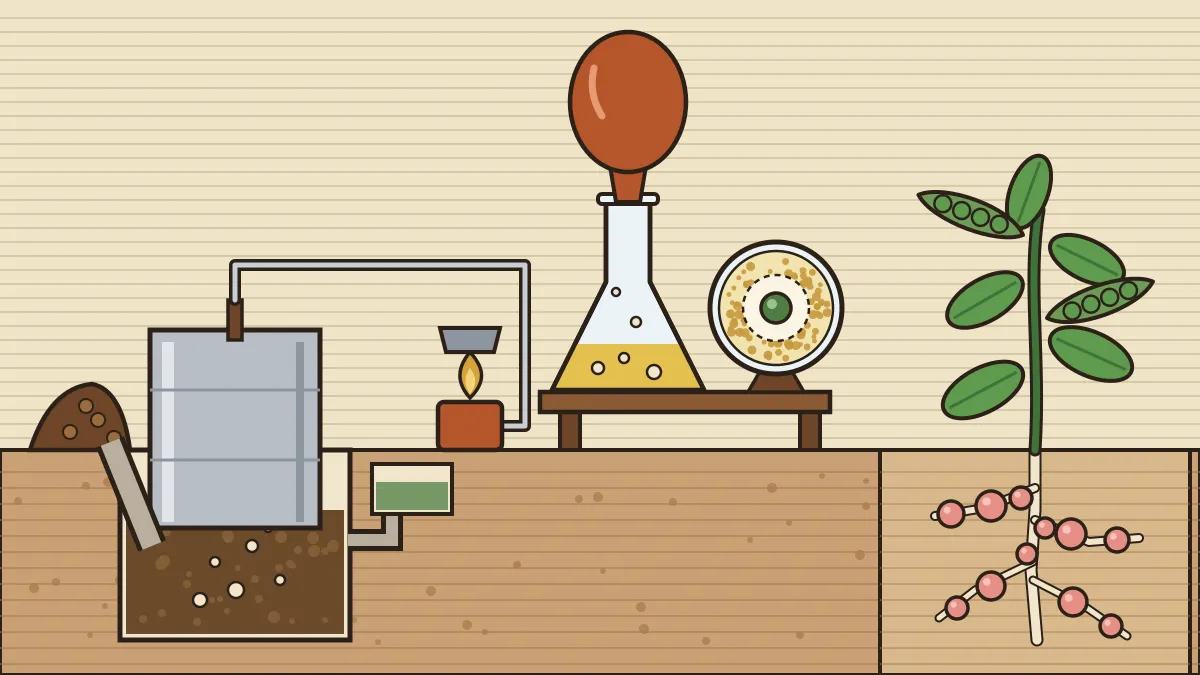
A gobar gas plant is a concrete tank, 10 to 15 feet deep, fed with a slurry of dung and water. A floating cover rises as gas collects under it. A pipe carries the gas to kitchens for cooking and lighting, and the spent slurry leaves by a second outlet and is used as manure, so the plant gives both fuel and fertiliser. India developed the technology mainly through the Indian Agricultural Research Institute and the Khadi and Village Industries Commission.
- Composition: biogas is mostly methane (about 55 to 70%), which is why it burns. The rest is mainly CO2, with traces of hydrogen sulphide.
- Renewable: the feed is farm and kitchen waste, so biogas is a renewable biomass fuel. It burns cleanly and leaves no solid residue.
Today the same idea has gone commercial: purified biogas, compressed as CBG, is the focus of the GOBARdhan push, and the national energy resources page places it among renewables.
Microbes in the Field: Biocontrol and Biofertilisers
Biocontrol means using living organisms against pests and plant diseases, instead of toxic chemicals that pollute soil, groundwater and food. The animals are easy: the ladybird eats aphids, and the dragonfly eats mosquitoes. The microbial agents are the ones to memorise.
| Biocontrol agent | Type | Target |
|---|---|---|
| Bacillus thuringiensis (Bt) | Bacterium, sold as dried spores | Butterfly and moth caterpillars. The toxin is released in the larva's gut, and other insects are spared. |
| Trichoderma | Free-living fungus in root soil | Several plant-disease fungi |
| Baculoviruses (Nucleopolyhedrovirus) | Virus | Insects and other arthropods only, so safe for mammals, birds and fish |
Scientists then moved the Bt toxin genes into the plant itself. Bt cotton, approved in India in 2002, is the example, and a caterpillar feeding on it is killed by the plant's own toxin.
Biofertilisers are living organisms that enrich the nutrients in soil. Their main sources are bacteria, fungi and cyanobacteria.
| Biofertiliser | Kind | Contribution |
|---|---|---|
| Rhizobium | Bacterium living in root nodules of legumes (pea, gram, soyabean) | Fixes atmospheric nitrogen into a form the plant can use |
| Azotobacter, Azospirillum | Free-living soil bacteria | Fix nitrogen and add it to the soil |
| Mycorrhiza (Glomus) | Fungus in partnership with roots | Absorbs phosphorus for the plant; also gives drought and salinity tolerance and resistance to root pathogens |
| Cyanobacteria (Anabaena, Nostoc, Oscillatoria) | Photosynthetic, in water and soil | Fix nitrogen in paddy fields; add organic matter too |
In a nodule the plant supplies sugar and the bacterium supplies fixed nitrogen; in mycorrhiza the fungus trades phosphorus for sugar. Biofertilisers leave no chemical residue, though they work slowly. Which soils need them most is on our soils page.
(1) Rhizobium is symbiotic, in nodules; Azotobacter is free-living. (2) Mycorrhiza brings in phosphorus, not nitrogen. (3) Biofertilisers and biopesticides are part of organic farming. CDS 2026-I tested this last one.
How UPSC Has Asked It: Past Papers Solved
These are actual CDS and NDA questions. The pattern is plain: name the target of penicillin, why antibiotics fail on viruses, true/false on biogas and which is a biocontrol agent.
The antibiotic penicillin can kill invading bacteria without harming human cells because it targets bacterial :
(a) Cell wall (b) Plasma membrane (c) Ribosome (d) Chromosome
Answer: (a). Penicillin blocks the building of the cell wall. Human cells have no cell wall, so they are safe. Ribosome-targeting drugs such as streptomycin are a different group.
Which one of the following statements regarding Penicillin is correct?
(a) Penicillin-resistant bacteria can store this antibiotic in vacuole (b) Penicillin-resistant bacteria can degrade this antibiotic by an enzyme called β-lactamase (c) Penicillin-resistant bacteria can degrade this antibiotic by an enzyme called lactic acid dehydrogenase (d) Penicillin is not absorbed by bacteria; so most bacteria are resistant
Answer: (b). β-lactamase splits the penicillin molecule. Lactic acid dehydrogenase belongs to lactic acid metabolism, and bacteria have no vacuole for storing the drug.
An antibiotic is not useful against a virus whereas a vaccine is. Which one of the following is the most appropriate reason for this?
(a) An antibiotic can break RNA only, whereas virus has DNA. (b) An antibiotic is a carbohydrate in its chemical nature, whereas a vaccine is a protein which works well to kill a virus. (c) Only a vaccine can break the genetic material of a virus. (d) A virus does not use biochemical pathways which can be blocked by an antibiotic. But a vaccine can boost an immune system to fight the virus.
Answer: (d). Antibiotics block steps in bacterial metabolism, and a virus has none of its own. Vaccines train our immune system. The other options invent chemistry.
Which one of the following statements about biogas is not correct?
(a) It is mainly composed of methane gas. (b) It is a non-renewable source of energy. (c) It is formed by the decomposition of cow dung in the absence of oxygen. (d) It burns without smoke and leaves no residue.
Answer: (b). The question asks for the wrong statement. Biogas is made from dung and waste that keep being produced, so it is renewable.
Which one of the following is NOT a biocontrol agent?
(a) Bacillus thuringiensis (b) Ladybird beetle (c) Trichoderma (d) Aphid
Answer: (d). The aphid is the pest. The ladybird eats it, Bt kills caterpillars and Trichoderma suppresses plant-disease fungi.
Consider the following statements with reference to manure and organic farming : 1. Vermicompost is rich in organic matter and nutrients. 2. Biofertilizers and bio-pesticides are not used in organic farming. 3. Crop rotation is beneficial in controlling insects, pests and weeds. Which of the statements given above is/are correct?
(a) 1 only (b) 1 and 3 only (c) 2 and 3 only (d) 1, 2 and 3
Answer: (b). Statement 2 is false, since biofertilisers and biopesticides are the tools of organic farming. Statements 1 and 3 are true.
When yeast cells are O₂ starved, fermentation serves as the source of energy. This results in the production of:
(a) ATP + CO₂ + Ethanol (b) ATP + O₂ + Pyruvate (c) ATP + CO₂ + Lactic acid (d) ATP + O₂ + Acetaldehyde
Answer: (a). Yeast gives ethanol and CO2. Lactic acid with no gas is the muscle (and LAB) route, which is the tempting option (c).
Biogas questions reduce to methane, anaerobic, renewable (NDA 2019-II asked for its major constituent). For microbes, learn each name with its single job.
Practice MCQs (with answers)
- The large holes in Swiss cheese are caused by CO2 produced by
- Propionibacterium sharmanii
- Penicillium roqueforti
- Lactobacillus
- Saccharomyces cerevisiae
- Industrial citric acid is obtained from
- Acetobacter aceti
- Aspergillus niger
- Clostridium butylicum
- Lactobacillus
- The "clot buster" streptokinase comes from
- Aspergillus
- Monascus
- Streptococcus
- Trichoderma
- Which BOD value (mg per litre) is expected for untreated sewage?
- 2
- 8
- 20
- 400
- A gobar gas plant works best when the dung slurry is kept
- without oxygen
- in bright sunlight
- aerated with a pump
- sterilised with antibiotics
- Which pair is correct?
- Trichoderma – fixes atmospheric nitrogen
- Glomus – supplies phosphorus to roots
- Rhizobium – free-living nitrogen fixer
- Azotobacter – forms root nodules in pulses
- Cyclosporin A is used to
- lower blood cholesterol
- dissolve blood clots
- suppress immunity after an organ transplant
- cure bacterial infection
- A grower wants to protect cabbage from caterpillars without harming other insects. The best microbial choice is
- Rhizobium
- Azotobacter
- Penicillium
- Bacillus thuringiensis
1-a, 2-b, 3-c, 4-d, 5-a, 6-b, 7-c, 8-d. Q1: Penicillium roqueforti ripens Roquefort, a different cheese. Q4: sewage has the most organic matter, so the highest BOD. Q6: Rhizobium is symbiotic and Azotobacter is free-living, so the other pairs swap their roles. Q8: Bt kills only the caterpillars that eat it.
Quick Revision
- Curd: Lactobacillus (LAB), lactic acid, more B12. Bread, idli, dosa: CO2 puffs the dough (yeast in bread). Swiss cheese: Propionibacterium sharmanii. Roquefort: mould. Yeast: a fungus.
- Wine and beer are undistilled; whisky, brandy and rum are distilled. Yeast: ethanol + CO2. Acids: citric (Aspergillus niger), acetic (Acetobacter), butyric (Clostridium butylicum), lactic (Lactobacillus).
- Penicillin: Fleming 1928, Penicillium notatum; Florey and Chain; Nobel 1945; blocks the cell wall; resistance through β-lactamase; useless on viruses. Streptokinase: clot buster. Cyclosporin A: transplants. Statins (Monascus): cholesterol.
- Sewage: primary (physical), secondary (aerobic flocs, lowers BOD), activated sludge, anaerobic digester gives biogas. High BOD means more pollution.
- Biogas: methanogens (Methanobacterium), anaerobic, methane about 55 to 70%, renewable; spent slurry is manure; IARI and KVIC.
- Biocontrol: Bt (caterpillars; Bt cotton, 2002), Trichoderma, baculovirus. Ladybird eats aphids; aphid is a pest.
- Biofertilisers: Rhizobium (nodules), Azotobacter and Azospirillum (free-living), mycorrhiza (Glomus, phosphorus), cyanobacteria (paddy). World AMR Awareness Week: 18-24 November.
Frequently asked questions
Which microbe turns milk into curd?
Lactic acid bacteria, mainly Lactobacillus, turn milk into curd. They convert lactose to lactic acid, which coagulates and partly digests the milk proteins. A spoon of curd is added as a starter, and curd has more vitamin B12 than milk.
Why do antibiotics not work against viruses?
Antibiotics act by blocking steps in bacterial metabolism or the building of the bacterial cell wall. A virus has no cell wall and no metabolism of its own, so there is nothing for the drug to block. Viral diseases are prevented with vaccines, which prepare the immune system.
What is BOD and why does it matter in sewage treatment?
BOD, or biochemical oxygen demand, is the oxygen microbes use to break down the organic matter in a litre of water. High BOD means a lot of organic matter and heavy pollution. Secondary treatment in aeration tanks lowers the BOD before the water is released.
What is biogas and what is it made of?
Biogas is a fuel made when methanogenic bacteria break down dung and other organic waste without oxygen. It is mostly methane, with carbon dioxide and traces of hydrogen sulphide. The leftover slurry is a good manure.
What is the difference between a biofertiliser and a biocontrol agent?
A biofertiliser, such as Rhizobium, Azotobacter, mycorrhiza or cyanobacteria, improves the nutrients available to a crop. A biocontrol agent, such as Bacillus thuringiensis or Trichoderma, fights pests or plant diseases. Both reduce the need for chemical fertilisers and pesticides.
Related CDS / OTA Science topics
Biology questions are the easiest marks in GS
Cavalier's CDS/OTA batches teach biology from the NCERT base, with diagrams, mnemonics and weekly PYQ tests.