The Indian Navy has had a busy first fortnight of November. On 2 November the Ministry of Defence signed contracts worth ₹53,866.50 crore for eight Next Generation Corvettes, five to be built by GRSE and three by Goa Shipyard, ships meant for anti-submarine and surface warfare. Two days later INS Sahyadri reached Yokosuka in Japan for Exercise Malabar 2026. Behind every steel hull is Class 9 physics: a ship of metal floats, a submarine of the same metal can sink or hover on command, and one rule holds both up. Archimedes' principle, with pressure and Pascal's law, appears in almost every CDS and NDA paper, often as a one-step numerical. Our pages on gravity and Newton's laws cover the mechanics around it; this one stays inside the fluid.
Pressure and Why Depth Matters
By Abhishek Thakur · Science faculty, The Cavalier · 15 years teaching NDA and CDS Science
Pressure is the force acting normally on a unit area: P = F ÷ A. It is a scalar, and its SI unit is the pascal (Pa), which is one newton per square metre. The same force gives more pressure on a smaller area, which is why a knife cuts and a battle tank's wide tracks stop it sinking into soft ground.
| Unit | Value in pascals | Where it is used |
|---|---|---|
| 1 pascal (Pa) | 1 N m−2 | SI unit |
| 1 atmosphere (atm) | About 1.013 × 10⁵ Pa | Pressure of the air at sea level |
| 1 torr (1 mm of mercury) | About 133 Pa | Medicine, blood pressure |
A liquid presses on the bottom and the walls of its container, and the pressure at a point depends on three things only. The pressure at depth h below the surface of a liquid of density ρ is:
Three words hold the idea: depth, density, gravity. The shape of the vessel and the area of its base do not appear. A tall thin tube and a wide tank filled to the same height give the same pressure at the bottom, which is why dams are thicker at the base.
A submarine dives to 100 m in water. What is the pressure due to the water, and the total pressure on its hull? (Take ρ = 1000 kg m−3, g = 10 m s−2, 1 atm = 105 Pa.)
A useful shortcut: every 10 m of water adds about one atmosphere. A submarine's hull has to resist tens of atmospheres at its working depth.
Pascal's Law, the Hydraulic Lift and the Air Above
Pascal's law states that a pressure applied to an enclosed fluid is transmitted undiminished to every point of the fluid and to the walls of the container. It is named after Blaise Pascal (1623-1662). The most famous application is the hydraulic lift. A small force on a small piston creates a pressure, the same pressure acts on a large piston, and the force there is larger in the ratio of the areas.
The small piston of a hydraulic lift has an area of 5 cm² and the large one 500 cm². What force on the small piston lifts a car of mass 2000 kg? (g = 10 m s−2)
200 N lifts a two-tonne car, yet energy is conserved: the small piston must move 100 times farther than the large one rises, so the work done is the same (see our page on work and energy). Hydraulic brakes and jacks use the same principle.
Atmospheric pressure is the weight of the air column above a point: about 1.013 × 10⁵ Pa at sea level. Torricelli measured it in 1643 with the mercury barometer, a tube of mercury inverted in a trough. The mercury stands about 76 cm high, where its weight balances the air. Mercury is used because it is very dense; a water barometer would need a tube over 10 m tall. Pressure falls with height, to roughly half at about 6 km.
"Pascal" is the unit; Pascal's law is the principle. Pressure is a scalar. The force on the bottom of a vessel does depend on the base area, even though the pressure does not. In a barometer, tilting the tube or using a wider one does not change the vertical height of the column.
Buoyancy and Archimedes' Principle
An object in a fluid feels an upward push, the buoyant force or upthrust, because pressure grows with depth and so is greater at the bottom of the object than at its top. Archimedes' principle says that when an object is wholly or partly immersed in a fluid, the buoyant force on it is equal to the weight of the fluid it displaces.
Archimedes (about 287-212 BC), of Syracuse, is said to have found it in his bath while testing whether a king's crown was pure gold, and to have run out shouting "Eureka". His test survives as the measurement of relative density: the density of a substance divided by that of water, a pure number.
A metal piece weighs 12 N in air and 8 N when fully immersed in water. Find its relative density and density. (g = 10 m s−2)
Sinking, floating or hovering depends on the average density of the object against the fluid's.
| Condition | Result | Examples |
|---|---|---|
| Average density of object > fluid | Sinks: weight exceeds the maximum buoyant force | Iron nail, stone, a submarine with flooded tanks |
| Average density = fluid | Hovers anywhere inside | Submarine at neutral buoyancy |
| Average density < fluid | Floats, with part above the surface | Wood, ice, a ship, a hot-air balloon in cooler air |
A floating body displaces fluid whose weight equals its own weight, and the part submerged is in the ratio of the densities: fraction submerged = ρobject ÷ ρfluid. A block of density 600 kg m−3 floats in water with 60 per cent submerged, and in a liquid of density 800 kg m−3 with 75 per cent.
1. Buoyancy is a force, not a pressure; UPSC has tested this distinction. 2. The buoyant force depends on the volume displaced and the fluid's density, not on the object's weight or material. 3. Gravity cancels out of the floating condition. On the Moon, with g at one-sixth, a floating object sits at the same depth (CDS 2026-II). 4. When ice floating in a glass of water melts, the water level stays unchanged, because the ice displaces exactly its own weight of water.
Why a Steel Ship Floats: Plimsoll Line and Sea Water
Steel is nearly eight times as dense as water, so how does a ship float? The answer is shape. The hull is hollow and mostly filled with air. The ship's average density, meaning its total mass divided by the total volume enclosed by the hull, is below that of water. NDA 2023-II tested this contrast.
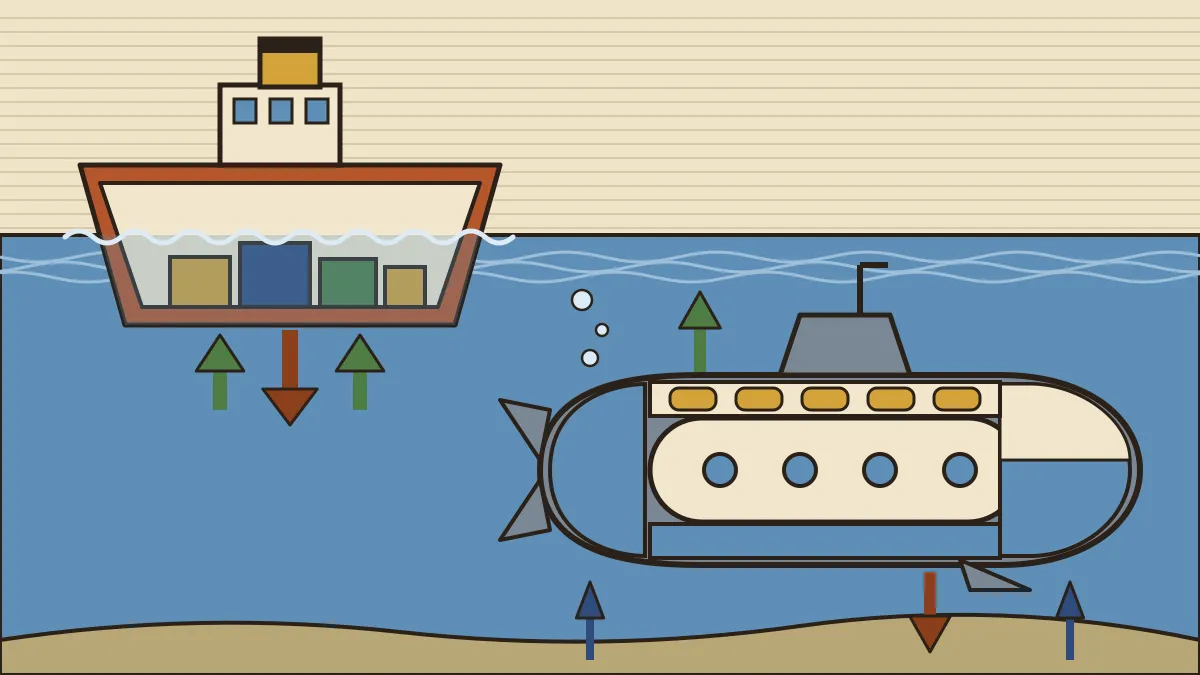
A ship of mass 10,000 tonnes (107 kg) floats in a river (ρ = 1000 kg m−3) and then in sea water (ρ = 1025 kg m−3). What volume of water does it displace in each?
The weight is the same but sea water is denser, so a ship rides higher in the sea than in a river. It is also why a swimmer floats more easily in the very salty Dead Sea.
The same fact explains the Plimsoll line painted on every merchant ship. The British MP Samuel Plimsoll campaigned against overloaded "coffin ships", and the Merchant Shipping Act of 1876 made a load mark compulsory. The marks show the greatest depth to which the hull may be loaded in fresh, tropical, summer and winter waters. The fresh-water mark sits slightly higher on the hull, since the ship sinks deeper in lighter water.
An iceberg is the same principle on a grand scale. Ice (about 917 kg m−3) in sea water (1025) has a submerged fraction of 917 ÷ 1025, about 0.9, so nine-tenths of an iceberg is hidden.
Submarines, Ballast Tanks and the Hydrometer
A submarine is a ship that can change its own average density. It has a strong inner pressure hull where the crew lives, and around it, or inside the outer casing, are ballast tanks. The three states of a submarine follow directly from the table above.
| Action | Ballast tanks | Weight versus buoyancy |
|---|---|---|
| Dive | Vents open, tanks flooded with sea water | Weight greater than buoyancy; the boat sinks |
| Hover (neutral buoyancy) | Part water, part air, balanced with small trim tanks | Weight equals buoyancy |
| Surface | Compressed air blows the water out | Buoyancy greater than weight; the boat rises |
The submarine's volume, and so its buoyant force, hardly changes; its weight is adjusted by letting water in and out. A moving boat steers up or down with its fins, the hydroplanes. Underwater it relies on sound; our page on sonar and radar explains how ships such as the new corvettes hunt for it.
The hydrometer uses flotation to measure the density of a liquid. It is a sealed glass tube, weighted at the bottom so that it floats upright, with a scale on the stem. In a denser liquid it floats higher, because less volume needs to be submerged to displace its weight. In a lighter liquid it sinks deeper. With a different scale it is the lactometer for milk, and garages use one to test the acid in a lead-acid battery.
How UPSC Has Asked It: Past Papers Solved
UPSC asks this chapter as one-liners or one-step numericals.
A liquid is kept in a glass beaker. Which one of the following statements is correct regarding the pressure exerted by the liquid column at the base of the beaker?
(a) The pressure depends on the area of the base of the beaker (b) The pressure depends on the height of liquid column (c) The pressure does not depend on the density of the liquid (d) The pressure neither depends on the area of the base of the beaker nor on the height of liquid column
Answer: (b). P = hρg depends on height, density and g. Option (d) correctly drops the area but wrongly drops the height.
An iron nail sinks in water whereas an iron ship floats. Which of the following statements is correct in this regard? 1. Average density of ship is greater than that of the water. 2. Average density of iron nail is greater than that of the water. 3. Average density of the ship is less than that of the water. 4. Average density of the ship is equal to that of the water.
(a) 1 and 2 (b) 2 and 3 (c) 2 and 4 (d) 1 and 4
Answer: (b). The nail is solid iron, denser than water. The ship's hollow hull gives it an average density below water.
A metallic sphere of mass 1 kg and volume 2 × 10⁻⁴ m³ is completely immersed in water. The buoyant force exerted by water on the sphere is: (Given: density of water = 1000 kg/m³, g = 10 m/s²)
(a) 0.5 N (b) 1.5 N (c) 2 N (d) 2.5 N
Answer: (c). B = Vρg = 2 × 10⁻⁴ × 1000 × 10 = 2 N. The mass is a distractor: the force depends on the displaced volume alone.
Gravitational acceleration at moon is 1/6 of that on earth. On earth, if an object floats in water with fraction 'fe' of its volume submersed in water, and on moon, fraction 'fm' is submersed, then
(a) fe > fm (b) fe < fm (c) fe = fm (d) fm = (1/6) fe
Answer: (c). For floating, weight = buoyant force, so ρobject V g = ρwater Vsub g. The g cancels, leaving Vsub ÷ V = ρobject ÷ ρwater. On the Moon both forces fall to one-sixth, and the balance is unchanged.
The volume of a sealed packet is 1 litre and its mass is 800 g. The packet is first put inside water with density 1 g cm⁻³ and then in another liquid B with density 1.5 g cm⁻³. Then which one of the following statements holds true?
(a) The packet will float in both water and liquid B. (b) The packet will sink in both water and liquid B. (c) The packet will sink in water but will float in liquid B. (d) The packet will float in water and sink in liquid B.
Answer: (a). Density of the packet = 800 g ÷ 1000 cm³ = 0.8 g cm⁻³, which is below both 1 and 1.5. It floats in both.
Compare densities first. Every float-or-sink question, and the Moon question too, is solved by ρobject against ρfluid. For numericals, keep SI units and use B = Vρg.
Practice MCQs (with answers)
- The SI unit of pressure is the
- joule
- pascal
- newton
- watt
- The pressure at the bottom of a liquid column does NOT depend on the
- depth of the liquid
- density of the liquid
- shape of the container
- acceleration due to gravity
- The areas of the two pistons of a hydraulic lift are in the ratio 1 : 50. A force of 40 N on the smaller piston gives a force on the larger piston of
- 2000 N
- 400 N
- 800 N
- 4000 N
- An object weighs 10 N in air and 6 N when fully immersed in water. The buoyant force on it is
- 16 N
- 6 N
- 4 N
- 10 N
- When a ship sails from a river into the sea, it
- rises slightly in the water
- sinks deeper
- stays at the same level
- sinks to the bottom
- A submarine dives by
- pumping water out of its ballast tanks
- heating its hull
- increasing its volume
- flooding its ballast tanks with water
- A hydrometer is used to measure the
- atmospheric pressure
- relative density of a liquid
- speed of a ship
- depth of the sea
- A wooden block of density 800 kg m−3 floats in water. The fraction of its volume that is submerged is
- 20 per cent
- 40 per cent
- 100 per cent
- 80 per cent
1-b, 2-c, 3-a, 4-c, 5-a, 6-d, 7-b, 8-d. Q3: 40 × 50 = 2000 N. Q4: buoyant force = loss of weight = 10 − 6 = 4 N. Q8: submerged fraction = 800 ÷ 1000.
Quick Revision
- P = F ÷ A; pascal = N m−2; 1 atm = 1.013 × 10⁵ Pa = 76 cm Hg; 1 torr = 133 Pa.
- P = hρg: depth, density, g; not shape or base area. Total = Patm + hρg; about 1 atm per 10 m of water.
- Pascal's law: pressure transmitted undiminished. Hydraulic lift F2 = F1 × A2 ÷ A1; work not multiplied.
- Archimedes: B = Vρg, a force. Floats if average density is lower; fraction submerged = ρobject ÷ ρfluid. Relative density = weight in air ÷ loss of weight in water.
- Ship: hollow hull; rides higher in sea water. Plimsoll line: 1876. Iceberg: about 90% submerged. Submarine: floods tanks to dive, compressed air to surface. Hydrometer floats higher in denser liquid. Melting floating ice leaves the level unchanged.
Frequently asked questions
What is Archimedes' principle?
When an object is wholly or partly immersed in a fluid, the upward buoyant force on it equals the weight of the fluid it displaces: B = Vρg, where V is the volume displaced and ρ the fluid's density. It explains why objects feel lighter in water and why ships float.
Why does a steel ship float while a steel nail sinks?
A ship's hull is hollow and mostly full of air, so its average density, total mass divided by enclosed volume, is below that of water. A nail is solid steel, nearly eight times denser than water. A floating ship displaces water that weighs as much as the ship.
How does a submarine dive and surface?
To dive, it floods its ballast tanks with sea water, so its weight exceeds the buoyant force. To surface, compressed air blows the water out, so buoyancy exceeds weight. By balancing water and air it can hover at a chosen depth.
What is Pascal's law and where is it used?
Pressure applied to an enclosed fluid is transmitted undiminished to every part of the fluid and the container walls. Hydraulic lifts, brakes and jacks use it: a small force on a small piston gives a large force on a large piston.
Why does a ship sit higher in sea water than in river water?
Sea water is denser because of dissolved salts. A floating ship must displace its own weight of water, so in denser water it displaces less volume and the hull rides higher.
Related CDS / OTA Science topics
Physics is a steady source of marks in CDS and NDA
Cavalier's CDS/OTA and NDA batches teach physics from first principles, with numericals and weekly PYQ tests.