By Akanksha Kumari · Science faculty, The Cavalier · B.Tech, 15 years teaching Science
A missile is a guided weapon: a rocket or jet engine that carries a warhead and steers itself to a target. India builds most of its missiles through the Defence Research and Development Organisation (DRDO), and its modern missile family goes back to one programme, the Integrated Guided Missile Development Programme (IGMDP), launched in 1983 under Dr APJ Abdul Kalam. For an NDA or CDS candidate it is a favourite corner of defence GK: ballistic or cruise, joint or indigenous, what the latest test proved.
It is also a science chapter: rockets obey Newton's third law, a ballistic missile follows a projectile path, and a ramjet works only because fast air squeezes itself. This page is the front door to the missiles branch of our Defence GK library: the IGMDP, the classification tables, range, guidance and propulsion in plain words, a family tree, who operates what, and a guide to the pages that go deeper. Only publicly released facts are used: no stockpile numbers, no deployments.
IGMDP: The Programme That Built the Family
The IGMDP set out to build a family of strategic and tactical missiles at home, for all three services, with Dr APJ Abdul Kalam leading it from the Defence Research and Development Laboratory (DRDL), Hyderabad. It chose five missiles, one for each need. DRDO announced in January 2008 that the programme had met its aims and was wound up. The Hyderabad missile complex and the Dr APJ Abdul Kalam Island off Odisha, where many tests are flown, carry his name.
| Missile | Type | Notes | Status |
|---|---|---|---|
| Prithvi | Surface-to-surface, short-range ballistic | First flown 1988; single-stage and liquid-fuelled, unusual among Indian ballistic missiles. Prithvi-II is quoted at 250 to 350 km | In service. PIB tested Prithvi-II with Agni-I on 17 Jul 2025 |
| Agni | Began as a re-entry technology demonstrator | The 1989 flight tested how a warhead survives re-entry; Agni then grew into a solid-fuel family | In service and still tested: Agni series |
| Trishul | Short-range surface-to-air | Quick-reaction missile for low flyers and sea-skimmers; about 11 to 12 km in books | Closed: shut down in 2008 without entering service as a weapon |
| Akash | Surface-to-air | PIB has called it short range; older books say medium range, about 25 to 30 km | In service with the Air Force and Army; PIB announced on 23 Dec 2025 that Akash-NG had finished user trials |
| Nag | Third-generation anti-tank, fire and forget | Homes on the tank by itself; about 4 km quoted for the first version | PIB announced in Jan 2025 that Nag Mk 2 finished field trials and is ready for Army induction |
The end year, Akash's class and exact ranges vary between books. Remember the stable core: 1983, Dr APJ Abdul Kalam, five missiles, Trishul closed.
Anti-tank missiles have their own page; DRDO's laboratories are on the DRDO page.
How Missiles Are Classified
Ask two questions of any missile: where is it fired from and what does it hit? and how does it fly? The first gives the class name.
| Class | Fired from, aimed at | Indian examples |
|---|---|---|
| Surface-to-surface (SSM) | Land or ship, against a ground or sea target | Prithvi, Agni series, Pralay, BrahMos (land version), Dhanush (a ship-launched ballistic missile based on Prithvi) |
| Surface-to-air (SAM) | Land or ship, against aircraft, missiles or drones | Akash, MRSAM, QRSAM, VSHORADS, Kusha; S-400 is imported from Russia |
| Air-to-air (AAM) | Aircraft, against another aircraft | Astra (beyond-visual-range) |
| Air-to-surface (ASM) | Aircraft or helicopter, against ground targets | RudraM-II, BrahMos (air-launched version) |
| Anti-ship | Ship, shore, aircraft or submarine, against ships | BrahMos (ship version), NASM-SR (helicopter-launched) |
| Anti-tank (ATGM) | Ground vehicle, helicopter or a soldier, against armour | Nag, Helina and Dhruvastra, MPATGM |
| Submarine-launched ballistic (SLBM) | Submerged submarine, against land targets | The K-series, carried by the nuclear-powered submarines |
The second question, how it flies, separates the two great families.
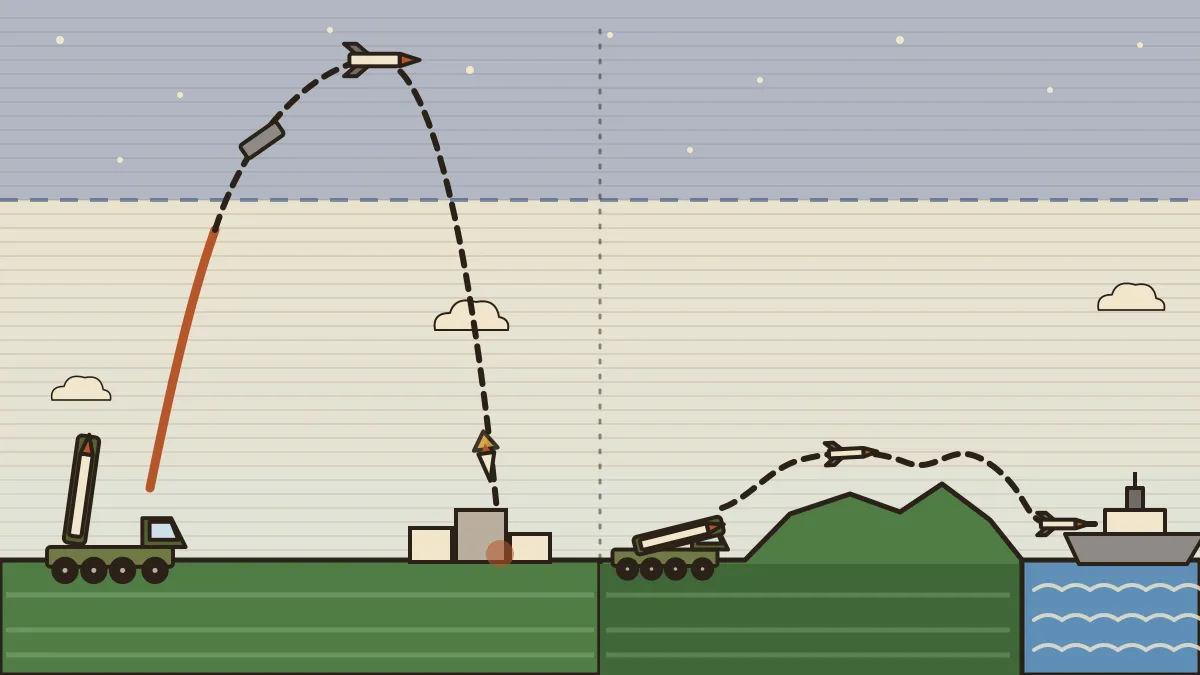
| Ballistic missile | Cruise missile | |
|---|---|---|
| Path | Powered only in the short boost phase, then a free-fall arc under gravity; the warhead re-enters the atmosphere at the end | Flies like a pilotless aircraft with wings, under power and steering all the way |
| Engine | Rocket motor, solid or liquid propellant, carrying its own oxygen supply | Air-breathing engine: turbofan or turbojet for subsonic missiles, ramjet for supersonic ones, with a booster to get started |
| Speed | Very high in the final fall, several times the speed of sound | Subsonic (below Mach 1) or supersonic; BrahMos Aerospace gives about Mach 2.8 for BrahMos |
| Height | High; long-range ones leave the atmosphere | Usually low, to stay below radar; BrahMos can cruise high (up to 15 km) and end as low as 5 m, per BrahMos Aerospace |
| Indian examples | Prithvi, Agni series, K-series | BrahMos, LRLACM, the older subsonic Nirbhay |
A ballistic missile needs special interceptors, covered in ballistic missile defence; a low cruise missile slips under the radar horizon and is met by layered air defence. PIB describes Pralay as a solid-propellant quasi-ballistic missile. In general, such a missile flies a flatter, lower path than a true ballistic one and can change course in flight, so its landing point is harder to predict. Official releases give no detail of Pralay's path.
Agni, Prithvi and Dhanush are ballistic; BrahMos flies under power all the way with a ramjet. Full story: BrahMos.
Range Classes, Guidance and Propulsion
Range classes are conventions, and definitions vary between countries and books. India publishes few exact ranges, so releases name the class and skip the kilometres. The bands below are the common textbook ones.
| Class | Common band (ballistic) | What PIB calls them |
|---|---|---|
| Short-range (SRBM) | Up to about 1,000 km | Prithvi-II and Agni-1 |
| Medium-range (MRBM) | About 1,000 to 3,000 km | Agni-4 (Aug 2026) |
| Intermediate-range (IRBM) | About 3,000 to 5,500 km | Agni-3 and Agni-5; also Agni-Prime, with a design range of up to 2,000 km (Sep 2025) |
| Intercontinental (ICBM) | Above about 5,500 km | No Indian missile is called an ICBM in the releases checked |
PIB calls Agni-4 medium range yet Agni-Prime, at up to 2,000 km, intermediate range, and many books list Agni-4 as an IRBM. Use the band the question gives. Separately, the Missile Technology Control Regime puts any system that can carry about 500 kg to at least 300 km in its tightest Category I.
Cruise missiles are grouped by speed: subsonic (below Mach 1), supersonic (Mach 1 to 5) and hypersonic (above Mach 5).
Guidance is how a missile finds its target, usually in three stages:
- Inertial navigation: gyroscopes and accelerometers measure the missile's own turns and speed. It needs no outside signal and cannot be jammed, but errors build up. NASM-SR uses a fibre-optic-gyroscope system.
- Satellite and data-link correction: GPS or India's NavIC fixes the position, and a radio link lets an operator re-target. NASM-SR's two-way link sends the seeker's live pictures to the pilot.
- Terminal seekers: a nose sensor takes over for the last few kilometres. An active radar (RF) seeker sends its own signal, as on Akash-NG and Astra; an imaging infrared seeker sees the target's heat picture, as on MPATGM. A missile that locks on and then needs no help is fire and forget.
Propulsion decides range and speed. A solid motor carries fuel and oxidiser mixed in one block: simple, always ready, good for road-mobile missiles such as the Agni family. A liquid motor pumps them separately: finer control, slower to prepare. A ramjet has no compressor, because speed forces the air in, so it needs a booster first; PIB calls BrahMos a two-stage missile. A scramjet burns fuel in air still flowing at supersonic speed, the heart of hypersonic cruise. Newton's third law lies behind all: the engine throws gas back, the missile goes forward. Revise it on our laws of motion and Newton's laws notes, and the ballistic arc on kinematics.
The Family Tree
Every entry is indigenous unless it says otherwise.
- Missiles of India
- Strategic ballisticAgni tests are run under the aegis of the Strategic Forces Command
- Agni seriesAgni-1 to Agni-5, Agni-Prime · solid fuel · MIRV flight-trial 8 May 2026
- K-series SLBMsSubmarine-launched · official ranges not published
- Tactical surface-to-surfaceBattlefield range
- PrithviIGMDP · short-range ballistic · liquid fuel
- PralayQuasi-ballistic · solid propellant · flight-test 5 Nov 2026
- BrahMosSupersonic cruise · India–Russia joint venture · land, ship, air versions
- LRLACMLong Range Land Attack Cruise Missile · flight-test 15 Jun 2026
- Surface-to-airLayered air defence
- KushaLong range · maiden flight-test 23 Jul 2026
- Akash and Akash-NGAkash from the IGMDP · Akash-NG user trials announced complete 23 Dec 2025
- MRSAMMedium range · co-developed with Israel · built in India
- QRSAM and VSHORADSQuick-reaction and shoulder-fired · VSHORADS flight-trials announced 27 Feb 2026
- Air-to-air and air-to-surfaceFired from aircraft
- AstraBeyond-visual-range air-to-air · range above 100 km (PIB)
- RudraM-IIAir-to-surface · flight-tests announced 2 Jun 2026
- Anti-tankArmour killers
- NagIGMDP · fire-and-forget · Nag Mk 2 field trials Jan 2025
- Helina and DhruvastraHelicopter-launched · Army and Air Force versions
- MPATGMMan-portable · infrared seeker · top-attack test 11 Jan 2026
- Anti-shipSea strike
- BrahMosShip and air versions of the cruise missile above
- NASM-SRHelicopter-launched · first salvo launch announced 29 Apr 2026
- Hypersonic effortsOnly officially announced steps
- Long-range hypersonic missileFlight-trial on 16 Nov 2024 · for ranges above 1,500 km (PIB)
- Scramjet engineFull-scale combustor ground tests: over 12 minutes (9 Jan 2026), over 1,200 seconds (9 May 2026)
- Strategic ballisticAgni tests are run under the aegis of the Strategic Forces Command
A flight-test is not an induction: PIB called the 5 November 2026 Pralay test a user evaluation trial, with induction "imminent". The strategic branch has its own page, Agni series. The K-series missiles ride on the boats described on nuclear submarines and form one leg of the triad on nuclear doctrine and the triad.
Hypersonic means above Mach 5. Such a missile can be a scramjet-powered cruise missile or a warhead that glides after a rocket boost. PIB's release of 17 November 2024 says only that it was designed for ranges above 1,500 km and made terminal manoeuvres.
Who Operates What, and Who Controls the Nuclear Ones
| Service | Missile families | Go deeper |
|---|---|---|
| Indian Army | Akash, anti-tank missiles, land-attack BrahMos, tactical surface-to-surface missiles | Army weapon systems |
| Indian Navy | Ship-launched BrahMos, ship-borne surface-to-air, helicopter-launched anti-ship, submarine-launched ballistic | Submarines |
| Indian Air Force | Surface-to-air squadrons, air-launched BrahMos and RudraM-II, Astra | Air defence, surface-to-air missiles |
| Strategic Forces Command | Nuclear-capable delivery systems, as the military arm of the Nuclear Command Authority | Tri-services, Strategic Forces Command |
The Strategic Forces Command, raised in 2003, is the tri-service command that controls delivery of nuclear weapons. PIB's Agni releases say the tests were "carried out under the aegis of the Strategic Forces Command", and that is all the Government has put on record. Warhead numbers and launcher locations are not given, so this page gives none.
The Missile Technology Control Regime (MTCR) is a voluntary group of countries that agree to control exports of missiles and missile technology. India joined as its 35th member on 27 June 2016 and, like every member, commits to apply the guidelines to its own exports. Wider pacts are on defence agreements.
- 23 Dec 2025: PIB announces Akash-NG user evaluation trials complete. 31 Dec 2025: two Pralay missiles launched in quick succession.
- 11 Jan 2026: MPATGM top-attack test on a moving target. 3 Feb 2026: solid-fuel ducted ramjet demonstrated.
- 6 Feb 2026: Agni-3 test-fired. 27 Feb 2026: PIB announces three VSHORADS flight-trials that intercepted high-speed targets.
- 29 Apr 2026: PIB announces the first salvo launch of NASM-SR from a Navy helicopter.
- 8 May 2026: Advanced Agni with MIRV flight-tested; the payloads were aimed at different targets.
- 22 May: Agni-1. 2 Jun: RudraM-II flight-tests announced. 15 Jun: LRLACM. 23 Jul: maiden Kusha test. 6 Aug: Agni-4 (all 2026).
- 5 Nov 2026: Pralay flight-tested in user evaluation trials; see Pralay Flight-Tested Again, and our explainers on Agni-4 and LRLACM.
Guided Tour: Pages in the Missiles Section
| Page | What it covers |
|---|---|
| Agni Series | Agni-I to Agni-V and Agni-Prime, MIRV flight-trials, propellant stages |
| BrahMos | The India–Russia joint venture, how a ramjet works, its versions and exports |
| Ballistic Missile Defence | The two-tier interceptor programme and the national air-defence shield plans |
| Anti-Tank Missiles | Nag, Helina, Dhruvastra and MPATGM; fire-and-forget versus guided by wire or radio |
| Missile Tests 2026 | A running log of this year's tests: missile, date, site, agency and what each proved |
| Nuclear Doctrine and the Triad | The 2003 doctrine, the Nuclear Command Authority and the three legs of the triad |
| DRDO | The organisation behind the missiles: laboratories and flagship programmes |
| Surface-to-Air Missiles | S-400, MRSAM, Akash and SPYDER in Air Force service |
Exam pins
- IGMDP: launched 1983 under Dr APJ Abdul Kalam; five missiles: Prithvi, Agni, Trishul, Akash, Nag. Trishul was closed in 2008.
- Prithvi: surface-to-surface, short-range ballistic, liquid-fuelled. Agni: solid fuel; began as a re-entry technology demonstrator.
- Nag: fire-and-forget anti-tank missile. Akash: surface-to-air (short or medium range).
- Ballistic: powered boost, then free fall (Prithvi, Agni, K-series). Cruise: powered and low all the way (BrahMos, LRLACM, Nirbhay).
- BrahMos: India–Russia joint venture, supersonic cruise, about Mach 2.8; air, sea and land versions; not ballistic.
- Pralay: quasi-ballistic; latest flight-test 5 Nov 2026.
- Hypersonic: above Mach 5; first long-range hypersonic missile flight-trial 16 Nov 2024, from Dr APJ Abdul Kalam Island.
- MTCR: India became the 35th member on 27 June 2016.
- Agni tests are run under the Strategic Forces Command (raised 2003).
Asked in past papers
Questions ask you to sort missiles into types, name one from its description or attach a figure to it.
Which one of the following is India's first indigenously designed and developed long-range subsonic cruise missile which can be deployed from multiple platforms?
(a) Astra (b) Akash (c) Nirbhay (d) Shankhnaad
Answer: (c). Nirbhay is the subsonic cruise missile. Astra (air-to-air) and Akash (surface-to-air) tempt only because they are well-known DRDO names.
Consider the following missiles: 1. Agni-I 2. BrahMos 3. Dhanush. Which of the above is/are cruise missile/missiles?
(a) 1 and 2 (b) 2 only (c) 1 and 3 (d) 3 only
Answer: (b). BrahMos is the only cruise missile; Agni-I and the ship-launched Dhanush are ballistic. Option (a) tempts because Agni is the best-known Indian missile name.
With reference to BrahMos missile, consider the following statements: 1. It has a flight range of up to 290 km. 2. It is capable of attaining a speed of 2.8 Mach. 3. Its cruising altitude could be up to 30 km. Which of the statements given above is/are correct?
(a) 1 and 2 (b) 2 only (c) 1 and 3 (d) 3 only
Answer: (a). BrahMos Aerospace gives a range of up to 290 km, a speed of about Mach 2.8 and a cruising altitude of up to 15 km, so statement 3 (30 km) is the wrong one.
What is the range capability of Agni-P Ballistic Missile?
(a) 1,000 to 2,000 km (b) 2,000 to 3,000 km (c) 3,000 to 4,000 km (d) 4,000 to 5,000 km
Answer: (a). Agni-Prime is designed for up to 2,000 km, as PIB repeated on 25 September 2025. Do not link every "Agni" with the long ranges of Agni-4 and Agni-5.
Which of the following statements about India's military arsenal is/are correct? 1. HAMMER is a weapon system built for the Rafale fighter aircraft. 2. SCALP cruise missile is also known as Storm Shadow. 3. BrahMos missiles are built under a joint venture between India and Russia.
(a) 1 and 2 only (b) 2 and 3 only (c) 1, 2 and 3 (d) 3 only
Answer: (c). All three are true; BrahMos is the India–Russia joint venture. Knowing only the BrahMos line leads to (d).
Learn the family tree for the classify-and-name questions and the exam pins for the figures. Practise on the CDS and NDA past-paper pages, and watch our daily defence notes for each new test.
Practice MCQs (with answers)
- The Integrated Guided Missile Development Programme was launched in 1983 under
- Dr Vikram Sarabhai
- Dr APJ Abdul Kalam
- Dr Homi Bhabha
- Dr Satish Dhawan
- Which IGMDP missile is a third-generation anti-tank guided missile?
- Prithvi
- Trishul
- Nag
- Akash
- Which of these is not one of the five IGMDP missiles?
- Prithvi
- Akash
- Trishul
- BrahMos
- A ballistic missile's engine burns mainly during the
- boost phase
- mid-course coast
- re-entry
- entire flight
- Which guidance method needs no signal from outside the missile?
- GPS correction
- Inertial navigation
- Radio data link
- Command guidance by an operator
- India became a member of the Missile Technology Control Regime in
- 2008
- 2012
- 2014
- 2016
1-b, 2-c, 3-d, 4-a, 5-b, 6-d. Q2: Prithvi is ballistic; Trishul and Akash are surface-to-air. Q3: BrahMos is a joint venture with Russia, outside the IGMDP. Q4: a ballistic missile is powered only in the short boost phase; "entire flight" describes a cruise missile. Q5: GPS, a data link and an operator all depend on an outside signal that can be jammed; inertial navigation uses only the missile's own gyroscopes and accelerometers. Q6: 27 June 2016, as the 35th member.
Where to Go Next
A three-minute talk on "ballistic versus cruise missiles" makes a strong lecturette: practise with our lecturette topics for SSB, keeping to facts the Government has published. Then return to the Defence GK library for the services that fire these missiles. If the NDA is your target, Cavalier's NDA coaching batches teach the science behind this chapter with the General Ability Test, weekly tests and SSB training on our own GTO ground.
Frequently asked questions
What was the IGMDP and which missiles came out of it?
The Integrated Guided Missile Development Programme was launched in 1983 under Dr APJ Abdul Kalam to build a family of missiles in India. It chose five: Prithvi, Agni, Trishul, Akash and Nag. Trishul was closed in 2008, and DRDO announced in January 2008 that the programme had met its aims.
What is the difference between a ballistic and a cruise missile?
A ballistic missile is powered by a rocket only in the short boost phase and then follows a high arc under gravity, re-entering the atmosphere at great speed. A cruise missile has wings and an air-breathing engine and flies low and under power all the way to the target. Agni and Prithvi are ballistic; BrahMos is cruise.
Is BrahMos a ballistic or a cruise missile?
BrahMos is a supersonic cruise missile. PIB describes it as a two-stage precision strike missile that operates on the fire-and-forget principle and can be launched from air, sea and land platforms. It was developed by a joint venture between India and Russia.
How are missile ranges classified?
A common textbook scheme calls up to about 1,000 km short range, about 1,000 to 3,000 km medium range, about 3,000 to 5,500 km intermediate range and above that intercontinental. The bands vary between countries, and PIB does not follow one table: it calls Agni-4 a medium-range missile and Agni-Prime intermediate range with up to 2,000 km. Use the band the question gives.
When did India join the Missile Technology Control Regime?
India became the 35th member of the Missile Technology Control Regime on 27 June 2016. The regime is a voluntary group of countries that agree to control the export of missiles and related technology. Members commit to apply its guidelines to their own exports.
More in Defence GK
Sources: pib.gov.in/PressReleasePage.aspx?PRID=2073994 · pib.gov.in/PressReleasePage.aspx?PRID=2259380 · pib.gov.in/PressReleasePage.aspx?PRID=2333276 · pib.gov.in/PressReleasePage.aspx?PRID=2170979
Preparing for NDA?
Cavalier's NDA batches cover Maths and the GAT, defence GK included, with daily practice, weekly tests and SSB training on our own GTO ground.