By Aditya Tiwari · Polity faculty, The Cavalier · Lawyer, 10 years teaching law and Polity
The Army, Navy and Air Force each have their own chief and headquarters, but the decisions that bind them together are taken higher up: by the President, the Cabinet, the Raksha Mantri and the Chief of Defence Staff. This "higher defence organisation" is where the exam questions on the CDS, the Department of Military Affairs, the Chiefs of Staff Committee, Article 33 and the Seventh Schedule come from. For an NDA or CDS candidate it is also the polity chapter with a uniform on.
This page is the front door to the tri-service section of our Defence GK library. It lays out the chain of command, explains each layer in the order a decision travels, and ends with a guide to the pages that go deeper.
The Chain of Command at a Glance
Read the diagram from the top: authority is constitutional at the top and professional at the bottom.
- President, Supreme CommanderArticle 53(2) · Smt Droupadi Murmu
- Union Cabinet and the Cabinet Committee on Security (CCS)Chaired by the Prime Minister
- Raksha Mantri (Defence Minister), head of the Ministry of DefenceShri Rajnath Singh · assisted by Shri Sanjay Seth as Raksha Rajya Mantri
- Defence SecretaryShri Rajesh Kumar Singh · Departments of Defence, Defence Production, Defence R&D and Ex-Servicemen Welfare
- Chief of Defence Staff (CDS), Secretary of the Department of Military AffairsGen N S Raja Subramani · Permanent Chairman, Chiefs of Staff Committee
- HQ Integrated Defence StaffHeaded by the CISC: Air Mshl Tejinder Singh
- Tri-service commandsAdministrative link only: the CDS commands no force and no Service Chief
- Andaman and Nicobar CommandTri-service · its own C-in-C (CINCAN): Vice Adm Vineet McCarty
- Strategic Forces CommandTri-service · operates within the Nuclear Command Authority, not under the CDS · Lt Gen Dinesh Singh Rana
- Chief of the Army StaffGen Dhiraj Seth · Army HQ, 7 commands
- Chief of the Naval StaffAdm Krishna Swaminathan · Naval HQ, 3 commands
- Chief of the Air StaffACM Ashutosh Dixit · Air HQ, 7 commands
- Raksha Mantri (Defence Minister), head of the Ministry of DefenceShri Rajnath Singh · assisted by Shri Sanjay Seth as Raksha Rajya Mantri
- Union Cabinet and the Cabinet Committee on Security (CCS)Chaired by the Prime Minister
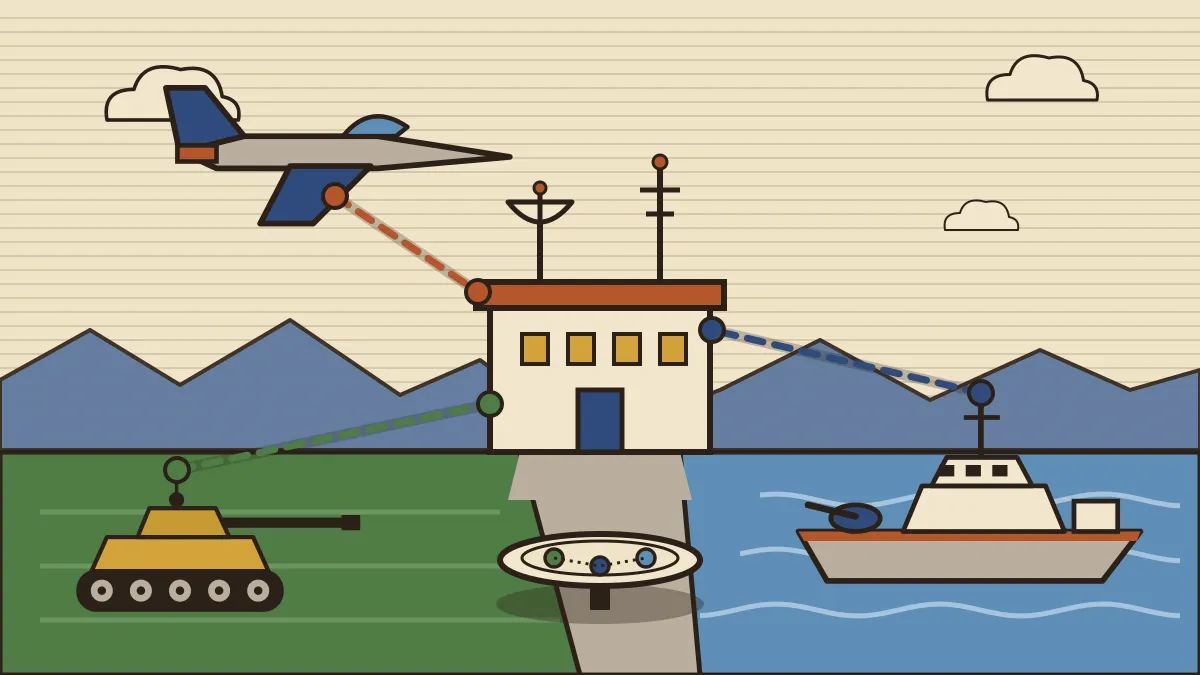
The three Service Chiefs are the Raksha Mantri's advisers on their own service. The CDS advises on tri-service matters and commands none of them. Counting the 7 Army, 3 Navy and 7 Air Force commands gives 17 single-service commands; the two in the diagram are the only tri-service ones. The Coast Guard is an armed force of the Union too, but sits under the Ministry rather than the Chiefs of Staff Committee.
The President, the Cabinet and Parliament
Article 53(2) says the "supreme command of the Defence Forces of the Union shall be vested in the President", and that its exercise "shall be regulated by law". The same Article's clause (3)(b) lets Parliament give functions to other authorities by law. In practice the President acts on the aid and advice of the Council of Ministers under Article 74, so command is real in law and ceremonial in daily practice. Officers' commissions, the President's Colours and the Republic Day salute all flow from this office.
The Cabinet Committee on Security is where the executive decides. It is chaired by the Prime Minister and its core members are the ministers of Defence, Home, Finance and External Affairs. It took the decision on 24 December 2019 to create the post of CDS, which PIB's factsheet records as a CCS decision (the release of the same day described it as a Cabinet approval). Major defence purchases and the structure of the forces are the kind of matter that reaches it.
| Parliament's role | How it works |
|---|---|
| Makes the law | Defence is in the Union List, so only Parliament legislates on it (Article 246). The Army Act 1950, Navy Act 1957, Air Force Act 1950 and Coast Guard Act 1978 are its work |
| Votes the money | The Lok Sabha votes the Demands for Grants of the Ministry of Defence under Article 113; defence expenditure is not "charged", so it can be debated and voted |
| Scrutinises | Questions, debates and the Standing Committee on Defence (31 members: 21 from the Lok Sabha, 10 from the Rajya Sabha) |
| Approves an Emergency | Under Article 352 the President may proclaim an Emergency for war, external aggression or armed rebellion, but only on the Cabinet's written recommendation, and both Houses must approve within one month |
| Limits rights in the forces | Article 33 (below) |
Article 352 originally allowed an Emergency for "internal disturbance". The 44th Amendment (1978) replaced it with armed rebellion, which is why "internal disturbance" is the odd option in CDS 2021-II (Q92 below). Article 355 separately makes it the Union's duty to protect every State against external aggression and internal disturbance.
The Ministry of Defence and Its Five Departments
The Ministry of Defence is headed politically by the Raksha Mantri, Shri Rajnath Singh, with Shri Sanjay Seth as Raksha Rajya Mantri. Its senior civil servant is the Defence Secretary, Shri Rajesh Kumar Singh, who heads the Department of Defence and coordinates the other four. The Ministry's work is divided under the Allocation of Business Rules made under Article 77(3).
| Department | Head | Core work |
|---|---|---|
| Defence (DoD) | Defence Secretary | Defence policy and planning, coordination, defence cooperation with other countries; also matters outside the DMA list such as the Coast Guard and the NCC |
| Military Affairs (DMA), 2019 | CDS, as Secretary | The three Services, the Integrated Headquarters, the Territorial Army, works for the Services, procurement exclusive to the Services (capital acquisitions excepted), jointness in training and staffing, restructuring of commands |
| Defence Production (DDP) | Secretary (Defence Production) | Defence public sector undertakings, the corporatised ordnance factories, indigenisation |
| Defence R&D (DR&D), 1980 | Secretary, DR&D | Runs DRDO; weapons and technology development |
| Ex-Servicemen Welfare (DESW), 2004 | Secretary, DESW | Resettlement, pensions and welfare of veterans |
Three bodies are easy to confuse. The CCS is chaired by the Prime Minister. The Defence Acquisition Council, the Ministry's apex body for buying equipment, is chaired by the Raksha Mantri. The Defence Planning Committee, set up in April 2018, is chaired by the National Security Adviser. The Ministry's own page has its own detailed treatment.
The CDS, the DMA and the Chiefs of Staff Committee
The Kargil Review Committee (1999, chaired by K. Subrahmanyam) found the gap between the Ministry and Service Headquarters too wide. A Group of Ministers in 2001 recommended a Chief of Defence Staff. The Prime Minister announced the post on 15 August 2019, and the CCS approved it on 24 December 2019. General Bipin Rawat was named the first CDS on 31 December 2019 and took office on 1 January 2020. The present holder is Gen N S Raja Subramani, the third CDS, in office since 31 May 2026.
The CDS wears three hats: Permanent Chairman of the Chiefs of Staff Committee, Secretary of the Department of Military Affairs, and principal military adviser to the Raksha Mantri on tri-service matters. He is first among equals: no command over the three Service Chiefs. The CCS release of December 2019 says he administers tri-services organisations, with the tri-service cyber and space agencies placed under his command, and that he is military adviser to the Nuclear Command Authority. The full story is on the CDS page.
The Chiefs of Staff Committee (COSC) brings together the CDS (chair) and the three Chiefs: Gen Dhiraj Seth, Adm Krishna Swaminathan and ACM Ashutosh Dixit. Before the CDS, the chair passed by rotation to the longest-serving Chief, an arrangement that left it with little power. That post of Chairman, COSC was folded into the CDS's when the first CDS was appointed in December 2019.
HQ Integrated Defence Staff, set up on 1 October 2001, is the secretariat. It is headed by the Chief of Integrated Defence Staff (CISC), a three-star officer, currently Air Mshl Tejinder Singh. It was built for a CDS who did not yet exist, which is why it took the CISC title; read more at HQ IDS. PIB's factsheet lists joint logistic nodes at Mumbai, Guwahati and Port Blair and several joint doctrines among the first results of the DMA era.
- 31 May 2026: a new CDS took charge, the third since the post was created.
- 1 Jul 2026: a new CISC took over at HQ IDS.
- 1 Oct 2026: HQ IDS marked 25 years; see our report 25 Years of an Organisation Built Because Kargil Went Wrong.
Tri-Service Commands and Theatre Plans
Two commands draw their staff from all three services. The Andaman and Nicobar Command (2001, Port Blair) is the only tri-service geographic command, led by Vice Adm Vineet McCarty; see its page and our report on the command. The Strategic Forces Command (2003) is a functional tri-service command that manages the nuclear arsenal as the military arm of the Nuclear Command Authority (its Executive Council is chaired by the National Security Adviser, and the CDS is the NCA's military adviser), under Lt Gen Dinesh Singh Rana; see SFC.
Theatre commands are the next integration step: one commander for all land, sea and air forces in a geographic theatre. The DMA's charter includes facilitating the restructuring of commands for jointness. As of 7 November 2026 the Government has not officially announced the creation of any theatre command. Press reports in April and July 2026 said the CDS had sent a proposal to the Raksha Mantri that still needed Cabinet Committee on Security approval, and in October 2026 the Defence Secretary was reported as saying the plan awaits a decision at the highest level. Treat any specific number or location as unconfirmed until the Government announces it. Single-service HQ lists stay on each service's pages, such as the Army and Navy hubs; the integration debate is on theatre commands.
Article 33 and Defence in the Union List
Article 33 sits in Part III, the Fundamental Rights chapter itself. It lets Parliament, by law, decide how far the rights in that Part apply to four groups, so as to ensure the proper discharge of duties and the maintenance of discipline:
- members of the Armed Forces;
- forces charged with the maintenance of public order;
- persons employed in intelligence or counter-intelligence bodies set up by the State;
- persons employed in telecommunication systems set up for such forces or bodies.
The Army Act 1950, Navy Act 1957 and Air Force Act 1950 are the main examples. The Army Act restricts, for instance, joining associations and communicating with the press. In Prithi Pal Singh Bedi (1982) the Supreme Court held that Parliament need not name each right it restricts. Do not confuse it with Article 34, which deals with restriction of rights while martial law is in force. Our study notes on Fundamental Rights and Emergency Provisions cover the wider chapters.
Defence also fills the top of the Union List (List I, Seventh Schedule):
| Entry | Subject |
|---|---|
| 1 | Defence of India and every part thereof, including preparation for defence and demobilisation after war |
| 2 | Naval, military and air forces; any other armed forces of the Union |
| 2A | Deployment of Union armed forces in a State in aid of the civil power (inserted by the 42nd Amendment, 1976) |
| 3 | Delimitation of cantonment areas and their local self-government and housing control |
| 4 | Naval, military and air force works |
| 5 | Arms, firearms, ammunition and explosives |
| 6 | Atomic energy and the minerals needed for it |
| 7 | Industries declared by Parliament necessary for defence or the prosecution of war |
| 9 | Preventive detention for reasons connected with defence, foreign affairs or the security of India |
"Public order" is a State subject, but the 42nd Amendment excluded from it the use of Union armed forces in aid of the civil power, so Parliament alone legislates on that deployment.
Guided Tour: Every Page in the Tri-Services Section
Read in this order if you are starting from zero.
| Page | What it covers |
|---|---|
| Chief of Defence Staff | The Kargil-to-2019 story, the CDS's role and limits, the list of CDSs and the age and appointment rules |
| Theatre Commands | Why integration matters, the 17 single-service commands versus the 2 tri-service ones, the proposals and a dated status tracker |
| Integrated Defence Staff | HQ IDS (2001), the CISC, the agencies under it and the Defence Intelligence Agency |
| Andaman and Nicobar Command | India's first tri-service command: 2001, Port Blair, the rotating C-in-C and the exam traps around it |
| Strategic Forces Command | Raised 2003; the Nuclear Command Authority, custody of the arsenal and the triad's delivery systems |
| Ministry of Defence | The Raksha Mantri, the five departments, the Defence Acquisition Council, the Defence Secretary and the constitutional base |
| Tri-Service Agencies | Defence Cyber Agency, Defence Space Agency, AFSOD and joint institutions such as the AFMS |
The services themselves have their own sections: Indian Army, Indian Navy, Indian Air Force and Indian Coast Guard. For how their ranks line up, read rank equivalence.
Exam pins
- Supreme Commander: the President, under Article 53(2); the Prime Minister and Raksha Mantri do not hold supreme command.
- Cabinet Committee on Security: chaired by the Prime Minister; it approved the CDS post on 24 December 2019.
- CDS: four-star General; Permanent Chairman of the COSC; Secretary of the DMA; no command over the Service Chiefs.
- First CDS: General Bipin Rawat, from 1 January 2020 (named 31 December 2019).
- COSC members: CDS (chair), COAS, CNS, CAS. Before 2019 the senior-most Chief chaired it by rotation.
- Ministry of Defence: five departments: Defence, Military Affairs (2019), Defence Production, Defence R&D (1980), Ex-Servicemen Welfare (2004).
- HQ IDS: established 1 October 2001; headed by the CISC, a three-star officer.
- Two tri-service commands: Andaman and Nicobar (2001) and Strategic Forces (2003).
- Article 33 restricts Fundamental Rights of the forces by an Act of Parliament; Article 34 is martial law.
- Union List: Entry 1 is defence, Entry 2 is the armed forces, Entry 2A is deployment in aid of civil power (42nd Amendment).
- Defence Planning Committee (2018): chaired by the NSA. Defence Acquisition Council: chaired by the Raksha Mantri.
Asked in past papers
Questions here are either constitutional or about who heads what. Both kinds reward exact wording.
Consider the following statements about the position of the Chief of Defence Staff: 1. He is the Head of the Department of Military Affairs within the Ministry of Defence. 2. He is the Permanent Chairman of the Chiefs of Staff Committee. 3. He does not exercise any military command over the three Service Chiefs.
(a) 1 only (b) 2 and 3 only (c) 1 and 3 only (d) 1, 2 and 3
Answer: (d). All three statements are true: the CDS is Secretary of the DMA, Permanent Chairman of the COSC and first among equals with no command over the Chiefs. Each wrong option drops at least one true statement; statement 3 is the one students doubt, because "chairman" sounds like "commander". Check each statement on its own.
Which of the following are administered under the Ministry of Defence, Government of India? 1. Territorial Army 2. Hydrographic surveys and preparation of navigational charts 3. National Cadet Corps 4. All matters relating to Coast Guard Organization
(a) 1, 2, 3 and 4 (b) 1, 3 and 4 only (c) 2 and 4 only (d) 1 and 3 only
Answer: (a). All four sit in the Ministry's allocation of business. Candidates drop the hydrographic and Coast Guard items because they are not Army matters, but the Ministry covers more than the three Services.
Which one of the following is not a circumstance for proclamation of Emergency by the President of India under Article 352 of the Constitution of India?
(a) War (b) External aggression (c) Internal disturbance (d) Armed rebellion
Answer: (c). The 44th Amendment replaced "internal disturbance" with "armed rebellion". Option (d) is the tempting wrong choice for those who remember only the old wording.
Who is the Chairman of the Defence Planning Committee set up in April 2018?
(a) The Prime Minister (b) The National Security Advisor (c) The Defence Minister (d) The Chief of the Army Staff
Answer: (b). The DPC is chaired by the National Security Adviser. The Raksha Mantri chairs the Defence Acquisition Council, not this body.
Which one among the following statements about the Department of Defence (DoD) is not correct? (a) It is headed by the Defence Secretary. (b) It deals with defence policy and planning. (c) It facilitates the restructuring of military commands for optimal utilization of resources. (d) It is responsible for defence cooperation with foreign countries.
Answer: (c). Restructuring commands for jointness is the DMA's task. The other three describe the Department of Defence.
Questions test who heads what and which Article does what. An old paper shows why you must learn the post-2019 position: CAPF 2015 asked who functions as Chairman, COSC, with "the longest serving Chief" among the options, which was right then and is wrong now. Practise on the CDS and NDA past-paper pages, and keep our daily defence notes open.
Practice MCQs (with answers)
- The supreme command of the Defence Forces of the Union is vested in the President by
- Article 53(2)
- Article 52
- Article 74
- Article 75
- Parliament may restrict the Fundamental Rights of members of the armed forces under
- Article 32
- Article 33
- Article 34
- Article 35
- The Chief of Defence Staff is the Secretary of the
- Department of Defence
- Department of Defence Production
- Department of Defence Research and Development
- Department of Military Affairs
- Which of the following is not a member of the Chiefs of Staff Committee?
- Chief of the Army Staff
- Chief of the Naval Staff
- Director General, Indian Coast Guard
- Chief of the Air Staff
- "Naval, military and air forces; any other armed forces of the Union" is which entry of the Union List?
- Entry 1
- Entry 2
- Entry 4
- Entry 9
- The Defence Acquisition Council is chaired by the
- Prime Minister
- National Security Adviser
- Raksha Mantri
- Chief of Defence Staff
1-a, 2-b, 3-d, 4-c, 5-b, 6-c. Q1: Article 74 is the Council of Ministers' aid and advice, not the command provision. Q2: Article 34 is about martial law, the usual trap. Q4: the Coast Guard Director General is not on the COSC; the Coast Guard works under the Ministry. Q5: Entry 1 is defence of India as a whole, Entry 4 is military works. Q6: the DPC, not the DAC, is chaired by the NSA.
Where to Go Next
For the career side, read career in the Indian Army, and for the interview, our GD guide, where theatre commands and jointness are standard topics. The polity background is in our study notes on the President and Union Executive and the Schedules of the Constitution. Graduates reach officer training through the CDS course; Class 12 candidates through the NDA batches, which pair weekly tests with SSB training. See also our report on the joint-services course run by HQ IDS.
Frequently asked questions
Who is the Supreme Commander of the Indian Armed Forces?
The President of India is the Supreme Commander, under Article 53(2) of the Constitution. The exercise of that command is to be regulated by law, and in practice the President acts on the advice of the Council of Ministers. The Prime Minister and the Raksha Mantri do not hold supreme command.
What is the difference between the CDS and the Service Chiefs?
The CDS is the Permanent Chairman of the Chiefs of Staff Committee, Secretary of the Department of Military Affairs and the Raksha Mantri's principal military adviser on tri-service matters. He has no command over the three Service Chiefs, each of whom commands his own service. The CDS is first among equals and focuses on jointness.
Who chairs the Chiefs of Staff Committee?
The Chief of Defence Staff is its Permanent Chairman. The other members are the Chiefs of the Army, Navy and Air Staff. Before the CDS post was created in December 2019, the senior-most Chief chaired the committee by rotation.
What is Article 33 of the Indian Constitution?
Article 33 lets Parliament, by law, decide how far Fundamental Rights apply to members of the armed forces, forces charged with maintaining public order, and intelligence bodies. The aim is to ensure the proper discharge of duties and discipline. The Army Act 1950, Navy Act 1957 and Air Force Act 1950 are the main examples.
How many departments does the Ministry of Defence have?
The Ministry of Defence has five departments: Defence, Military Affairs, Defence Production, Defence Research and Development, and Ex-Servicemen Welfare. The Department of Military Affairs was added in 2019 and is headed by the CDS. The Defence Secretary heads the Department of Defence and coordinates the rest.
More in Defence GK
Sources: pib.gov.in/FactsheetDetails.aspx?Id=148566 · mod.gov.in/department-military-affairs-0/proactive-disclosures_ · legislative.gov.in/constitution-of-india · pib.gov.in/PressReleasePage.aspx?PRID=2267339
Preparing for CDS or OTA?
Cavalier's CDS/OTA batches teach the whole GK paper, defence awareness included, with PYQ drills, weekly tests and SSB training.