By Col Manoj Batra (Retd) · SSB faculty, The Cavalier · Senior GTO (retd), 20 SSB
An Army officer is expected to know the kit his arm fights with, and a defence GK paper asks the same from the other side: which gun is Indian, which tank is Russian, who builds which rifle. This page sorts the Army's weapons into eight families, gives one to three headline examples for each, and says plainly whether each is indigenous, licence-built in India or imported.
It then tells the indigenisation story with dates and numbers from PIB. This is the front door to the weapons pages of our Indian Army section. Only publicly released information is used: no unit holdings, no locations.
The Eight Weapon Families
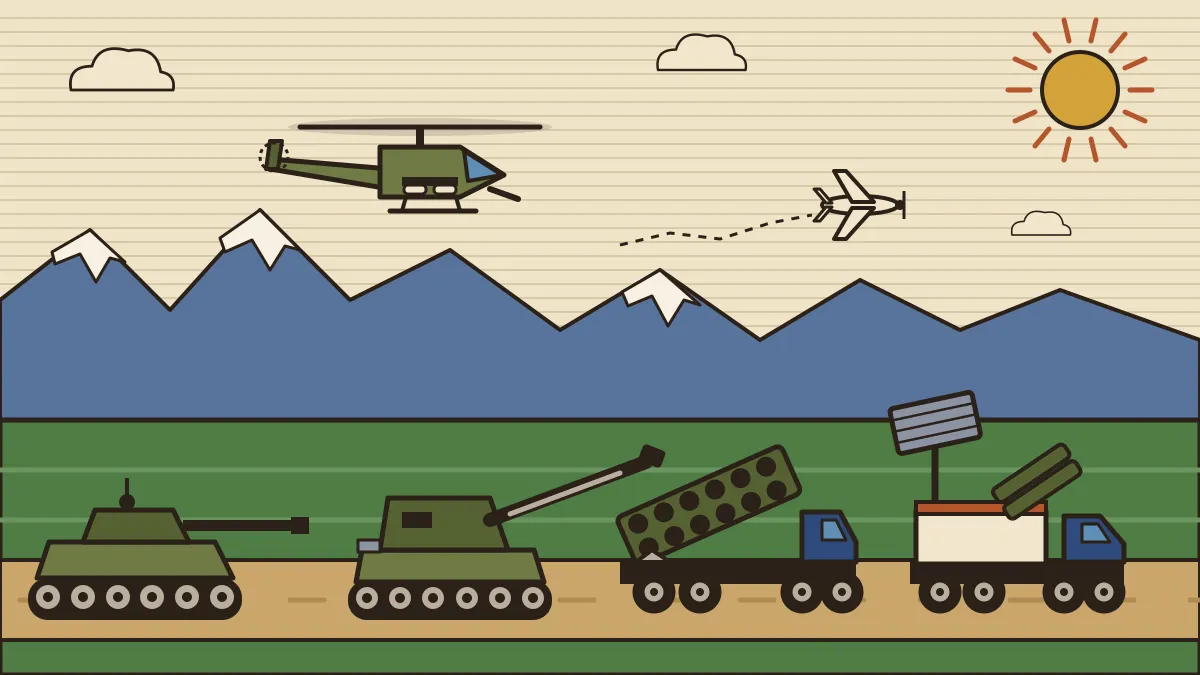
The Army's weapons fall into tanks and infantry combat vehicles, artillery guns, rockets, air defence, infantry small arms, helicopters, drones and loitering munitions, and surveillance and locating systems. The picture shows six of them, from armour on the left to the helicopter and drone above. The arms that use them are on the combat arms page.
Armour and Artillery: Headline Systems
Tanks and infantry combat vehicles. The fleet is built around the Russian-pattern T-90 and T-72, with the Arjun as the Indian-designed tank.
| System | Type | Origin and maker | Status |
|---|---|---|---|
| Arjun Mk-1 / Mk-1A | Main battle tank | DRDO (CVRDE) design; built at Heavy Vehicles Factory (HVF), Avadi | Indigenous. PIB records 72 new features in Mk-1A; 118 ordered 23 Sep 2021 (about ₹7,523 crore) |
| T-90S "Bhishma" | Main battle tank | Russian design; built under licence at HVF Avadi | Licence-built |
| T-72 "Ajeya" | Main battle tank | Soviet design; built under licence at Avadi | Licence-built; a 1000 hp engine was on the second Positive Indigenisation List |
| Zorawar | Light tank | DRDO design with industry | Indigenous design, still in trials as of late 2025 (press reports) |
| BMP-2 "Sarath" | Infantry combat vehicle | Soviet design; built under licence (Ordnance Factory Medak, now AVNL) | Licence-built |
Artillery. In a name like "155 mm/52 cal", 155 mm is the bore and 52 cal is the barrel length as a multiple of it. A longer barrel gives longer range, so the move from 39 to 45 to 52 calibre is the story of the Army's gun modernisation.
| System | Type | Origin and maker | Status |
|---|---|---|---|
| Dhanush | Towed 155 mm/45 cal | Gun Carriage Factory, Jabalpur (AWEIL), from Bofors drawings | Made in India from an imported design; 114 ordered (press reports); DAC cleared the Dhanush Gun System again in Mar 2026 |
| ATAGS | Towed 155 mm/52 cal | DRDO's ARDE, Pune; built by Bharat Forge (Tata builds the towing vehicles) | Indigenous. About ₹6,900 crore of contracts, 26 Mar 2025: Bharat Forge for the guns, Tata Advanced Systems for the towing vehicles (PIB) |
| K9 Vajra-T | Self-propelled 155 mm/52 cal | South Korean K9 design; built by L&T at Hazira | Licence-built. ₹7,628.70 crore contract, 20 Dec 2024 |
| M777 | Towed ultra-light 155 mm | BAE Systems, United States | Imported |
| Pinaka | Multi-barrel rocket launcher | DRDO (ARDE with HEMRL) | Indigenous. First tranche of guided rockets for Armenia flagged off 18 Jan 2026 |
- 29 Dec 2025: DRDO flight-tested the Pinaka Long Range Guided Rocket (LRGR) to its maximum range of 120 km.
- 27 Mar 2026: the Defence Acquisition Council cleared the Dhanush Gun System, an Air Defence Tracked System and a Runway Independent Aerial Surveillance System for the Army.
- 8 Jul 2026: the LRGR was tested at Chandipur for a minimum range of 60 km from the in-service launcher; see our Pinaka LRGR explainer.
Gun-by-gun detail is on artillery guns, and tank generations on main battle tanks.
Air Defence, Small Arms and Army Aviation
Air defence. Older guns such as the Bofors L-70 and the upgraded Schilka (PIB lists the Schilka among the Army Day 2026 displays) now stand beside DRDO missiles and Akashteer, an indigenous control system that fuses the air picture. The Air Force's own layers are on IAF air defence.
| System | Type | Origin and maker | Status |
|---|---|---|---|
| Akash / Akash Prime | Surface-to-air missile system | DRDO design; missiles by Bharat Dynamics | Indigenous. Improved Akash for two more Army Air Defence regiments, March 2023 (82% indigenous content, to 93% by 2026-27). Akash Prime, customised for above 4,500 m, destroyed two high-speed drone targets in Ladakh, 16 Jul 2025 |
| MRSAM | Medium-range surface-to-air missile | Developed with Israel; built in India | Co-developed |
| L-70 / Schilka | Anti-aircraft guns | Swedish Bofors design; Soviet ZSU-23-4 | Imported designs, upgraded |
Older books call Akash medium-range. PIB's 2023 release calls it a Short Range Surface-to-Air Missile (SRSAM) system, and UPSC follows official wording.
Infantry small arms. The Army is moving on from the 5.56 mm INSAS; detail is on infantry weapons.
| System | Type | Origin and maker | Status |
|---|---|---|---|
| INSAS | 5.56 mm rifle and LMG | Developed by DRDO's ARDE; made by the ordnance factories | Indigenous, but ageing; a 2025 PIB release calls it inadequate for modern combat |
| AK-203 | Assault rifle | Indo-Russian Rifles Pvt Ltd (IRRPL), Korwa, Amethi | Made in India by a joint venture. 6,01,427 rifles contracted 6 Dec 2021 |
| Ugram | 7.62 mm assault rifle | DRDO's ARDE with an Indian private firm | Indigenous design |
Army Aviation. The Army flies its own helicopters; Army Aviation explains why.
| System | Type | Origin and maker | Status |
|---|---|---|---|
| Dhruv ALH / Rudra | Utility helicopter; Rudra is the armed version | HAL, Bengaluru | Indigenous |
| LCH Prachand | Light combat (attack) helicopter | HAL, Bengaluru | Indigenous. 156 ordered 28 Mar 2025 for ₹62,700 crore: 90 for the Army, 66 for the IAF. Works above 5,000 m; over 65% indigenous content planned |
| AH-64E Apache | Attack helicopter | Boeing, United States | Imported. Six ordered Feb 2020; press reports say all six had arrived by December 2025 |
Drones, Loitering Munitions and Surveillance
This is the fastest-moving family. A loitering munition is a drone with a warhead that circles over an area and dives onto a target it has picked, so it sits between a missile and a surveillance drone. PIB records:
- Artillery gets its own drones. On 14 August 2026 the Ministry signed contracts of about ₹1,577 crore with Tata Advanced Systems and NIBE for Loiter Munition Systems for Artillery Regiments, under Buy (Indian) through the Fast Track Procedure. Our explainer on the contract shows how it changes the gunner's job.
- New units. PIB names Rudra Brigades, Divyastra Batteries and Bhairav Battalions as new force multipliers. The 2026 Republic Day parade showed Shaktibaan and Divyastra, the new unmanned-warhead systems, and counter-drone gear such as the Prabal system and the Corps of EME's Drone Shakti lorry.
| System | Type | Origin and maker | Status |
|---|---|---|---|
| Nagastra | Loitering munition | Solar Defence and Aerospace, Nagpur | Indigenous |
| Heron | Medium-altitude surveillance drone | Israel Aerospace Industries | Imported |
| Swathi (Plains) | Weapon-locating radar | DRDO design; Bharat Electronics | Indigenous. 12 contracted 30 Mar 2023 |
A weapon-locating radar like Swathi tracks an incoming shell or rocket back to its source, so the gunners know where to reply. Surveillance also covers battlefield radars and the aerial surveillance system cleared in March 2026.
The Indigenisation Picture: Positive Lists, DAP and Production
The tables above are mixed: some systems are wholly Indian, some are foreign designs built here, a few are still bought abroad. PIB's account is that the first group is growing and that policy now pushes every new purchase towards it.
1. Positive Indigenisation Lists. Items on them will, after a stated date, be bought only from Indian industry. Two departments issue them, and the difference is a common trap.
| Issued by | For whom | What PIB records |
|---|---|---|
| Department of Military Affairs (DMA) | The three Services: weapons, platforms, systems | First list 21 Aug 2020 (101 items); second 31 May 2021 (108). Four lists covered 411 items; the fifth (98, 4 Oct 2023) made 509 |
| Department of Defence Production (DDP) | Defence PSUs: spares, sub-systems, components | Third list Aug 2022 (780 items), fourth May 2023 (928), fifth Jul 2024 (346). The first four held 4,666 items, 2,972 indigenised by Jul 2024. The sixth, 18 Aug 2026, has 405 items worth about ₹3,070 crore, including parts for T-72, T-90 and BMP-II |
A PIB factsheet of August 2026 counts 10 lists (five each), covering 5,521 items, up to May 2026. Our explainer on the sixth list shows why it works as an import ban in effect.
2. Defence Acquisition Procedure. DAP 2020 ranks purchase routes, with Buy (Indian-IDDM), meaning Indigenously Designed, Developed and Manufactured, on top at a minimum 50% indigenous content. The draft DAP 2026 (February 2026) proposes simpler acquisition categories and indigenous content requirements of up to 60%, as PIB puts it. K9 Vajra-T, a licence-built gun, was bought under plain Buy (Indian), so the label matters.
3. Production and exports, from PIB:
| Measure | Figure | As of |
|---|---|---|
| Defence production | ₹1.78 lakh crore, up 15.6% on ₹1.54 lakh crore; ₹43,746 crore in FY 2013-14 (indigenous production, PIB). About 76% public sector, 24% private | FY 2025-26 |
| Defence exports | ₹38,424 crore, up from ₹23,622 crore; ₹686 crore in 2013-14; over 80 countries. DPSUs 54.84%, private 45.16% | FY 2025-26 |
| Government target | ₹3 lakh crore production, ₹50,000 crore exports | By 2029 |
| Army ammunition | 159 of 175 variants (about 91%) indigenised | Army, 2025 |
The 2024-25 production figure is ₹1,50,590 crore in PIB's August 2025 release (provisional) and ₹1.54 lakh crore in June 2026 (revised); use the latest. PIB also gives item-level shares (82% for improved Akash, over 65% for Prachand, about 91% for ammunition) rather than one figure for all Army equipment, so be wary of a quoted "70% indigenous". UPSC follows official figures.
4. Joint ventures and industry reform. The Ordnance Factory Board was split into seven companies in 2021; AVNL (armoured vehicles, at Avadi and Medak) and AWEIL (guns and rifles, at Jabalpur, Kanpur and Korwa) are two of them. Indo-Russian Rifles Pvt Ltd makes the AK-203: the Indian side (AWEIL and Munitions India) holds 50.5%, Russia's Rosoboronexport and Concern Kalashnikov 49.5%. FDI is allowed up to 74% automatically and 100% with approval. The DPSU map is on defence PSUs, the research side on DRDO, and the policy story on indigenisation and exports.
- 2 Apr 2026: PIB reports record defence exports of ₹38,424 crore for FY 2025-26.
- 17 Jun 2026: record production of ₹1.78 lakh crore; our production explainer unpacks it.
- 18 Aug 2026: the sixth Positive Indigenisation List (405 items) is notified.
A Note on Missiles
The Army also fires missiles: BrahMos, Akash, Nag and Pinaka's guided rockets. How they work and how ranges are classed belongs to the missile section: missiles of India, anti-tank missiles and BrahMos. Warship equivalents of this page begin at surface ships, and the combined view is on tri-services.
Guided Tour: Pages in the Weapon Systems Section
| Page | What it covers |
|---|---|
| Main Battle Tanks | Arjun, T-90 Bhishma, T-72 Ajeya, the Zorawar light tank and future-tank plans |
| Artillery Guns | Bofors, Dhanush, ATAGS, K9 Vajra, M777, Pinaka and Sharang, and the School of Artillery at Deolali |
| Infantry Weapons | INSAS, AK-203 and Korwa, the SIG 716, carbines, sniper rifles and unit-level anti-tank missiles |
| Army Aviation | The Army Aviation Corps, Rudra, Prachand, Apache, Dhruv and Cheetah, and why the Army has its own aviation |
The wider ecosystem is on defence organisations and the money behind it on the defence budget. Our daily defence notes track new contracts as they are signed.
Exam pins
- Arjun: DRDO (CVRDE) design, built at HVF Avadi. T-90 Bhishma and T-72 Ajeya are Russian designs built under licence at Avadi.
- Dhanush: Bofors-based 155 mm/45 cal, Gun Carriage Factory Jabalpur. ATAGS: DRDO's 155 mm/52 cal gun; contracts of 26 Mar 2025 to Bharat Forge (guns) and Tata Advanced Systems (towing vehicles).
- K9 Vajra-T: South Korean design, built by L&T at Hazira; self-propelled; contract of 20 Dec 2024.
- Pinaka: DRDO rocket launcher; LRGR tested at 120 km maximum (Dec 2025) and 60 km minimum (Jul 2026).
- AK-203: Indo-Russian Rifles Pvt Ltd, Korwa, Amethi; 6,01,427 rifles; Indian share 50.5%.
- Prachand (HAL): 156 ordered, 90 Army and 66 IAF, ₹62,700 crore; Rudra is the armed Dhruv.
- Akash: short-range SAM in PIB wording; Akashteer is the air defence control system.
- DMA lists are for the Services (509 items, five lists); DDP lists are for DPSUs. First list 21 Aug 2020; sixth DDP list 18 Aug 2026.
- Buy (Indian-IDDM) tops DAP 2020 (50% indigenous content); draft DAP 2026 proposes up to 60%.
- FY 2025-26: production ₹1.78 lakh crore, exports ₹38,424 crore; 2029 targets ₹3 lakh crore and ₹50,000 crore.
Asked in past papers
Weapon questions are mostly matching: system to type, or system to maker.
Which one of the following manufacturers is engaged in upgradation of the Swedish 155-mm Bofors Howitzer under the project 'Dhanush'?
(a) Bharat Electronics Limited (b) Ordnance Factory Board (c) Bharat Dynamics Limited (d) Mishra Dhatu Nigam
Answer: (b). Dhanush came from the ordnance factories, which the Board then ran. BEL, BDL and Mishra Dhatu Nigam are real defence companies, which is why they tempt.
India's first private sector Howitzer gun-making unit is located at
(a) Surat (b) Kolkata (c) Hazira (d) Sahibabad
Answer: (c). L&T's plant at Hazira, Gujarat, builds the K9 Vajra-T. Surat is next door, which is the trap.
Recently India signed a contract for the manufacture of nearly 6 lakh AK-203 rifles with which one of the following countries?
(a) Canada (b) Russia (c) France (d) Israel
Answer: (b). The 6,01,427-rifle contract of 6 December 2021 is with the India-Russia joint venture at Korwa.
The Defence Research & Development Organisation (DRDO) recently conducted a successful flight-test of the Pinaka Long Range Guided Rocket (LRGR). The rocket was tested for a user-defined minimum range of
(a) 30 km (b) 40 km (c) 50 km (d) 60 km
Answer: (d). PIB's note on the 8 July 2026 test gives a minimum of 60 km. The December 2025 test, of the maximum range, was 120 km.
Learn each system as a triple: type, maker, origin. UPSC asks whether a weapon is a gun, rocket, missile or drone, and whether India designed it or only built it. Newest-test questions are won from our daily defence notes; practise older ones on the NDA and CDS past-paper pages.
Practice MCQs (with answers)
- The K9 Vajra-T self-propelled gun is built in India by
- Hindustan Aeronautics Limited
- Larsen & Toubro, at Hazira
- BEML Limited
- Gun Carriage Factory, Jabalpur
- In the description "155 mm/52 cal", the "52 cal" refers to
- the maximum range in kilometres
- the number of rounds the gun carries
- the barrel length as a multiple of the bore
- the weight of the shell in kilograms
- The Positive Indigenisation Lists of the Department of Military Affairs cover
- items the armed forces will buy only from Indian industry after a stated timeline
- foreign firms cleared to sell to the Army
- items that may be exported
- defence companies to be privatised
- The AK-203 rifles for the Indian Army are produced at Korwa by
- Hindustan Aeronautics Limited
- DRDO
- Bharat Electronics Limited
- Indo-Russian Rifles Private Limited
- Which of the following is NOT a wholly Indian design?
- Pinaka
- Arjun
- K9 Vajra-T
- ATAGS
- PIB describes the Akash weapon system as
- a ballistic missile for strategic use
- a short-range surface-to-air missile system designed by DRDO
- an anti-tank missile fired from helicopters
- a loitering munition
1-b, 2-c, 3-a, 4-d, 5-c, 6-b. Q1: Gun Carriage Factory makes Dhanush, not K9. Q2: a longer barrel usually means a longer range. Q5 is the trick: K9 Vajra-T is a South Korean design built under licence; the other three are DRDO designs. Q6: older books say medium range, PIB says short-range.
Where to Go Next
For the career side, read career in the Indian Army. Boards ask "know your service" and the weapons of your arm, so read our SSB interview tips and the lecturette topics: indigenisation and drone warfare are standard group-discussion subjects. Study with the NDA study material and CDS/OTA study material, then see wars and operations for where these weapons were used. Our NDA coaching batches cover defence GK with weekly tests and SSB training, and the CDS course does the same for graduates.
Frequently asked questions
Which tank does the Indian Army use?
The Army's main battle tanks are the Russian-designed T-90S Bhishma and T-72 Ajeya, both built under licence at Heavy Vehicles Factory, Avadi, and the Indian-designed Arjun. A DRDO light tank, Zorawar, was still in trials and not yet in service as of late 2025, according to press reports.
Is the Dhanush gun indigenous?
Dhanush is made in India at Gun Carriage Factory, Jabalpur, but it is based on the drawings of the Swedish Bofors 155 mm gun. It is a 155 mm/45 calibre towed gun. The ATAGS, designed by DRDO, is the fully indigenous 155 mm/52 calibre gun that the Army contracted for in March 2025.
What is the difference between ATAGS and K9 Vajra?
ATAGS is a towed gun designed by DRDO; the March 2025 contracts went to Bharat Forge for the guns and Tata Advanced Systems for the towing vehicles, so it is Indian in design. K9 Vajra-T is a self-propelled tracked gun, a South Korean design built under licence by L&T at Hazira. Both are 155 mm/52 calibre.
What is a Positive Indigenisation List?
It is a list of defence items that, after a set date, will be bought only from Indian industry. The Department of Military Affairs issues lists for the Services (five lists, 509 items) and the Department of Defence Production for defence PSUs (the sixth, with 405 items, came on 18 August 2026). In effect they work as an import ban.
How much defence equipment does India export?
PIB reports defence exports of ₹38,424 crore in FY 2025-26, up from ₹23,622 crore the year before and ₹686 crore in 2013-14. The government's target is ₹50,000 crore by 2029. Exports reach over 80 countries, and guided Pinaka rockets for Armenia are one example.
More in Indian Army
← Back to Indian Army · Defence GK home
Sources: pib.gov.in/PressReleasePage.aspx?PRID=2299449 · pib.gov.in/PressReleasePage.aspx?PRID=2273824 · pib.gov.in/PressReleasePage.aspx?PRID=2300723 · pib.gov.in/PressReleasePage.aspx?PRID=2115365
Preparing for NDA?
Cavalier's NDA batches cover Maths and the GAT, defence GK included, with daily practice, weekly tests and SSB training on our own GTO ground.