By Col Vijayant Thakur (Retd) · Defence faculty, The Cavalier
Every examiner loves to put the services' rank names side by side. A Commodore is not a Major General. A Wing Commander is not a Colonel. A Sergeant in the Air Force is not a Naik. Questions like these turn up in the CDS and CAPF papers, in the general-awareness sections of the other defence exams, and in the SSB interview, where a candidate who cannot say what a Group Captain is level with loses marks on the first "know your services" question.
This page is the one place in our Defence GK library where all the services are read together: the commissioned table, the JCO, sailor and airman table, the Coast Guard and CAPF ladders, honorary and five-star ranks, entry ranks and the traps that past papers have set. Each service's own insignia are on its own page: Army, Navy, Air Force and Coast Guard.
The Full Table: Commissioned Officers
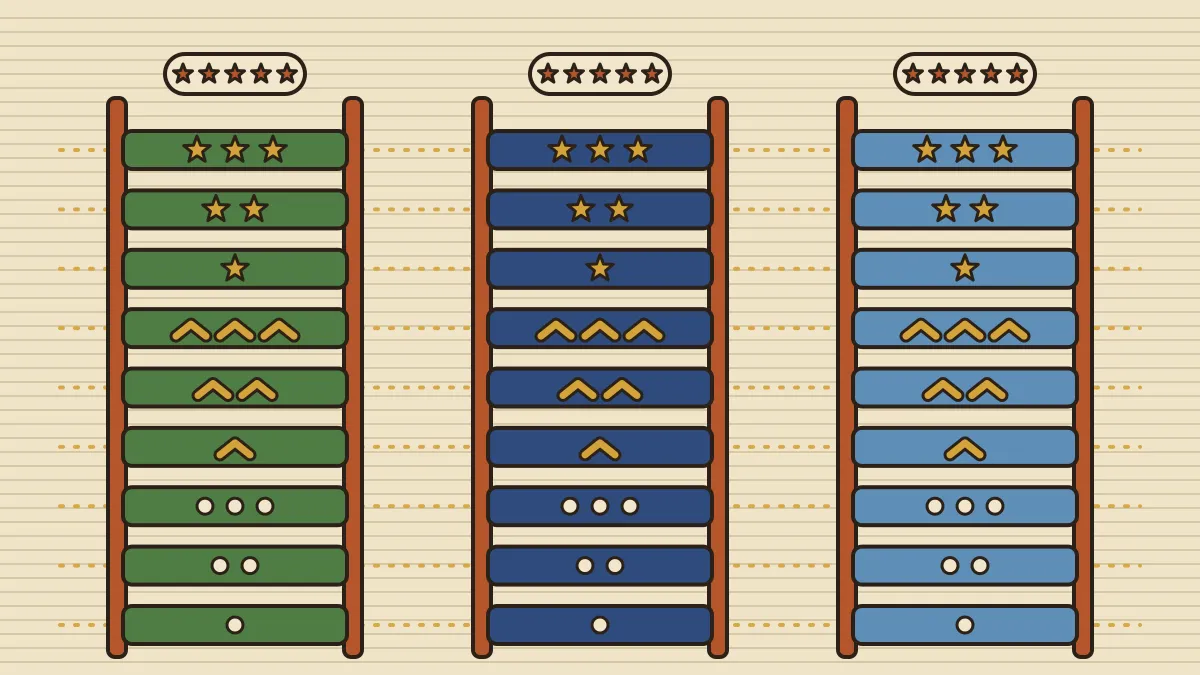
Read the table downward for seniority and across for equivalence. The pay level is the cleanest test of "equal": the Navy publishes its officer levels, and Army and Air Force officers sit on the same ones. The insignia column is the Army's own description of its shoulder badges.
| Stars | Army | Army insignia, in words | Navy | Air Force | Pay level |
|---|---|---|---|---|---|
| Five | Field Marshal | Crossed sword and baton in a lotus-flower wreath, Ashoka emblem above | Admiral of the Fleet (never conferred) | Marshal of the Indian Air Force | Ceremonial: no separate level |
| Four | General | Crossed sword and baton, one star, Ashoka emblem above | Admiral | Air Chief Marshal | 18 (the Chief) |
| Three | Lieutenant General | Crossed sword and baton, Ashoka emblem above | Vice Admiral | Air Marshal | 15 to 17 |
| Two | Major General | Crossed sword and baton, one star above | Rear Admiral | Air Vice Marshal | 14 |
| One | Brigadier | Three stars in a triangle, Ashoka emblem above | Commodore | Air Commodore | 13A |
| Senior officers | Colonel | Two stars, Ashoka emblem above | Captain | Group Captain | 13 |
| Lieutenant Colonel | One star, Ashoka emblem above | Commander | Wing Commander | 12A | |
| Major | Ashoka emblem alone | Lieutenant Commander | Squadron Leader | 11 | |
| Junior officers | Captain | Three stars in a line | Lieutenant | Flight Lieutenant | 10B |
| Lieutenant | Two stars in a line | Sub Lieutenant | Flying Officer | 10 |
Three points make the table easy to hold. The star count (one to five) is common usage, not a legal term, but it shows at a glance that Brigadier, Commodore and Air Commodore are level. The Navy and Air Force names change at every rung but the Army's do not, so learn the table by the Army column. And only the Service Chiefs (and the CDS) hold four stars: the Vice Chief and the Army Commanders are Lieutenant Generals, and the Navy's pay table lists the Vice Chief and the commanders-in-chief at Level 17, below the Chief's Level 18.
The Navy's table puts a Captain on Level 13 starting at Rs 1,30,600, while the civil Level 13, which the Coast Guard and CAPF use, starts at Rs 1,23,100. They match the armed forces by level, not always in pay. See pay at each rank.
Navy and Air Force insignia in words
In the Navy, flag officers wear shoulder boards with the national emblem on an octagon, a crossed Indian sword and telescope, and stars: two for a Rear Admiral, three for a Vice Admiral, four for an Admiral. The Navy unveiled this design in December 2023 for use from 1 January 2024; before it, the boards had the emblem on a crown-shaped red patch and a baton in place of the telescope. Lower ranks are read from gold sleeve stripes with the executive curl: one broad stripe for a Commodore, four for a Captain, three for a Commander, two with a thinner one between for a Lieutenant Commander, two for a Lieutenant, one for a Sub Lieutenant. In the Air Force, air officers wear stars on their collar patches, from one for an Air Commodore to four for the Air Chief Marshal, and junior ranks are told apart by sleeve braids. A Midshipman is not on the table: it is a Navy trainee rank, not a commission.
JCOs, Sailors and Airmen: Where Most Websites Go Wrong
Below the commissioned ranks, the three services have different structures. The Army has Junior Commissioned Officers (JCOs) and then non-commissioned ranks. The Navy calls its senior sailors Master Chief Petty Officers and Chief Petty Officers. The Air Force has Warrant Officers and then airmen. They line up as follows.
| Level | Army | Army insignia, in words | Navy | Air Force |
|---|---|---|---|---|
| JCO / senior sailor / warrant officer | Subedar Major | Ashoka emblem | Master Chief Petty Officer 1st Class | Master Warrant Officer |
| Subedar | Two stars in a line | Master Chief Petty Officer 2nd Class | Warrant Officer | |
| Naib Subedar | One star | Chief Petty Officer | Junior Warrant Officer | |
| Non-commissioned ranks | Havildar | Three chevrons | Petty Officer | Sergeant |
| Naik | Two chevrons | Leading Seaman (called Leading Rate on the Navy's site) | Corporal | |
| Lance Naik | One chevron | Seaman 1st Class | Leading Aircraftman | |
| Sepoy | No rank badge | Seaman 2nd Class | Aircraftman |
The Army's rank-badge page shows the three JCO ranks above a braid band of crimson, yellow and crimson. The Company Quartermaster Havildar, with three chevrons and the Ashoka emblem, is a Havildar's appointment and not a rank in this table.
- Cavalry and armoured regiments use older names. Subedar Major, Subedar and Naib Subedar are Risaldar Major, Risaldar and Naib Risaldar. Havildar, Naik, Lance Naik and Sepoy are Daffadar, Lance Daffadar, Acting Lance Daffadar and Sowar. Pay and status are the same.
- "Sergeant" is an Air Force airman rank. The Army has no Sergeant, and the Air Force Sergeant is level with a Havildar, not a Naik.
- "Able Seaman" is not an Indian Navy rank today. Older books say Leading Seaman where the Navy's site now says Leading Rate: the same step.
- Agniveers hold a rank of their own, distinct from Sepoy, Seaman or Aircraftman. See our 4 November 2026 article on the regular-enrolment pathway.
Coast Guard, CAPF and Police: Where Equivalence Is Functional
The Indian Coast Guard is an armed force under the Ministry of Defence; the Central Armed Police Forces (CAPF) sit under the Ministry of Home Affairs, and state police under the states. For these forces there is no single official table equating them to the Army, Navy and Air Force. What exists is the pay matrix, and the pay level is the honest basis for comparison. The Coast Guard's recruitment portal publishes its officer ranks with pay levels; read against the Navy's table, the nearest matches are these.
| Coast Guard officer rank | Pay level | Nearest Navy rank | Nearest Army rank |
|---|---|---|---|
| Director General | 16 | Vice Admiral (top scale) | Lieutenant General |
| Additional Director General | 15 | Vice Admiral | Lieutenant General |
| Inspector General | 14 | Rear Admiral | Major General |
| Deputy Inspector General | 13A | Commodore | Brigadier |
| Commandant | 13 | Captain | Colonel |
| Commandant (Junior Grade) | 12 | Commander (Level 12A in the Navy) | Lieutenant Colonel |
| Deputy Commandant | 11 | Lieutenant Commander | Major |
| Assistant Commandant | 10 | Sub Lieutenant / Lieutenant | Lieutenant / Captain |
Two things here are functional rather than formal. There is no separate Coast Guard rung for a Navy Lieutenant or Army Captain: an Assistant Commandant stays on Level 10 until Deputy Commandant. And Commandant (Junior Grade) is on Level 12, not the Navy's 12A, so Commander is a near match only. The enrolled ranks (Navik up to Pradhan Adhikari, Levels 3 to 8) are not formally mapped to the Navy's Petty Officer scale.
The CAPF Group A ladder runs Assistant Commandant, Deputy Commandant, Second-in-Command, Commandant, DIG, IG, Additional DG and DG. A CRPF recruitment notice places the Assistant Commandant on Level 10, the Deputy Commandant on Level 11, the Commandant on Level 13 and the DIG on Level 13A: the same levels as a Lieutenant, a Major, a Colonel and a Brigadier.
- It means a CAPF Assistant Commandant and a new Lieutenant start on the same pay level.
- It does not mean that a CAPF Commandant ranks with, or commands, a Colonel by any formal rule. These are separate services under separate ministries.
- Police ranks (Sub-Inspector, Inspector, DSP, SP, DIG and so on) are set by each state. The IPS starts on Level 10 like the others. A table matching a Sub-Inspector to a Havildar is unofficial, so keep it out of an exam answer.
Our CAPF page describes the seven forces, the CAPF AC batches cover the Paper I section where this is asked, and the Coast Guard AC course covers that route.
Five-Star Ranks and Honorary Ranks
The three five-star ranks are ceremonial: awarded by the President as Supreme Commander, rarely, for service of the highest order. India has conferred only three, on three officers.
| Rank | Holder | Conferred | What to remember |
|---|---|---|---|
| Field Marshal | Sam Manekshaw | January 1973 | Army Chief from 8 June 1969 to 15 January 1973; honoured for leading the Army in the 1971 war |
| Field Marshal | K.M. Cariappa | 1986 | First Indian head of the Army, in January 1949; the title Commander-in-Chief became Chief of the Army Staff in 1955 |
| Marshal of the Indian Air Force | Arjan Singh | January 2002 | Chief of the Air Staff 1964 to 1969; the IAF's only five-star officer |
| Admiral of the Fleet | None | Never conferred | On paper only; the Navy has never had one |
Sources differ on the exact days. Remember 1973, 1986 and 2002, and that Manekshaw's came first although Cariappa was the senior Chief. Our article on Marshal Arjan Singh and the IAF's only five-star rank covers his career.
The Coast Guard has no five-star rank; its head is the Director General.
Honorary ranks
- Honorary Lieutenant and Honorary Captain for JCOs. The Army's page on honorary commissions says they are granted twice a year, on Independence Day and Republic Day, with 12 Honorary Lieutenants for every 1,000 JCOs and one Honorary Captain for every four Honorary Lieutenants. The Air Force runs a parallel scheme for senior warrant officers (Honorary Flying Officer, Honorary Flight Lieutenant).
- Sportspersons and public figures. The Air Force made Sachin Tendulkar an Honorary Group Captain in 2010. The Territorial Army has given Honorary Lieutenant Colonel to Kapil Dev (2008), M.S. Dhoni (2011) and Neeraj Chopra (2025).
- Between friendly armies. The Army Chiefs of India and Nepal give each other the honorary rank of General, a tradition from 1950 (our explainer).
Starting Ranks and Time-Scale Promotions
Every officer entry commissions you at the bottom of the ladder, on Level 10. What changes is the service and the academy.
| Entry | Academy | Commissioned as |
|---|---|---|
| NDA or CDS exam | Indian Military Academy (IMA), Dehradun (Army) | Lieutenant |
| NDA or CDS exam | Indian Naval Academy, Ezhimala (Navy) | Sub Lieutenant |
| NDA or CDS exam | Air Force Academy, Dundigal (Air Force) | Flying Officer |
| CDS exam, Short Service Commission | Officers Training Academy, Chennai (Army) | Lieutenant |
| AFCAT | Air Force, flying and ground duty branches | Flying Officer |
| CAPF AC / Coast Guard AC | CAPF Group A (BSF, CRPF, CISF, ITBP, SSB) / Indian Coast Guard | Assistant Commandant |
The Army's own page confirms that IMA cadets are commissioned as Lieutenants after a Direct Entry course of one and a half years. Until then they are Gentleman Cadets (IMA) or Flight Cadets (Air Force Academy), not officers.
After commissioning, the middle ranks come by time scale: a fixed number of years, if you clear the required courses and are medically fit. Above that, promotion is by selection against vacancies. These are the Army's usual norms.
| Step | Army norm |
|---|---|
| Lieutenant to Captain | 2 years of commissioned service (time scale) |
| Captain to Major | 6 years (time scale) |
| Major to Lieutenant Colonel | 13 years (time scale) |
| Lieutenant Colonel to Colonel | Selection; time-scale Colonel at 26 years |
| Colonel and above | Selection only, by merit and vacancy |
The Navy and Air Force run comparable ladders for their equivalent ranks, with details set in each service's own policy. The exam-safe shape is time scale up to Lieutenant Colonel and its equivalents, selection from Colonel upward. Books differ on the years, so a question that gives them is almost always testing the order of ranks.
Read this alongside careers in the Indian Army, the Navy and the Air Force, and the Indian Army section for the Army's structure.
The Equivalence Traps Examiners Set
These questions are not hard. They are built on a word that sounds senior or junior, and the same few traps keep working.
| The trap | The truth |
|---|---|
| "Commodore equals Major General" | Commodore is one-star, level with Brigadier. Rear Admiral is the Major General's equal. |
| "Wing Commander equals Colonel" | Wing Commander is level with a Lieutenant Colonel. Group Captain is the Colonel's equal. |
| "Captain is the same everywhere" | An Army Captain is a Navy Lieutenant; a Navy Captain is an Army Colonel. |
| "Every Army head is a General" | Only the Chief of the Army Staff (and the CDS) hold the four-star rank of General. The Vice Chief and the Army Commanders are Lieutenant Generals. |
The same ladders lead into the tri-services section, where the Chief of Defence Staff, a four-star officer, heads the Department of Military Affairs. Our article on Air Vice Marshal Shakti Sharma's appointment uses the star system, and our Air Force structure explainer sets the ranks beside the commands. See also women in the defence forces.
Exam pins
- Brigadier = Commodore = Air Commodore (one-star, Level 13A). Major General = Rear Admiral = Air Vice Marshal (two-star, Level 14).
- Lieutenant General = Vice Admiral = Air Marshal (three-star). General = Admiral = Air Chief Marshal (four-star, held by the Service Chiefs and the CDS; Level 18 for the Chiefs).
- Colonel = Navy Captain = Group Captain. Lt Colonel = Commander = Wing Commander. Major = Lt Commander = Squadron Leader. Captain = Lieutenant = Flight Lieutenant. Lieutenant = Sub Lieutenant = Flying Officer (Level 10, the entry rank).
- Subedar Major, Subedar, Naib Subedar = Master Chief Petty Officer 1st Class, 2nd Class, Chief Petty Officer = Master Warrant Officer, Warrant Officer, Junior Warrant Officer.
- Havildar = Petty Officer = Sergeant. Naik = Leading Seaman = Corporal. Lance Naik = Seaman 1st Class = Leading Aircraftman. Sepoy = Seaman 2nd Class = Aircraftman.
- Five-star: Field Marshals Manekshaw (1973) and Cariappa (1986); Marshal of the IAF Arjan Singh (2002); no Admiral of the Fleet has ever been conferred.
- Honorary Lieutenant and Honorary Captain are for JCOs, twice a year (Independence Day and Republic Day).
- CAPF and police equivalence with the Army is by pay level and is not a formal rank equivalence.
Asked in past papers
Only a few rank questions appear in the papers we hold, all of the "which rank equals which" kind. They are short, and an unprepared candidate gets them wrong because the words sound alike.
Which one of the following is not a correct ascending order of commissioned ranks in the defence forces of India?
(a) Lieutenant, Captain, Major, Lieutenant Colonel, Colonel, Brigadier, Major General, Lieutenant General, General (b) Flying Officer, Flight Lieutenant, Squadron Leader, Wing Commander, Group Captain, Air Commodore, Air Vice Marshal, Air Marshal, Air Chief Marshal (c) Flying Officer, Flight Lieutenant, Squadron Leader, Group Captain, Wing Commander, Air Commodore, Air Vice Marshal, Air Marshal, Air Chief Marshal (d) Sub Lieutenant, Lieutenant, Lieutenant Commander, Commander, Captain, Commodore, Rear Admiral, Vice Admiral, Admiral
Answer: (c). Option (c) puts Group Captain before Wing Commander. The correct order is Squadron Leader, Wing Commander, Group Captain. The other three lists are in correct ascending order. Notice the word "not" in the stem: it asks for the wrong list.
The equivalent rank of Commodore of Indian Navy in the Indian Army is
(a) Brigadier (b) Lieutenant Colonel (c) Colonel (d) Major General
Answer: (a). A Commodore is one-star, level with a Brigadier (Level 13A on the Navy's own pay table). The tempting wrong options are Colonel, which is the Navy Captain, and Major General, which is the Navy Rear Admiral. We checked this against the Navy's published pay table.
Which one among the following is the equivalent rank of 'Wing Commander' of Indian Air Force in Indian Army?
(a) Lieutenant (b) Captain (c) Lieutenant Colonel (d) Colonel
Answer: (c). Wing Commander is level with a Lieutenant Colonel and a Navy Commander (Level 12A). The tempting option is (d): Group Captain, one step higher, is the Colonel's equal. We checked this against the Navy's published pay table.
Three traps: a wrong order built on a word that sounds big (Group before Wing), a cross-service match where the nearest-sounding rank is a step off (Commodore, Wing Commander), and a negative stem ("not correct"). Work out the Army rank first, then match the others to it.
Practice MCQs (with answers)
- The Navy equivalent of the Army's Naib Subedar is
- Chief Petty Officer
- Petty Officer
- Master Chief Petty Officer 1st Class
- Leading Seaman
- An Air Vice Marshal is equivalent in the Navy to a
- Commodore
- Vice Admiral
- Captain
- Rear Admiral
- Which five-star rank has never been conferred in India?
- Field Marshal
- Marshal of the Indian Air Force
- Admiral of the Fleet
- Air Chief Marshal
- Which is the correct ascending order of Air Force ranks, from Flight Lieutenant?
- Flight Lieutenant, Squadron Leader, Group Captain, Wing Commander
- Flight Lieutenant, Squadron Leader, Wing Commander, Group Captain
- Flight Lieutenant, Wing Commander, Squadron Leader, Group Captain
- Squadron Leader, Flight Lieutenant, Wing Commander, Group Captain
- Honorary Lieutenant and Honorary Captain in the Army are conferred on
- Junior Commissioned Officers
- Serving Majors
- Retiring Brigadiers
- Naiks with 15 years of service
- Newly commissioned Army, Navy and Air Force officers all begin on pay Level
- 8
- 10
- 12A
- 13
1-a, 2-d, 3-c, 4-b, 5-a, 6-b. Q2: two-star is Rear Admiral; a Vice Admiral is three-star. Q3: the Army has had two Field Marshals and the Air Force one Marshal. Q4 is the CDS 2018-I trap: Wing Commander comes before Group Captain. Q5: the honorary ranks are for JCOs. Q6: Lieutenant, Sub Lieutenant and Flying Officer are all Level 10.
Where to Go Next
Keep the pay page open beside this one. Then learn the people and places that go with the ranks: who holds each appointment now, the training academies and the military firsts. For practice, work through CDS PYQs, NDA PYQs and AFCAT PYQs, the defence awareness notes and the daily defence current affairs. In the SSB, "know your service" comes up in the personal interview: see the PI guide.
Cavalier's CDS and OTA batches teach the whole GK paper, defence section included, with past-paper drills and weekly tests, then take you into the SSB. Get the daily current-affairs email from our newsletter page.
Frequently asked questions
What is the Navy and Air Force equivalent of an Army Major?
A Major is level with a Lieutenant Commander in the Navy and a Squadron Leader in the Air Force. All three sit on Level 11 of the pay matrix. The next step up is Lieutenant Colonel, which is a Commander and a Wing Commander.
Is a Commodore a general-level rank?
A Commodore is one-star, level with an Army Brigadier and an Air Commodore. It is below Rear Admiral, which is the Major General's equal. The Navy's own pay table puts a Commodore on Level 13A and a Rear Admiral on Level 14.
What is the equivalent of a CAPF Assistant Commandant in the Army?
There is no formal rank equivalence between the CAPF and the armed forces. The two start on the same pay level, Level 10, which is where a newly commissioned Lieutenant begins, so the nearest comparison is Lieutenant. Do not read it as a rule about command or precedence.
What are the Navy and Air Force equivalents of Subedar Major?
A Subedar Major is a Master Chief Petty Officer 1st Class in the Navy and a Master Warrant Officer in the Air Force. These are senior sailors and airmen, not commissioned officers. A Subedar Major is a Junior Commissioned Officer, one rank above Subedar and two above Naib Subedar.
How many five-star officers has India had?
India has had three: Field Marshals Sam Manekshaw (1973) and K.M. Cariappa (1986) in the Army, and Marshal of the Indian Air Force Arjan Singh (2002). No Admiral of the Fleet has ever been conferred in the Navy. All three five-star ranks are ceremonial.
More in Defence GK
Sources: joinindiannavy.gov.in/en/page/ranks-insignia.html · joinindiannavy.gov.in/en/page/pay-scale-of-officers.html · indianarmy.nic.in/KnowYourArmy/know-your-army-main/rank-badges-know-your-army-main · joinindiancoastguard.cdac.in/pay_perks_officers
Preparing for CDS or OTA?
Cavalier's CDS/OTA batches teach the whole GK paper, defence awareness included, with PYQ drills, weekly tests and SSB training.