By Col Vijayant Thakur (Retd) · Defence faculty, The Cavalier
Air defence is the job of stopping hostile aircraft, missiles and drones before they reach what they are aimed at. In India the Indian Air Force carries the lead for the defence of the country's airspace, the Army protects its own formations with a dedicated arm, and the Navy defends its ships. What ties the three together is a network, the Integrated Air Command and Control System (IACCS), that builds one picture of the sky and shares it.
The subject has been a regular in Defence GK papers and SSB discussions since Operation Sindoor in May 2025. This page is the front door to the air-defence branch of our Indian Air Force section: the split of roles, the layered idea, IACCS, the systems in one table, and what officials have said about Operation Sindoor, Mission Sudarshan Chakra and counter-drone systems. Only publicly released information is used: no locations, no deployments.
Who Defends the Sky: Air Force, Army and Navy
The Air Force is responsible for defending Indian airspace as a whole. The Ministry of Defence's 2025 year-end review says air-defence radars were deployed for active monitoring of Indian airspace and fighters on ORP (operational readiness platform, aircraft kept ready to scramble) were manned round the clock. The job runs command by command: PIB's official biography of the current Chief lists "Air Defence Commander at Southern Air Command" among his postings.
The Army has its own arm, Army Air Defence, whose guns and missiles protect formations and vulnerable points on the ground; its college is at Gopalpur in Odisha. The Navy's ships carry their own missiles and guns. The three keep separate weapons but share one air picture.
| Service | What it protects | Examples named by PIB | Feeds the shared picture through |
|---|---|---|---|
| Indian Air Force | The nation's airspace, its own bases and vital areas | Fighters, AEW&C aircraft, Akash, Akash-NG, SPYDER, S-400 | IACCS |
| Indian Army | Field formations, vulnerable areas and points | Akash and Akash Prime, L-70 guns, MRSAM (ABHRA), counter-drone systems | Akashteer, its air-defence control and reporting system |
| Indian Navy | Ships and task groups at sea | Ship-borne missiles such as the Barak family, guns | Trigun, the Navy network named by the Raksha Mantri on 30 Sep 2025 (the Ministry's year-end review calls the Navy's feed IMSAS) |
The Army's arm is on combat arms and its weapons, Akash and Akash Prime among them, are on Army weapon systems. Ship-borne air defence sits with the escorts on surface ships.
Exam options mix them. The Air Force defends the airspace and its own assets with IACCS, radars, fighters and missile squadrons. The Army has a separate arm for formations in the field, with its own training and college. They work together through shared networks.
The Layered Idea: Detect, Decide, Engage
No single weapon stops every threat. A fighter, a cruise missile and a small drone fly at different heights and speeds, so defence is built in layers. The Director General of Military Operations described the defensive layers at the 12 May 2025 briefing, and PIB's note of 14 May 2025 lists them from the International Boundary inward: counter-unmanned aerial systems, shoulder-fired weapons, legacy air-defence weapons and modern air-defence weapon systems.
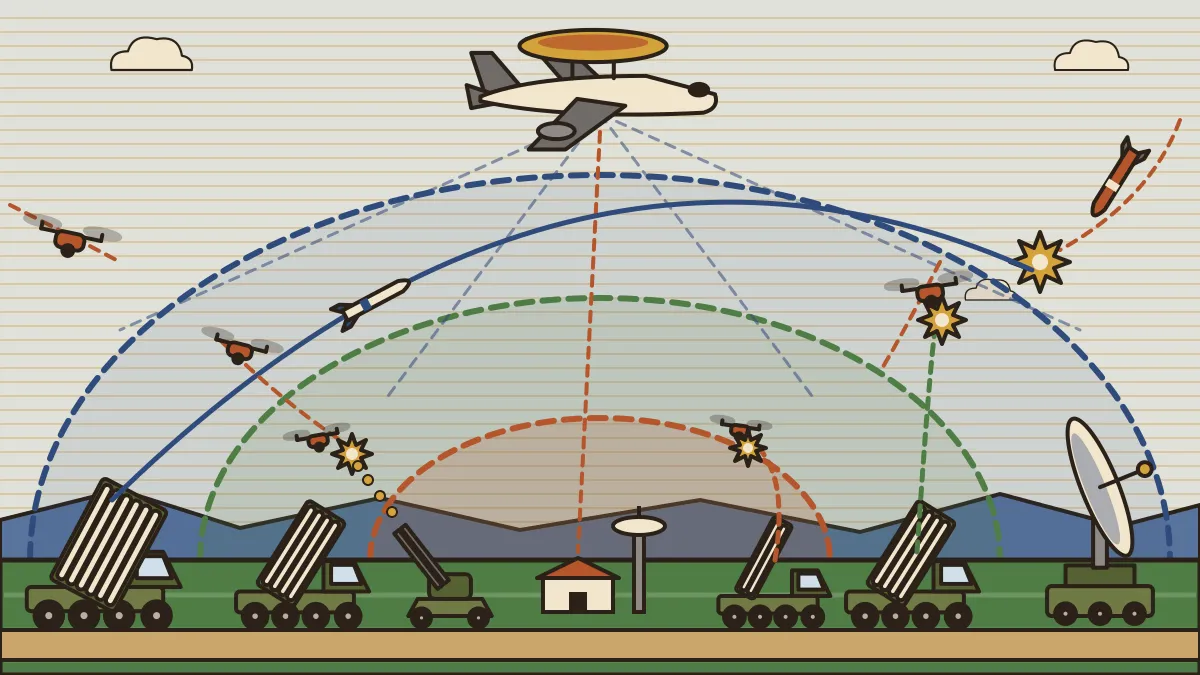
Every engagement follows one chain. Detect: ground radars and airborne early-warning aircraft find the target, and a radar on an aircraft sees past the curve of the Earth to low flyers. Decide: the network separates friend from foe and picks the weapon; this is IACCS. Engage: the weapon suited to the range fires, and if the target survives the next layer takes over. The table gives the main systems by layer. Range classes follow PIB wording; the Ministry rarely publishes exact kilometres, so book figures differ.
| Layer | System | Range class | Origin | Service |
|---|---|---|---|---|
| Detect | Ground air-defence radars | Fixed and mobile | Mixed; many indigenous | Air Force, with Army and Navy sensors feeding in |
| Netra AEW&C (Embraer EMB-145 aircraft) | Airborne early warning | India (DRDO) | Air Force. Final Operational Clearance on 25 Jun 2026 | |
| Decide | IACCS | Whole national air picture | India | Air Force |
| Interceptors | Su-30MKI, Rafale, Tejas | Any, by aircraft | Russian design built in India; France; India | Air Force |
| Long | S-400 (press name "Sudarshan Chakra") | Long range | Russia (procured, not co-produced) | Air Force |
| Kusha long-range SAM | Long range | India (DRDO, with industry) | In trials: maiden flight test 23 Jul 2026 | |
| Medium | MRSAM (Barak-8 family) | Medium range | Co-developed with Israel; built in India | Air Force, Army (ABHRA) and Navy variants |
| Short | Akash | Short range (PIB wording) | India (DRDO; made by Indian industry) | Air Force and Army |
| Akash-NG | Short range, new generation | India (DRDO) | Air Force. User trials completed 23 Dec 2025 | |
| SPYDER | Short range, quick reaction | Israel | Air Force; an upgrade was cleared by the Defence Acquisition Council in 2025 | |
| Very short | Igla-S | Shoulder-fired | Russia (press reports) | Army |
| VSHORADS (DRDO) | Shoulder-fired and close-in | India (Research Centre Imarat) | Army cases cleared in Jul and Oct 2026 | |
| L-70 gun | Close-in gun | Bofors design | Army; shown with the Air Force at Vayushakti-26 |
The detail on each missile belongs to the child page: our surface-to-air missiles page covers S-400, MRSAM, Akash and SPYDER one by one and who operates what, and the radar networks page explains how radar works and how the sensors join IACCS.
PIB's 2025 note describes Akash as a short-range system that can engage multiple targets at once, in group or autonomous mode, with built-in electronic counter-countermeasures, on mobile platforms.
Older books call Akash medium range; PIB says short range, and UPSC follows official wording. The press also calls the S-400 "Sudarshan Chakra", while Mission Sudarshan Chakra is a national programme announced on 15 August 2025 (below). S-400 delivery counts vary in press reports, so do not memorise them.
- 23 Dec 2025: DRDO completes user trials of Akash-NG with Air Force representatives watching; PIB says this paves the way for induction.
- 27 Mar 2026: the Defence Acquisition Council clears the S-400 system for the Air Force and an Air Defence Tracked System for the Army.
- 25 Jun 2026: Netra AEW&C gets Final Operational Clearance; see our Netra explainer.
- 3 Jul 2026: the Council clears MRSAM, V-SHORADS and the Akash Tarang anti-UAV system for the Army.
- 22 Jul 2026: DRDO signs two contracts for the AEW&C Mk-II programme, built on six converted A321 aircraft.
- 23 Jul 2026: Kusha makes its maiden flight test off the Odisha coast and intercepts its target.
- 26 Oct 2026: Council clearances of ₹2.12 lakh crore include V-SHORADS and counter-drone systems for the Army and air-defence systems for the Air Force.
IACCS: The Network That Joins It All
The Integrated Air Command and Control System is the Air Force's automated, net-centric network. PIB's 2025 note says it brought the Army, Navy and Air Force elements together. The Ministry of Defence's 2025 year-end review, which carries the Air Force's own account, says IACCS integrated the air-surveillance picture from all sensors in the country and passed it to the Army through Akashteer and to the Navy through IMSAS (the review's name for the Navy's feed; the Raksha Mantri and PIB use Trigun), building one Air Situation Picture across the country.
The Raksha Mantri said on 30 September 2025 that IACCS worked in unison with the Army's Akashteer and the Navy's Trigun as a joint operational backbone, and that the unified real-time picture reduced the risk of fratricide: a friendly aircraft being engaged by mistake. The more weapons from three services are in the sky, the more that picture matters. The Ministry's review also records that from 7 May 2025 a total of 32 airports west of a stated line were closed to civil flights, with normal operations back from 12 May.
The sensors behind the network are on radar networks.
Operation Sindoor: The Air-Defence Facts
Operation Sindoor was launched on the intervening night of 6 and 7 May 2025 after the Pahalgam terror attack of 22 April 2025 (Ministry of Defence year-end review). This section gives only what PIB and the Ministry have stated about air defence. The wider story is on Operation Sindoor.
- 7 and 8 May 2025: PIB's note says military targets in northern and western India were engaged with drones and missiles and that these were neutralised by the Integrated Counter UAS Grid and air-defence systems.
- Systems named officially: battle-proven Pechora, OSA-AK and low-level air-defence guns, and the indigenous Akash. PIB says Army, Navy and, primarily, Air Force assets performed with exceptional synergy, with IACCS bringing them together.
- 12 May 2025: the DGMO said the multi-tier defence prevented attacks on airfields and logistics installations on the night of 9 and 10 May, and that civil and military infrastructure remained largely unaffected.
- Counter-drone effort: counter-UAS assets from across the country were mobilised along the borders within a short span (Ministry review).
- Airborne warning: the Deputy Chief of the Air Staff spoke of the operational use of Netra AEW&C during the operation (PIB, 25 June 2026).
- Later statements: the Ministry's 2026 Republic Day note said Akash and S-400 "provided a protective shield", and on 12 June 2026 the Raksha Mantri said air defence "completely thwarted the enemy's intentions".
Counts of weapons used or targets intercepted vary widely across press reports and are not given in the official statements above, so this page does not repeat them. Learn the structure: the four layers, the named systems and IACCS. For neutral background, see our explainer on Operation Sindoor and the logic of deterrence.
Mission Sudarshan Chakra and Ballistic Missile Defence
Mission Sudarshan Chakra was announced by the Prime Minister in his Independence Day address on 15 August 2025. As PIB's English text records, he said that over the next ten years, till 2035, he wanted to expand, strengthen and modernise the national security shield. His three basic points: research, development and manufacturing all in India; a system that works out the possibilities of future warfare; and precise, targeted action.
| Date | Who | What was said officially |
|---|---|---|
| 15 Aug 2025 | Prime Minister, Red Fort | Mission announced; shield to be expanded, strengthened and modernised till 2035; research, development and manufacturing in India |
| 1 Jan 2026 | Raksha Mantri, DRDO Foundation Day | DRDO is to equip vital installations with an air-defence system over the next decade |
| 12 Jun 2026 | Raksha Mantri, DRDL Hyderabad | A multi-level missile defence system: protects military installations, critical and civil infrastructure and key establishments; three-layered protection; able to deliver "a decisive punch" |
| 15 Aug 2026 | Prime Minister, Red Fort | Work on the mission is progressing rapidly; the nation must develop drones and counter-drone systems |
The official statements describe the aim and the principles. The releases checked give no cost, system list or deployments, so neither does this page.
A ballistic missile climbs out of the atmosphere and falls back at great speed, so it needs interceptors built for the job. India's DRDO-developed programme is on ballistic missile defence, in the missiles of India section. This page is for aircraft, cruise missiles and drones. Our DRDL and Sudarshan Chakra explainer ties the two together.
Counter-Drone Systems
Small drones are cheap, slow and hard to see, so they get their own layer. Counter-drone systems work by soft kill (jamming or spoofing the drone's control and navigation, an electronic warfare job) or hard kill (destroying it with a missile, gun or laser). The officially announced pieces are these.
| System | What it is | Official date and detail |
|---|---|---|
| IADWS | Integrated Air Defence Weapon System: QRSAM missiles, VSHORADS missiles and a high-power laser weapon, run from one command centre | First flight tests off Odisha, 23 Aug 2025. Two high-speed UAV targets and a multi-copter drone were engaged at once and destroyed |
| Akash Tarang | An anti-UAV electronic warfare system for Army formations | Cleared by the Defence Acquisition Council, 3 Jul 2026 |
| LLLR(I) | Improved Low Level Light Weight Radar that detects and tracks fighter-size targets and mini or micro drones | ₹770 crore contract with Bharat Electronics, 21 Oct 2026 |
| Platform-based C-UAS | Counter-drone cover to improve the survival of tanks | Cleared by the Defence Acquisition Council, 26 Oct 2026 |
The Army's drone and counter-drone kit is also on Army weapon systems.
Pages in the Air-Defence Branch
Two child pages go deeper; the rest show where related topics live.
| Page | What it covers |
|---|---|
| Surface-to-Air Missiles | S-400, MRSAM, Akash and SPYDER one by one: who built them and who operates what |
| Radar Networks | How radar works (pulse, Doppler, AESA), ground radars and how IACCS joins the sensors |
| Ballistic Missile Defence | The two-tier programme and the shield plans, in the missiles section |
| Force Multipliers | AEW&C aircraft, tankers and the other aircraft that multiply the fighters |
| Army Combat Arms | Army Air Defence as an arm of the Army, beside armour, artillery and infantry |
| Operation Sindoor | The 2025 operation as a whole, in neutral wording |
The Air Force commands page shows the headquarters that run the air-defence battle region by region.
Exam pins
- The IAF's IACCS (Integrated Air Command and Control System) joins sensors and weapons into one air picture; the Army's link is Akashteer and the Navy's is Trigun.
- Layers, in the DGMO's words from the boundary inward: counter-UAS, shoulder-fired weapons, legacy air-defence weapons, modern air-defence systems (12 May 2025).
- S-400 is Russian, long range, with the Air Force; the contract was signed on 5 October 2018 (Lok Sabha reply, 2021). Press name: "Sudarshan Chakra".
- Akash is DRDO's indigenous short-range system in PIB wording; Akash-NG finished user trials on 23 Dec 2025.
- Kusha is DRDO's long-range surface-to-air missile; maiden flight test 23 Jul 2026.
- MRSAM (Barak-8 family) was co-developed with Israel; the Army's version is ABHRA.
- Netra AEW&C: Final Operational Clearance on 25 Jun 2026.
- IADWS (23 Aug 2025): QRSAM + VSHORADS + a laser weapon.
- Mission Sudarshan Chakra: announced 15 Aug 2025; horizon 2035.
Asked in past papers
Questions are short and factual: which country supplies a system, which institute is where, what a term means.
From which one of the following countries has India procured the S-400 Triumf air defence missile system?
(a) United Kingdom (b) U.S.A. (c) France (d) Russia
Answer: (d). The contract was signed with Russia on 5 October 2018 and the system serves with the Air Force. France is tempting because of the Rafale.
Which one of the following pairs of military training institute of India and location is not correctly matched?
(a) Army War College : Mhow (b) High Altitude Warfare School : Gulmarg (c) Army Air Defence College : Pune (d) Rashtriya Indian Military College : Dehradun
Answer: (c). The Army Air Defence College is at Gopalpur in Odisha, not Pune. The other three pairs are correct.
The term 'Thermal High Altitude Area Defense', sometimes mentioned in news, refers to
(a) Anti-Missile system (b) Air-launched cruise missile (c) Aircraft navigation system (d) Surface-to-air guided weapon
Answer: (a). The question misprints "Terminal" as "Thermal": THAAD is a United States anti-ballistic missile system. Option (d) tempts because it is ground-launched, but it is built against ballistic missiles, so "anti-missile system" fits better.
Name the country from which India bought the Barak Missile Defence System.
(a) Israel (b) France (c) Russia (d) USA
Answer: (a). The Barak family comes from Israel. The land-based MRSAM variant was co-developed by DRDO and Israel Aerospace Industries. Russia tempts because of the S-400.
Expect a named system and its country (S-400, Barak so far) and a defence institute or term. Learn the layers table and add the systems in the news from our daily defence notes. Practise on the CDS, NDA and AFCAT papers.
Practice MCQs (with answers)
- The Integrated Air Command and Control System (IACCS) is run by the
- Indian Army
- Indian Navy
- Indian Air Force
- Defence Research and Development Organisation
- Which one is the Army's air-defence control and reporting system that works with IACCS?
- Akashteer
- Trigun
- Netra
- Kusha
- DRDO's long-range surface-to-air missile that made its maiden flight test in July 2026 is
- Akash-NG
- VSHORADS
- QRSAM
- Kusha
- Which of these belongs to the outermost, long-range layer?
- Igla-S
- S-400
- L-70 gun
- Akash
- In PIB's wording, the Akash weapon system is a
- very short range, shoulder-fired system
- long-range missile
- short-range surface-to-air missile system
- ballistic missile defence interceptor
- The Integrated Air Defence Weapon System tested on 23 August 2025 combined QRSAM, VSHORADS and
- a high-power laser weapon
- an anti-ship missile
- BrahMos
- Pinaka rockets
1-c, 2-a, 3-d, 4-b, 5-c, 6-a. Q1: IACCS is the Air Force's network; the Army's is Akashteer. Q2: Trigun is the Navy's link; Netra is an AEW&C aircraft and Kusha a missile. Q3: Akash-NG finished user trials in December 2025, VSHORADS is a very-short-range missile and QRSAM is a quick-reaction missile, so only Kusha fits "long range" and "July 2026". Q4: Igla-S is shoulder-fired, the L-70 is a close-in gun and Akash is short range, so the S-400 is the long-range system. Q5: older books call Akash medium range; PIB says short range, and UPSC follows PIB. Q6: the third element was a laser-based directed-energy weapon, which is why IADWS is also a counter-drone system.
Where to Go Next
Rehearse a three-minute answer on "layered air defence" with our lecturette topics for SSB, then revise AFCAT defence awareness. If you want to wear the Air Force blue, our career in the Indian Air Force page shows the branches, and Cavalier's AFCAT coaching batches cover general awareness, military aptitude, reasoning, numerical ability and English, and prepare you for the Air Force Selection Board.
Frequently asked questions
What is the role of the Indian Air Force in air defence?
The Indian Air Force is responsible for defending Indian airspace. It runs air-defence radars, keeps fighters on alert, operates missile squadrons and joins everything through IACCS. The Army and Navy protect their own formations and ships and share the air picture.
What is IACCS in the Indian Air Force?
IACCS is the Integrated Air Command and Control System, the Air Force's automated network that fuses the air-surveillance picture from sensors across the country. The Ministry of Defence says it passed that picture to the Army through Akashteer and to the Navy through its own system during Operation Sindoor.
What are the layers of air defence in India?
Air defence is built in layers so that each weapon handles the range it is best at. The DGMO described four layers from the International Boundary inward on 12 May 2025: counter-UAS, shoulder-fired weapons, legacy air-defence weapons and modern air-defence systems. In class terms these map to long range (S-400, Kusha), medium range (MRSAM), short range (Akash, SPYDER) and very short range (Igla-S, VSHORADS).
What is Mission Sudarshan Chakra?
Mission Sudarshan Chakra was announced by the Prime Minister on 15 August 2025 to expand, strengthen and modernise the national security shield till 2035, with research, development and manufacturing in India. The Raksha Mantri described it on 12 June 2026 as a multi-level missile defence system that protects military and civil infrastructure with three-layered protection. It is a programme, and different from the S-400, which the press calls Sudarshan Chakra.
Which air-defence systems did PIB name for Operation Sindoor?
PIB named the battle-proven Pechora, OSA-AK and low-level air-defence guns, and the indigenous Akash, with the Integrated Counter UAS Grid and IACCS tying them together. Later official statements added the S-400. The official notes give no counts of intercepts.
More in Indian Air Force
← Back to Indian Air Force · Defence GK home
Sources: static.pib.gov.in/WriteReadData/specificdocs/documents/2025/may/doc2025514554901.pdf · pib.gov.in/PressReleasePage.aspx?PRID=2210154 · pib.gov.in/PressReleasePage.aspx?PRID=2173013 · pib.gov.in/PressReleasePage.aspx?PRID=2272327
Aiming for the Air Force?
Cavalier's AFCAT batches cover general awareness, military aptitude, numerical ability and English, then prepare you for the AFSB.