By Capt. (Dr.) RC Muni (Retd) · Defence faculty, The Cavalier
A submarine is the one warship that wins by not being seen. The Indian Navy's Submarine Arm, whose members call themselves the "Dolphins", runs two very different kinds of boat: diesel-electric submarines that patrol India's coastal waters and the chokepoints beyond, and nuclear-powered ballistic-missile submarines whose whole purpose is to stay hidden and keep India's nuclear deterrent safe. Defence papers test both: the letters (SSBN, SSN, SSK), the boat names and the dates.
This is the submarine section of the Indian Navy part of our Defence GK library. It explains the types, tells the story from 1967, lists the classes with dates, sets out where Project 75 and Project 75I stand, and ends with the traps that cost marks.
SSBN, SSN, SSK and AIP in Plain Words
All the labels begin with SS, "submarine". After that, N means nuclear-powered, B means it carries ballistic missiles, and K is the old "hunter-killer" tag now used for a conventional attack boat. AIP is not a type of boat; it is an extra power source some conventional boats carry.
| Label | Stands for | Power under water | Role | In Indian service |
|---|---|---|---|---|
| SSBN | Nuclear-powered ballistic-missile submarine | A reactor makes steam to turn the propeller; no air needed, so months submerged in principle | Carries long-range ballistic missiles with nuclear warheads and hides as the "second-strike" deterrent; does not hunt ships | Arihant class: INS Arihant, INS Arighaat |
| SSN | Nuclear-powered attack submarine | Same reactor idea | Hunts enemy submarines and ships with torpedoes and missiles; carries conventional weapons | None officially in service; the only SSNs so far were the leased Chakra boats |
| SSK | Conventional (diesel-electric) attack submarine | Batteries under water, recharged by diesel engines at the surface or snorkel depth; days submerged | Coastal and chokepoint patrol, anti-ship and anti-submarine work, special operations | Kalvari, Sindhughosh, Shishumar classes |
| SSK with AIP | An SSK with Air Independent Propulsion | A second power source (a fuel cell in India's case) that needs no outside air | As an SSK, but quieter and submerged several times longer, as PIB puts it | Not yet fitted; DRDO's system is in trials |
The picture shows the difference. A diesel-electric boat has to raise a snorkel mast through the surface to draw in air for its engines and push out exhaust, and that is when radar, infrared sensors and patrol aircraft can find it. A nuclear boat never has to.
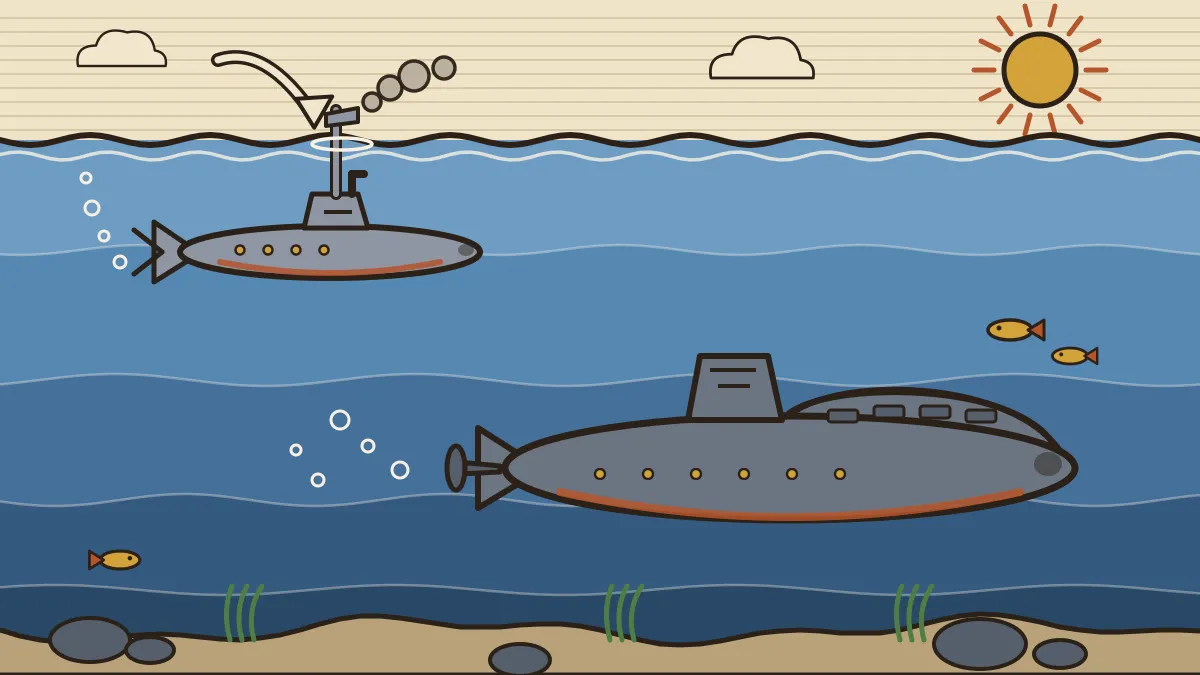
PIB describes India's AIP as a fuel-cell system developed by the DRDO's Naval Materials Research Laboratory (NMRL), whose distinctive feature is that hydrogen is generated on board. The physics of both boat types is on Nuclear Submarines (SSBN) and Diesel-Electric Submarines (SSK).
From INS Kalvari (1967) to the Arihant Class
The Navy's own history, published by PIB at the 2017 commissioning of the new Kalvari, starts with a team of officers trained at HMS Dolphin, UK, in 1962. The Arm itself began on one day.
| Year | Milestone |
|---|---|
| 8 Dec 1967 | The first INS Kalvari, a Soviet-built Foxtrot-class boat, is commissioned at Riga under Commander K.S. Subramanian. The Submarine Arm is formed that day, now kept as Submarine Day. |
| 31 May 1996 | The first Kalvari is decommissioned (some reference sites say 1992; the Navy's history, via PIB, says 1996, which UPSC follows) |
| 1971 | Two Foxtrots take part in the war; the first Karanj's commanding officer, Cdr V.S. Shekhawat, won a Vir Chakra and later became Chief of the Naval Staff |
| 1986 onwards | The Soviet-built Sindhughosh class (Project 877EKM, the "Kilo") and the German-designed Shishumar class (Type 209) arrive |
| 1988 | The Navy's first nuclear-powered boat, Chakra, is commissioned on lease from the Soviet Union and goes back after about three years |
| 7 Feb 1992 | INS Shalki joins: the first submarine built in India, at Mazagon Dock Mumbai |
| 2012 | A second Chakra (an Akula-class boat) is commissioned on lease from Russia; press reports say she returned to Russia in 2021 |
| 14 Dec 2017 | The new INS Kalvari, first of the six Scorpene-design boats of Project 75, is commissioned at Mumbai |
| 29 Aug 2024 | INS Arighaat, the second Arihant-class boat, is commissioned at Visakhapatnam |
| 15 Jan 2025 | INS Vagsheer, the sixth and last Kalvari-class boat, is commissioned at Mumbai |
The Arm's badge is the National Emblem between two dolphins. Fleets and bases are on Fleet Operations; PIB places Karanj and Vela in the Western Naval Command's submarine fleet at Mumbai (see Naval Commands).
The Classes in Service, With Dates
The Navy does not publish a running count of boats, and older boats retire quietly, so this table gives what is on the official record rather than a total.
| Class | Type | Origin and builder | Boats and dates |
|---|---|---|---|
| Kalvari class (Project 75) | SSK | French Scorpene design (Naval Group); built at Mazagon Dock | Six boats, Dec 2017 to Jan 2025; built without AIP |
| Sindhughosh class (Project 877EKM, "Kilo") | SSK | Soviet Union / Russia | First boat 1986. INS Sindhudhvaj retired in July 2022; the lead boat, INS Sindhughosh, on 19 Dec 2025 |
| Shishumar class (Type 209) | SSK | German HDW design; two boats built in Germany, two at Mazagon Dock | Four boats, 1986 to 1994; INS Shalki was the first built in India |
| Arihant class | SSBN | Indian-designed; the press calls it the Advanced Technology Vessel (ATV) project | INS Arihant (in service 2016, as reported; no commissioning release was issued) and INS Arighaat (29 Aug 2024, PIB) |
The six Kalvari-class boats, with the dates PIB published at each commissioning:
| Boat | Commissioned | What to remember |
|---|---|---|
| INS Kalvari (S21) | 14 Dec 2017, Mumbai | Tiger shark in Malayalam; the Navy's maiden SM-39 Exocet firing, 2 Mar 2017 |
| INS Khanderi | 28 Sep 2019, Mumbai | Named after Shivaji Maharaj's island fort |
| INS Karanj | 10 Mar 2021, Mumbai | The old Karanj fought in 1971 |
| INS Vela | 25 Nov 2021, Mumbai | Name of a Foxtrot boat decommissioned in 2009 |
| INS Vagir | 23 Jan 2023, Mumbai | PIB called her Aug 2023 deployment to Fremantle the Navy's maiden submarine deployment to Australia |
| INS Vagsheer | 15 Jan 2025, Mumbai | Sixth and last; commissioned with INS Surat and INS Nilgiri, the first tri-commissioning of destroyer, frigate and submarine. PIB spells it both Vagsheer and Vaghsheer |
PIB gives the Kalvari as 67.5 metres long, with 360 battery cells, two 1,250 kW diesel engines, SM-39 Exocet missiles and wire-guided torpedoes. The ships that hunt submarines are on Surface Ships.
The Arihant Class, as Officially Published
Government statements on the nuclear boats are brief, so learn exactly what has been said. PIB records the reactor on INS Arihant reaching criticality on 10 August 2013. On 5 November 2018 the Prime Minister's Office said INS Arihant, an SSBN, had returned from her first deterrence patrol, completing India's nuclear triad. On 29 August 2024 INS Arighaat was commissioned at Visakhapatnam in the Raksha Mantri's presence; the Defence Ministry called her "significantly more advanced than its predecessor Arihant". Doctrine is on Nuclear Doctrine and the Triad, the command that manages nuclear forces on Strategic Forces Command and the missiles on Missiles of India.
Press reports said a third boat, INS Aridhaman, was quietly commissioned at Visakhapatnam on 3 April 2026, and the Raksha Mantri's social-media post that day was read as a hint. As of 9 November 2026 we found no formal Government or PIB announcement or commissioning release, so this page counts the two boats officially announced: INS Arihant and INS Arighaat. Check our daily defence notes for any later announcement.
Project 75, Project 75I and the DRDO's AIP
Project 75 (P-75) is the finished programme: six Scorpene-design boats built by Mazagon Dock with France's Naval Group, first steel cut on 14 December 2006, the sixth boat commissioned in January 2025. Project 75 India (P-75I) is the next one: six more advanced conventional boats, this time with AIP.
| Project 75 | Project 75I | |
|---|---|---|
| Boats | Six (Kalvari class) | Six planned |
| Design partner | Naval Group, France | A foreign OEM paired with an Indian builder under the Strategic Partnership model |
| AIP | Not at build; an "AIP plug" is to be added later | Fuel-cell AIP is part of the requirement |
| Official milestones | All six delivered; sixth commissioned 15 Jan 2025 | DAC approval 31 Jan 2019 (over Rs 40,000 crore); RFP issued 20 Jul 2021 to Mazagon Dock and L&T |
PIB's 2019 release called P-75I the second project under the Strategic Partnership model, after the Naval Utility Helicopter. The 2021 RFP listed five foreign OEMs: Naval Group, TKMS (Germany), JSC ROE (Russia), Daewoo (South Korea) and Navantia (Spain).
What press reports add. In January 2025 ThePrint reported that the defence ministry had found Mazagon Dock with TKMS the winning bid, with the rival bid failing the AIP requirement. In September 2025 TKMS announced that Mazagon Dock had begun contract negotiations with the Indian procurement authority. As of 9 November 2026 we found no PIB or Ministry release announcing a signed contract, so treat any contract date as unconfirmed. A separate proposal for three more Scorpene-class boats has appeared in press reports; no contract has been announced, and they are not part of the official Project 75 count of six.
The DRDO's AIP. PIB announced on 9 March 2021 that the land-based prototype at NMRL was proven on 8 March, with L&T and Thermax as partners. On 30 December 2024 the Ministry signed a contract of about Rs 1,990 crore with Mazagon Dock for the AIP plug and its integration. See our explainer on AIP reaching phase-2 trials and the DRDO page.
- 19 Dec 2025: INS Sindhughosh, lead boat of the Kilo-class Sindhughosh class, was decommissioned at Mumbai after 40 years, as announced by the Western Naval Command.
- 31 Aug 2026: the diving support vessel INS Nipun was commissioned at Mumbai; PIB says she can support submarine rescue.
- 24 Oct 2026: the DRDO's AIP energy module began Setting to Work Phase-2 at L&T's Hazira complex, with integration on a Kalvari-class boat planned for early 2027, according to the release.
Submarine Rescue and Escape
The Navy's Deep Submergence Rescue Vehicle (DSRV) is a small submersible that mates with a disabled boat and takes off crew; press reports say the first was commissioned at Mumbai on 12 December 2018. Its mother ship is the Nistar class: INS Nistar (Visakhapatnam, 18 July 2025) was the first indigenously built diving support vessel, and INS Nipun followed in 2026. For escape training, PIB records that Vinetra ("Trainer"), a facility with a five-metre escape tower for Kalvari-class crews, was commissioned on 13 September 2024 at INS Satavahana, Visakhapatnam.
The Two Exam Traps
Both are nuclear-powered, but only the SSBN is a nuclear-missile boat. An SSBN hides to keep ballistic missiles safe; an SSN hunts ships and submarines with conventional weapons. "Nuclear-powered" does not mean "nuclear-armed". The Arihant class are SSBNs; the leased Chakra boats were attack submarines.
The Navy reuses names. The first Kalvari was a Soviet Foxtrot commissioned at Riga on 8 December 1967, which is why Submarine Day falls on that date. The new Kalvari (S21) is the Scorpene-design boat commissioned at Mumbai on 14 December 2017. Karanj, Vela and Vagir are likewise revived Foxtrot names. "When was the Navy's first submarine commissioned?" is 1967.
Also remember that ships that hunt submarines are not submarines: INS Malvan and Mangrol are surface craft (see INS Malvan and the Mangrol craft).
Pages in the Submarine Section
| Page | What it covers |
|---|---|
| Nuclear Submarines (SSBN) | How a reactor drives a boat, the Arihant-class boats with dates, the K-series missiles and the place in the triad |
| Diesel-Electric Submarines (SSK) | Battery and snorkel physics, AIP, and the Kalvari, Sindhughosh and Shishumar boats |
| Surface Ships | The surface fleet submarines work with |
| Fleet Operations | Fleets, flotillas and where the submarine arm fits |
| Nuclear Doctrine and the Triad | No first use, credible minimum deterrence and the three legs of the triad |
| Missiles of India | Ballistic and cruise missiles, including sea-launched ones |
| DRDO | The organisation behind the AIP, sonars and torpedoes |
| Tri-Services | Home of the Strategic Forces Command |
Exam pins
- Submarine Day: 8 December, for the first INS Kalvari, commissioned at Riga in 1967 (Foxtrot class).
- The new INS Kalvari (S21) was commissioned on 14 December 2017; the first Kalvari left service on 31 May 1996.
- Project 75: six Kalvari-class boats (Kalvari, Khanderi, Karanj, Vela, Vagir, Vagsheer), Scorpene design, built at Mazagon Dock; the last commissioned on 15 January 2025.
- INS Shalki (7 Feb 1992) was the first submarine built in India, a Type 209.
- SSBN = nuclear-powered ballistic-missile submarine; SSN = nuclear-powered attack submarine; SSK = conventional attack submarine.
- The Arihant class are SSBNs: INS Arihant and INS Arighaat (29 August 2024).
- P-75I: six AIP-fitted conventional boats, Strategic Partnership model; DAC approval 31 Jan 2019, RFP 20 Jul 2021.
- India's AIP is a DRDO-NMRL fuel cell that makes hydrogen on board; land prototype proven 8 March 2021.
Asked in past papers
Submarine questions in past papers tend to ask about programmes (what is P-75I?) and boat names, not about reactor physics.
P-751 (or P-75 India) project refers to manufacture of
(a) Diesel-electric submarines (b) Nuclear-powered submarines (c) Aircraft carrier warships (d) Field guns
Answer: (a). P-75I is the programme for six conventional, AIP-fitted submarines. Option (b) is the tempting error: Project 75 India shares a name with nothing nuclear, and the nuclear boats come under a separate strategic programme.
The policy on strategic partnerships in defence was approved by the Ministry of Defence in May 2017. Which of the following is not among the four segments identified by the Ministry for acquisition through the strategic partnership route?
(a) Artillery guns (b) Fighter aircraft and helicopters (c) Submarines (d) Armoured fighting vehicles and main battle tanks
Answer: (a). The four segments were submarines, single-engine fighters, helicopters and armoured vehicles or tanks. Artillery is the odd one out. P-75I is the submarine segment, and PIB called it the second project under the Strategic Partnership model.
Which one of the following is a decommissioned aircraft carrier?
(a) INS Rajput (b) INS Chakra (c) INS Khanderi (d) INS Viraat
Answer: (d). INS Viraat is the former carrier. The distractors are a destroyer (Rajput) and two submarines: Chakra, the leased nuclear-powered boat, and Khanderi, a Kalvari-class boat. The word "carrier" decides the question, not the unfamiliar names.
Practice MCQs (with answers)
- Submarine Day, 8 December, marks the commissioning of
- INS Arihant in 2016
- the first INS Kalvari at Riga in 1967
- INS Shalki in 1992
- the new INS Kalvari at Mumbai in 2017
- In the label SSBN, the letter B stands for
- battery
- bomber
- blue-water
- ballistic missile
- Which was the first submarine built in India, commissioned on 7 February 1992?
- INS Shalki
- INS Sindhughosh
- INS Karanj
- INS Vela
- A nuclear-powered submarine whose job is to carry long-range ballistic missiles is classed as
- SSK
- SSN
- SSBN
- SSP
- The fuel-cell Air Independent Propulsion system for India's conventional submarines is developed by
- BARC
- ISRO
- HAL
- the Naval Materials Research Laboratory of the DRDO
- The new INS Kalvari, the lead boat of Project 75, was commissioned on
- 8 December 1967
- 14 December 2017
- 15 January 2025
- 28 September 2019
1-b, 2-d, 3-a, 4-c, 5-d, 6-b. Q1: 2017 is the new Kalvari; the Arm dates from 1967. Q3: Karanj and Vela are Scorpene boats of 2021. Q4: an SSN is also nuclear-powered but carries conventional weapons. Q5: BARC is a nuclear-research centre and ISRO a space agency. Q6: 1967 is the first Kalvari, 2025 is Vagsheer, 2019 is Khanderi.
Where to Go Next
Read the SSBN and SSK pages next, then return to the Indian Navy hub. Our career in the Indian Navy page explains entry routes, boards ask what you know about the service you want, so keep our SSB interview tips open beside this page, and our daily defence notes carry each new submarine event. Graduates enter through the CDS course to the Indian Naval Academy, which our CDS batches cover with weekly tests and SSB training; 12th-pass candidates take the Naval wing of the NDA with our NDA course.
Frequently asked questions
When is Submarine Day celebrated in India and why?
Submarine Day is kept on 8 December. It marks the commissioning of the Navy's first submarine, the Soviet-built Foxtrot-class INS Kalvari, at Riga on 8 December 1967, the day the Submarine Arm was formed. The new INS Kalvari, commissioned in 2017, carries the old name but is a different boat.
What is the difference between SSBN and SSN?
Both are nuclear-powered, so they can stay under water for months. An SSBN carries long-range ballistic missiles with nuclear warheads and hides as a deterrent. An SSN is an attack submarine that hunts ships and submarines with conventional torpedoes and missiles.
How many submarines does the Indian Navy have?
The Navy does not publish a running count. The official record shows six Kalvari-class boats (all delivered by January 2025), the older Sindhughosh and Shishumar classes, and the SSBNs INS Arihant and INS Arighaat. Old boats retire, for example INS Sindhughosh on 19 December 2025, so a total in a news report is quickly dated.
What is Project 75I?
Project 75 India (P-75I) is the planned programme to build six advanced diesel-electric submarines with fuel-cell AIP in India under the Strategic Partnership model. The Defence Acquisition Council approved it on 31 January 2019 and the Request for Proposal went out on 20 July 2021. As of 9 November 2026 we found no official announcement of a signed contract.
What was India's first submarine and what is the Kalvari of 2017?
India's first submarine was the Foxtrot-class INS Kalvari, commissioned at Riga on 8 December 1967 and decommissioned on 31 May 1996. The Navy gave the name to the first Scorpene-design boat of Project 75, commissioned at Mumbai on 14 December 2017, as a name revival and not as the same boat.
More in Indian Navy
← Back to Indian Navy · Defence GK home
Sources: pib.gov.in/PressReleasePage.aspx?PRID=1512525 · pib.gov.in/PressReleaseIframePage.aspx?PRID=2049870 · pib.gov.in/PressReleasePage.aspx?PRID=1737191 · pib.gov.in/PressReleasePage.aspx?PRID=1703456
Preparing for CDS or OTA?
Cavalier's CDS/OTA batches teach the whole GK paper, defence awareness included, with PYQ drills, weekly tests and SSB training.