By Capt. (Dr.) RC Muni (Retd) · Defence faculty, The Cavalier
A nuclear-powered ballistic-missile submarine (SSBN) is the Navy's quietest and most secret warship. It carries long-range missiles with nuclear warheads and does one job: stay hidden, so that no enemy can be sure of destroying India's retaliation in a first strike. Two things make that possible. A reactor lets the boat stay under water for months, and the hull is hard to find in a deep ocean.
This page sits under Indian Navy Submarines in our Defence GK library. It explains the reactor in plain words, sets out the Arihant class with the dates the Government itself has published, covers the leased INS Chakra boats, and says exactly how much has been made public about the missiles. Diesel-electric boats have their own page: diesel-electric submarines.
How a Reactor Drives a Submarine
A nuclear submarine burns nothing. Inside the reactor, nuclear fission of uranium nuclei releases heat, and control rods that absorb neutrons set how fast the chain reaction runs. From there the boat is a floating steam engine. The Government has not published the design of the Indian reactor, so the loop below is the standard pressurised-water layout taught in physics.
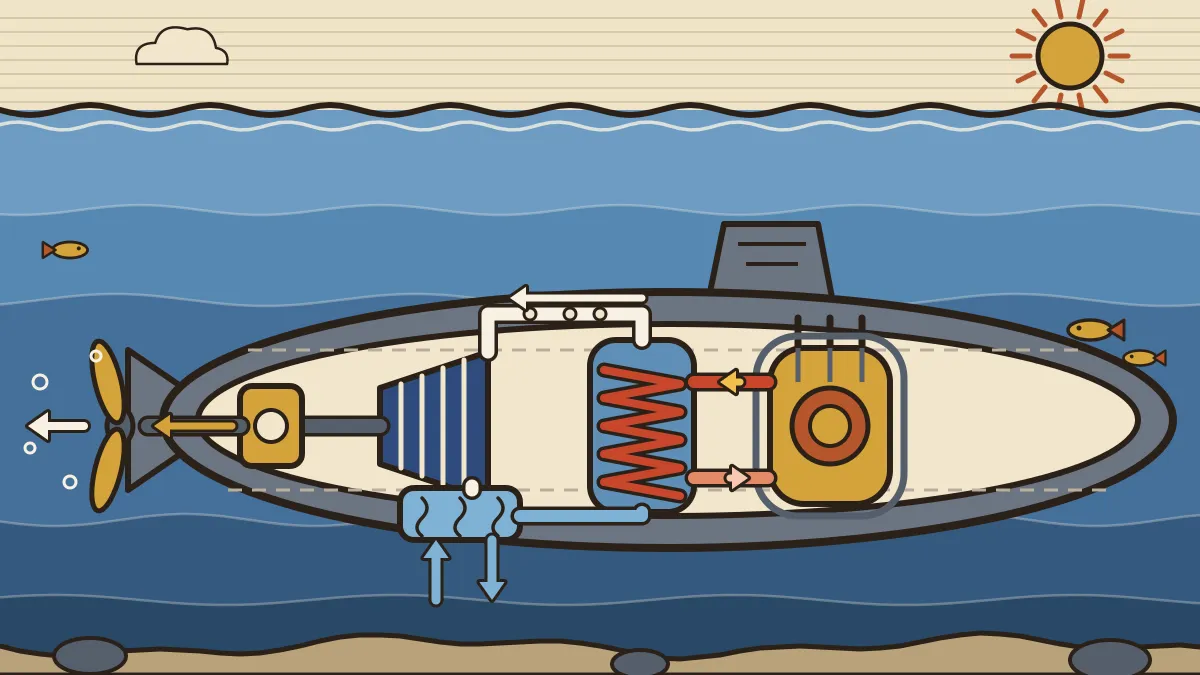
| Step | What happens |
|---|---|
| 1. Fission | Uranium nuclei split inside the reactor core and release heat. This is controlled fission, not fusion and not an explosion. |
| 2. Hot-water loop | Water in a sealed primary loop carries the heat out of the core. It is kept under pressure so it stays liquid at high temperature, and it never leaves the reactor compartment. |
| 3. Steam generator | The hot loop passes through coils and boils a separate supply of water into steam. |
| 4. Turbine and shaft | Steam spins the turbine, which turns the propeller shaft through gearing. |
| 5. Condenser | Used steam gives up its heat to the cold seawater outside the hull, turns back into water and returns to the steam generator. |
Why this keeps a boat under water for months. The reactor needs no oxygen, so the boat never has to raise a mast to breathe, and a small quantity of fuel lasts for years. The limit is not fuel but the crew: food and endurance. A diesel-electric boat, by contrast, runs on batteries that must be recharged by diesel engines, and those engines need air.
| Label | Power under water | Weapons and job | Indian examples |
|---|---|---|---|
| SSBN | Reactor and steam turbine | Ballistic missiles with nuclear warheads; hides as the deterrent | INS Arihant, INS Arighaat |
| SSN | Reactor and steam turbine | Torpedoes and missiles with conventional warheads; hunts ships and submarines | The leased Akula-class INS Chakra |
| SSK | Diesel engines and batteries | Conventional attack boat for coastal and chokepoint work | Kalvari, Sindhughosh, Shishumar classes |
Our science article on radioactivity and nuclear energy covers fission and reactors from first principles.
The Arihant Class, With Dates
Government statements on these boats are short, so the table gives each date with the document that carries it. Where there is no official document, the row says so.
| Date | Event | On the record |
|---|---|---|
| 26 Jul 2009 | INS Arihant ("Destroyer of the Enemies") is launched at the Ship Building Centre, Visakhapatnam; about 6,000 tonnes | PIB Ministry of Defence year-end review, 2009 |
| 10 Aug 2013 | The nuclear propulsion reactor on board INS Arihant achieves criticality | PIB, Prime Minister's message of 10 Aug 2013 |
| 2016 | INS Arihant enters service | Press reports (ANI among them); no commissioning release was issued |
| 5 Nov 2018 | The Prime Minister receives the crew; the boat has returned from her first deterrence patrol, completing the survivable nuclear triad | PIB, Prime Minister's Office |
| 14 Oct 2022 | INS Arihant launches a submarine-launched ballistic missile into the Bay of Bengal in a user training launch | PIB, Ministry of Defence |
| 29 Aug 2024 | INS Arighaat, the second Arihant-class boat, is commissioned at Visakhapatnam in the Raksha Mantri's presence | PIB, Ministry of Defence |
In 2018 PIB called the boat a "Strategic Strike Nuclear Submarine (SSBN)", yet it also said India joined a handful of countries able to design, construct and operate SSBNs. The Defence Ministry said in 2024 that Arighaat is "significantly more advanced than its predecessor Arihant" and that both boats together "will enhance India's capability to deter potential adversaries".
ANI reported on 3 April 2026 that the Navy was to commission a third boat, INS Aridhaman, at Visakhapatnam that day, and the Raksha Mantri posted a short message about it. As of 27 November 2026 we found no PIB or Ministry release confirming it. This page therefore counts the two boats officially announced. Also, PIB's 2018 text expands SSBN as "Strategic Strike Nuclear Submarine", while the standard expansion, used in later PIB texts and by UPSC, is nuclear-powered ballistic-missile submarine. UPSC follows official figures and standard expansions.
- 3 Apr 2026: ANI reported that INS Aridhaman was to be commissioned at Visakhapatnam that day; no PIB commissioning release has been published (see the Exam note above).
The ATV Programme: How the Boats Came About
The Indian SSBN effort is known in press as the Advanced Technology Vessel (ATV) project. PIB's 2009 review spells it "Advanced Technology Vehicle", so you may see either word. The same review records two facts worth knowing.
- At the 2009 launch the Prime Minister congratulated the programme's Director General, Vice Admiral (Retd) DSP Verma, and his team, and made a special mention of the cooperation extended by Russia.
- The 2013 message credited the Department of Atomic Energy, the Indian Navy and the DRDO for the reactor milestone.
For Arighaat, the 2024 release stressed indigenous systems and equipment designed, built and integrated by Indian scientists, industry and Naval personnel, with MSMEs gaining work and jobs. Pair it with our indigenisation page.
INS Chakra: The Leased Nuclear Submarines
India's first nuclear-powered boats were not SSBNs and not Indian-built. The Navy twice leased a nuclear-powered submarine from the Soviet Union and Russia and gave it the name Chakra.
| First Chakra | Second Chakra | |
|---|---|---|
| Type | Charlie-class SSGN (guided-missile), leased from the Soviet Union | Akula-class SSN, leased from Russia |
| In Indian service | 1988 to 1991 (end per press) | 2012 to 2021 (end per press) |
| Role | Nuclear-powered boat with guided missiles (SSGN) | Nuclear-powered attack boat (SSN) with conventional weapons |
| On the record | PIB: commissioned in 1988 (Dec 2017 release), on a three-year lease (Apr 2012 release). The 1991 end is from press | PIB: commissioned 4 Apr 2012 at Visakhapatnam by the Defence Minister. Press: reported heading back to Russia in June 2021, with no official comment |
The lesson for exams: nuclear-powered does not mean nuclear-armed. Neither Chakra carried nuclear-armed ballistic missiles. Only the Arihant class carries the strategic missiles.
The Missiles: What Has Been Published
This is the part where the facts are thinnest, so learn what is on the record. PIB's 14 October 2022 release says INS Arihant carried out a successful launch of a Submarine Launched Ballistic Missile (SLBM). The missile was tested to a predetermined range, and it impacted the target area in the Bay of Bengal with very high accuracy. It called the launch significant "to prove crew competency and validate the SSBN programme, a key element of India's nuclear deterrence capability".
The release does not name the missile or give its range. Press reports, ANI among them in September 2024, name the K-series: K-15 on INS Arihant and the longer-range K-4 on INS Arighaat, both DRDO-developed. The Government has not published ranges, how many missiles a boat carries, or where the boats patrol. For the missile family as a whole see Missiles of India, and for the Agni family our explainer on the Agni-4 test and the nuclear triad.
Deterrence, the Triad and No First Use
The reason an SSBN exists is second-strike capability: after an attack, India must still be able to retaliate. PIB's 2022 release said a "robust, survivable and assured retaliatory capability" is in keeping with Credible Minimum Deterrence, which underpins India's No First Use commitment.
| Leg of the triad | Why it matters |
|---|---|
| Land | Ballistic missiles such as Agni, tested under the aegis of the Strategic Forces Command, as PIB's test releases say |
| Air | Weapons delivered by aircraft |
| Sea | The SSBN: the hardest leg to find, which is why the 2018 patrol was said to complete a survivable triad |
The PMO's 2018 release also says India has a "robust nuclear command and control structure" under its Nuclear Command Authority and "remains committed to the doctrine of Credible Minimum Deterrence and No First Use" as set out in the Cabinet Committee on Security decision of 4 January 2003. The tri-service Strategic Forces Command (raised 2003) is the military arm that manages the nuclear forces, and PIB records that the Chief of Defence Staff advises the Authority. The Navy's job is to crew and sail the boats. Full doctrine is on Nuclear Doctrine and the Triad, and our explainer on Operation Sindoor and the logic of deterrence shows how the theme appears in current affairs.
Exam pins
- SSBN = nuclear-powered ballistic-missile submarine; SSN = nuclear-powered attack submarine (conventional weapons); SSK = conventional attack submarine.
- A reactor boat uses controlled nuclear fission, makes steam, spins a turbine, and needs no air.
- INS Arihant was launched on 26 July 2009; her reactor went critical in August 2013.
- 5 November 2018: INS Arihant's first deterrence patrol completed (PIB, PMO).
- 14 October 2022: INS Arihant fired an SLBM into the Bay of Bengal.
- INS Arighaat, the second boat, was commissioned on 29 August 2024 at Visakhapatnam.
- The Navy twice leased a boat named Chakra: Charlie class (1988, three-year lease, PIB) and Akula class (commissioned 4 April 2012, PIB).
- Credible Minimum Deterrence and No First Use rest on the CCS decision of 4 January 2003.
- The Strategic Forces Command was raised in 2003; the Nuclear Command Authority holds political control.
Asked in past papers
Defence papers ask the physics of the reactor more often than boat names, so revise both.
Basic scientific principle behind a nuclear reactor is
(a) Nuclear fusion (b) Controlled nuclear fusion (c) Uncontrolled nuclear fission (d) Controlled nuclear fission
Answer: (d). A reactor, including a submarine's, splits heavy nuclei in a chain reaction held steady by control rods. Option (c) is the bomb; fusion is what powers the Sun and is not used in any working reactor.
Of the following, which does not belong to a nuclear reactor?
(a) A turbine (b) A heat exchanger (c) A mechanism to reduce CO₂ emission (d) A reaction chamber
Answer: (c). Fission burns no fuel, so there is no carbon dioxide to remove. The turbine, the heat exchanger (the steam generator of the table above) and the reaction chamber are all part of the plant. The tempting error is (b): a heat exchanger sounds like industry, but it is the link between the hot loop and the steam.
Which one of the following metals is alloyed with sodium to transfer heat in a nuclear reactor?
(a) Potassium (b) Calcium (c) Magnesium (d) Strontium
Answer: (a). Sodium and potassium are both alkali metals, and their alloy (NaK) is liquid at room temperature, so it can carry heat as a liquid-metal coolant. Calcium, magnesium and strontium are alkaline-earth metals. This tests coolant chemistry only; the Government has not said what coolant an Indian naval reactor uses.
Which one of the following is a decommissioned aircraft carrier?
(a) INS Rajput (b) INS Chakra (c) INS Khanderi (d) INS Viraat
Answer: (d). INS Viraat left service in 2017. Chakra is the leased nuclear-powered submarine, Khanderi a Kalvari-class submarine and Rajput a destroyer. The word "carrier" decides it.
Practice MCQs (with answers)
- In a submarine reactor, the heat from fission is first used to
- split seawater into hydrogen and oxygen
- make steam that turns a turbine
- charge the batteries directly
- burn diesel more efficiently
- A nuclear submarine can stay under water far longer than a diesel-electric boat mainly because
- it carries many more batteries
- it surfaces to snorkel less often
- its reactor needs no air and refuelling is rare
- it travels faster at depth
- The second Arihant-class submarine, INS Arighaat, was commissioned on
- 5 November 2018
- 26 July 2009
- 15 January 2025
- 29 August 2024
- The Prime Minister's Office said on 5 November 2018 that INS Arihant had returned from her first
- deterrence patrol
- commissioning ceremony
- sea acceptance trial
- refit
- Which of these was a leased nuclear-powered submarine of the Indian Navy?
- INS Arihant
- INS Chakra
- INS Shalki
- INS Kalvari
- The Cabinet Committee on Security decision that sets out Credible Minimum Deterrence and No First Use was taken in
- 1974
- 1998
- 2003
- 2018
1-b, 2-c, 3-d, 4-a, 5-b, 6-c. Q2: the limit on a nuclear boat is the crew's food and endurance, not fuel; option (b) describes a diesel boat. Q3: 2018 is the first patrol, 2009 the launch of Arihant and 15 January 2025 the commissioning of the Kalvari-class INS Vagsheer. Q5: INS Arihant is an Indian-built SSBN, INS Shalki is a conventional Shishumar-class boat and INS Kalvari is a Scorpene-design boat. Q6: 1974 and 1998 are the Pokhran test years, and 2018 is the year of the first patrol.
Where to Go Next
Read the submarines hub for the full list of classes, then the diesel-electric page to see why a battery boat is so different. The Tri-Services section covers the Strategic Forces Command. Our career in the Indian Navy page explains entry routes, and interviewers at the SSB expect you to know your service, so keep our lecturette topics beside this page, since nuclear doctrine is a favourite theme. Our daily defence notes carry each new announcement. Graduates enter the Navy through the CDS course, which our CDS batches cover with weekly tests and SSB training; twelfth-pass candidates take the Naval wing of the NDA with our NDA course.
Frequently asked questions
How does a nuclear submarine work?
A reactor splits uranium nuclei and the heat boils water into steam in a steam generator. The steam spins a turbine that turns the propeller shaft, and seawater cools the used steam back into water. The reactor needs no air, so the boat can stay under water for months, limited mainly by its crew's food.
Which are India's nuclear ballistic missile submarines?
The Arihant class. INS Arihant was launched on 26 July 2009 and completed her first deterrence patrol, announced on 5 November 2018. INS Arighaat was commissioned at Visakhapatnam on 29 August 2024.
How many nuclear submarines does India have?
Officially announced SSBNs are two, INS Arihant and INS Arighaat. ANI reported on 3 April 2026 that a third boat, INS Aridhaman, was to be commissioned that day, but we found no PIB or Ministry announcement.
What was INS Chakra?
INS Chakra was the name of two leased nuclear-powered submarines. The first was a Charlie-class boat from the Soviet Union, commissioned in 1988 on a three-year lease (PIB); the second an Akula-class boat from Russia, commissioned on 4 April 2012 (PIB). Neither was an SSBN like the Arihant class.
Why does India need a nuclear submarine under No First Use?
A policy of No First Use means India will not strike first, so it must be able to retaliate after an attack. A submarine hidden in the deep ocean is the hardest weapon to destroy, so it protects that retaliation. PIB links the SSBN programme to Credible Minimum Deterrence and the No First Use commitment.
More in Submarines
← Back to Submarines · Defence GK home
Sources: pib.gov.in/PressReleasePage.aspx?PRID=1551894 · pib.gov.in/PressReleasePage.aspx?PRID=2049870 · pib.gov.in/PressReleasePage.aspx?PRID=1867778 · pib.gov.in/newsite/PrintRelease.aspx?relid=97960
Preparing for CDS or OTA?
Cavalier's CDS/OTA batches teach the whole GK paper, defence awareness included, with PYQ drills, weekly tests and SSB training.