India observes National Cancer Awareness Day on 7 November. The Union Health Ministry began the observance in 2014, and the date is widely linked to the birth anniversary of Marie Curie, born on 7 November 1867. On 30 October 2026 the Department of Posts released commemorative stamps on breast-cancer awareness. The connection is not sentimental. Curie's discovery of radium gave medicine its first weapon against tumours, and radiation therapy is still one of the three pillars of cancer treatment. The science behind it, radioactivity, links three CDS topics (atomic structure, isotopes and nuclear energy), and UPSC asks about it almost every year.
The Discovery: Becquerel, the Curies, Rutherford
| Year | Scientist | Discovery |
|---|---|---|
| 1896 | Henri Becquerel | Uranium salts fog a wrapped photographic plate on their own: radioactivity is discovered by accident |
| 1898 | Marie and Pierre Curie | Discover polonium (named after Marie's homeland, Poland) and radium; Marie coins the word "radioactivity" |
| 1899–1900 | Ernest Rutherford; Paul Villard | Rutherford names the alpha and beta rays; Villard identifies the gamma rays |
| 1909–1911 | Rutherford (with Geiger and Marsden) | Alpha particles fired at gold foil reveal the nucleus |
| 1932 | James Chadwick | Discovers the neutron |
| 1938–39 | Otto Hahn and Fritz Strassmann; Lise Meitner and Otto Frisch | Uranium splits: nuclear fission is found and then explained |
Becquerel and the two Curies shared the 1903 Nobel Prize in Physics. Marie Curie won the 1911 Nobel Prize in Chemistry alone, for radium and polonium. She remains the only person to win Nobel Prizes in two different sciences. She died in 1934 of aplastic anaemia caused by years of radiation exposure. Her notebooks are still kept in lead-lined boxes. The older unit of activity, the curie (3.7 × 10¹⁰ decays per second, roughly the activity of one gram of radium), is named after the couple.
Chadwick found the neutron. Einstein explained the photoelectric effect, and that, not relativity, was the work cited in his 1921 Nobel. J.J. Thomson found the electron, Rutherford the nucleus, and Curie radium. NDA 2021-I swapped the first two (see the past papers below).
Alpha, Beta and Gamma: What Comes Out of the Nucleus
Radioactivity is the spontaneous disintegration of an unstable nucleus. Because it happens inside the nucleus, it is not affected by temperature, pressure or chemical combination. Uranium decays at the same rate whether it is a metal, an oxide or dissolved in acid. Each decay is random, but a large number of atoms decays at a fixed, predictable rate.
| Property | Alpha (α) | Beta (β−) | Gamma (γ) |
|---|---|---|---|
| What it is | Helium nucleus (2 protons + 2 neutrons) | Fast electron created in the nucleus | Electromagnetic wave (photon) |
| Charge | +2 | −1 | 0 |
| Mass | About 4 u | About 1/1836 of a proton (0.00055 u) | None |
| Penetrating power | Least: stopped by a sheet of paper or a few cm of air | Medium: stopped by a few mm of aluminium | Highest: needs thick lead or concrete |
| Ionising power | Highest | Medium | Lowest |
| Change in nucleus | Mass number −4, atomic number −2 | Mass number unchanged, atomic number +1 (a neutron turns into a proton) | No change; the nucleus only loses excess energy |
| In electric/magnetic field | Deflected | Deflected the opposite way, and more strongly (much lighter) | Not deflected |
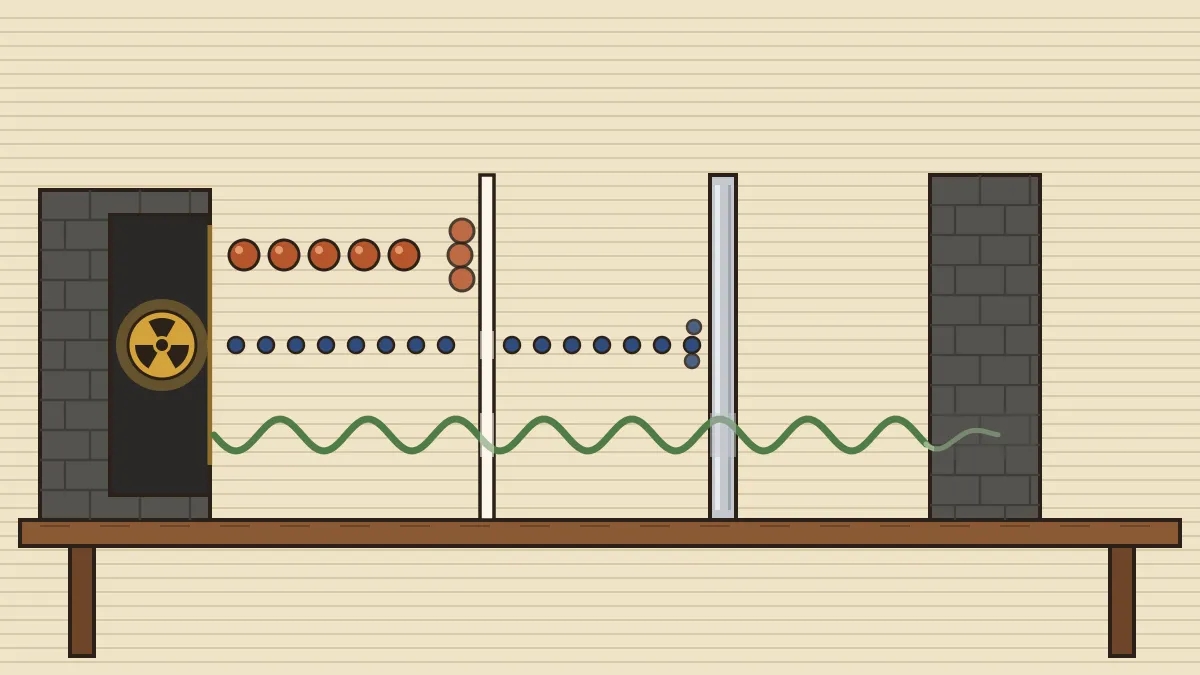
A moving alpha particle is a positive charge, so a magnetic field pushes it sideways according to Fleming's left-hand rule. UPSC turned exactly that into a CDS 2026 question. The rule that tracks a whole decay chain is the group displacement law of Soddy and Fajans (1913). Alpha emission moves an element two places back in the periodic table, and beta emission moves it one place forward.
Uranium-238 (Z = 92) ends its decay chain as lead-206 (Z = 82). How many α and β particles are emitted?
Isotopes, isobars and isotones are covered on our isotopes page. One fact from it matters here. Isotopes of an element have identical chemistry, because they have the same electrons, so chemical methods such as chromatography cannot separate them. Uranium-235 is separated from uranium-238 by a physical method: spinning uranium hexafluoride gas in centrifuges.
Half-Life: The Clock Inside the Nucleus
The half-life (T½) is the time in which half the nuclei of a sample decay. After one half-life, ½ is left; after two, ¼; after three, ⅛. In general:
| Isotope | Half-life | Where you meet it |
|---|---|---|
| Technetium-99m | About 6 hours | The most widely used isotope for medical imaging |
| Iodine-131 | About 8 days | Thyroid cancer and an overactive thyroid; fallout after reactor accidents |
| Cobalt-60 | About 5.3 years | Gamma-ray cancer therapy ("cobalt unit"), sterilising medical kits |
| Tritium (hydrogen-3) | About 12.3 years | The only naturally occurring radioactive isotope of hydrogen; a weak beta emitter |
| Carbon-14 | About 5,730 years | Radiocarbon dating |
| Uranium-238 | About 4.5 billion years | Dating the oldest rocks; roughly the age of the Earth |
80 g of an isotope has a half-life of 6 hours. How much is left after one day?
A wooden beam from an excavation shows ⅛ of the carbon-14 activity of fresh wood. How old is it?
After two half-lives, the sample has not "finished decaying". 75% has decayed and 25% remains. Decay never reaches zero in a fixed number of half-lives; it only keeps halving.
Radiocarbon dating was developed by Willard Libby (Nobel Prize in Chemistry, 1960). Cosmic-ray neutrons striking nitrogen-14 in the upper air keep making carbon-14, and every living thing keeps the same ratio of carbon-14 to carbon-12 while it is alive. After death, intake stops and the carbon-14 decays. The method works for objects up to about 50,000 years old, such as wood, bone, cloth and charcoal from Harappan hearths. Older rocks are dated with uranium–lead or potassium–argon clocks.
Fission, Fusion and the Reactor
In fission, a slow neutron strikes a heavy nucleus such as uranium-235, which splits into two medium nuclei (for example barium and krypton). It also releases two or three neutrons and about 200 MeV of energy. The products weigh slightly less than the original. That "missing" mass has become energy, by Einstein's E = mc² (1905). The released neutrons can split more nuclei, which is a chain reaction. Above a critical mass of fuel, it can run away.
In fusion, light nuclei such as isotopes of hydrogen join to form helium and release even more energy per kilogram. Fusion needs temperatures of tens of millions of degrees, so on Earth it has been achieved only in experimental machines and in weapons. It powers the Sun and the stars. India is a full member of ITER, the international fusion reactor being built in France.
| Part of a fission reactor | Job | Common materials |
|---|---|---|
| Fuel | Supplies fissile nuclei | Natural uranium (India's PHWRs), enriched uranium, plutonium |
| Moderator | Slows neutrons so they cause fission efficiently | Heavy water (D₂O), graphite, ordinary water |
| Control rods | Absorb neutrons to control or stop the chain reaction | Cadmium, boron |
| Coolant | Carries heat to make steam | Heavy water, water, liquid sodium (fast breeders) |
| Shield | Stops radiation escaping | Thick concrete, lead |
Reactor = controlled fission. Atom bomb = uncontrolled fission. Hydrogen bomb = fusion, set off by a fission trigger, which is why it is also called a thermonuclear bomb. Sun = fusion of hydrogen into helium.
How India turns this physics into electricity is covered in two of our articles. The first explains Homi Bhabha's three-stage programme, from natural uranium to fast breeders to thorium. The second covers India's 24 reactors, the SHANTI Act and the 100 GW target.
Radioisotopes at Work, and Why Radiation Harms
- Medicine. Cobalt-60 gamma rays and linear accelerators kill tumour cells (teletherapy). Sealed sources such as iridium-192 are placed inside the body (brachytherapy). Iodine-131 treats thyroid disease. Technetium-99m and fluorine-18 (PET scans) light up organs and tumours for diagnosis. Radiation therapy sits beside surgery and chemotherapy as a standard cancer treatment. Vaccination prevents some cancers outright: see our article on India's single-dose HPV campaign against cervical cancer.
- Agriculture and food. Gamma irradiation creates useful mutations for new crop varieties; BARC's Trombay varieties of groundnut, mustard and pulses are an example. Irradiation also stops onions and potatoes from sprouting and kills insects in stored grain. The sterile insect technique uses radiation to sterilise male pests.
- Industry. Gamma radiography checks welds and castings for hidden cracks. Radiation gauges measure the thickness of paper and sheet metal. Many household smoke detectors contain a tiny alpha source, americium-241.
- Earth science and archaeology. Carbon-14 and uranium–lead dating.
Why radiation is dangerous. Ionising radiation knocks electrons out of atoms and breaks chemical bonds, including those in DNA. Large doses cause radiation sickness, and smaller doses over time raise the risk of cancer. Alpha emitters are harmless outside the body, since skin stops them, but very dangerous if swallowed or inhaled.
The SI unit of activity is the becquerel (one decay per second). Absorbed dose is measured in grays, and the biological effect of a dose in sieverts. In India, the Atomic Energy Regulatory Board (1983) licenses every reactor, X-ray unit and radiotherapy machine. The Tata Memorial Centre in Mumbai, the country's leading cancer hospital, has been under the Department of Atomic Energy since 1962.
How UPSC Has Asked It: Past Papers Solved
These are actual CDS and NDA questions since 2018. UPSC asks about this topic mostly as who discovered what, which process powers what and which isotope, with the occasional field-direction puzzle.
Which of the following pairs of physical phenomenon and the discoverer is/are correctly matched? 1. James Chadwick – Photoelectric effect. 2. Albert Einstein – Neutron. 3. Marie Curie – Radium.
(a) 1, 2 and 3 (b) 1 and 2 only (c) 2 and 3 only (d) 3 only
Answer: (d). The first two names have been swapped: Chadwick found the neutron (1932) and Einstein explained the photoelectric effect (1905). Only Curie–radium is correct.
The hydrogen bomb and the uranium bomb are based, respectively, on
(a) nuclear fusion and fission (b) fission and thermonuclear fusion (c) geothermal fission and fusion (d) geothermal fusion and fission
Answer: (a). A hydrogen bomb fuses hydrogen isotopes. A uranium (atom) bomb splits uranium-235. Watch the word "respectively", which fixes the order.
Basic scientific principle behind a nuclear reactor is
(a) Nuclear fusion (b) Controlled nuclear fusion (c) Uncontrolled nuclear fission (d) Controlled nuclear fission
Answer: (d). Moderators and control rods keep the chain reaction steady. Uncontrolled fission is a bomb, and controlled fusion has not yet produced commercial power.
Nuclear energy is generated by
(a) nuclear fission and its expression was proposed by Einstein (b) nuclear fission and its expression was proposed by Rutherford (c) nuclear fusion and its expression was proposed by Bohr (d) nuclear fusion and its expression was proposed by Heisenberg
Answer: (a). Today's nuclear power plants run on fission, and the mass–energy relation E = mc² is Einstein's (1905).
The radioactive isotope of hydrogen is
(a) Protium (b) Deuterium (c) Tritium (d) Hydronium
Answer: (c). Tritium (1 proton, 2 neutrons) is a beta emitter with a half-life of about 12.3 years. Protium and deuterium are stable. Hydronium (H₃O⁺) is an ion, not an isotope.
Employing Chromatography, one cannot separate
(a) radio-isotopes (b) colours from a dye (c) pigments from a natural colour (d) drugs from blood
Answer: (a). Chromatography separates substances by their different chemical affinities. Isotopes of an element behave identically in chemistry, so chromatography cannot tell them apart.
A positively charged particle (alpha-particle) is projected towards west in a horizontal plane. It is deflected towards north in the same plane by a magnetic field. Which one among the following is the direction of the magnetic field?
(a) Towards south (b) Towards east (c) Vertically downwards (d) Vertically upwards
Answer: (d). Use Fleming's left-hand rule, with the middle finger along the motion of the positive charge (west) and the thumb along the force (north). The forefinger, which gives the field, then points vertically upward. The vector form F = q(v × B) gives the same result.
Practice MCQs (with answers)
- Which radiation is stopped by a sheet of paper?
- Gamma
- Alpha
- Beta
- X-rays
- When a nucleus emits one beta particle, its
- mass number falls by 1
- atomic number falls by 1
- atomic number rises by 1 and the mass number is unchanged
- mass number rises by 1
- A sample has a half-life of 10 days. What fraction remains after 30 days?
- 1/8
- 1/3
- 1/6
- 1/16
- In a nuclear reactor, cadmium rods are used as
- fuel
- moderator
- coolant
- control rods
- Marie Curie won the Nobel Prize in Chemistry in
- 1903
- 1911
- 1921
- 1935
- Radiocarbon dating is NOT suitable for dating
- a 3,000-year-old wooden boat
- charcoal from a Harappan hearth
- a 2-billion-year-old rock
- bones from a Neolithic grave
- Which isotope is widely used for imaging in nuclear medicine because of its half-life of about six hours?
- Technetium-99m
- Uranium-238
- Carbon-14
- Cobalt-60
- The rate of radioactive decay of a sample can be changed by
- heating it strongly
- raising the pressure
- dissolving it in acid
- none of these
1-b, 2-c, 3-a, 4-d, 5-b, 6-c, 7-a, 8-d. Q3: 30 ÷ 10 = 3 half-lives, so (½)³ = 1/8. Q6: carbon-14 is useful only up to about 50,000 years. Q8: decay is a nuclear process, so heat, pressure and chemical state do not affect it.
Quick Revision
- Becquerel 1896 (uranium); Curies 1898 (polonium, radium); Nobels: Physics 1903 (shared), Chemistry 1911 (Marie alone). Chadwick, neutron, 1932. Fission: Hahn–Strassmann 1938.
- α = helium nucleus, +2, A −4, Z −2, stopped by paper, most ionising. β = electron, −1, Z +1, stopped by aluminium. γ = photon, no charge, no change in A or Z, most penetrating, undeflected.
- Decay is unaffected by heat, pressure or chemistry. N = N₀ ÷ 2ⁿ; λ = 0.693 ÷ T½. After 2 half-lives, 75% has decayed.
- C-14: half-life 5,730 years; Libby; useful to about 50,000 years. U-238: 4.5 billion years. Tritium: the naturally occurring radioactive isotope of hydrogen (12.3 years). Tc-99m: imaging. I-131: thyroid. Co-60: cancer therapy.
- U-238 → Pb-206: 8 α + 6 β. Isotopes cannot be separated chemically (no chromatography).
- Reactor = controlled fission; moderator (heavy water, graphite), control rods (cadmium, boron). Atom bomb = fission; H-bomb = fusion. E = mc² (Einstein).
- Units: becquerel (activity), gray (absorbed dose), sievert (biological dose). Regulator: AERB (1983). National Cancer Awareness Day: 7 November (since 2014).
Frequently asked questions
Who discovered radioactivity?
Henri Becquerel discovered radioactivity in 1896, when uranium salts fogged a photographic plate wrapped in paper. Marie and Pierre Curie then discovered polonium and radium in 1898, and Marie Curie coined the word radioactivity. The three shared the 1903 Nobel Prize in Physics.
What is the difference between alpha, beta and gamma radiation?
Alpha particles are helium nuclei with a +2 charge. They are stopped by paper and are the most ionising. Beta particles are fast electrons from the nucleus, stopped by a few millimetres of aluminium. Gamma rays are electromagnetic waves with no charge or mass. They are the most penetrating and are not deflected by electric or magnetic fields.
What is half-life?
Half-life is the time taken for half the nuclei in a radioactive sample to decay. After n half-lives, the amount left is the original amount divided by 2 to the power n. Carbon-14 has a half-life of about 5,730 years, and iodine-131 about 8 days.
Can the rate of radioactive decay be changed?
No. Radioactive decay is a property of the nucleus, so it is not affected by temperature, pressure or the chemical form of the element. That is what makes radioactive isotopes reliable clocks for dating.
Why is National Cancer Awareness Day observed on 7 November?
India's Union Health Ministry began observing National Cancer Awareness Day in 2014. The 7 November date is widely linked to the birth anniversary of Marie Curie, whose discovery of radium led to radiation therapy, still a standard treatment for cancer.
Related CDS / OTA Science topics
Science is a third of the CDS GS paper
Cavalier's CDS/OTA batches teach physics, chemistry and biology from first principles, with numericals and weekly PYQ tests.