By Capt. (Dr.) RC Muni (Retd) · Defence faculty, The Cavalier
A diesel-electric submarine (SSK) is a warship that cannot breathe under water. Its diesel engines need air, so it carries a huge battery, hides on that battery and comes up near the surface only when the battery runs low. Almost everything an examiner asks about these boats follows from that one trade-off: why they are quiet, why they are limited, and why the Navy wants air-independent propulsion (AIP).
This page sits under Indian Navy Submarines. It explains the battery-and-snorkel cycle, sets out DRDO's fuel-cell AIP exactly as PIB describes it, lists the six Kalvari-class boats with their commissioning dates, records what is on the official record for the older Sindhughosh and Shishumar classes, and gives the status of Project 75I. The reactor-driven boats are on nuclear submarines.
Battery and Snorkel Physics in Plain Words
Burning diesel needs oxygen, and a sealed hull under water has none to spare. An electric motor needs no air. So the boat is built as two machines in one: diesel engines that charge, and an electric motor that drives the propeller. The engines turn generators, the generators fill the battery, and the battery turns the motor.
PIB's description of the Kalvari shows the scale. Her 360 battery cells weigh 750 kg each, which is about 270 tonnes of battery by simple multiplication, and they power a permanently magnetised propulsion motor described as extremely silent. Two 1,250 kW MAN diesel engines are fitted "for rapidly charging batteries". The equipment inside the pressure hull sits on shock-absorbing cradles, which also cuts noise.
| Mode | Where the boat is | What turns the propeller | How easy to detect |
|---|---|---|---|
| On the surface | Hull out of the water | Diesel engines, directly or through the generators | Easiest; the boat is a normal ship on radar |
| Snorkelling | Just below the surface at periscope depth, mast raised | Diesel engines run on air drawn down the mast; part of their power charges the battery | The weak moment: the mast, the exhaust, a wake and the noise of running engines |
| Submerged on battery | Deep, mast down | Electric motor, battery only | Quietest state; the engines are off. But every hour drains the battery |
| Submerged with AIP (planned) | Deep, mast down | Battery plus a fuel-cell module that needs no outside air | Quiet, and the boat stays down far longer between snorkels |
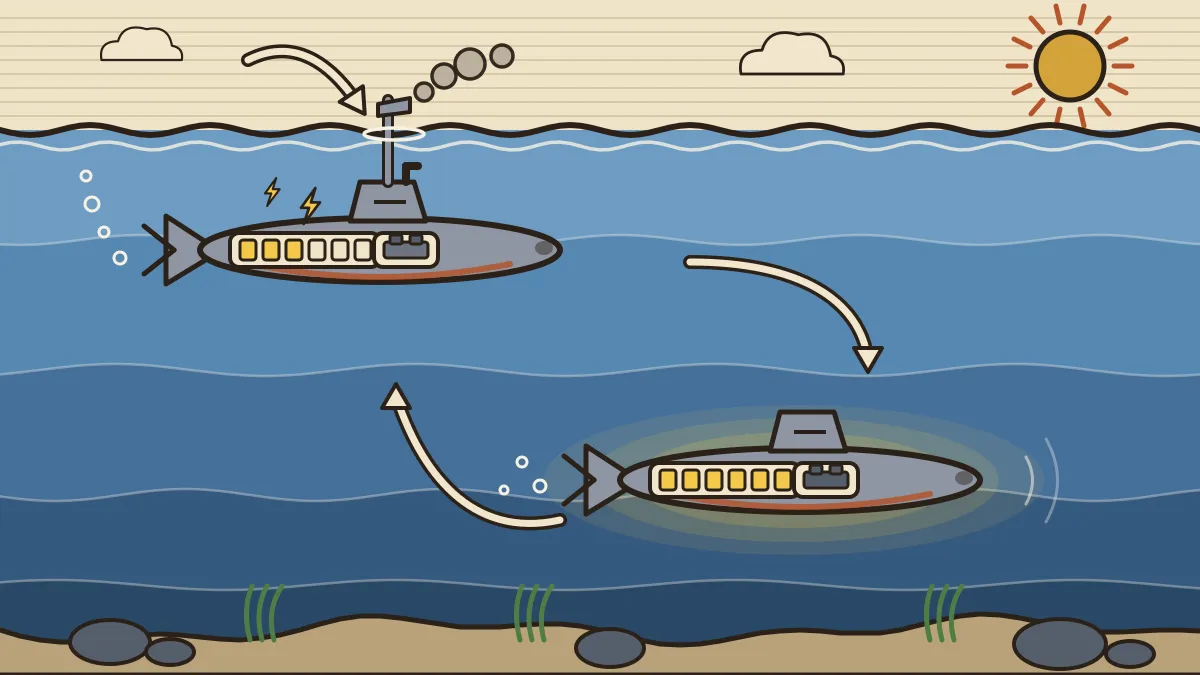
Why snorkelling is the vulnerable moment. The snorkel is a mast with a valve at its head. It lets air in and exhaust out while the hull stays hidden. But the mast leaves a small wake, the exhaust is hot, and the engines are the loudest thing the boat has. Radar, infrared sensors and listening ships can pick up those clues, and maritime patrol aircraft and the anti-submarine ships on the surface ships page exist to find them.
Speed matters too. Water drag rises very sharply with speed, so a boat creeping on battery lasts many times longer than one sprinting.
Air-Independent Propulsion: DRDO's Fuel-Cell System
AIP is a second power source that works without outside air. PIB says it "enhances the submerged endurance of the boat, several folds" and, in the 24 October 2026 release, that it reduces the boat's dependence on atmospheric oxygen. In plain terms, the boat can stay down longer before it has to snorkel. India's version is a fuel cell, and PIB calls it unique because the hydrogen is generated on board. It was developed by the Naval Materials Research Laboratory (NMRL) of the DRDO; see also the DRDO page.
| Date | Milestone, as PIB recorded it |
|---|---|
| 8 Mar 2021 | The land-based prototype at NMRL is proven, run in endurance mode and maximum-power mode; industry partners L&T and Thermax (PIB, 9 Mar 2021) |
| 23 Jan 2023 | NMRL and Naval Group sign an agreement in Mumbai to enter the detailed design phase for integrating the AIP in Kalvari-class boats; Naval Group is to certify the design |
| 30 Dec 2024 | The Ministry signs a contract of about Rs 1,990 crore with Mazagon Dock for the AIP plug (the extra hull section) and its integration on Indian submarines |
| 24 Oct 2026 | "Setting to Work Phase-2" of the AIP Energy Module is inaugurated at L&T's complex at Hazira, Gujarat |
The 24 October 2026 release says the module will next be energised for power production and tested to Navy protocols, then handed to Mazagon Dock for integration on a Kalvari-class boat in early 2027. So as of 27 November 2026 no Indian submarine has the AIP fitted, on PIB's own account. Our explainer on AIP reaching phase-2 trials covers the release, and the wider push for home-grown defence kit is on indigenisation and exports.
AIP does not make a boat nuclear-powered, and it does not change its label: a boat with AIP is still an SSK. A reactor needs no air at all and can run for months; AIP only stretches a conventional boat's time submerged. The word "independent" means independent of air, not independent of fuel.
The Kalvari Class: Project 75
Project 75 (P-75) is the programme that built six Scorpene-design boats at Mazagon Dock, Mumbai, in collaboration with Naval Group, France. PIB's account of the lead boat: first steel cut on 14 December 2006, launched 27 October 2015, delivered to the Navy 21 September 2017, length 67.5 metres, pennant S21, and the Navy's maiden SM-39 Exocet firing from a submarine on 2 March 2017. Her weapons are the sea-skimming SM-39 Exocet anti-ship missile and wire-guided heavy-weight torpedoes, with anti-torpedo decoys for self-defence.
| Boat | Commissioned (PIB) | What to remember |
|---|---|---|
| INS Kalvari (S21) | 14 Dec 2017, Mumbai | Lead boat; "tiger shark" in Malayalam; motto "Ever Onward" |
| INS Khanderi | 28 Sep 2019, Mumbai | Second boat; the Raksha Mantri took a four-hour sea sortie in her at Karwar on 27 May 2022 |
| INS Karanj | 10 Mar 2021, Mumbai | Third boat; joined the Western Naval Command's submarine fleet |
| INS Vela | 25 Nov 2021, Mumbai | Fourth boat; delivered 9 Nov 2021; PMSM propulsion motor |
| INS Vagir | 23 Jan 2023, Mumbai | Fifth boat; "sand shark"; the lowest build time of any Indian-built submarine up to then; Aug 2023 deployment to Fremantle was the Navy's first submarine deployment to Australia |
| INS Vagsheer | 15 Jan 2025, Mumbai | Sixth and last; commissioned with INS Surat and INS Nilgiri. PIB spells it both Vagsheer and Vaghsheer |
PIB places Karanj, Vela and Vagir in the Western Naval Command's submarine fleet at Mumbai (see Western Fleet and Naval Commands); its December 2025 backgrounder agrees with the months above.
Weapons contracts on the record. On 30 December 2024 the Ministry signed about Rs 877 crore with Naval Group to integrate the DRDO-developed Electronic Heavy Weight Torpedo on the class. On 30 December 2025 it signed about Rs 1,896 crore with WASS Submarine Systems, Italy, for 48 heavy-weight torpedoes, delivered from April 2028 to early 2030. Missiles are on Missiles of India.
- 28 Dec 2025: the President of India took a dived sortie in INS Vagsheer off Karwar, PIB records, the second President to sail in a submarine after Dr APJ Abdul Kalam.
- 30 Dec 2025: contract for 48 heavy-weight torpedoes for the Kalvari class (Rs 1,896 crore).
- 24 Oct 2026: the AIP Energy Module began Setting to Work Phase-2 at L&T Hazira, with integration on a Kalvari-class boat planned for early 2027.
Why "Kalvari" Appears Twice
The Navy reuses submarine names. Several Kalvari-class names were first carried by Soviet-built Foxtrot-class boats, and PIB records each old boat's end of service.
| Name | The old Foxtrot boat (PIB) | The new Scorpene boat |
|---|---|---|
| Kalvari | The Navy's first submarine, commissioned at Riga on 8 Dec 1967; decommissioned 31 May 1996 | 14 Dec 2017 |
| Karanj | Commissioned 4 Sep 1969 at Riga; took part in the 1971 war; decommissioned in 2003 | 10 Mar 2021 |
| Vela | Decommissioned in 2010 | 25 Nov 2021 |
| Vagir | Decommissioned in 2001 | 23 Jan 2023 |
The Submarine Arm was formed on 8 December 1967 when the Tricolour was hoisted on the first INS Kalvari, which is why the Navy keeps 8 December as Submarine Day. PIB says a team of officers had trained at HMS Dolphin, UK, in 1962, and that two Foxtrots took part in the 1971 war. The Arm's badge shows the National Emblem between two dolphins.
"The first submarine of the Indian Navy" is the Foxtrot Kalvari of 1967. "The lead boat of Project 75" is the Scorpene Kalvari of 2017. "The first submarine built in India" is neither: it is INS Shalki, commissioned on 7 February 1992 (see the next section).
Sindhughosh and Shishumar Classes
The Navy does not publish a running count of boats and old boats retire quietly, so this section records only what is on the official record, with dates.
| Class | Origin | What the record shows |
|---|---|---|
| Sindhughosh class (Project 877EKM, "Kilo") | Soviet Union / Russia | Inducted from the 1980s. INS Sindhudhvaj was decommissioned on 16 July 2022 after 35 years (PIB). Press reports said the lead boat, INS Sindhughosh, retired in December 2025; we found no PIB release, so no date is relied on. PIB has named other boats of the class in recent years: INS Sindhuratna (June 2021), INS Sindhukirti (a Rs 934 crore refit contract at Hindustan Shipyard, Visakhapatnam, signed 13 March 2023; PIB calls her the third Kilo-class boat) and INS Sindhukesari (SIMBEX 2023; a unit citation in 2024) |
| Shishumar class (HDW Type 209, "Type 1500") | German design, built under licence | Boats PIB names: INS Shishumar, INS Shankush, INS Shalki and INS Shankul. INS Shalki, the first built by Mazagon Dock, was commissioned on 7 Feb 1992 and was the first submarine built in India (PIB). She visited Colombo in August 2024. A medium refit with life certification of INS Shankush was contracted at Mazagon Dock for Rs 2,725 crore, with delivery planned in 2026 (PIB year-end review 2023) |
No official list says which older boats are operational on a given day, so this page does not guess.
Reference books and websites give slightly different dates for individual Sindhughosh and Shishumar boats. UPSC follows official figures, so remember the PIB-dated ones: Shalki on 7 February 1992 and Sindhudhvaj retired 16 July 2022. The PIB texts we found give no other dates for these two classes, so none is given here.
Project 75I: What Is on the Official Record
Project 75 India (P-75I) is the follow-on programme: six conventional submarines, AIP-fitted, built in India under the Strategic Partnership model. Only official milestones are listed here.
| Date | Official milestone (PIB) |
|---|---|
| 31 Jan 2019 | The Defence Acquisition Council approves indigenous construction of six submarines at over Rs 40,000 crore; PIB calls it the second project under the Strategic Partnership model, after the Naval Utility Helicopter |
| 20 Jun 2019 | Expression of Interest issued for Indian strategic partners; cost given as about Rs 45,000 crore |
| Jun 2021 | The DAC approves the RFP at approximately Rs 43,000 crore |
| 20 Jul 2021 | RFP issued to Mazagon Dock and L&T; the five foreign OEMs shortlisted were Naval Group (France), TKMS (Germany), JSC ROE (Russia), Daewoo (South Korea) and Navantia (Spain); requirement includes fuel-cell AIP, advanced torpedoes and modern missiles |
As of 27 November 2026 we found no PIB release announcing a signed P-75I contract, so treat any contract date or boat price in the press as unconfirmed. ANI reported on 1 October 2026 the Defence Secretary saying a six-submarine deal was in its final stages; that is not a PIB milestone and is not counted here.
PIB's 2019 release calls P-75I the second Strategic Partnership project; its July 2021 RFP release calls it the first acquisition programme under the model to reach RFP. Answer with the 2019 order: it followed the Naval Utility Helicopter. PIB's cost also differs by release (over Rs 40,000 crore, about Rs 45,000 crore, about Rs 43,000 crore); for the 2019 approval give "over Rs 40,000 crore".
Exam pins
- A diesel-electric boat uses diesel engines to charge batteries and an electric motor to move under water; it is most detectable while snorkelling.
- The Kalvari class (Project 75) has six Scorpene-design boats built at Mazagon Dock with Naval Group, France.
- Order and dates: Kalvari 14 Dec 2017, Khanderi 28 Sep 2019, Karanj 10 Mar 2021, Vela 25 Nov 2021, Vagir 23 Jan 2023, Vagsheer 15 Jan 2025.
- The lead boat is S21, 67.5 m long, with 360 battery cells and two 1,250 kW diesel engines; first steel cut 14 Dec 2006.
- The Navy's first submarine, the Foxtrot INS Kalvari, was commissioned at Riga on 8 Dec 1967; Submarine Day is 8 December.
- INS Shalki (7 Feb 1992, Shishumar class) was the first submarine built in India.
- DRDO-NMRL's AIP is a fuel cell that makes hydrogen on board; land prototype proven 8 March 2021; Rs 1,990 crore AIP plug contract with Mazagon Dock on 30 Dec 2024.
- AIP Energy Module reached Setting to Work Phase-2 at L&T Hazira on 24 Oct 2026; integration on a Kalvari-class boat planned early 2027.
- P-75I: six AIP-fitted conventional boats, DAC approval 31 Jan 2019, RFP 20 Jul 2021; no official contract announcement found by 27 Nov 2026.
- Decommissioned (PIB): Kilo-class INS Sindhudhvaj, 16 Jul 2022, after 35 years.
Asked in past papers
Questions here come in two kinds: programme questions on what P-75I is and where the policy sits, and the sonar that finds a submarine.
P-751 (or P-75 India) project refers to manufacture of
(a) Diesel-electric submarines (b) Nuclear-powered submarines (c) Aircraft carrier warships (d) Field guns
Answer: (a). P-75I is the programme for six conventional, AIP-fitted submarines, the follow-on to Project 75. Option (b) is the tempting error: the numeral 75 has no link with the nuclear boats.
The policy on strategic partnerships in defence was approved by the Ministry of Defence in May 2017. Which of the following is not among the four segments identified by the Ministry for acquisition through the strategic partnership route?
(a) Artillery guns (b) Fighter aircraft and helicopters (c) Submarines (d) Armoured fighting vehicles and main battle tanks
Answer: (a). The four segments were submarines, fighter aircraft, helicopters and armoured vehicles or tanks. Artillery is the odd one out. P-75I is the submarine segment. Option (b) looks wrong because it joins two items, but both are on the list.
Which one of the following is a decommissioned aircraft carrier?
(a) INS Rajput (b) INS Chakra (c) INS Khanderi (d) INS Viraat
Answer: (d). INS Viraat is the former carrier. The distractors are a destroyer (Rajput), the leased nuclear-powered Chakra and the Kalvari-class submarine Khanderi. The word "carrier" decides it.
SONAR is a device that is used to measure the distance of underwater objects by a ship. Which of the following types of waves does it use for this purpose?
(a) Infrasonic waves (b) Sound waves in audible range for human beings (c) Ultrasonic waves (d) All of the above
Answer: (c). Sonar sends out ultrasonic pulses and times the echo. Option (b) tempts because we call the device "sound navigation"; option (d) is the "safe-looking" choice that the question is built to catch.
Practice MCQs (with answers)
- In a diesel-electric submarine, the diesel engines are used mainly to
- fire torpedoes
- charge the batteries
- make sonar pulses
- turn the periscope
- A conventional submarine is easiest to detect when it is
- snorkelling at periscope depth
- running on battery at depth
- lying still on the seabed
- in a covered dock
- Which Kalvari-class boat was commissioned on 25 November 2021?
- INS Karanj
- INS Khanderi
- INS Vagir
- INS Vela
- The air-independent propulsion system developed by DRDO's NMRL is based on a
- steam turbine
- small nuclear reactor
- fuel cell
- wind turbine
- Project 75I envisages how many AIP-fitted conventional submarines?
- four
- six
- eight
- ten
- The Kilo-class submarine INS Sindhudhvaj was decommissioned, after 35 years, in
- 2017
- 2022
- 2025
- 2027
1-b, 2-a, 3-d, 4-c, 5-b, 6-b. Q1: the engines charge; the electric motor turns the propeller. Q2: snorkelling brings the mast, exhaust and engine noise. Q3: Karanj is March 2021, Khanderi September 2019, Vagir January 2023. Q4: AIP does not mean nuclear. Q5: six, the same number as Project 75. Q6: PIB records Sindhudhvaj leaving service on 16 July 2022.
Where to Go Next
Read the nuclear boats next to see why a reactor changes the whole cycle above, then go back to the submarines section. Our career in the Indian Navy page explains entry routes. Boards ask what you know about the service you want, so keep our SSB interview tips open beside this page, and our daily defence notes carry each new submarine event, such as INS Malvan and anti-submarine warfare. Graduates enter the Naval Academy through the CDS course, which our CDS batches cover with weekly tests and SSB training; 12th-pass candidates take the Naval wing of the NDA with our NDA course.
Frequently asked questions
Why does a diesel-electric submarine have to snorkel?
Its diesel engines need air, and a sealed boat under water has none to spare, so it runs on batteries when submerged. When the battery runs low it rises to periscope depth, raises the snorkel mast, runs the diesels and recharges. This is the boat's weak moment because the mast, exhaust and engine noise can be detected.
What is AIP in a submarine and has India fitted it?
Air-independent propulsion is a second power source that needs no outside air, so a conventional boat stays submerged much longer. India's version is a DRDO-NMRL fuel cell that makes hydrogen on board. As of 27 November 2026, PIB says it is in Setting to Work Phase-2, with integration on a Kalvari-class boat planned for early 2027, so no boat has it yet.
Which are the six Kalvari-class submarines and when were they commissioned?
They are INS Kalvari (14 December 2017), INS Khanderi (28 September 2019), INS Karanj (10 March 2021), INS Vela (25 November 2021), INS Vagir (23 January 2023) and INS Vagsheer (15 January 2025). All are Scorpene-design boats built at Mazagon Dock, Mumbai, with Naval Group of France under Project 75.
Which Indian submarines have been decommissioned recently?
PIB records INS Sindhudhvaj, a Sindhughosh-class (Kilo) boat, decommissioned on 16 July 2022 after 35 years. Press reports said the lead boat, INS Sindhughosh, retired in December 2025, but we found no official release. The Navy does not publish a running list of the boats still in service.
What is the status of Project 75I?
Project 75I is the plan for six AIP-fitted diesel-electric submarines built in India under the Strategic Partnership model. The Defence Acquisition Council approved it on 31 January 2019 and the Request for Proposal went out on 20 July 2021. As of 27 November 2026 we found no official announcement of a signed contract.
More in Submarines
← Back to Submarines · Defence GK home
Sources: pib.gov.in/PressReleasePage.aspx?PRID=1512525 · pib.gov.in/PressReleasePage.aspx?PRID=2328040 · pib.gov.in/PressReleasePage.aspx?PRID=2088874 · pib.gov.in/PressReleaseIframePage.aspx?PRID=1562133
Preparing for CDS or OTA?
Cavalier's CDS/OTA batches teach the whole GK paper, defence awareness included, with PYQ drills, weekly tests and SSB training.