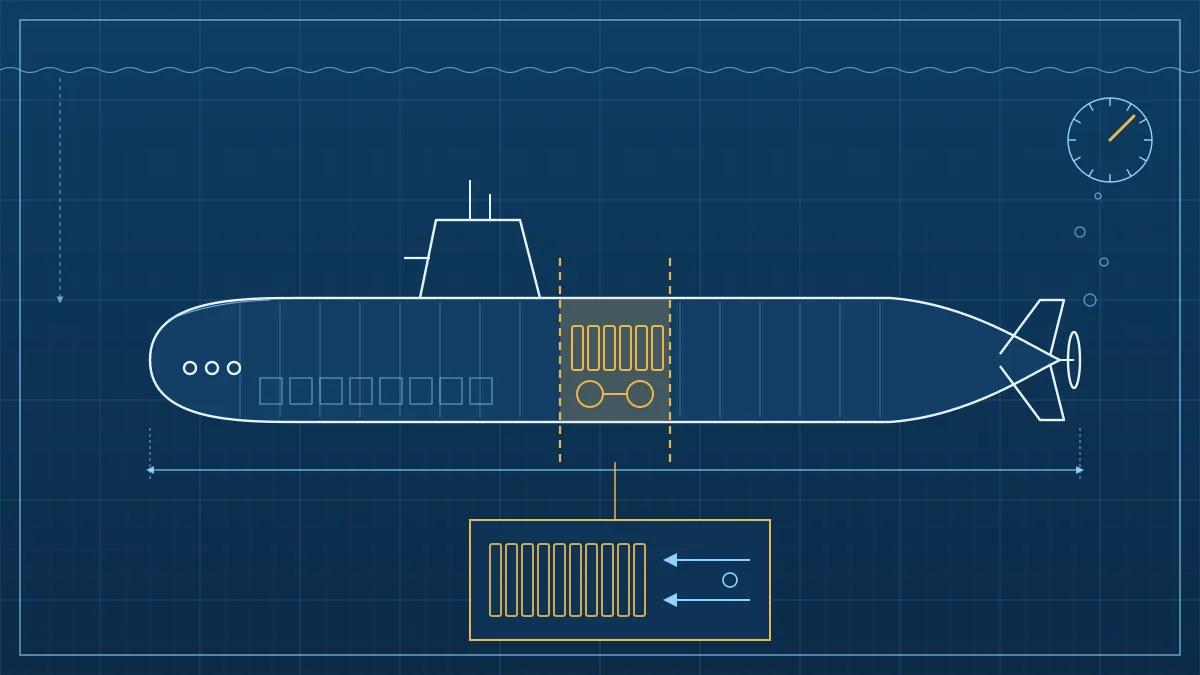
The Air Independent Propulsion (AIP) system developed by the Naval Materials Research Laboratory (NMRL) of DRDO reached a new milestone on 24 October 2026, when Setting to Work Phase-2 of its energy module was inaugurated at Larsen & Toubro's A.M. Naik Heavy Engineering Complex, Hazira, Gujarat. The DRDO Chairman attended virtually, with the Navy's Chief of Materiel and DRDO's Director General (Naval Systems & Materials) at Hazira.
The next step, according to the release, is to energise the module for power production, test it to the Navy's protocols, and then hand it to Mazagon Dock Shipbuilders for integration on a Kalvari-class submarine in early 2027. The DRDO Chairman stressed the "exacting safety culture" that hydrogen and fuel-cell systems demand.
To see why this matters, start with the basic weakness of a conventional submarine.
The problem AIP solves
A diesel-electric submarine runs underwater on batteries. Its diesel engines need air, so to recharge the batteries the submarine must come near the surface and raise a snorkel — a pipe that draws in air for the engines and expels exhaust.
That is when it is most vulnerable. A snorkel mast and its exhaust can be picked up by radar, by infrared sensors and by patrol aircraft, and the noise of running diesels carries through the water. On batteries alone, a conventional submarine can typically stay down for only about two to four days at low speed before it must snorkel again.
Air Independent Propulsion is any system that lets a non-nuclear submarine generate power underwater without atmospheric oxygen, so it can stay submerged for much longer — weeks rather than days — and snorkel far less often. DRDO's stated aim for its system is underwater endurance of up to about 14 days.
Nuclear submarines do not need AIP. Their reactors produce power without air, which is why they can stay submerged for months. AIP is a way of giving conventional submarines some of that stealth at a fraction of the cost.
Four ways to build AIP
| Technology | How it works | Example |
|---|---|---|
| Fuel cell | Hydrogen and oxygen combine electrochemically to produce electricity, with water as the by-product — silent, few moving parts | German Type 212 and Type 214 submarines |
| Stirling engine | An external-combustion engine burns fuel with stored liquid oxygen to drive a generator | Swedish Gotland class |
| MESMA | Ethanol burned with liquid oxygen produces steam that drives a turbine | French design offered for the Scorpene |
| Closed-cycle diesel | A diesel engine runs on stored oxygen mixed with recycled exhaust gas | German development |
Fuel cells are generally regarded as the quietest option. The German Type 212A's fuel cells have allowed record submerged transits of more than two weeks without snorkelling.
What is distinctive about India's design
India's AIP is a fuel-cell system, and its distinguishing feature is where the hydrogen comes from.
- Most fuel-cell submarines carry hydrogen stored in metal hydrides, which is heavy and demands careful handling.
- NMRL's system generates hydrogen on board by reacting sodium borohydride with water, producing hydrogen and sodium metaborate. The hydrogen feeds a phosphoric acid fuel cell, and liquid oxygen is carried for the reaction.
Generating hydrogen as it is needed avoids storing large quantities of it, which DRDO presents as a safety and logistics advantage. The land-based prototype, built at NMRL in Ambernath, Maharashtra, was tested in March 2021 in both endurance mode and maximum-power mode. L&T is building the energy module.
The Kalvari class and the "AIP plug"
The Kalvari class is India's Project 75: six submarines of the French Scorpene design, built by Mazagon Dock Shipbuilders in Mumbai under technology transfer from France's Naval Group. INS Kalvari was commissioned in December 2017, and the sixth, INS Vagsheer, in January 2025.
The boats were built without AIP. Adding it requires cutting the hull and inserting a new section — an "AIP plug" — that contains the energy module, which lengthens the submarine. The plan is to fit the plug during a submarine's scheduled refit, which explains why the module goes to Mazagon Dock rather than straight into a boat. A separate programme, Project 75(I), is intended to give the Navy new conventional submarines with AIP built in from the start.
Why it matters for the Navy
India's submarine arm combines nuclear submarines — the Arihant class of ballistic-missile boats — with a larger conventional fleet that patrols the Indian Ocean and its chokepoints. For the conventional boats, endurance underwater is the difference between a submarine that must expose itself every few days and one that can wait silently near a chokepoint for weeks. Submarines are among the hardest targets to find, which is why so much of the Navy's recent investment goes into the opposite capability — hunting them, as described in our explainers on INS Malvan and anti-submarine warfare and the Mangrol shallow-water craft.
There is also an industrial point. AIP is a technology few countries have mastered, and it is not easily bought. An indigenous system, built by DRDO with Indian industry, gives the Navy control over a capability it would otherwise have to import — the same logic behind indigenous warships such as the Project 17A frigates built at Mazagon Dock.
🔑 Revision block
- The event: Setting to Work Phase-2 of DRDO's AIP energy module inaugurated at L&T Hazira, Gujarat, 24 October 2026.
- Developer: Naval Materials Research Laboratory (NMRL), DRDO, Ambernath (Maharashtra); land-based prototype tested March 2021 in endurance and maximum-power modes.
- Next: module energised and tested to Navy protocols → handed to Mazagon Dock → integration on a Kalvari-class submarine in early 2027.
- Why AIP: diesel-electric boats must snorkel to charge batteries (about 2-4 days on batteries); AIP lets them stay submerged for weeks; DRDO aims for about 14 days. Nuclear submarines do not need AIP.
- AIP types: fuel cell (German Type 212/214), Stirling (Swedish Gotland), MESMA (French, offered for Scorpene), closed-cycle diesel.
- India's design: phosphoric acid fuel cell; hydrogen generated on board from sodium borohydride + water; liquid oxygen carried.
- Kalvari class: Project 75, six Scorpene-design boats, Mazagon Dock, with France's Naval Group; INS Kalvari (2017) to INS Vagsheer (2025); AIP fitted as a hull "plug" during refit. Project 75(I) = new boats with AIP built in.
🎯 Practice MCQs
Q1. Air Independent Propulsion is used to: (a) increase the surface speed of aircraft carriers (b) let non-nuclear submarines stay submerged longer without atmospheric oxygen (c) power torpedoes after launch (d) cool the reactors of nuclear submarines
→ (b) AIP reduces how often a diesel-electric submarine must snorkel to recharge its batteries.
Q2. India's indigenous AIP system has been developed by which DRDO laboratory? (a) Naval Materials Research Laboratory (b) Defence Research and Development Laboratory (c) Naval Science and Technological Laboratory (d) Gas Turbine Research Establishment
→ (a) NMRL, at Ambernath in Maharashtra, built the land-based prototype tested in 2021.
Q3. In India's AIP design, hydrogen for the fuel cell is obtained by: (a) carrying compressed hydrogen gas in cylinders (b) electrolysing seawater (c) storing it in metal hydrides (d) reacting sodium borohydride with water on board
→ (d) Generating hydrogen as needed avoids storing large quantities of it.
Q4. The Kalvari-class submarines are based on which design? (a) Kilo (b) Type 209 (c) Scorpene (d) Collins
→ (c) They were built by Mazagon Dock under Project 75 with technology from France's Naval Group.
Q5. Which of the following types of submarine does NOT need an AIP system? (a) Nuclear-powered submarines (b) Diesel-electric attack submarines (c) Conventional coastal submarines (d) Scorpene-class submarines
→ (a) A nuclear reactor generates power without air, so nuclear boats can stay submerged for months.
Q6. The Stirling-engine type of AIP is associated with the submarines of: (a) Germany (b) Sweden (c) France (d) Japan
→ (b) The Swedish Gotland class uses Stirling AIP; German Type 212/214 boats use fuel cells.
Q7. A diesel-electric submarine raises a "snorkel" in order to: (a) launch missiles (b) communicate with satellites (c) draw in air to run its diesel engines and recharge its batteries (d) release excess pressure from its ballast tanks
→ (c) Snorkelling is when the submarine is most exposed to detection.
Q8. The AIP energy module's Setting to Work Phase-2 was inaugurated in October 2026 at: (a) L&T's heavy engineering complex at Hazira (b) Mazagon Dock, Mumbai (c) Cochin Shipyard (d) Naval Dockyard, Visakhapatnam
→ (a) After testing, the module is to be handed to Mazagon Dock for integration on a Kalvari-class submarine.
Q9. Which programme is intended to give the Indian Navy new conventional submarines with AIP built in from the start? (a) Project 17A (b) Project 28 (c) Project 15B (d) Project 75(I)
→ (d) Project 75 produced the Kalvari class; Project 75(I) is the follow-on with AIP.
Q10. The by-product of the reaction in a hydrogen-oxygen fuel cell is: (a) carbon dioxide (b) water (c) carbon monoxide (d) sulphur dioxide
→ (b) Fuel cells combine hydrogen and oxygen electrochemically, producing electricity, heat and water.
📋 How this gets asked (PYQ pattern)
Submarines and naval technology appear regularly in the NDA GAT, and AIP brings together defence knowledge and basic science.
The first form is the definition question: what AIP stands for, and what it does. The trap is to connect it with nuclear submarines, which do not need it.
The second is the class-and-origin question: the Kalvari class with the Scorpene design and France, the Arihant class as nuclear ballistic-missile submarines, and Mazagon Dock as the builder. Project numbers paired with classes — 75 with Kalvari, 17A with Nilgiri, 28 with Kamorta — make a standard matching grid.
The third is the science question: what a fuel cell produces, or why oxygen must be carried. A question on the by-product of a hydrogen fuel cell (water) bridges defence and chemistry.
A fourth, occasional, is the laboratory question: which DRDO lab developed a given system. NMRL is the answer here.
For the SSB interview or a group discussion on self-reliance, the useful point is that AIP shows where indigenous development matters most: in technologies that are not freely sold. A Navy that can keep its conventional submarines hidden for weeks has a much stronger deterrent in the Indian Ocean, and an AIP system built in India removes a dependence that would otherwise be hard to escape.
Preparing for NDA? Keep a table of every warship and submarine class with its project number, builder and origin — it answers a large share of naval questions in the GAT. Build the base with our NDA study material, follow the daily NDA current affairs, and train with serving-standard faculty in the upcoming Cavalier courses in Delhi.
✍️ Written by Maj Sunil Chopra — Co-founder & defence faculty at The Cavalier. Reviewed by the Cavalier Faculty Desk.