By Col Vijayant Thakur (Retd) · Defence faculty, The Cavalier
A surface-to-air missile (SAM) is fired from the ground or a vehicle at an aircraft, a cruise missile or a drone. The Air Force keeps a family of them, sorted by how far they reach: S-400 at long range, MRSAM in the middle, Akash and SPYDER closer in. Examiners ask the same few things about each: which country, which agency, which range class, which service.
This page is the missile-by-missile detail under Indian Air Force air defence, where the layers and the IACCS network are explained. Only what PIB, the Ministry of Defence and DRDO have published is used: no sites, no deployments, no counts of rounds.
Three Layers in Plain Words
Think of a cricket field. The long-range missile is the fielder at the boundary, the medium-range missile covers the inner ring, and the short-range missile is the slip cordon. A hostile aircraft that gets past one meets the next. That is layered air defence. A PIB note of 4 February 2022 on the Air Force's capacity said the induction of S-400, MRSAM, VSHORADS and close-in weapon systems "will enable a layered Air Defence capability".
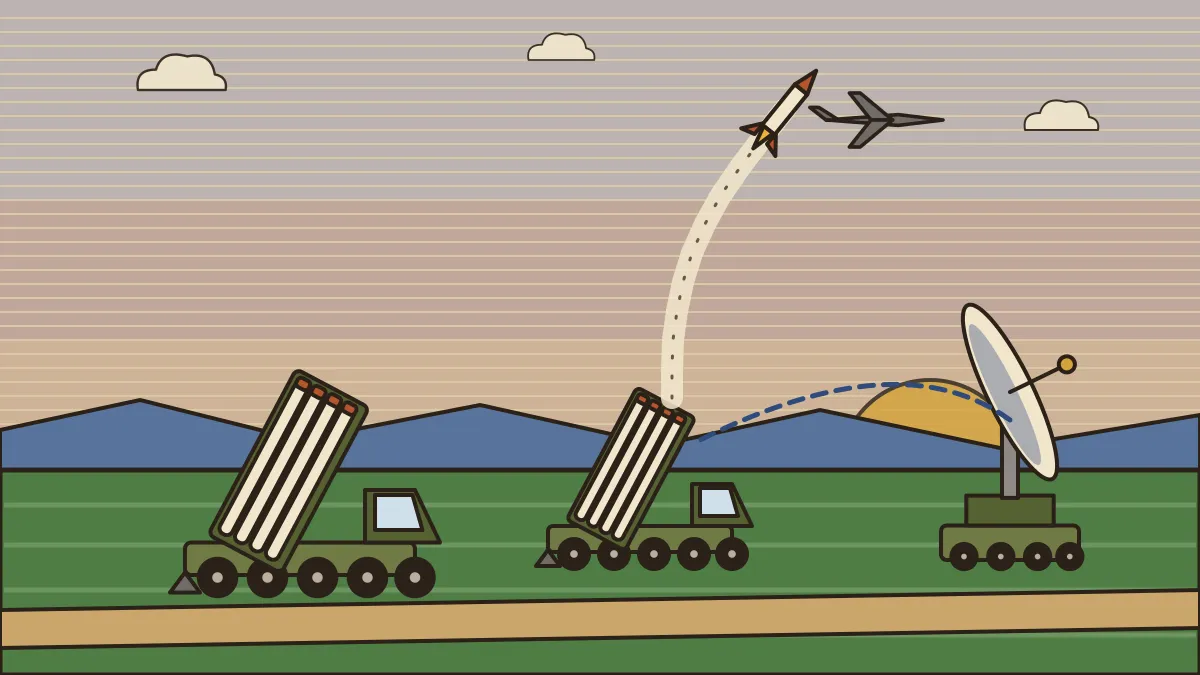
- Long range: reaches threats far from the site they guard. S-400 today, Kusha when it is inducted.
- Medium range: the working middle layer. MRSAM.
- Short range: protects bases and vulnerable points from aircraft, drones and missiles that got through. Akash, Akash-NG, SPYDER.
- Very short range: shoulder-fired and gun systems, mostly with the Army.
None of these fires on its own. Radars find the target and the Integrated Air Command and Control System (IACCS) picks the weapon; the network is explained on radar networks.
S-400 Triumf: The Long-Range Layer
The S-400 Triumf is a Russian long-range surface-to-air missile system. India procured it; it is not built in India. PIB's India-Russia note of December 2025 says exactly that: "not jointly produced but procured". The contract with Russia was signed on 5 October 2018, as the Raksha Rajya Mantri told the Lok Sabha on 3 December 2021, adding that deliveries were "as per contractual timelines". The Ministry has not published a delivery table, and press figures for squadrons delivered vary, so this page gives none.
The Defence Acquisition Council cleared the S-400 long-range surface-to-air missile system for the Air Force on 27 March 2026, and PIB said it "will counter enemy long-range air vectors targeting vital areas". ANI's reports call the S-400 "Sudarshan Chakra" or "Sudarshan". PIB's Republic Day 2026 release said that the Akash and S-400 systems "provided a protective shield" in Operation Sindoor, which it said reflects the Prime Minister's Sudarshan Chakra vision.
On Operation Sindoor, PIB's description of the Republic Day tableau (23 January 2026) said the S-400 made the longest-range engagement of the operation, at 350 km, against an adversary airborne early-warning platform. Take that as PIB's wording for the tableau story, not as a technical specification of the missile.
The press nickname for the S-400 (in ANI's reports) is different from Mission Sudarshan Chakra, the national shield programme announced on 15 August 2025. The programme is on the air defence page.
MRSAM and the Barak-8 Family: The Medium Layer
MRSAM (Medium-Range Surface-to-Air Missile) is the India-Israel system. PIB says it was "developed jointly by DRDO and Israel Aerospace Industries". One family, three users:
- Air Force: a PIB note of 4 February 2022 lists the induction of MRSAM among the systems building a layered defence.
- Army: DRDO and the Army carried out four flight tests of the Army version at Dr APJ Abdul Kalam Island off Odisha on 3 and 4 April 2025. The targets were at long range, short range, high altitude and low altitude, and all four were destroyed with direct hits. PIB said this paved the way for operationalising the system in two regiments. The Defence Acquisition Council cleared more MRSAM for the Army on 3 July 2026.
- Navy: a contract of about ₹2,960 crore with Bharat Dynamics Limited for MRSAM missiles was signed on 16 January 2025.
Naval releases call the same missile Barak-8; the MRSAM system's missile is "the BARAK 8 missile" in PIB's May 2025 note on the MRSAM-India Eco-System Summit, which also lists Bharat Electronics and Bharat Dynamics among the participants. The ship-borne use is on guided missile destroyers.
Barak-1 is an older, shorter-range naval point-defence missile. Barak-8 is the MRSAM family. See our explainer on the Barak-1 upgrade contract.
Akash and Akash-NG: The Indigenous Short-Range Layer
Akash is DRDO's own surface-to-air system, made with Indian industry: for its Army version, Akash Prime, PIB names Bharat Dynamics Limited and Bharat Electronics Limited among the industry partners. In PIB's Operation Sindoor note it is "a Short Range Surface to Air Missile system to protect vulnerable areas and vulnerable points", able to engage multiple targets at once in group or autonomous mode, with built-in electronic counter-countermeasures. Both the Air Force and the Army use it.
Older books and some question banks call Akash medium range. PIB calls it short range. UPSC follows official wording, so answer "short range" if the option says so, and "indigenous" in either case.
- Akash Prime is the Army's upgraded version. On 16 July 2025 it destroyed two high-speed unmanned targets at high altitude in Ladakh. PIB says it is customised for altitudes above 4,500 metres and has an indigenous radio-frequency (RF) seeker.
- Akash-NG (New Generation) is the Air Force's next missile. DRDO completed its user evaluation trials on 23 December 2025 with Air Force representatives present. PIB lists an indigenous RF seeker and a solid rocket motor, and says completion "paved the way for induction". It has not been announced as inducted.
- On 16 February 2026 the Raksha Mantri flagged off the Akash 3rd and 4th Regiment combat systems at BEL Bengaluru.
The Army arm that fires Akash is on Army combat arms, and its weapons are on Army weapon systems.
SPYDER, Kusha and the Older Guard
SPYDER is an Israeli quick-reaction short-range system with the Air Force: a PIB reply of 11 December 2008 says the Ministry signed a contract with Rafael of Israel to procure the Spyder Low Level Quick Reaction Missile System for the Indian Air Force. The Ministry's Defence Acquisition Council gave approval in August 2025 for upgrading the SAKSHAM/SPYDER weapon system "for integration with Integrated Air Command and Control System". At Exercise Vayushakti-26 (27 February 2026) PIB said air defence was shown through "Akash and Spyder missile systems, supported by Army air defence assets, like L-70 and M-777".
Kusha is DRDO's long-range surface-to-air missile; PIB says its radars and command centre were also developed by DRDO laboratories and industry partners. It had its maiden flight test on 23 July 2026 from Dr APJ Abdul Kalam Island, intercepting a target that simulated a high-speed, high-altitude threat. PIB says the Raksha Mantri described it as a capability "possessed only by a handful of nations". A BEL briefing in February 2026 listed it as "Project Kusha (MR SAM/LR SAM)". It is in trials, not in service. The missile-science background is on missiles of India.
The legacy systems are named by PIB only in the Sindoor context: "battle-proven" Pechora and OSA-AK air-defence systems and low-level air-defence guns, alongside Akash, in a layered defence grid. The Ministry has not announced a retirement date for Pechora, so none is given here. The V-SHORADS (very short range air defence system) was cleared for the Army by the Defence Acquisition Council on 3 July 2026.
- 27 Mar 2026: the Defence Acquisition Council clears the S-400 system for the Air Force.
- 3 Jul 2026: MRSAM and V-SHORADS cleared for the Army. Details in our DAC explainer.
- 23 Jul 2026: Kusha, the long-range SAM, makes its maiden flight test.
- 26 Oct 2026: the Defence Acquisition Council clears VSHORADS for the Army and unspecified "Air Defence Systems" for the Air Force (PIB).
Who Operates What
The Air Force defends the airspace and its own bases. The Army has a separate arm, Army Air Defence, an arm of its own that protects field formations, and the Navy fires its own ship-borne missiles. Several systems appear in both Air Force and Army hands, which is why options get muddled.
| System | Origin | Range class | Operator |
|---|---|---|---|
| S-400 Triumf | Russia (procured) | Long | Air Force |
| Kusha | India (DRDO) | Long; in trials | Not yet inducted |
| MRSAM / Barak-8 | India with Israel (DRDO and IAI) | Medium | Air Force, Army and Navy |
| Akash | India (DRDO; made by BDL and BEL) | Short (PIB) | Air Force and Army |
| Akash Prime / Akash-NG | India (DRDO) | Short (PIB) | Army (Prime); Air Force (NG, user trials done) |
| SPYDER | Israel | Short, quick reaction | Air Force |
| Pechora, OSA-AK | Russian-origin legacy | Legacy (PIB) | Named in Operation Sindoor |
| V-SHORADS | India (DRDO) | Very short | Army cases cleared 2026 |
All of them plug into one network, IACCS, which gives the Army and Navy the same air picture. The aircraft that carry airborne radars are on force multipliers, and the fighters that work with these missiles are on IAF fighter jets.
Exam pins
- S-400 Triumf = Russia, long range, with the Air Force; contract signed 5 October 2018; procured, not co-produced.
- MRSAM = India-Israel (DRDO and Israel Aerospace Industries); the missile is Barak-8; used by the Air Force, Army and Navy.
- Akash = indigenous (DRDO); PIB says short range; made by BDL and BEL; Air Force and Army.
- Akash Prime = Army version for above 4,500 m; test in Ladakh on 16 Jul 2025.
- Akash-NG = user trials completed 23 Dec 2025, with an RF seeker.
- Kusha = DRDO long-range SAM; maiden flight test 23 Jul 2026.
- SPYDER = Israeli quick-reaction short-range system with the Air Force.
- Pechora and OSA-AK = battle-proven legacy systems named by PIB for Operation Sindoor.
- Army Air Defence is the Army's own arm for ground-based air defence, separate from the Air Force.
- The press name "Sudarshan Chakra" for the S-400 is not Mission Sudarshan Chakra.
Asked in past papers
Only one real past-paper question on these missiles exists in the papers we hold, and it is a country question. The second item below is from a model paper, not an actual exam.
From which one of the following countries has India procured the S-400 Triumf air defence missile system?
(a) United Kingdom (b) U.S.A. (c) France (d) Russia
Answer: (d). The contract was signed with Russia on 5 October 2018. France is tempting because of the Rafale fighter; the United States is tempting because of its own Patriot and THAAD systems.
Name the country from which India bought the Barak Missile Defence System.
(a) Israel (b) France (c) Russia (d) USA
Answer: (a). The Barak family comes from Israel; the medium-range MRSAM (Barak-8) was developed jointly by DRDO and Israel Aerospace Industries. Russia tempts because of the S-400.
Practice MCQs (with answers)
- The S-400 Triumf air-defence system was procured by India from
- France
- Israel
- The United States
- Russia
- MRSAM was developed jointly by DRDO and
- Rafael Advanced Defense Systems
- Israel Aerospace Industries
- NPO Mashinostroyeniya
- Dassault Aviation
- In PIB's wording, Akash is a
- long-range ballistic missile defence system
- shoulder-fired missile
- medium-range missile developed by Israel
- short-range surface-to-air missile system
- Akash Prime, tested in Ladakh in July 2025, is designed for altitudes above
- 1,500 metres
- 3,000 metres
- 4,500 metres
- 9,000 metres
- DRDO's long-range surface-to-air missile that made its maiden flight test on 23 July 2026 is
- Kusha
- Akash-NG
- V-SHORADS
- Barak-1
- Which one is the Army's own arm for ground-based air defence?
- Army Air Defence
- Army Aviation Corps
- Corps of Signals
- Regiment of Artillery
1-d, 2-b, 3-d, 4-c, 5-a, 6-a. Q1: Russia; France is the Rafale country. Q2: the partner is Israel Aerospace Industries; Rafael makes other Israeli systems and is a tempting near-match, and NPO Mashinostroyeniya is a Russian firm, not the MRSAM partner. Q3: PIB says short range, and the Israeli option is wrong because Akash is indigenous. Q4: the 4,500 m figure is PIB's. Q5: Akash-NG finished user trials in December 2025, V-SHORADS is very short range and Barak-1 is a naval point-defence missile. Q6: Army Air Defence is the Army's own arm for this job; the Artillery option is tempting because it also handles guns.
Where to Go Next
Practise a three-minute talk on "why India needs layered air defence" with our lecturette topics for SSB, then revise AFCAT defence awareness. To see how the branches of the Air Force work, read career in the Indian Air Force, and if you are aiming at the NDA, see our NDA coaching page. Cavalier's AFCAT coaching covers general awareness, military aptitude, reasoning, numerical ability and English, and prepares you for the Air Force Selection Board.
Frequently asked questions
Which missile is used in IAF air defence?
The Air Force uses a layered family: the Russian S-400 Triumf for long range, MRSAM (Barak-8) for medium range, and the indigenous Akash and the Israeli SPYDER for shorter ranges. DRDO's long-range Kusha made its first flight test on 23 July 2026 and is still in trials.
From which country did India buy the S-400?
India bought the S-400 Triumf from Russia. The contract was signed on 5 October 2018, and the Defence Acquisition Council cleared a further S-400 proposal for the Air Force on 27 March 2026. The Ministry has not published a delivery table.
Is Akash a medium-range or short-range missile?
Older books call it medium range, but PIB describes Akash as a short-range surface-to-air missile system. It is indigenous, designed by DRDO and made with Bharat Dynamics and Bharat Electronics, and used by both the Air Force and the Army.
What is MRSAM?
MRSAM is the Medium-Range Surface-to-Air Missile, developed jointly by DRDO and Israel Aerospace Industries. Its missile is known as Barak-8, and the Air Force, Army and Navy all use versions of it. The Army version completed four flight tests in April 2025.
What is the difference between Air Force and Army air defence?
The Air Force defends the nation's airspace and its own bases, while Army Air Defence is a separate arm that protects field formations. Both fire Akash, and both feed one shared air picture through the IACCS network.
More in Air Defence
← Back to Air Defence · Defence GK home
Sources: pib.gov.in/PressReleasePage.aspx?PRID=1777612 · pib.gov.in/PressReleasePage.aspx?PRID=2118918 · pib.gov.in/PressReleasePage.aspx?PRID=2207971 · pib.gov.in/PressReleasePage.aspx?PRID=2288526
Aiming for the Air Force?
Cavalier's AFCAT batches cover general awareness, military aptitude, numerical ability and English, then prepare you for the AFSB.