By Abhishek Thakur · Science faculty, The Cavalier · 15 years teaching NDA and CDS Science
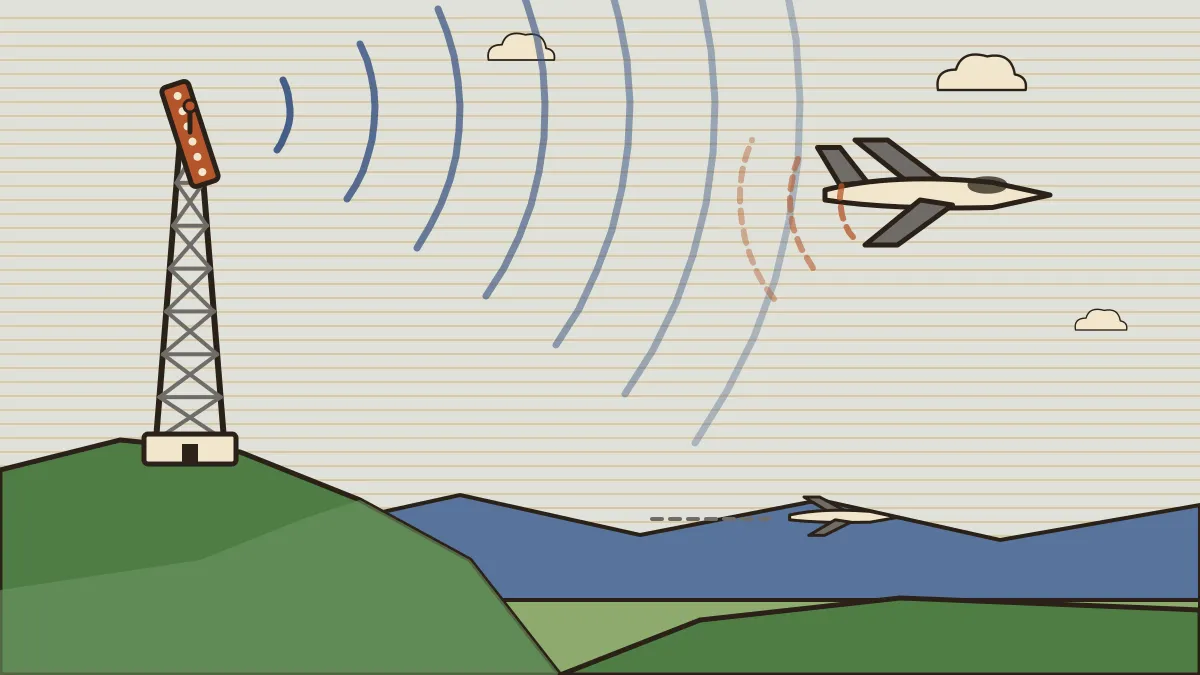
A radar is a machine that shouts into the sky and listens for the echo. From the time the echo takes to return it works out how far an aircraft is, from the direction of the antenna it knows where, and from a small change in the echo's frequency it knows how fast it is moving. Every air-defence missile, every fighter intercept and every airport approach in India begins with that one idea.
This page is for the aspirant who wants the physics and the Indian names in one place. It sits under our air defence page, which shows where radars fit in the detect, decide and engage chain, and it leans on the same school physics you meet in waves and the electromagnetic spectrum. Only publicly released information is used: no radar locations and no deployments.
The Pulse and the Sum: R = c·t/2
RADAR stands for RAdio Detection And Ranging. A pulse radar sends a very short burst of radio waves, then switches to listening. Radio waves are electromagnetic waves, so they travel at the speed of light, c = 3 × 10⁸ m/s (the same speed in air as in vacuum for our purpose). If the burst meets an aircraft, a small part of it bounces back.
The pulse travels out and back, so the distance covered is twice the range. That gives the one formula to remember:
An echo returns 400 microseconds after the pulse leaves.
The direction comes from where the antenna is pointing when the echo arrives. A rotating antenna sweeps all 360 degrees; an electronically steered one, described below, jumps its beam from place to place.
Radar uses radio waves and microwaves, not X-rays, which cannot be used for it, and not sound. Sound needs a medium and is the working wave of sonar, which is the underwater equivalent. NDA 2023-I tested exactly this (see the past papers below).
Doppler: Telling a Moving Target from a Hill
The Doppler effect is the change in the frequency of a wave when the source and observer move relative to each other: higher pitch as they approach, lower as they move apart. Your school example is an ambulance siren. For radar the target reflects the wave, so the shift is doubled, and the formula is:
A 20 kHz shift on a 10 GHz wave is a tiny fraction, but a radar can measure it. Why bother? Because hills, buildings and the ground send back huge echoes that do not move. A moving-target indication or pulse-Doppler radar keeps only echoes whose frequency has shifted, so the stationary clutter is cancelled and a fast low flyer stands out. The same principle lets a radar tell an incoming aircraft (frequency up) from one flying away (frequency down), and it is the principle in the speed-check radar used by traffic police, which CAPF 2020 asked about.
Frequency Bands and the AESA Revolution
Radars work in bands, named by letters. The pattern to remember is that lower frequency, longer wavelength travels further and is hard to stop, while higher frequency, shorter wavelength gives a sharper beam and finer detail from a smaller antenna. Approximate bands on the common IEEE scheme:
| Band | Frequency (approx.) | Typical use |
|---|---|---|
| L | 1 to 2 GHz | Long-range air surveillance |
| S | 2 to 4 GHz | Medium-range surveillance, air-traffic control, weather |
| C | 4 to 8 GHz | Weather, some tracking radars |
| X | 8 to 12 GHz | Fighter radars, fire control, precision tracking |
Old radars turn a big dish by motor. A phased-array radar has a flat antenna made of hundreds or thousands of small elements. Each element sends the same signal, but with a tiny, controlled delay in timing (a phase shift). The waves from the elements add up strongly in one chosen direction and cancel elsewhere, so the beam points that way. Change the delays and the beam swings in microseconds, with no moving part. In an AESA (active electronically scanned array) every element carries its own small transmit-and-receive module, as opposed to one big transmitter feeding all of them.
Electronic steering lets the beam recheck a threatened sector many times a second, track many targets at once, keep working if a few modules fail, and hop frequency to resist jamming.
PIB's description of the Arudhra radar names the idea: a "4D multi-function phased array radar with electronic steering in both azimuth and elevation" (azimuth is the sideways angle, elevation the angle upward). "4D" means the radar reports range, azimuth, elevation and, through Doppler, velocity.
The Horizon Problem: Why Low Flyers Win and AEW&C Matters
Radio waves at radar frequencies travel in nearly straight lines. The Earth curves away, so a ground radar sees only to its radar horizon. An aircraft below that line is hidden, whatever the radar's power. A standard rule of thumb, which allows for a little bending of the waves in the atmosphere, is:
Same radar, same aircraft, almost seven times the reach. This is why attackers fly low and use the terrain, and why a hilltop site helps (a taller antenna adds to the first square root). The remedy is to lift the radar: put it on a hill, a mast, or, best, an aircraft. An airborne early warning and control aircraft carries its radar at about 9 to 10 km height, so its horizon to a low target is several hundred km instead of a few tens. India's own Netra aircraft has been cleared for service (see our Netra explainer) and the aircraft are covered on the force multipliers page.
Because the long-range radar cannot see everything near the ground, the Air Force and Army add low-level radars in a belt of many overlapping sites, such as the Ashwini and the LLLR below. Coverage is built by overlap, not by one big radar.
India's Ground Radars
India's air-defence radars are largely designed by DRDO (mainly its Electronics and Radar Development Establishment, LRDE, Bengaluru) and built by Bharat Electronics Limited (BEL). The table lists the names examiners and PIB use. Production details beyond what PIB has published are not repeated here.
| Radar | What it is | What PIB or DRDO has published |
|---|---|---|
| Rohini | Air Force surveillance radar (DRDO describes it as a 3D medium-range radar) | Shown on the Air Force's static display on Air Force Day 2024 and 2025 (PIB) |
| Arudhra | Medium Power Radar, a 4D multi-function phased array with electronic steering, with a co-located Identification Friend or Foe (IFF) system | MoD contract with BEL of over ₹2,800 crore for the Air Force, 23 Mar 2023; in Sep 2026 the Defence Acquisition Council gave approval for Arudhra radars for the Navy to replace air route surveillance radars at naval air stations |
| Ashwini | Low Level Transportable Radar (LLTR), an active electronically scanned phased array on solid-state technology, designed by DRDO's LRDE | ₹2,906 crore contract with BEL for the Air Force, 12 Mar 2025. MoD's 2021 review recorded that 19 earlier LLTRs had been supplied to the Air Force |
| Aslesha | Low-level 3D radar for the Air Force (DRDO design) | "Arudhra and Aslesha" named among systems inducted into the Air Force in 2021 (MoD year-end review); Aslesha model in the Air Force's 2022 Republic Day tableau |
| Bharani | Lightweight low-level radar (DRDO) | Displayed by DRDO at Aero India 2023 (PIB) |
| Swordfish (LRTR) | Long Range Tracking Radar, an AESA radar for the ballistic missile defence programme (DRDO) | Tracks ballistic missiles, not aircraft; a separate task from the air-defence radars above |
Do not confuse them with missile-guidance radars, which are fitted to a missile system itself. Akash, for instance, has its own radar, and PIB lists the "radar of Akash Weapon System" among the sensors that feed Akashteer.
- Mar 2025: MoD signs a ₹2,906 crore contract with BEL for LLTR Ashwini for the Air Force.
- Sep 2026: Defence Acquisition Council approves Arudhra radars for the Navy.
- Oct 2026: MoD signs a ₹770 crore contract with BEL for the Improved Low Level Light Weight Radar, LLLR(I), for the Army.
IACCS and Akashteer: From Many Radars to One Picture
A radar alone gives one sensor's view. The Integrated Air Command and Control System (IACCS) is the Air Force's automated network that collects the feeds from radars and other sensors across the country, builds a single air picture, and passes it to the people and weapons that need it. The Ministry of Defence's 2025 year-end review says IACCS integrated the air-surveillance picture from all sensors in the country. Where its centres are is not published and this page does not guess.
The Army has its own network. Akashteer is the Army's automated Air Defence Control and Reporting System. The MoD signed a ₹1,982 crore contract with BEL for it on 29 March 2023, and the Army's 2024 year-end review records that the first batch of control centres was flagged off from BEL, Ghaziabad in April 2024. PIB's May 2025 explainer lists the sensors it integrates: the tactical control radar Reporter, 3D tactical control radars, the Low Level Lightweight Radar and the radar of the Akash weapon system. It gives a common picture to the control room, radars and guns, and it connects with IACCS and with the Navy's Trigun.
On Operation Sindoor, PIB's 30 September 2025 note records the Raksha Mantri saying that the tri-service network gave a unified real-time operational picture, cut the risk of fratricide (engaging a friendly aircraft by mistake) and helped timely decisions. The weapons that act on this picture are on the surface-to-air missiles page.
Exam pins
- RADAR = RAdio Detection And Ranging.
- Range R = c × t ÷ 2; 1 ms of echo delay is 150 km.
- Radar uses radio waves or microwaves, travelling at 3 × 10⁸ m/s; sonar uses ultrasonic sound.
- The Doppler effect gives speed; speed-check radar and moving-target indication rest on it.
- Phased array: the beam is steered by timing delays, with no moving antenna; AESA has a module on every element.
- Line of sight limits ground radar; AEW&C radars on aircraft see low flyers from far away. Netra is India's.
- Arudhra: 4D phased-array Medium Power Radar; Ashwini: low-level transportable AESA radar; both DRDO-designed and built by BEL.
- Swordfish (LRTR) is for ballistic missile defence.
- Networks: IACCS (Air Force), Akashteer (Army, contract 29 Mar 2023), Trigun (Navy).
Asked in past papers
The radar link in papers is through physics: which wave, which effect.
Which one of the following statements about X-rays is not true?
(a) They have wavelengths of about 1 Å. (b) These can be generated by bombarding a metal target by high energy electrons. (c) Due to their wavelengths being shorter, these can be used for radar systems. (d) These are also used for the treatment of certain forms of cancer.
Answer: (c). Radar uses radio waves and microwaves, not X-rays. The other three statements are true, and the short wavelength of X-rays is the reason they are not used: they are absorbed and scattered too much to travel far through air.
Which of the following are the characteristics of electromagnetic waves? 1. They are elastic waves. 2. They can also move in vacuum. 3. They have electric and magnetic components which are mutually perpendicular. 4. They move with a speed equal to 3 lakh meters per second.
(a) 1, 2, 3 and 4 (b) 1, 2 and 4 only (c) 2 and 3 only (d) 3 and 4 only
Answer: (c). Radar waves are electromagnetic, so 2 and 3 hold. They are not elastic (mechanical) waves, and the speed is 3 lakh kilometres per second, so 4 is false. Option (a) tempts if you skim the units.
The radar used by police to check over-speeding vehicles works on the principle of
(a) Raman effect (b) Induction effect (c) Doppler effect (d) Coulomb effect
Answer: (c). The speed gun sends microwaves and measures the frequency shift of the echo from the moving vehicle, which is proportional to its speed. Raman effect is about scattering of light by molecules.
The electromagnetic waves, which are used for satellite communication, are
(a) infrared radiations (b) ultraviolet radiations (c) radio waves (d) visible lights
Answer: (c). Radio waves and microwaves pass through the atmosphere and the ionosphere and carry signals over long distances, the same family of waves that radars use. Infrared and visible light are easily blocked by cloud.
Examiners ask which wave (radio or microwave, not X-ray or sound) and which effect (Doppler, not Raman). Revise the electromagnetic spectrum and its uses, then sound waves for the Doppler effect, and test yourself on the NDA and CDS papers.
Practice MCQs (with answers)
- A pulse radar receives an echo 200 microseconds after sending the pulse. The target range is
- 15 km
- 30 km
- 60 km
- 120 km
- The principle that lets a radar separate a moving aircraft from a stationary hill is the
- Doppler effect
- Photoelectric effect
- Raman effect
- Total internal reflection
- In an AESA radar, the beam is steered mainly by
- rotating the dish with a motor
- changing the timing (phase) of signals from many small elements
- changing the colour of the light used
- raising the antenna to a higher mast
- Which of the following is the Army's air-defence control and reporting system that connects with the Air Force's IACCS?
- Trigun
- Netra
- Akashteer
- Arudhra
- A ground radar cannot see an aircraft flying very low at long range mainly because
- radio waves are absorbed by clouds
- the Earth's curvature hides it below the radar horizon
- low aircraft are too slow for Doppler
- radar waves cannot travel through air
- The Swordfish Long Range Tracking Radar is associated with
- weather forecasting for airports
- naval gunfire control
- airborne early warning
- ballistic missile defence
1-b, 2-a, 3-b, 4-c, 5-b, 6-d. Q1: R = c × t ÷ 2 = 3 × 108 × 200 × 10-6 ÷ 2 = 30,000 m = 30 km; Forgetting to halve gives the tempting 60 km. Q2: only the Doppler effect changes frequency with motion. Q3: an AESA has no moving dish, and each element's phase is controlled; height helps range but does not steer the beam. Q4: Trigun is the Navy's link, Netra is an aircraft and Arudhra is a radar. Q5: curvature, not cloud, is the cause; this is why AEW&C aircraft matter. Q6: Swordfish tracks ballistic missiles.
Where to Go Next
The radar is the "detect" step; the "decide" and "engage" steps are on the parent air defence page. Radar is also the heart of the technical branches of the Air Force: read about the career in the Indian Air Force, and see what NDA aspirants should prepare on our NDA coaching page. For the Air Force exam and its interview, our AFCAT coaching covers the physics and general awareness together, and the DAC decisions on radars are in our September 2026 DAC explainer.
Frequently asked questions
What does RADAR stand for and how does it work?
RADAR stands for Radio Detection And Ranging. It sends a short pulse of radio waves and listens for the echo; the range is c × t ÷ 2, where t is the echo delay, because the pulse travels out and back. The antenna direction gives the bearing and the Doppler shift gives the speed.
What is the Doppler effect in radar?
The Doppler effect is the change in frequency of a wave from a moving target. A radar measures the shift in the echo to find how fast the target is approaching or receding, and it uses the shift to ignore stationary clutter such as hills. Police speed guns use the same principle.
What is an AESA radar and why is it better?
An AESA, or active electronically scanned array, is a flat radar made of many small transmit-and-receive modules. The beam is steered electronically by timing differences, so it can swing in microseconds without a moving antenna. It tracks many targets at once, keeps working if a few modules fail and is harder to jam.
Why can't radar see low-flying aircraft from far away?
Radar waves travel in straight lines while the Earth curves, so a ground radar sees only to its radar horizon. For an antenna 30 m high, an aircraft at 100 m is lost beyond about 64 km, while one at 10,000 m is visible at about 435 km. Radars on aircraft, hills and masts, and overlapping low-level radars, are used to fill the gap.
Which radars does the Indian Air Force use?
PIB and the Ministry of Defence have named DRDO-designed radars such as Rohini, Arudhra, Aslesha and Ashwini, with BEL as the manufacturer for contracts like Arudhra and Ashwini. All feed the Air Force's IACCS network, which shares the air picture with the Army's Akashteer and the Navy's Trigun. Locations of the radars are not published.
More in Air Defence
← Back to Air Defence · Defence GK home
Sources: pib.gov.in/PressReleasePage.aspx?PRID=1910065 · pib.gov.in/PressReleasePage.aspx?PRID=1911937 · pib.gov.in/PressReleasePage.aspx?PRID=2129132 · pib.gov.in/PressReleasePage.aspx?PRID=2173013
Aiming for the Air Force?
Cavalier's AFCAT batches cover general awareness, military aptitude, numerical ability and English, then prepare you for the AFSB.