On 26 November 2026, the Ministry of Earth Sciences announced that scientists of the Indian Institute of Geomagnetism, Mumbai, had found a new way to detect rare and extreme solar particle events. Gamma-ray detectors at India's polar stations, Maitri in Antarctica and Ny-Ålesund in the Arctic, recorded a Ground-Level Enhancement (GLE) on 11 November 2025, event number 77 in the series, which came with an intense X-class flare and a fast coronal mass ejection. The news ties together ideas UPSC has asked about since 2023: flares, auroras, Lagrange points and Aditya-L1. This article follows them from the Sun's surface to Earth's magnetic field and back to the satellite that watches it.
The Sun's Weather: Flares, CMEs and the Solar Wind
By Abhishek Thakur · Science faculty, The Cavalier · 15 years teaching NDA and CDS Science
The Sun is a ball of hot, electrically charged gas called plasma. Its surface, the photosphere, is at about 5,500 °C, while the outer atmosphere, the corona, is hotter than 1 million °C, a puzzle scientists are still working on. Magnetic fields rise through the surface in tangled loops. Where they are strongest, the surface looks darker because it is cooler, and we see sunspots. The number of sunspots rises and falls in an 11-year cycle, and storms are most frequent near its peak. Cycle 25 reached its peak in 2024.
Four different things leave the Sun in a storm, and exam options mix them up.
| Phenomenon | What it is | Speed and time to Earth | Main effect |
|---|---|---|---|
| Solar flare | A sudden burst of electromagnetic radiation (X-rays, ultraviolet, radio) from magnetic energy released near a sunspot | Speed of light: about 8 min 20 s | Radio blackouts on the sunlit side |
| Solar energetic particles (SEPs) | Protons and electrons accelerated to very high energies by flares and CME shocks | A large fraction of light speed: tens of minutes to hours | Radiation danger to astronauts and satellites; at the highest energies, a ground-level enhancement |
| Coronal mass ejection (CME) | A giant cloud of plasma and magnetic field, with a mass of billions of tonnes, thrown out of the corona | About 250 to 3,000 km/s: roughly 1 to 4 days | Geomagnetic storms and auroras |
| Solar wind | A steady stream of charged particles from the corona, even on a quiet day | Typically about 400 km/s: roughly 4 days | Shapes Earth's magnetosphere and comet tails |
Flare classes. Flares are graded by the peak flux of X-rays measured by satellites, on a scale in which each letter is ten times the previous one: A, B, C, M, X. A C-class flare is weak, an M-class flare can cause brief radio blackouts, and an X-class flare is the strongest. Within a class the number is a multiplier: X2 is twice X1.
The Sun is 1.5 × 10⁸ km from Earth. How long does light take, and how long does a CME at 1,000 km/s take?
A flare and a CME often come from the same eruption. A flare is light, reaching Earth in minutes; a CME is matter, taking days. "Radio blackout within minutes" points to the flare, and "geomagnetic storm after a day or two" to the CME.
Most of the Sun's steady output is visible light and near-infrared, with a share in ultraviolet. The full range of waves, and which parts the atmosphere absorbs, is on our Electromagnetic Spectrum page. The fusion that powers all of this is covered in Life Cycle of Stars.
Earth's Shield: The Magnetosphere
Charged particles from the Sun are held off by Earth's magnetic field. A moving charge in a magnetic field feels a force at right angles to both its velocity and the field, F = qvB sin θ. The direction follows Fleming's left-hand rule, covered on our motors and magnetic effect page. A force at right angles cannot speed a particle up or slow it down. It only turns it, so a charged particle caught in a field spirals around the field line.
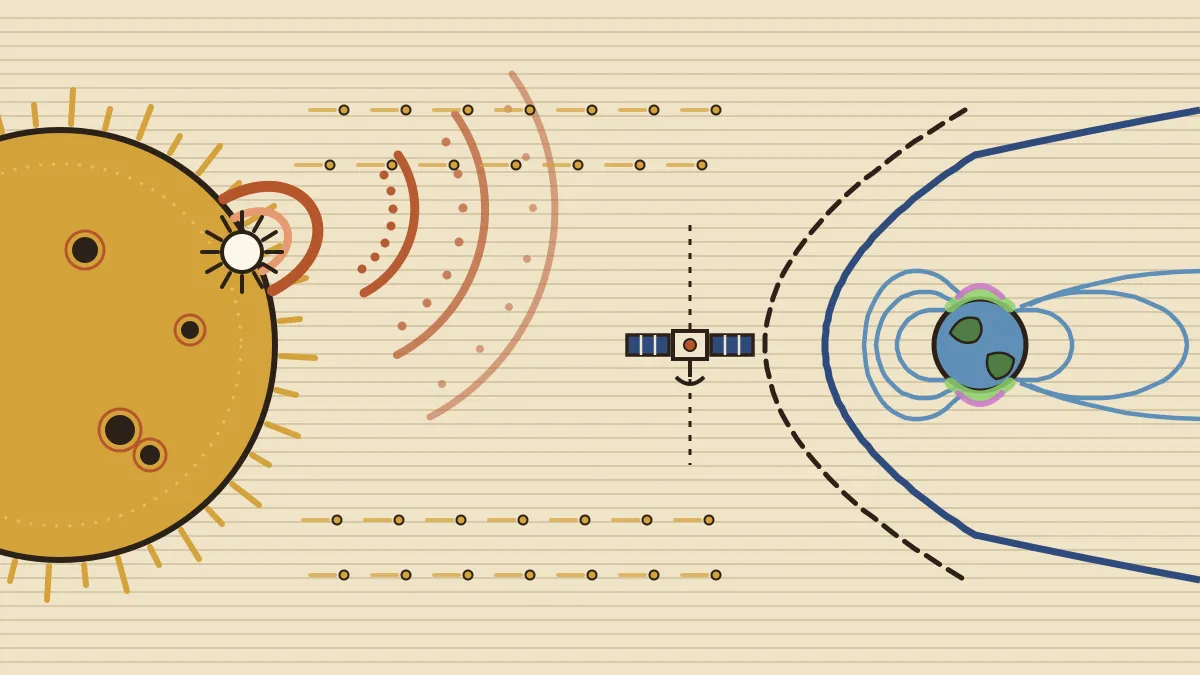
- Bow shock: where the supersonic solar wind slows abruptly as it meets the field.
- Magnetopause: the boundary of the magnetosphere, the region Earth's field controls: compressed on the sunward side, stretched into a long magnetotail on the night side.
- Van Allen belts: two doughnut-shaped regions where particles are trapped and bounce between the poles; found in 1958.
Light is neutral, so the magnetic field does nothing to it. X-rays and ultraviolet from a flare are instead absorbed by the upper atmosphere, and their effect is to ionise it. This is why a flare disturbs high-frequency radio, which depends on the ionosphere reflecting waves back to the ground. The layers of the atmosphere are mapped on our Atmosphere page.
Auroras: The Light Show at the Poles
When a CME arrives with its magnetic field pointing the right way, it can connect with Earth's field and pour energy into the magnetosphere. That is a geomagnetic storm. Charged particles are funnelled down the field lines into the polar regions, where they collide with atoms of the upper atmosphere, mostly 100 to 300 km up. The atoms are excited and then release the energy as light. Each gas glows its own colour:
| Gas | Colour | Where |
|---|---|---|
| Oxygen | Green (the commonest) at lower heights, red higher up | Green near 100–150 km; red above about 200 km |
| Nitrogen | Blue and purple-red | Lower edges of the display |
The display is the aurora borealis (northern lights) around the north geomagnetic pole and the aurora australis (southern lights) around the south one. Both appear at the same time, in rings called auroral ovals. Normally they stay at high latitudes. A strong storm stretches the oval towards the equator, which is why India saw red auroras over Hanle in Ladakh in April 2023 and again in May 2024, captured by the Indian Astronomical Observatory's camera. Our daily article on space weather and solar storms covers a recent case.
Flare = a burst of light and X-rays. CME = a cloud of plasma. Solar wind = the steady outflow. Aurora = charged particles striking oxygen and nitrogen in the upper atmosphere near the poles. Magnetosphere = Earth's magnetic shield.
When Space Weather Hits: 1859 to 2025
| Date | Event | What happened |
|---|---|---|
| 1–2 Sep 1859 | Carrington Event | The strongest storm on record. Telegraph systems failed, some operators got shocks, and auroras were seen in the tropics |
| 13 Mar 1989 | Quebec blackout | Induced currents in the grid tripped the power system of Quebec, Canada, for about nine hours |
| Apr 2023, May 2024 | Hanle auroras | Red aurora recorded over Ladakh, far south of the usual auroral zone |
| 11 Nov 2025 | GLE #77 | An X-class flare, a fast CME and a strong particle event; Indian gamma-ray detectors at Maitri and Ny-Ålesund detected GLE signatures for the first time |
A ground-level enhancement is the rarest kind of solar particle event. The protons from the Sun are so energetic that, on striking the atmosphere, they trigger a shower of secondary particles that reaches the ground. The traditional instrument is the neutron monitor. The Indian result is that compact NaI(Tl) scintillation detectors, which turn gamma rays into flashes of light, are cheaper and can supplement neutron monitors, widening the network. At Maitri the response was prompt and at Ny-Ålesund more gradual, which helps scientists study how particles enter at different places.
What space weather can damage. Satellites: particles damage electronics, and a storm heats the upper atmosphere, raising drag on low-orbit satellites (see Satellite Orbits). Navigation and radio: a disturbed ionosphere makes GPS positions drift and blacks out high-frequency radio. Power grids: a changing magnetic field induces currents in long conductors, as in Quebec. Aviation and astronauts: more radiation on polar routes and in orbit.
Watching the Sun: Lagrange Points and Aditya-L1
A Lagrange point is a place near two large bodies where a small object can stay in step with them, because the pulls of the two bodies and the motion of the system balance. For the Sun and Earth there are five.
| Point | Where | Stable? | Use |
|---|---|---|---|
| L1 | Between Sun and Earth, about 1.5 million km from Earth (1% of the way to the Sun) | No: the spacecraft needs small corrections | Solar observatories: Aditya-L1 |
| L2 | Beyond Earth, 1.5 million km on the far side from the Sun | No | Space telescopes such as James Webb |
| L3 (far side of the Sun); L4, L5 | L3 is unstable. L4 and L5 each form an equilateral triangle with the Sun and Earth, ahead of and behind Earth | L4, L5: yes | Trojan asteroids gather at Jupiter's L4 and L5 |
An object at L1 sees the Sun continuously, with no eclipses or occultations by Earth, and it sits upstream of Earth in the solar wind. That is the idea behind Aditya-L1, India's first dedicated solar observatory. It was launched by PSLV-C57 from Sriharikota on 2 September 2023 (see our page on launch vehicles) and entered its halo orbit around L1 on 6 January 2024. A halo orbit is a path that loops around the L1 point itself, rather than around a body. It carries seven payloads:
| Type | Payload | Studies |
|---|---|---|
| Remote sensing (looks at the Sun) | VELC (Visible Emission Line Coronagraph) | The corona, and the origin of CMEs |
| SUIT (Solar Ultraviolet Imaging Telescope) | The photosphere and chromosphere in ultraviolet | |
| SoLEXS and HEL1OS | Soft and hard X-rays from flares | |
| In situ (measures what reaches L1) | ASPEX and PAPA | Solar wind and energetic particles |
| Magnetometer | The magnetic field at L1 |
L1 is 1.5 × 10⁶ km from Earth. How much notice does a spacecraft there give of a solar-wind stream at 400 km/s, and of a fast CME at 1,000 km/s?
The warning is short, but enough to put satellites into a safe mode. A forecast days ahead comes from watching the CME leave the Sun, which is what a coronagraph like VELC does. Our articles on 100 years of Kodaikanal solar data add the research side.
How UPSC Has Asked It: Past Papers Solved
These are actual CDS and NDA questions since 2019. Since 2023 UPSC has put Aditya-L1, auroras and Lagrange points into the paper almost every year.
Which of the following statements regarding 'aurora' is/are correct? 1. The solar wind upon reaching the Earth's atmosphere is directed towards two magnetic poles and a colourful display of lights is seen in the night sky. 2. The particles interact with the different gases of the atmosphere and each gas glows with a particular colour. 3. In April 2023, aurora was captured in the night sky in India by the Indian Astronomical Observatory at Hanle, Ladakh.
(a) 1 only (b) 2 and 3 only (c) 1 and 3 only (d) 1, 2 and 3
Answer: (d). All three are true.
In Sun-Earth system, the Sun, the Earth and the Lagrange point L4 form:
(a) an isosceles triangle (b) an equilateral triangle (c) a straight line (d) a scalene triangle
Answer: (b). L1, L2 and L3 lie on the straight line through the Sun and Earth, so (c) is the tempting wrong option.
Which one of the following statements is true for James Webb Space Telescope launched in December 2021?
(a) It orbits the Sun, about 15 lakh km away from the Earth. (b) It orbits the Earth, about 15 lakh km away. (c) It is stationary in space nearly 10 lakh km away from the Earth. (d) It revolves around the Moon nearly 3.5 lakh km away from the Earth.
Answer: (a). Webb is at the Sun–Earth L2 point and orbits the Sun with Earth. Aditya-L1 is at the same distance, on the sunward side.
Which of the following are the major missions of Indian Space Research Organization in 2023? 1. Chandrayaan-3 2. Solar Mission Aditya-L1 3. Liquid fuel powered rockets 4. Solar powered rockets
(a) 1 and 2 only (b) 1, 2 and 3 (c) 3 and 4 only (d) 1, 2, 3 and 4
Answer: (a). Chandrayaan-3 and Aditya-L1 are missions. Rocket types are not missions.
Consider the following statements regarding the structure of the atmosphere: I. The average height of the troposphere is higher nearer the poles than at the equator. II. The mesosphere contains the ozone layer. III. Radio waves transmitted from the Earth are reflected to the Earth by the ionosphere. IV. In the mesosphere, temperature decreases with an increase in altitude.
(a) I and II only (b) II and III only (c) III and IV only (d) I, II, III and IV
Answer: (c). The troposphere is deeper at the equator, and the ozone layer is in the stratosphere.
Radiations coming from the Sun are mostly in the form of
(a) light only. (b) light and long wavelength infrared. (c) light and short wavelength infrared. (d) both short and long wavelength infrared.
Answer: (c). Long-wavelength infrared is what the warm Earth radiates back.
Consider the following statements about Light year: 1. Light year is a unit for measurement of very large distances. 2. Light year is a unit for measurement of very large time intervals. 3. Light year is a unit for measurement of intensity of light.
(a) 1, 2 and 3 (b) 2 and 3 only (c) 1 and 2 only (d) 1 only
Answer: (d). A light year is the distance light covers in a year, about 9.46 × 10¹² km.
Space questions ask where the object is (L1, L2, L4), what the mission did and what the phenomenon is (aurora, ionosphere). Pair every mission with its orbit and every phenomenon with its atmospheric layer.
Practice MCQs (with answers)
- Light from the Sun takes about how long to reach the Earth?
- 8 seconds
- 80 seconds
- 8 minutes 20 seconds
- 83 minutes
- Which of the following is the most powerful class of solar flare?
- X
- M
- C
- B
- Which of these reaches Earth at the speed of light?
- The plasma of a CME
- The X-rays of a flare
- The solar wind
- None of these
- Auroras are produced when charged particles collide with atoms of the
- troposphere
- ozone layer
- lower stratosphere
- upper atmosphere, above about 100 km
- Aditya-L1 is stationed about
- 150 million km from Earth, towards the Sun
- 1.5 million km from Earth, towards the Sun
- 1.5 million km from Earth, away from the Sun
- 15 million km from Earth, towards the Sun
- A moving charged particle in a magnetic field experiences a force
- of zero magnitude
- parallel to its velocity
- along the field
- perpendicular to both its velocity and the field
- Which pair of Sun–Earth Lagrange points are stable?
- L4 and L5
- L1 and L2
- L2 and L3
- L1 and L3
- A CME at 1,000 km/s covers the 1.5 × 10⁸ km to Earth in about
- 8 minutes
- 15 hours
- 42 hours
- 15 days
1-c, 2-a, 3-b, 4-d, 5-b, 6-d, 7-a, 8-c. Q3: only the electromagnetic radiation, such as X-rays, travels at the speed of light; plasma and particles are slower. Q5: L1 is on the sunward side (L2 is the far side), and the distance is 1.5 million km, one-hundredth of the Earth–Sun distance. Q6: the force F = qvB sin θ is at right angles to both v and B, so it turns the particle without changing its speed. Q8: 1.5 × 10⁸ ÷ 1,000 = 1.5 × 10⁵ s, about 42 hours.
Quick Revision
- Sun: photosphere about 5,500 °C; corona over 1 million °C; sunspots are cooler, magnetic; 11-year cycle (Cycle 25 peaked in 2024).
- Flare = light and X-rays, 8 min 20 s, classes A, B, C, M, X (each 10 times). CME = plasma, 1–4 days. Solar wind ≈ 400 km/s. SEPs = fast protons; at the highest energies, a ground-level enhancement.
- Magnetic force on a charge: F = qvB sin θ, perpendicular to v and B; spiral along field lines. Bow shock, magnetopause, magnetotail, Van Allen belts.
- Aurora: particles hit oxygen (green, red) and nitrogen (blue) at 100–300 km near the poles; borealis in the north, australis in the south; Hanle, Ladakh, April 2023 and May 2024.
- Flares disturb radio via the ionosphere; CMEs cause storms, drag, grid currents. Carrington 1859; Quebec 1989.
- GLE #77: 11 Nov 2025, X-class flare; IIG, Mumbai, detected it with gamma-ray detectors at Maitri (Antarctica) and Ny-Ålesund (Arctic).
- Lagrange points: L1 between Sun and Earth, 1.5 million km (Aditya-L1); L2 on the far side (James Webb); L4 and L5 are stable and form equilateral triangles.
- Aditya-L1: PSLV-C57, 2 Sep 2023; halo orbit at L1, 6 Jan 2024; seven payloads: VELC, SUIT, SoLEXS, HEL1OS, ASPEX, PAPA, magnetometer.
Frequently asked questions
What is the difference between a solar flare and a CME?
A solar flare is a burst of X-rays and ultraviolet light that reaches Earth in about eight minutes. A coronal mass ejection is a cloud of plasma and magnetic field, with a mass of billions of tonnes, that takes one to four days to arrive.
What causes an aurora?
Earth's magnetic field guides charged particles from the Sun to the polar regions, where they strike oxygen and nitrogen atoms 100 to 300 km up. The atoms release the energy as light: green or red from oxygen, blue from nitrogen.
What is a Lagrange point and why is Aditya-L1 at L1?
A Lagrange point is a position near two large bodies where a small object can stay in step with them. L1 lies between the Sun and Earth, about 1.5 million km from Earth. A spacecraft there sees the Sun without eclipses and measures the solar wind before it reaches Earth.
What does Aditya-L1 study?
Aditya-L1 carries seven payloads. Four look at the Sun: VELC (the corona), SUIT (ultraviolet images), SoLEXS and HEL1OS (X-rays). Three measure particles and fields at L1: ASPEX, PAPA and a magnetometer. It was launched by PSLV-C57 on 2 September 2023.
What is a ground-level enhancement?
A ground-level enhancement is a sudden rise in cosmic-ray counts at the ground, caused by very energetic solar protons striking the atmosphere and producing particle showers. Indian scientists recorded GLE number 77, of 11 November 2025, with gamma-ray detectors at Maitri and Ny-Ålesund.
Related CDS / OTA Science topics
Science is a third of the CDS GS paper
Cavalier's CDS/OTA batches teach physics from first principles, with numericals and weekly PYQ tests that link each news item to the syllabus.