On 5 November 2026 the Press Information Bureau reported that a team led by Indian astronomers from Gauhati University and the Indian Institute of Astrophysics (IIA) had redefined a star cluster called UBC 63. It was listed as one cluster about 4,892 light years away. Using data from the European Space Agency's Gaia satellite, the team found two clusters that had passed close to each other a few million years ago. The proof was in the colours and brightness of their stars. To follow that logic you need the life story of a star, a favourite UPSC topic: nebulae, red giants, white dwarfs, neutron stars and black holes.
Birth: From Nebula to Protostar
By Abhishek Thakur · Science faculty, The Cavalier · 15 years teaching NDA and CDS Science
Every star begins in a nebula, a vast cloud of gas (mostly hydrogen and some helium) and dust. Where the cloud is slightly denser, gravity pulls matter inward, and the lump grows into a denser body. As it collapses it heats up. At this stage it is a protostar: hot and glowing from the heat of contraction, but not yet burning hydrogen. When the core reaches a temperature of about 10 million kelvin, hydrogen nuclei begin to fuse and a star is born.
A protostar with less than about 0.08 times the mass of the Sun never gets hot enough to fuse hydrogen. It becomes a brown dwarf, a failed star.
A light year is the distance light travels in a year, 9.461 × 10¹² km: a unit of distance, not time. A parsec is about 3.26 light years. The nearest star after the Sun, Proxima Centauri, is about 4.2 light years away.
The Main Sequence: Where Stars Spend Their Lives
A star that has begun fusion settles into the main sequence, which is about 90% of its life. Two forces are in balance here. Gravity tries to crush the star, and the heat and pressure of fusion in the core push outward. This balance is called hydrostatic equilibrium. In the Sun's core, at about 1.5 × 10⁷ K, the proton-proton chain turns four hydrogen nuclei into one helium nucleus, releasing 26.7 MeV. The helium nucleus weighs a little less than the four protons, and the missing mass appears as energy by E = mc², as in the fusion section of our radioactivity and nuclear energy page. The fuel is described on the hydrogen isotopes page.
The Sun is about 4.6 billion years old and will spend roughly 10 billion years on the main sequence. The surprise is that heavier stars die younger: a big star has more fuel, but burns it far faster.
As a classroom rule of thumb, main-sequence life is about 10 billion years ÷ M2.5, where M is the mass in solar masses. Estimate the life of a star four times as massive as the Sun.
Red dwarfs, with a tenth of the Sun's mass, will shine for trillions of years.
Colour, Temperature and the HR Diagram
A star's colour tells its surface temperature. The hotter the surface, the shorter the wavelength it emits most strongly: the hottest stars are blue-white and the coolest are red. (Twinkling is a different matter: it comes from refraction in the Earth's air, and planets, being discs rather than points, twinkle little.)
| Class | Colour | Surface temperature | Example |
|---|---|---|---|
| O | Blue | Above 30,000 K | Rare, very massive stars |
| B | Blue-white | 10,000–30,000 K | Rigel |
| A | White | 7,500–10,000 K | Sirius, Vega |
| F | Yellow-white | 6,000–7,500 K | Procyon |
| G | Yellow | 5,200–6,000 K | The Sun |
| K | Orange | 3,700–5,200 K | Arcturus |
| M | Red | Below 3,700 K | Betelgeuse, Proxima Centauri |
The classes run O B A F G K M, from hottest to coolest ("Oh Be A Fine Girl, Kiss Me"). The Hertzsprung-Russell (HR) diagram plots each star's brightness (luminosity) against its temperature, with the temperature axis running from hot on the left to cool on the right.
| Region of the HR diagram | What lives there |
|---|---|
| A diagonal band from top left to bottom right | The main sequence: hot, bright, massive stars at the top left; cool, dim red dwarfs at the bottom right. The Sun is in the middle |
| Top right | Red giants and supergiants: cool but extremely bright because they are so large (brightness grows with the square of the radius) |
| Bottom left | White dwarfs: very hot but very dim because they are tiny |
Two Roads to the End
When the core's hydrogen is used up, the star's path depends on its mass. The figure below shows the two roads, which divide at about eight times the mass of the Sun.
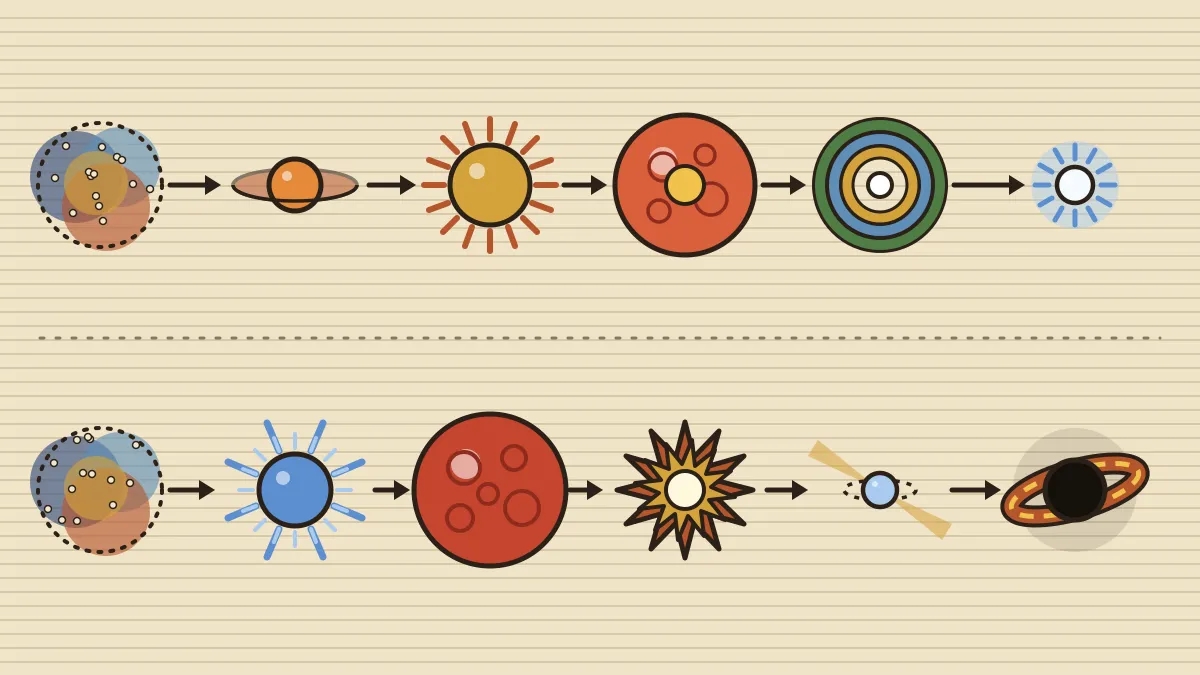
| Stage | Low and medium mass (like the Sun) | Massive stars (above about 8 times the Sun) |
|---|---|---|
| After the main sequence | Red giant: the core shrinks and heats, the outer layers swell and cool | Red supergiant: fusion goes on to carbon, oxygen and finally iron |
| The end of fusion | The outer layers drift off as a planetary nebula (nothing to do with planets) | The iron core collapses in a fraction of a second: a supernova |
| What remains | A white dwarf, about the size of the Earth, which slowly cools | A neutron star or a black hole |
The red giant. When core hydrogen runs out, the core collapses and heats up. At about 108 K helium fuses into carbon, while the outer envelope expands; the Sun will swell into a red giant in about five billion years. Fusion can build elements only up to iron, near the peak of the binding-energy curve, so heavier elements such as gold come from supernovae and similar violent events. The carbon, oxygen and calcium in our bodies were made inside stars.
The white dwarf and Chandrasekhar's limit. A white dwarf is the exposed core of a dead Sun-like star, typically about 60 per cent as massive as the Sun but only the size of the Earth. Electrons resisting being squeezed together hold it up, but only below about 1.4 solar masses, the Chandrasekhar limit. Subrahmanyan Chandrasekhar worked it out in 1930, on the voyage from India to England, and shared the 1983 Nobel Prize in Physics with William Fowler. The Sun is safely below the limit and will end as a white dwarf; it will not explode.
The supernova. In a massive star the iron core collapses, and the outer layers rebound in a supernova that can outshine a galaxy for weeks. The Crab Nebula is the remnant of one recorded by Chinese astronomers in 1054 AD.
The neutron star. If the collapsed core has between about 1.4 and 3 solar masses, electrons and protons are crushed into neutrons. A neutron star has a radius of only about 10 km and a density near 1017 kg per cubic metre, like a giant nucleus. Shrinking makes it spin very fast to conserve angular momentum, and its beams sweep past us like a lighthouse. These are pulsars, discovered by Jocelyn Bell in 1967, with periods of milliseconds to seconds.
The black hole. If more than about 3 solar masses remain (typically from stars born with over about 20 solar masses), nothing stops the collapse. The result is a black hole, where gravity is so strong that even light cannot escape. Its boundary is the event horizon, at the Schwarzschild radius, where the escape speed (see the satellite orbits page) equals the speed of light. It is a collapsed star, not a "black star".
The Schwarzschild radius is R = 2GM ÷ c². Find it for the Sun (M = 2 × 1030 kg) and for the Earth (M = 6 × 1024 kg). Take G = 6.67 × 10⁻¹¹ and c = 3 × 10⁸ m/s.
The Event Horizon Telescope published the first image of a black hole, in the galaxy M87, in 2019, and in 2022 one of Sagittarius A*, at the centre of our Milky Way. See also our reports on the X-ray black hole in NGC 4490 and faint black holes seen by radio telescopes.
Star Clusters and the UBC 63 Discovery
A star cluster is a group of stars born from the same cloud, so they share the same age and distance. Any difference between them is caused by mass alone.
| Property | Open cluster | Globular cluster |
|---|---|---|
| Size | Hundreds to a few thousand stars | Tens of thousands to millions of stars |
| Shape | Loose, irregular, held together weakly | Tight, spherical, strongly bound |
| Age | Mostly young (millions to hundreds of millions of years) | Very old (about 10 billion years or more) |
| Location | In the disc of the galaxy | In the halo around the galaxy |
The age of a cluster can be read from its HR diagram. The massive stars burn out first, so the main sequence of an old cluster is "cut off" at the top, and the point where it ends is called the turn-off point. The lower the turn-off, the older the cluster.
That is how UBC 63 was split. It is an open cluster, and its stars lay along two separate sequences in the colour-magnitude diagram, which is the HR diagram in observer's terms. Gaia data, machine learning and simulations then showed two clusters of very different ages: UBC 63A, about 21 million years old, and UBC 63B, about 562 million years old. They could not have formed together. Simulations show that about six million years ago the two passed within about 7 parsecs (23 light years) of each other, and they are now about 26 parsecs (85 light years) apart and moving away: the clusters are not bound. Related: the blue straggler star report.
(1) A light year measures distance, not time. (2) A planetary nebula has nothing to do with planets. (3) Hotter means bluer; red stars are the coolest. (4) A Sun-like star becomes a white dwarf, not a supernova. (5) A black hole is a collapsed star, not a "black star".
How UPSC Has Asked It: Past Papers Solved
UPSC asks about stars through definitions. These are the real questions.
'Black hole' is a
(a) huge black star which has zero acceleration due to gravity on its surface (b) star which has moderate acceleration due to gravity on its surface (c) star which has collapsed into itself and has large acceleration due to gravity on its surface (d) star which has collapsed into itself and has zero acceleration due to gravity on its surface
Answer: (c). A black hole is a collapsed star whose gravity is so strong that even light cannot escape. Option (d) says "zero" gravity, the opposite of the truth.
Which one among the following stars is nearest to the earth?
(a) Sirius (b) Arcturus (c) Alpha Centauri (d) Proxima Centauri
Answer: (d). Proxima Centauri is about 4.2 light years away, slightly closer than Alpha Centauri (about 4.4). Sirius is about 8.6 light years away and Arcturus about 37.
What is a constellation?
(a) A particular pattern of equidistant stars from the earth in the sky (b) A particular pattern of stars that may not be equidistant from the earth in the sky (c) A particular pattern of planets of our solar system in the sky (d) A particular pattern of stars, planets and satellites in the sky due to their position in the space
Answer: (b). A constellation is only an apparent pattern. Its stars lie at very different distances, so (a) is wrong. Planets and satellites are not part of one.
Light year is a unit of measurement of
(a) very large distances (b) time interval in years (c) amount of light received on earth in a year (d) mass of atoms
Answer: (a). One light year is the distance light covers in a year, about 9.46 × 10¹² km.
The twinkling of a star is due to:
(a) atmospheric reflection of starlight. (b) atmospheric refraction of starlight. (c) continuous change in the position of the star. (d) oscillation of starlight.
Answer: (b). The air is turbulent, so its refractive index keeps changing and the apparent position and brightness of the star's light flicker. CDS asked it again in 2025-II (Q29).
Know the life cycle in order, the Chandrasekhar limit and the light year.
Practice MCQs (with answers)
- Which sequence correctly describes the life of a Sun-like star?
- Nebula, protostar, red giant, main sequence, white dwarf
- Nebula, main sequence, protostar, red giant, white dwarf
- Nebula, protostar, main sequence, red giant, white dwarf
- Nebula, protostar, main sequence, supernova, neutron star
- The Chandrasekhar limit is about
- 1.4 times the mass of the Sun
- 3 times the mass of the Sun
- 0.08 times the mass of the Sun
- 10 times the mass of the Sun
- Which stars have the highest surface temperature?
- Red stars
- Yellow stars
- Orange stars
- Blue-white stars
- Pulsars are best described as
- collapsing gas clouds
- rapidly rotating neutron stars
- pairs of white dwarfs
- very small black holes
- The energy of a main-sequence star like the Sun comes mainly from the fusion of
- helium into carbon
- carbon into iron
- iron into gold
- hydrogen into helium
- The Sun will end its life as a
- neutron star
- black hole
- white dwarf
- pulsar
- The distance from a black hole's centre at which the escape speed equals the speed of light is called the
- event horizon (Schwarzschild radius)
- Chandrasekhar limit
- photosphere
- turn-off point
- On the HR diagram, white dwarfs are found at the
- top right
- bottom left
- top left
- middle of the main sequence
1-c, 2-a, 3-d, 4-b, 5-d, 6-c, 7-a, 8-b. Q1: (d) is the road of a massive star. Q6: the Sun is far below the mass needed for a supernova. Q8: white dwarfs are hot (left) and dim (bottom).
Quick Revision
- Life of a star: nebula → protostar → main sequence (hydrogen to helium, 26.7 MeV) → red giant (helium to carbon at about 108 K). Below 0.08 solar masses: brown dwarf. Heavier stars live shorter lives; the Sun lasts about 10 billion years.
- Sun-like stars: red giant → planetary nebula → white dwarf (below the Chandrasekhar limit, about 1.4 solar masses; 1930; Nobel 1983).
- Massive stars (above about 8 solar masses): supergiant → iron core collapse → supernova → neutron star (about 10 km; pulsars, 1967) or black hole (remnant above about 3 solar masses; first image 2019). Crab Nebula: supernova of 1054.
- O B A F G K M: blue (hottest) to red (coolest); the Sun is G. HR diagram: red giants top right, white dwarfs bottom left.
- Open clusters: young, loose. Globular clusters: old, tight. UBC 63: two clusters, 21 and 562 million years old. Light year = distance; Proxima Centauri is the nearest star after the Sun.
Frequently asked questions
What are the stages in the life cycle of a star?
A star begins as a nebula, collapses into a protostar and spends most of its life on the main sequence fusing hydrogen into helium. A Sun-like star then becomes a red giant, sheds its outer layers and ends as a white dwarf. A massive star explodes as a supernova and leaves a neutron star or a black hole.
What is the Chandrasekhar limit?
It is the largest mass a white dwarf can have, about 1.4 times the mass of the Sun. Above it, electron pressure cannot resist gravity and the star collapses. It is named after Subrahmanyan Chandrasekhar, who calculated it in 1930.
Why do some stars end as black holes and others as white dwarfs?
Mass decides. A star like the Sun leaves a core below the Chandrasekhar limit and becomes a white dwarf. A star born with many times the Sun's mass leaves a core that collapses past the neutron-star stage if more than about three solar masses remain, and it becomes a black hole.
Why are some stars blue and others red?
Colour shows surface temperature. Hotter stars emit most light at shorter wavelengths and look blue-white; cooler stars look red. The Sun, at about 5,800 K, is yellow.
What did the UBC 63 discovery show?
Using Gaia data, Indian astronomers found that UBC 63, thought to be one cluster 4,892 light years away, is two: UBC 63A, about 21 million years old, and UBC 63B, about 562 million. They passed close about six million years ago and are now moving apart.
Related CDS / OTA Science topics
Space science is now a regular slot in the GS paper
Cavalier's CDS/OTA batches teach physics and space science from first principles, with worked numericals and weekly PYQ tests.