The United Nations marks World Television Day on 21 November. The date recalls the first World Television Forum, held at UN Headquarters on 21 and 22 November 1996, and the General Assembly proclaimed the day in resolution 51/205 that December. Behind every picture on the old television tube sat a physics idea that UPSC loves: a beam of electrons, steered line by line across the screen by magnetic fields made by coils of current. The same idea runs a fan, a mixer-grinder and the starter motor of a jeep. This article goes from a compass needle jumping near a wire to the electric motor, the picture tube and the aurora. The CDS and NDA science papers have asked about it nearly every year since 2018, and the questions repeat the same dozen ideas.
A Current Makes a Field: Oersted and the Thumb Rule
By Abhishek Thakur · Science faculty, The Cavalier · 15 years teaching NDA and CDS Science
In April 1820 the Danish physicist Hans Christian Oersted noticed, during a lecture demonstration in Copenhagen, that a compass needle placed near a wire swung away when current flowed through it. Electricity and magnetism, treated as separate subjects until then, were joined. Within weeks André-Marie Ampère in France worked out the mathematics, and a little over a decade later Faraday showed the reverse effect (our page on electromagnetic induction covers it). The basic fact is simple: a moving charge, which means a current, produces a magnetic field. A stationary charge does not.
The field around a straight wire forms concentric circles in planes perpendicular to the wire. Its direction is given by the right-hand thumb rule (also called Maxwell's corkscrew rule): hold the wire in your right fist with the thumb along the current, and the curled fingers show the direction of the field lines.
| Source | Shape of field lines | Strength |
|---|---|---|
| Long straight wire | Concentric circles round the wire | B = μ₀I ÷ 2πr: falls off as 1/r, rises with current |
| Circular coil of N turns, radius R | Near the wire, small circles; near the centre, almost straight lines along the axis | At the centre: B = μ₀NI ÷ 2R |
| Long solenoid (n turns per metre) | Parallel straight lines inside (uniform field); outside it looks like a bar magnet | Inside: B = μ₀nI; outside, nearly zero |
Here μ₀ = 4π × 10⁻⁷ T m/A, and the SI unit of B is the tesla (the CGS unit is the gauss; 1 tesla = 10⁴ gauss). A solenoid is a long coil wound like a spring. The end where the current looks anticlockwise behaves as a north pole, and the end where it looks clockwise behaves as a south pole.
A solenoid has 1,000 turns per metre and carries 2 A. Find B inside.
The scaling in the table is what UPSC tests: how B changes when N, R, I or r changes. For two long parallel wires carrying equal and opposite currents, the fields add in the gap between them and cancel far away (CDS 2026-II, solved below).
(1) Magnetic field lines are closed loops: outside a magnet they run north to south, inside it south to north, so "no field lines inside a bar magnet" is false (NDA 2018-I). (2) Two field lines never cross. (3) Crowded lines mean a strong field.
Electromagnets, Magnetic Materials and the Earth
Slip a rod of soft iron inside a solenoid and the field becomes hundreds of times stronger, because the iron's tiny magnetic domains line up with the coil's field. That device is an electromagnet. It was Joseph Henry in the 1830s who made them powerful. Soft iron is chosen for the core because it magnetises easily and loses its magnetism the moment the current stops (low retentivity). Cranes, electric bells and relays rely on that. A permanent magnet needs the opposite: hardened steel or an alloy that keeps its magnetism. The strongest modern ones use rare-earth metals (see our note on rare earth elements and permanent magnets).
| Type | Response to a magnet | Examples |
|---|---|---|
| Diamagnetic | Weakly repelled | Copper, silver, gold, bismuth, zinc, water, nitrogen |
| Paramagnetic | Weakly attracted | Aluminium, sodium, platinum, oxygen, ferric chloride |
| Ferromagnetic | Strongly attracted; can be made into permanent magnets | Iron, cobalt, nickel, gadolinium and their alloys |
Heat destroys ferromagnetism. Above the Curie temperature (about 770 °C for iron) a ferromagnet turns paramagnetic.
The Earth is a giant magnet. A freely suspended magnet settles north–south because of the Earth's field. The pole near geographic north is physically a magnetic south pole, since it attracts the north pole of a compass needle. Three numbers describe the field at a place: declination (angle between geographic and magnetic north), inclination or dip (angle with the horizontal: 0° at the magnetic equator, 90° at the magnetic poles) and the horizontal component. The direction needs both declination and inclination, as CDS 2018-II tested. The field is also a shield against the solar wind; see our explainer on space weather and geomagnetic storms.
The Force on a Current, and the Electric Motor
Oersted's wire pushed a magnet. Newton's third law then demands that a magnet push the wire. Place a current-carrying conductor in a magnetic field and it feels a force:
The force is perpendicular to both the field and the current. Its direction comes from Fleming's left-hand rule: stretch the thumb, forefinger and middle finger of the left hand at right angles. If the forefinger shows the field and the middle finger the current, the thumb shows the force (the motion).
A 25 cm wire carries 4 A at right angles to a field of 0.5 T. Find the force, and the force if the wire is turned to 30° to the field.
Now bend the wire into a rectangular loop and hang it between two poles. The current runs up one side and down the other, so the two forces are equal, opposite and on different lines. They make a turning effect (torque) and the loop rotates. A loop in a uniform field therefore has zero net force but a non-zero torque, and the same holds for a bar magnet in a uniform field (NDA 2018-I asked this). That is the electric motor, a device that converts electrical energy into mechanical energy.
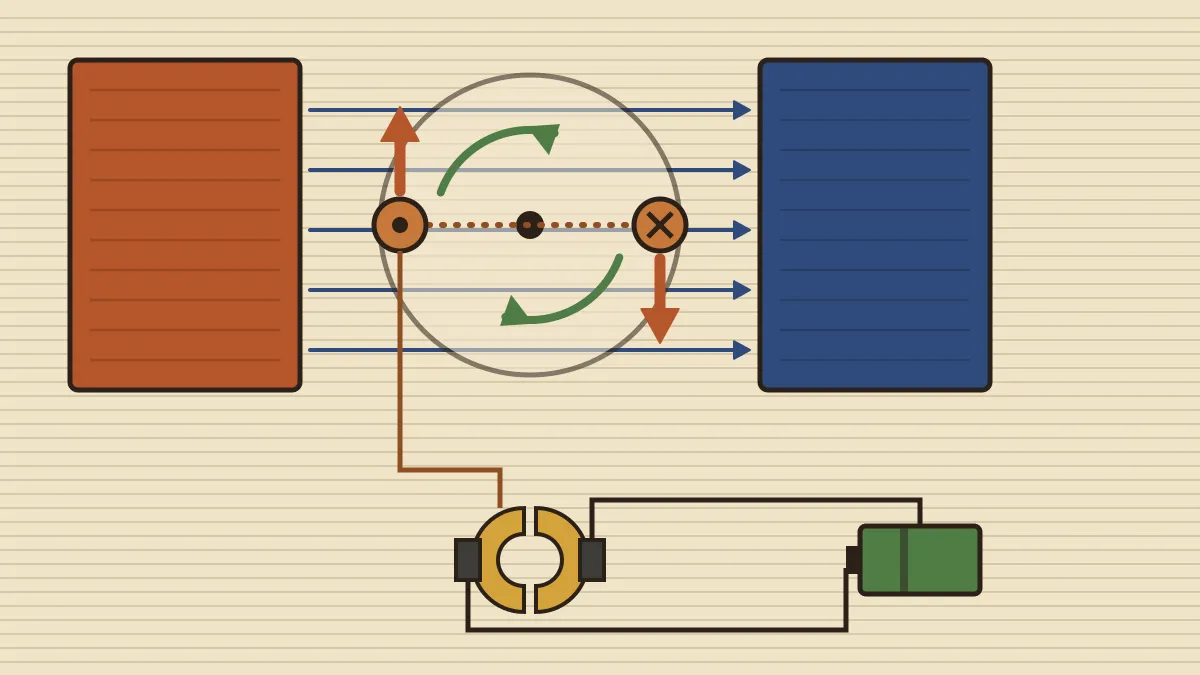
There is one problem. Once the coil passes the vertical, the sides swap places, and without help the forces would pull it back. The cure is the split-ring commutator: two half-rings, each joined to one end of the coil, with carbon brushes pressing on them. Every half-turn the brushes meet the other half-ring and the current in the coil reverses, so the torque keeps the same sense and the coil spins on. To make a motor faster or stronger: more turns, a stronger field, more current, or a soft-iron core in the armature.
| Electric motor | Generator (dynamo) | |
|---|---|---|
| Energy change | Electrical → mechanical | Mechanical → electrical |
| Principle | Force on a current in a field | Electromagnetic induction (Faraday) |
| Rule for direction | Fleming's left-hand rule | Fleming's right-hand rule: forefinger = field, thumb = motion, middle finger = induced current |
| Contact with outside circuit | Split ring (for a DC motor) | Slip rings give AC; split ring gives DC |
Right-hand thumb rule: direction of the field made by a current (wire, loop, solenoid). Fleming's left hand: current and field are given, find the force (motor, loudspeaker, galvanometer). Fleming's right hand: motion and field are given, find the induced current (generator). Remember "left = motor" and the confusion disappears.
The same force turns the needle of a moving-coil galvanometer. A small resistance in parallel (a shunt) makes it an ammeter; a large resistance in series makes it a voltmeter. Fuses work on the heating effect instead, as our circuits and power page shows.
A Moving Charge in a Magnetic Field
A current is only moving charges, so the force on a wire must come from a force on each moving charge. For a single charge q with speed v:
Three consequences follow, and each has been asked. First, a charge moving along the field feels no force and carries straight on (NDA 2023-I: a positive charge moving south in a north-pointing field feels no deflecting force). Second, the force is always sideways to the motion, so it does no work: the speed and kinetic energy stay constant, and only the direction changes. Third, a charge entering a field at right angles moves in a circle of radius
A proton enters a 0.1 T field at right angles with speed 2 × 10⁶ m/s. Find the radius.
A period that does not depend on speed is the secret of the cyclotron (see synchrotrons and particle accelerators). A field also separates positive and negative charges, because they curve opposite ways (NDA 2023-II).
Now the television. A cathode-ray tube (CRT) has an electron gun that fires a narrow beam at a phosphor-coated screen. J.J. Thomson showed in 1897 that cathode rays are streams of electrons, because electric and magnetic fields bend them. Cathode rays start at the cathode (the negative plate), not the anode, and travel in straight lines when there is no field. In a TV tube, two pairs of deflection coils use the magnetic force above to sweep the beam sideways and up and down, scanning the whole screen many times a second. Flat LED screens have retired the tube, but the examiners have not: NDA 2019-II still asks about it.
Nature runs the same experiment on a planetary scale: charged particles of the solar wind spiral along the Earth's field lines towards the poles and glow as the aurora (NDA 2024-I). X-rays and gamma rays, being uncharged waves, are not deflected by either field, as our page on the electromagnetic spectrum explains. UPSC asked it in two successive CDS papers (2025-II and 2026-I).
How UPSC Has Asked It: Past Papers Solved
These are real CDS and NDA questions. They test rules and scaling laws far more than long calculations.
A circular coil of radius R having N number of turns carries a steady current I. The magnetic induction at the centre of the coil is 0.1 tesla. If the number of turns is doubled and the radius is halved, which one of the following will be the correct value for the magnetic induction at the centre of the coil?
(a) 0.05 tesla (b) 0.2 tesla (c) 0.4 tesla (d) 0.8 tesla
Answer: (c). At the centre B = μ₀NI ÷ 2R, so B is proportional to N ÷ R. Doubling N doubles B, and halving R doubles it again: 0.1 × 4 = 0.4 T.
Two very thin and very long uniform wires, placed very close to each other, carry equal but opposite currents. Point 1 is exactly at the middle of those wires and point 2 is far away from the wires. Which one among the following regarding the net magnetic field produced is correct?
(a) Magnetic field at point 1 is zero (b) Magnetic field at point 2 is zero (c) Magnetic field lines will form elliptical loops around the wires (d) Magnetic field lines will form circular loops around the wires
Answer: (b). Between the wires, the two fields point the same way and add, so (a) is wrong. Far away the two fields are almost equal and opposite and cancel to a negligible value. The combined pattern is neither a clean ellipse nor a circle.
A charged particle moves through a magnetic field B with a velocity v. Which one of the following statements is true for the force (F) experienced by the particle?
(a) F is maximum when v and B are parallel to each other. (b) F is maximum when v and B are anti-parallel to each other. (c) F is maximum when v and B are perpendicular to each other. (d) The force F is independent of the angle between v and B.
Answer: (c). F = qvB sin θ, which is largest at θ = 90°. Parallel and anti-parallel (0° and 180°) both give zero.
The rule to determine the direction of a current induced in a coil due to its rotation in a magnetic field is:
(a) Right-Hand Thumb Rule. (b) Fleming's Left-Hand Rule. (c) Fleming's Right-Hand Rule. (d) Hund's Rule.
Answer: (c). A rotating coil is a generator, so the induced current's direction comes from Fleming's right-hand rule. The left-hand rule is for a motor and the thumb rule is for the field of a current.
Ms. Rani decides to convert her AC generator into a DC generator. Which one of the following she would need to use?
(a) A split-ring type commutator (b) Slip rings and brushes (c) A stronger magnetic field (d) A rectangular wire loop
Answer: (a). Slip rings (option b) give AC. A split-ring commutator reverses the connections every half-turn and gives one-way (DC) output.
Practice MCQs (with answers)
- The magnetic field lines around a long straight current-carrying wire are
- straight lines parallel to the wire
- concentric circles in planes perpendicular to the wire
- radial lines pointing away from the wire
- ellipses with the wire at one focus
- The current in a long straight wire is doubled and the distance of the point of observation is also doubled. The magnetic field at that point
- doubles
- is halved
- becomes four times
- remains unchanged
- The direction of the force on a current-carrying conductor placed in a magnetic field is found by
- the right-hand thumb rule
- Fleming's right-hand rule
- Fleming's left-hand rule
- Lenz's law
- A solenoid has 500 turns per metre and carries a current of 2 A. The magnetic field inside it is about (μ₀ = 4π × 10⁻⁷ T m/A)
- 1.26 × 10⁻³ T
- 6.3 × 10⁻⁴ T
- 2.5 × 10⁻³ T
- 1.26 × 10⁻² T
- An electron moving along the direction of a uniform magnetic field experiences
- the maximum possible force
- a force along its velocity
- no force
- a force that increases its speed
- Above its Curie temperature, iron behaves as a
- diamagnetic material
- ferromagnetic material
- superconductor
- paramagnetic material
- The split-ring commutator in a DC motor
- reverses the current in the coil every half-turn
- increases the strength of the magnetic field
- converts the supply from AC to DC
- reduces the resistance of the coil
- The best material for the core of an electromagnet is
- hardened steel
- soft iron
- copper
- aluminium
1-b, 2-d, 3-c, 4-a, 5-c, 6-d, 7-a, 8-b. Q2: B ∝ I ÷ r, so doubling both leaves it unchanged. Q4: B = 4π × 10⁻⁷ × 500 × 2 = 1.26 × 10⁻³ T. Q5: with v parallel to B, sin θ = 0, so F = 0. Q6: heating beyond about 770 °C destroys the alignment of domains, and iron becomes paramagnetic. Q7: the commutator is what keeps the torque in one direction; it does not change the field or the supply. Q8: soft iron magnetises strongly and demagnetises when the current stops; steel would keep its magnetism.
Quick Revision
- Oersted, 1820: a current deflects a compass needle. A moving charge makes a field; a still charge does not.
- Thumb rule gives field direction. Wire B = μ₀I/2πr; coil centre μ₀NI/2R; solenoid μ₀nI (uniform inside). μ₀ = 4π × 10⁻⁷ T m/A.
- Field lines are closed loops, never cross, and run S to N inside a magnet. Soft iron core: electromagnet (loses magnetism fast). Steel: permanent magnet.
- Dia (repelled: Cu, Ag, Au, Bi, water); para (weakly attracted: Al, Pt, O₂); ferro (strongly: Fe, Co, Ni). Curie point of iron about 770 °C.
- Earth's field: declination, inclination (dip: 0° at equator, 90° at poles), horizontal component.
- F = BIL sin θ on a wire; F = qvB sin θ on a charge. Zero when parallel, maximum when perpendicular. The magnetic force does no work. Radius r = mv/qB.
- Motor: Fleming's left hand, electrical → mechanical, split-ring commutator. Generator: Fleming's right hand, mechanical → electrical, slip rings (AC) or split ring (DC).
- Cathode rays: electrons from the cathode; TV tubes are CRTs with deflection coils. X-rays and gamma rays are not deflected. World Television Day: 21 November.
Frequently asked questions
What did Oersted discover?
In 1820 Hans Christian Oersted noticed that a compass needle kept near a wire turned away when a current flowed through the wire. This was the first proof that a current produces a magnetic field. Ampère soon gave the mathematics, and Faraday later showed the reverse effect.
How do I decide between Fleming's left-hand and right-hand rule?
Use the left hand when a current and a field are given and you want the force, as in a motor, loudspeaker or galvanometer. Use the right hand when a conductor is moved in a field and you want the induced current, as in a generator. In both rules the forefinger shows the field, but the thumb is the force in the left-hand rule and the motion in the right-hand rule.
Why does a DC motor need a split-ring commutator?
After half a turn the two sides of the coil swap places, and without a change in the current the forces would pull the coil back. The split ring and brushes reverse the current in the coil every half-turn. The torque then always acts in the same sense, and the coil keeps rotating in one direction.
Why can a magnetic field not change the speed of a charged particle?
The magnetic force on a moving charge is always perpendicular to its velocity. A force perpendicular to the motion does no work, so the kinetic energy and the speed stay the same. The field only bends the path.
What is the difference between a solenoid and an electromagnet?
A solenoid is simply a long coil of wire that makes a magnetic field when current flows through it, with a uniform field inside. An electromagnet is a solenoid wound around a soft iron core. The core multiplies the field many times, and the magnetism disappears when the current is switched off.
Related CDS / OTA Science topics
Magnetism is a favourite of the science paper
Cavalier's CDS/OTA batches teach physics from first principles, with the numericals, the rules and weekly PYQ tests.