On the night of 30 October 2026, ISRO's GSLV-F18 launched NVS-03, the newest satellite for NavIC, India's own navigation system, and the Prime Minister called it an important step in strengthening NavIC. Like its predecessors, NVS-03 is bound for a geosynchronous orbit about 36,000 km up, where one lap of the Earth takes exactly as long as one turn of the Earth. Why that height, why GPS flies lower and imaging satellites lower still, all follows from one equation and three laws. UPSC tests the physics sums and the missions alike.
Orbital Speed, Escape Speed and Weightlessness
A satellite is falling all the time; it just never lands. Fired sideways at about 7.9 km/s, a body drops exactly as fast as the curved ground falls away beneath it. Gravity supplies the centripetal force of circular motion, and equating the two gives everything else.
Speed falls with height because gravity weakens as 1/r² (see our page on gravity and the variation of g), and a weaker pull can only bend a slower path into a circle. The satellite's mass cancels: a 1 kg cubesat and the ISS at one height move equally fast.
| Height above Earth | Orbit radius r | Speed | Period | Who is there |
|---|---|---|---|---|
| Grazing the surface (no air) | 6,371 km | 7.9 km/s | 84 min | Newton's imaginary cannonball |
| 400 km | 6,771 km | 7.7 km/s | 92 min | ISS; Gaganyaan's target orbit |
| 20,200 km | 26,560 km | 3.9 km/s | 11 h 58 min | GPS |
| 35,786 km | 42,164 km | 3.07 km/s | 23 h 56 min | Geostationary satellites |
A higher orbit has a lower speed and a longer period but needs more energy to reach, because the satellite must climb out of the Earth's gravity well.
Escape speed is the least launch speed with which a body never returns (ignoring air). From ½mv² = GMm/R, ve = √(2GM/R) = √(2gR) ≈ 11.2 km/s, exactly √2 times the low-orbit speed. It does not depend on the body's mass or launch direction. Putting M = (4/3)πR³ρ gives ve ∝ R√ρ. The Moon's escape speed, about 2.4 km/s, is too low to keep an atmosphere.
A satellite circles at a height equal to the Earth's radius. Find its speed, its period and the rise in speed it needs to escape.
Weightlessness. At 400 km, g is still about 8.7 m/s² (89% of its surface value). Astronauts float because they and the station fall together, so the floor pushes on no one: the normal reaction is zero. A pendulum clock stops in orbit.
Kepler's Three Laws and the Period Sums
Newton showed that Kepler's planetary laws follow from inverse-square gravity, so satellites obey them too.
| Law | Statement | For a satellite |
|---|---|---|
| 1. Orbits (1609) | Each planet moves in an ellipse with the Sun at one focus | Nearest point perigee, farthest apogee; a circle is the special case |
| 2. Areas (1609) | The Sun–planet line sweeps equal areas in equal times | Fastest at perigee (conservation of angular momentum). The Earth is fastest in early January. |
| 3. Periods (1619) | T² ∝ a³ (a = semi-major axis, or radius) | Independent of the satellite's mass; double r and T rises 2√2 ≈ 2.83 times |
A geostationary satellite (r ≈ 42,000 km) takes about 24 h per orbit. (a) Find the period at one-quarter of this radius. (b) Show that GPS satellites (r = 26,560 km) go round twice a day.
Use r from the Earth's centre: "height R" means r = 2R. And the power is 3/2; squaring the ratio (1/16 instead of 1/8 for a fourfold radius) is the commonest wrong answer.
LEO, MEO, GEO and the Transfer Orbit
Orbits are grouped by height.
| Orbit | Height above Earth | Period | Main users |
|---|---|---|---|
| Low Earth orbit (LEO) | Below 2,000 km | About 90–127 min | ISS, imaging, OneWeb |
| Medium Earth orbit (MEO) | 2,000–35,786 km | 2–24 h | GPS, GLONASS, Galileo |
| Geostationary (GEO) | 35,786 km, over the equator | 23 h 56 min | GSAT, INSAT, NavIC |
| Transfer orbit (GTO) | Ellipse: perigee a few hundred km, apogee about 36,000 km | About 10.5 h | Drop-off for GEO-bound satellites |
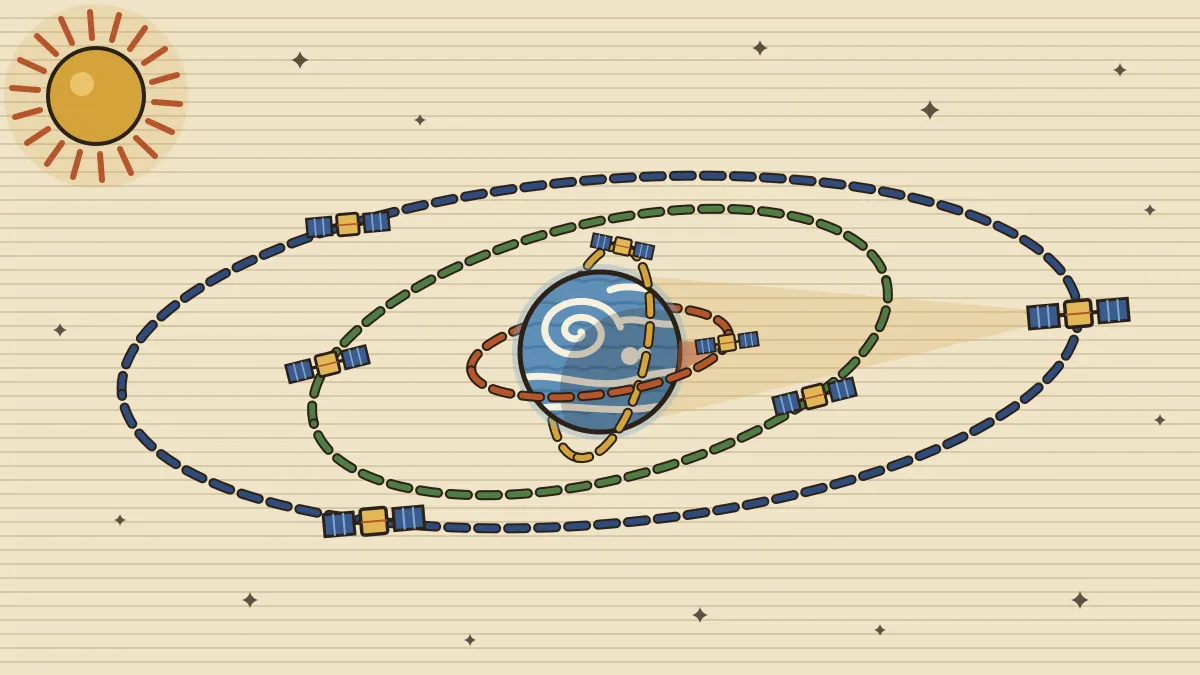
Geosynchronous versus geostationary. Any orbit with a period of one sidereal day (23 h 56 min 4 s) is geosynchronous. Not 24 hours: while spinning once, the Earth also moves about 1° along its orbit and needs about 4 minutes more to face the Sun again; one true rotation is 23 h 56 min. A geostationary orbit is the special case that is circular, over the equator and west to east, so the satellite seems fixed. An inclined geosynchronous satellite returns to the same longitude daily but swings north and south in a figure of eight. Arthur C. Clarke proposed geostationary relays in 1945; three satellites 120° apart cover the whole Earth except the polar regions.
It cannot hover over Delhi; it must sit over the equator, which is why dish antennas in India point southward. It is not still: it moves at 3.07 km/s. "Period 24 hours, any inclination" is geosynchronous, not geostationary.
The transfer orbit. Indian rockets do not place satellites directly in GEO. The GSLV and LVM3 release them into a GTO. At apogee the satellite fires its own liquid apogee motor, over several days, to round off the orbit and remove its tilt. If that fails, it is stranded: in February 2025 the oxidiser valves of NVS-02's engine did not open, leaving it in its transfer orbit. An eastward launch from Sriharikota (about 13.7° N) also borrows roughly 0.45 km/s from the Earth's spin.
Polar and Sun-Synchronous Orbits, and the Lagrange Points
A polar orbit is tilted about 90° to the equator and crosses both poles, usually in LEO. As the Earth turns beneath it, each pass covers a new strip, so it sees the whole globe within days.
A sun-synchronous orbit (SSO) is a near-polar orbit at about 600–800 km, tilted at about 98°. The Earth's equatorial bulge makes the orbit's plane turn slowly; at this height and tilt it turns about 1° a day eastward, keeping pace with the Earth's yearly circuit of the Sun. So the satellite crosses each latitude at the same local solar time every day. Identical lighting makes images taken weeks apart directly comparable. Cartosat, Resourcesat and Oceansat use it.
At the five Lagrange points, Sun and Earth together let a spacecraft circle the Sun in step with the Earth.
| Point | Where | Stable? | Who is there |
|---|---|---|---|
| L1 | Between Sun and Earth, about 1.5 million km from Earth | No | Aditya-L1, SOHO |
| L2 | Beyond the Earth, away from the Sun, about 1.5 million km | No | James Webb Space Telescope, Euclid |
| L3 | Behind the Sun, opposite the Earth | No | None |
| L4, L5 | 60° ahead of and behind the Earth; each forms an equilateral triangle with Sun and Earth | Yes | "Trojan" asteroids collect at such points |
Aditya-L1 was launched by PSLV-C57 on 2 September 2023 and entered a halo orbit around L1 on 6 January 2024. From there the Sun is never eclipsed.
Matching Orbit to Job, and Rocket to Orbit
Each job has a best orbit.
| Job | Best orbit | Why | Example |
|---|---|---|---|
| Detailed imaging | LEO, sun-synchronous | Close; same lighting every pass | Cartosat |
| Weather watch | GEO | Same hemisphere, all day | INSAT-3DS |
| TV and data relay | GEO | Fixed dish antennas | GSAT series |
| Global navigation | MEO | Wide view; about 24 satellites cover the world | GPS, Galileo |
| Regional navigation | GEO + inclined geosynchronous | Always above the region | NavIC |
| Human spaceflight | LEO, about 400 km | Quick to reach and return from | ISS, Gaganyaan |
EOS-05, imaging from geosynchronous orbit, trades sharpness for a constant watch (see GSLV-F17 and geo-imaging). Crowded low orbits now force ISRO into routine debris-avoidance manoeuvres.
GPS versus NavIC. GPS spreads at least 24 satellites over six planes tilted at 55°, about 20,200 km up, so at least four, the minimum a receiver needs (three for position, one to correct its clock), are always in view. NavIC serves only India and about 1,500 km around it, so ISRO chose orbits that never leave the region: three geostationary satellites and four geosynchronous ones inclined at 29°, whose north–south swing improves the geometry of a fix. Seven satellites do what a global system needs 24 for. More in our article on NavIC and satellite navigation.
All fly from Sriharikota; the cryogenic stage is what lets GSLV and LVM3 lift heavy loads to GTO.
| Launcher | Stages | Capacity (ISRO figures) | Remember it for |
|---|---|---|---|
| PSLV | 4: solid, liquid, solid, liquid | 1,750 kg to a 600 km SSO | Chandrayaan-1, Mars Orbiter Mission, 104 satellites in one launch (2017), Aditya-L1 |
| GSLV Mk II | 3, with a cryogenic upper stage | 2,250 kg to GTO | NVS series, INSAT-3DS, NISAR, EOS-05, NVS-03 |
| LVM3 | 3: two S200 solid boosters, liquid core, cryogenic stage | 4,000 kg to GTO; 8,000 kg to LEO | Chandrayaan-2 and 3, OneWeb, Gaganyaan |
| SSLV | 3 solid + a liquid trimming module | 500 kg to a 500 km LEO | Small satellites at short notice |
How UPSC Has Asked It: Past Papers Solved
Actual questions since 2020: NDA leans on sums and concepts, CDS on missions.
Two planets orbit the Sun in circular orbits, with their radius of orbit as R₁ = R and R₂ = 4R. Ratio of their periods (T₁ / T₂) around the Sun will be
(a) 1/16 (b) 1/8 (c) 1/4 (d) 1/2
Answer: (b). T ∝ R3/2, so (1/4)3/2 = 1/8. Option (a) squares the ratio; (c) assumes T ∝ R.
Escape speed from the Earth is close to 11.2 km s⁻¹. On another planet whose radius is half of the Earth's radius and whose mass density is four times that of the Earth, the escape speed in km s⁻¹ will be close to:
(a) 11.2 (b) 15.8 (c) 5.6 (d) 7.9
Answer: (a). ve ∝ R√ρ: half the radius halves it, four times the density doubles it. Option (c) forgets the density.
An astronaut whose weight on the Earth is 600 N experiences weightlessness on International Space Station orbiting around the Earth. It means that
(a) acceleration of the astronaut is zero (b) normal reaction of the space-station floor on the astronaut is zero (c) gravitational pull of earth on the astronaut is zero (d) space station applies a centrifugal force on the astronaut
Answer: (b). Astronaut and station fall together, so the floor exerts no force. Gravity is still about 89% of its surface value, ruling out (c); the astronaut accelerates at about 8.7 m/s², ruling out (a).
In Sun-Earth system, the Sun, the Earth and the Lagrange point L4 form:
(a) an isosceles triangle (b) an equilateral triangle (c) a straight line (d) a scalene triangle
Answer: (b). L4 is 60° ahead of the Earth, at the Sun–Earth distance from both. A straight line fits L1, L2 and L3.
Which one of the following statements is true for James Webb Space Telescope launched in December 2021?
(a) It orbits the Sun, about 15 lakh km away from the Earth. (b) It orbits the Earth, about 15 lakh km away. (c) It is stationary in space nearly 10 lakh km away from the Earth. (d) It revolves around the Moon nearly 3.5 lakh km away from the Earth.
Answer: (a). JWST loops round Sun–Earth L2, about 15 lakh km away, and so circles the Sun once a year with the Earth. Option (b) has the right distance but the wrong centre.
Which one of the following PSLVs, launched by ISRO, is not correctly matched with their Missions? PSLV — Mission
(a) PSLV C60 — SPADEX (b) PSLV C59 — Proba-3 (c) PSLV C58 — XPoSat (d) PSLV C57 — DS-SAR
Answer: (d). PSLV-C57 launched Aditya-L1 (September 2023); Singapore's DS-SAR flew on PSLV-C56 in July 2023. XPoSat (1 January 2024), Proba-3 and SpaDeX (both December 2024) are correctly matched.
Three types recur: proportion sums (T ∝ r3/2, v ∝ 1/√r, ve ∝ R√ρ), concept checks (weightlessness, Lagrange geometry) and missions (which rocket flew what). Learn the tables; practise the ratios.
Practice MCQs (with answers)
- Which ISRO launcher can place a 4,000 kg communication satellite in transfer orbit?
- LVM3
- PSLV
- SSLV
- GSLV Mk II
- If a satellite's orbital radius becomes 9 times larger, its period becomes
- 3 times
- 9 times
- 27 times
- 81 times
- A geostationary satellite must orbit
- over the poles, every 12 hours
- over the equator, west to east, once per sidereal day
- at any inclination, every 24 hours
- over the equator, east to west, once per sidereal day
- NavIC differs from GPS in that it
- uses only medium Earth orbit
- needs just three satellites for a fix
- is only for military users
- is regional, using geostationary and inclined geosynchronous satellites
- Imaging satellites use sun-synchronous orbits mainly because these
- stay above one point
- need no rocket
- pass each place at the same local time
- are the fastest
- Which Sun–Earth Lagrange point is stable?
- L4
- L1
- L2
- L3
- A satellite's speed in circular orbit suddenly rises by about 41.4%. It will
- fall to the Earth
- drop to a lower orbit
- stay in the same orbit
- escape the Earth's gravity
- A planet has the Earth's density but twice its radius. Its escape speed is about
- 5.6 km/s
- 22.4 km/s
- 11.2 km/s
- 15.8 km/s
1-a, 2-c, 3-b, 4-d, 5-c, 6-a, 7-d, 8-b. Q2: 93/2 = 27. Q3: option (c) is geosynchronous, not necessarily stationary. Q7: escape speed is √2 times orbital speed. Q8: ve ∝ R√ρ, so doubling R doubles it to 22.4 km/s.
Quick Revision
- v = √(GM/r); higher = slower, longer period, more energy; satellite mass irrelevant. 7.9 km/s low orbit; 11.2 km/s escape (√2 ×); ve ∝ R√ρ.
- Kepler: ellipse; equal areas (fastest at perigee); T² ∝ r³. Fourfold radius = 8 times the period.
- LEO below 2,000 km (ISS 400 km, 92 min); MEO (GPS 20,200 km, 12 h, 6 planes at 55°); GEO 35,786 km, equatorial, eastward, 3.07 km/s, 23 h 56 min.
- Geosynchronous = one sidereal day, any tilt. GTO = ellipse; the satellite circularises it.
- SSO: ~98°, 600–800 km, same local time. L1/L2 ~1.5 million km (Aditya-L1, JWST); L4/L5 stable.
- PSLV 1,750 kg SSO; GSLV 2,250 kg GTO; LVM3 4,000 kg GTO. NavIC: 3 GEO + 4 inclined, India + 1,500 km.
- Weightless = zero normal reaction; g at 400 km ≈ 89%.
Frequently asked questions
What is the difference between a geostationary and a geosynchronous orbit?
A geosynchronous orbit has a period of one sidereal day, 23 hours 56 minutes, and may be tilted, so the satellite traces a figure of eight. A geostationary orbit is the special case that is circular, over the equator and west to east at 35,786 km, so the satellite appears fixed in the sky.
Why does a satellite's speed decrease with height?
Gravity supplies the centripetal force, and it weakens with the square of the distance from the Earth's centre. A weaker pull can only hold a slower satellite on a curved path: about 7.9 km/s near the surface but 3.07 km/s at geostationary height.
Why are Earth-observation satellites placed in sun-synchronous orbits?
The plane of a sun-synchronous orbit turns about one degree a day, keeping pace with the Earth's motion round the Sun. The satellite therefore passes each place at the same local solar time, so lighting and shadows match from one image to the next.
Why does NavIC use geostationary and geosynchronous satellites instead of medium Earth orbit?
GPS must cover the whole world, so it needs at least 24 satellites in medium Earth orbit. NavIC serves only India and about 1,500 km around it, and high geostationary and inclined geosynchronous orbits keep all seven of its satellites over that region.
Why do astronauts feel weightless in the International Space Station?
They and the station fall round the Earth together, so the normal reaction from the floor is zero. Gravity has not vanished: at about 400 km it is still roughly 89 percent of its surface strength.
Related CDS / OTA Science topics
Physics numericals are free marks in the GS paper
Cavalier's CDS/OTA batches teach physics from first principles, with solved numericals, space current affairs and weekly PYQ tests.