Two items in this week's science news are about the same invisible thing. On 4 November 2026 PIB reported a silicon chip from the JNCASR research institute in Bengaluru that lets terahertz waves cross an engineered barrier with only 1-2% loss and carry data at up to 100 Gbit/s, a laboratory step towards 6G. Meanwhile TRAI's recommendations on how to give satellite broadband companies their spectrum are back in the news. "Spectrum" here is the electromagnetic spectrum, and governments auction or allot slices of it because radio frequencies are a limited resource. UPSC has asked about it in at least nine papers since 2018, nearly always as the same three questions: the order, the uses, and what the ozone layer absorbs.
One Wave, One Formula
By Abhishek Thakur · Science faculty, The Cavalier · 15 years teaching NDA and CDS Science
An electromagnetic wave is an electric field and a magnetic field oscillating together, each perpendicular to the other and to the direction of travel. It is a transverse wave. Unlike sound, it needs no medium: sunlight reaches us through empty space. James Clerk Maxwell predicted such waves in the 1860s and found that their speed matched the measured speed of light, which showed that light is itself an electromagnetic wave. Heinrich Hertz produced radio waves in the laboratory in the late 1880s, and Jagadish Chandra Bose produced very short waves (millimetre waves) in Calcutta in 1894-95.
In a vacuum every electromagnetic wave travels at the same speed, c = 3 × 10⁸ m/s. What differs is the frequency and wavelength, linked by one equation.
An FM station broadcasts at 100 MHz. What is the wavelength?
A radar pulse returns from an aircraft 200 microseconds after it was sent. How far is the aircraft?
The second sum is the radar twin of the echo sum on our sound and echo page, and the contrast is a standard exam point.
| Point | Electromagnetic wave | Sound wave |
|---|---|---|
| Nature | Transverse; oscillating electric and magnetic fields | Longitudinal in air; compressions and rarefactions |
| Medium needed? | No; travels through a vacuum | Yes; cannot cross a vacuum |
| Speed in air | About 3 × 10⁸ m/s | About 340 m/s |
| Deflected by electric or magnetic fields? | No (they carry no charge) | No |
NDA 2019-II offered the statement "they move with a speed equal to 3 lakh metres per second". The correct figure is 3 lakh kilometres per second (3 × 10⁸ m/s). Also, electromagnetic waves are not elastic waves, because they do not need a material medium to bend and spring back.
The Seven Bands in Order
The spectrum is divided by how the waves are made and detected, so the boundaries are soft. Going from longest wavelength to shortest, the frequency and the photon energy rise together. A memory line: Raju Made Idli, Vada, Upma, eXtra Garam (Radio, Microwave, Infrared, Visible, Ultraviolet, X-ray, Gamma).
| Band | Wavelength (approx.) | Made by | Found by |
|---|---|---|---|
| Radio | Above 0.1 m (up to km) | Charges accelerating in aerials and circuits | Hertz (late 1880s); Marconi made it a business |
| Microwave | 0.1 m to 1 mm | Klystron, magnetron valves | Bose (1894-95) among the first; oven by Percy Spencer (1945) |
| Infrared | 1 mm to 700 nm | Hot bodies; vibrating molecules | William Herschel (1800) |
| Visible | 700 nm (red) to 400 nm (violet) | Electrons dropping between atomic levels | Newton split it with a prism (1666) |
| Ultraviolet | 400 nm to about 1 nm | Very hot bodies, the Sun, special lamps | Johann Ritter (1801) |
| X-rays | About 1 nm to 0.001 nm | Fast electrons striking a metal target | Wilhelm Röntgen (1895); first Nobel in Physics (1901) |
| Gamma | Below 0.001 nm | Radioactive nuclei, nuclear reactions | Paul Villard (1900) |
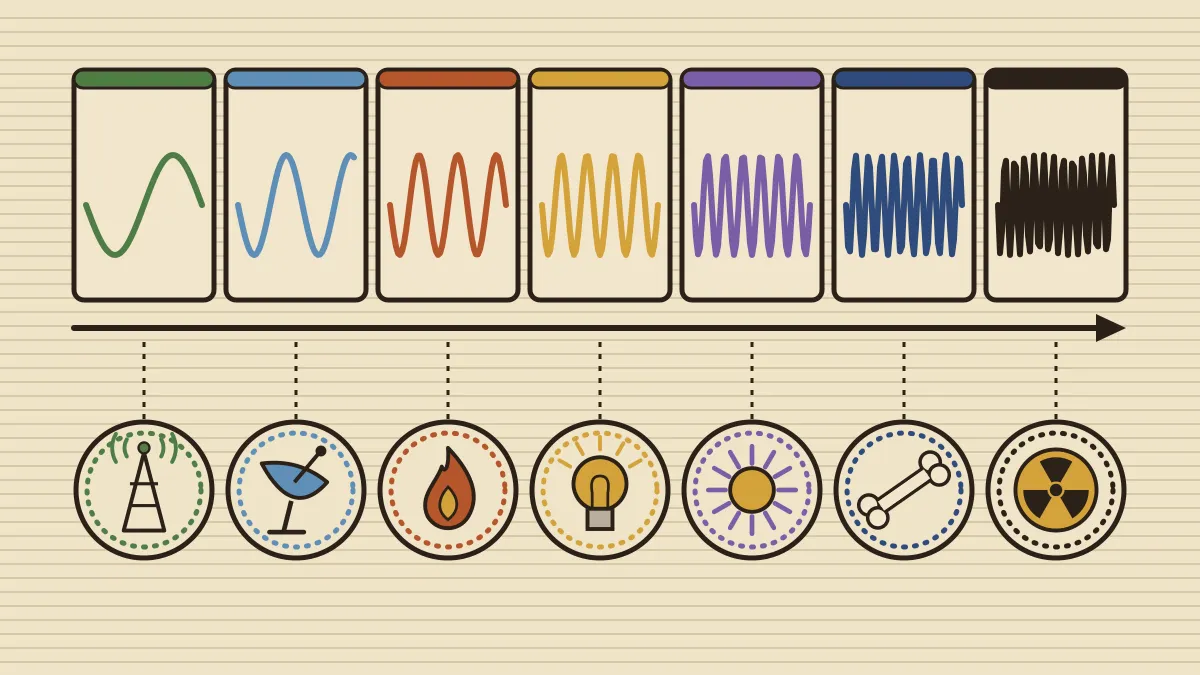
For the visible band, the colours from red to violet are the same wave family. Dispersion in a prism splits them, as shown on our dispersion page. X-rays and gamma rays overlap in wavelength; what separates them is the source (electrons or nuclei). The properties of gamma radiation from nuclei, and why it penetrates so far, are covered in our page on radioactivity.
What Each Band Does
- Radio waves. AM (medium-wave) radio uses roughly 530-1600 kHz, FM 88-108 MHz, and TV and mobile phones use higher radio frequencies. Low-frequency radio waves are bent back by the ionosphere, which is how AM stations are heard beyond the horizon.
- Microwaves. They pass through the ionosphere, so they are used for satellite communication (see our page on satellite orbits), radar, mobile networks and Wi-Fi. In a microwave oven the waves are absorbed by water molecules in food, which heat up.
- Infrared. Called "heat waves" because water and many other molecules readily absorb them. Uses: TV remote controls, night-vision and thermal cameras, and physiotherapy lamps. The greenhouse effect is infrared trapped by CO2 and water vapour.
- Visible light. The only band the eye detects (about 400-700 nm). Our eyes are most sensitive to yellow-green light, near 550 nm.
- Ultraviolet. Kills germs in water purifiers and sterilises operation theatres, makes vitamin D in the skin, reveals forged notes, and is used in LASIK eye surgery. It causes tanning and sunburn.
- X-rays. Soft tissue is transparent to them and bone is not, so they image bones; they are used in security scanners, in radiography of welds and in studying crystal structure. Metal-target tubes make them.
- Gamma rays. Sterilise medical equipment, destroy cancer cells (cobalt-60 units), and show hidden cracks in metal castings.
None of these waves carries a charge, so no electromagnetic wave is deflected by an electric or magnetic field, including X-rays and gamma rays. CDS 2026-I asked exactly this. A beam of electrons, by contrast, is deflected.
Hazards, UV Bands and the Ozone Layer
Radiation is split into two classes. Ionising radiation has enough photon energy to knock electrons out of atoms and damage DNA. It covers the short-wavelength end of ultraviolet, X-rays and gamma rays. Non-ionising radiation (radio, microwave, infrared, visible and long-wave ultraviolet) heats tissue or causes surface damage at high intensity but does not break molecules directly. Hospital X-ray rooms are lined with lead because the harm adds up over repeated exposures. A microwave oven has a metal mesh in its door, which stops the waves leaving the box.
| Ultraviolet band | Wavelength | What happens in the atmosphere |
|---|---|---|
| UV-A | 315-400 nm | Most of it reaches the ground; ageing of skin |
| UV-B | 280-315 nm | Mostly absorbed by ozone; the remainder causes sunburn and raises skin-cancer risk |
| UV-C | 100-280 nm | Fully absorbed by oxygen and ozone; the germ-killing lamps use it |
The ozone layer sits in the stratosphere (CDS 2021-I asked this) and absorbs the dangerous ultraviolet. It is thinned by chlorine and bromine from chlorofluorocarbons (CFCs), which is why the Montreal Protocol (1987) phased them out. The International Day for the Preservation of the Ozone Layer is 16 September, and CDS 2020-II set a trap on it. India's own measurements are in the news: our article on the unusual ozone layer over the Bay of Bengal explains what scientists found there.
The Terahertz Gap and 6G
Between microwaves and infrared lies a stretch of the spectrum called terahertz (roughly 0.1 to 10 THz, with wavelengths from about 3 mm to 30 micrometres). For decades it was called the terahertz gap. It was not empty. The problem was that no good technology existed on either side of it: electronic circuits, which build microwaves, run out of speed at these frequencies, and optical devices, which build infrared and visible light, struggle at the long-wavelength end. Without a good source and a good detector, nobody could use it.
The reward for closing the gap is large. A terahertz carrier can hold far more data than today's mobile bands, which is why 6G research aims at sub-terahertz and terahertz frequencies. The waves also pass through paper, clothing and plastic without the harm of X-rays, which suits security scanning. The problems are as big: the waves are absorbed by water vapour in the air, and walls, leaves and even a hand block them. So a terahertz circuit needs guides that carry the signal around bends and defects without losing it.
That is the problem the JNCASR chip addresses. As reported by PIB on 4 November 2026, it is a slab of high-resistivity silicon patterned with triangular holes, a photonic crystal. Waves travel along a channel in it, and a deliberate barrier (a short stretch where the hole sizes change) costs only 1-2% of the signal. The tests ran at about 310-360 GHz and reached up to 100 Gbit/s. It is a laboratory demonstration, not yet a handset part. Our article on the terahertz silicon chip explains the design. Silicon matters because it can be mass-produced cheaply.
Spectrum is limited, so governments assign it. Satellite broadband uses microwave bands, because these pass through the ionosphere. TRAI's recommendation was to assign it administratively, with a fee based on the operator's revenue, rather than by auction, unlike the 4G and 5G mobile bands.
How UPSC Has Asked It: Past Papers Solved
UPSC treats this topic as a set of true/false facts. The same ideas return every year in different words.
If the wavelengths corresponding to ultraviolet, visible and infrared radiations are given as λ_uv, λ_vis and λ_ir respectively, then which one of the following gives the correct relationship among these wavelengths?
(a) λ_uv < λ_vis < λ_ir (b) λ_ir < λ_uv < λ_vis (c) λ_vis < λ_uv < λ_ir (d) λ_ir < λ_vis < λ_uv
Answer: (a). UV is just beyond violet (shortest of the three) and infrared is just beyond red (longest). Option (d) is the exact reverse.
Consider the following statements about visible light, UV light and X-rays: 1. The wavelength of visible light is more than that of X-rays. 2. The energy of X-ray photons is higher than that of UV light photons. 3. The energy of UV light photons is less than that of visible light photons.
(a) 1, 2 and 3 (b) 1 and 2 only (c) 2 and 3 only (d) 1 only
Answer: (b). Statements 1 and 2 are true. Statement 3 is reversed: UV has a shorter wavelength, so its photons carry more energy than visible photons.
Which of the following are the characteristics of electromagnetic waves? 1. They are elastic waves. 2. They can also move in vacuum. 3. They have electric and magnetic components which are mutually perpendicular. 4. They move with a speed equal to 3 lakh meters per second.
(a) 1, 2, 3 and 4 (b) 1, 2 and 4 only (c) 2 and 3 only (d) 3 and 4 only
Answer: (c). Statement 1 is false (they need no medium) and statement 4 is false (3 lakh kilometres per second).
The electromagnetic waves, which are used for satellite communication, are
(a) infrared radiations (b) ultraviolet radiations (c) radio waves (d) visible lights
Answer: (c). Satellite links use the microwave part of the radio spectrum. Infrared and visible light are blocked by clouds.
X-rays can be used to: 1. Inspect welded joints between two metal parts of a machine 2. Study structure of crystals
(a) 1 only (b) 2 only (c) Both 1 and 2 (d) Neither 1 nor 2
Answer: (c). Industrial radiography finds hidden weld defects, and the pattern of X-rays scattered by crystals shows their atomic arrangement.
An X-ray beam can be deflected by :
(a) An electric field (b) A magnetic field (c) An electric as well as a magnetic field (d) Neither an electric field nor a magnetic field
Answer: (d). X-rays are photons with no charge, so neither field moves them. A beam of electrons would be deflected by either.
Which one of the following statements with regard to ozone is not correct?
(a) Ozone is found mostly at 15-55 km in the atmosphere. (b) Ozone is produced by gaseous chemical reactions. (c) 16th November is celebrated as the International Day for the Preservation of the Ozone Layer. (d) Ozone is a form of oxygen in which three oxygen atoms are bounded together.
Answer: (c). Ozone Day is 16 September. The other statements describe a stratospheric gas made of O3.
Two question types: order (longest wavelength, shortest wavelength, highest energy) and true/false properties (vacuum, charge, deflection). Rank the bands by wavelength first and the energy follows in the opposite order.
Practice MCQs (with answers)
- Which of the following electromagnetic waves has the highest frequency?
- Radio waves
- Ultraviolet rays
- Infrared rays
- Gamma rays
- A radio station broadcasts at 100 MHz. The wavelength of its waves is
- 0.3 m
- 3 m
- 30 m
- 300 m
- X-rays were discovered by
- Röntgen
- Becquerel
- Hertz
- Herschel
- The ozone layer protects life on Earth mainly by absorbing
- infrared rays
- visible light
- harmful ultraviolet rays
- radio waves
- Food heats in a microwave oven because the waves
- are ionising and break up the food molecules
- are absorbed by the water molecules in the food, which then heat up
- are infrared rays from a glowing coil
- make the oven walls hot
- Which statement about electromagnetic waves and sound waves is correct?
- Both need a material medium
- Both are transverse waves
- Sound travels faster than electromagnetic waves in air
- Electromagnetic waves can travel through a vacuum but sound cannot
- The "terahertz gap" lies between
- microwaves and infrared rays
- infrared and visible light
- ultraviolet rays and X-rays
- X-rays and gamma rays
- Which of the following is NOT an electromagnetic wave?
- X-rays
- Microwaves
- Ultrasonic waves
- Gamma rays
1-d, 2-b, 3-a, 4-c, 5-b, 6-d, 7-a, 8-c. Q2: λ = c ÷ f = 3 × 10⁸ ÷ 10⁸ = 3 m. Q4: X-rays and the shortest UV are absorbed higher up, but the ozone layer's special job is to stop harmful UV. Q5: microwaves are not ionising; the heating comes from water molecules absorbing them. Q8: ultrasonic waves are sound, so they are mechanical, not electromagnetic.
Quick Revision
- Electromagnetic waves: transverse, no medium, c = 3 × 10⁸ m/s in vacuum, c = fλ, E = hf, never deflected by electric or magnetic fields.
- Order (longest to shortest wavelength): Radio, Microwave, Infrared, Visible, Ultraviolet, X-ray, Gamma. Frequency and energy rise in the same direction.
- Discoverers: Herschel (IR, 1800); Ritter (UV, 1801); Hertz (radio, late 1880s); Röntgen (X-rays, 1895; Nobel 1901); Villard (gamma, 1900); Maxwell predicted the waves (1860s).
- Radio: broadcast; microwaves: radar, satellites, ovens; IR: remotes, heat, greenhouse effect; X-rays: bones, welds, crystals; gamma: cancer therapy, sterilising.
- Ionising: short UV, X-rays, gamma. Ozone sits in the stratosphere and absorbs harmful UV (UV-C fully, most UV-B). Ozone Day: 16 September; Montreal Protocol 1987.
- Terahertz (about 0.1-10 THz) lies between microwaves and infrared; its challenge is generating, detecting and routing it. JNCASR chip: 1-2% loss, 100 Gbit/s (PIB, 4 Nov 2026).
Frequently asked questions
What is the order of the electromagnetic spectrum?
From the longest wavelength to the shortest, the order is radio waves, microwaves, infrared, visible light, ultraviolet, X-rays and gamma rays. Frequency and photon energy rise in the same direction. All of them travel at 3 × 10⁸ m/s in a vacuum.
Why do electromagnetic waves not need a medium?
An electromagnetic wave is an oscillating electric and magnetic field, and each field generates the other, so the wave sustains itself in empty space. Sound is a mechanical wave and needs particles to carry it. That is why sunlight reaches Earth but sound cannot cross space.
What is the difference between X-rays and gamma rays?
Both are high-energy electromagnetic waves, and their wavelength ranges overlap. X-rays come from fast electrons striking a metal target, while gamma rays come from radioactive nuclei and nuclear reactions. Both are ionising and both are used in medicine.
What does the ozone layer absorb?
The ozone layer, in the stratosphere, absorbs harmful ultraviolet radiation. It absorbs all of UV-C and most of UV-B, while much of UV-A reaches the ground. Chemicals such as CFCs thin it, and the Montreal Protocol of 1987 phased them out.
What is the terahertz gap?
The terahertz gap is the part of the spectrum, roughly 0.1 to 10 THz, between microwaves and infrared. It was hard to use because electronic circuits and lasers both work poorly there. New chips, such as the one reported by JNCASR in November 2026, aim to carry data in this band for 6G.
Related CDS / OTA Science topics
Physics is half the CDS science paper
Cavalier's CDS/OTA batches teach physics, chemistry and biology from first principles, with numericals and weekly PYQ tests.