On 15 November 2026, a PIB Backgrounder titled "Opening Up India's Space Economy" put numbers on a quiet revolution. India's space economy is estimated at about US$9 billion, and registered space start-ups have grown from one in 2014 to about 440. On 18 July 2026, Skyroot Aerospace's Vikram-I reached orbit on its first flight, the first orbital launch by an Indian private company from Indian soil. Every one of these rockets, government or private, obeys the same few laws of physics. This article starts from those laws and ends at the launch pad.
Newton's Third Law: Why a Rocket Needs No Air
By Abhishek Thakur · Science faculty, The Cavalier · 15 years teaching NDA and CDS Science
A rocket does not climb by pushing on the air or on the launch pad. It climbs because it throws hot gas downward at very high speed. The engine pushes the gas down, and by Newton's third law the gas pushes the engine up with an equal force. This is why a rocket works best in the vacuum of space, where no air slows it down.
The same fact can be read through conservation of momentum. Before ignition the total momentum is zero. Once gas rushes out with momentum one way, the rocket must gain equal momentum the other way, so the total stays zero. A gun recoils in the same way; our page on momentum and conservation laws works through such cases. For a rocket that burns m kilograms of fuel every second and ejects it at speed v relative to the rocket, the push is:
A rocket of mass 5,000 kg ejects 50 kg of gas every second at 2,000 m/s. Take g = 9.8 m/s². Find the thrust and the initial acceleration.
Lift-off needs thrust greater than weight, and because M falls every second while thrust stays nearly constant, the acceleration rises during the burn. Our page on Newton's laws and equilibrium has the full set of three laws.
"A rocket moves because its exhaust pushes against the air" is wrong. It moves because the gas pushes back on the rocket. Action and reaction are equal and opposite yet never cancel, because they act on different bodies.
How Fast Is Fast Enough: Orbital and Escape Velocity
Staying up is a matter of speed, not height. A satellite is a body that has been thrown sideways so fast that, as it falls towards Earth, the curved surface falls away beneath it. At the surface it is √(gR) ≈ 7.9 km/s, and at a height of 400 km it is about 7.7 km/s, because gravity is slightly weaker. Our page on satellite orbits covers LEO, MEO and GEO.
| Quantity | Formula | Value for Earth | Depends on |
|---|---|---|---|
| Orbital velocity (near the surface) | √(gR) | About 7.9 km/s | Mass of Earth and the radius of the orbit, not the mass of the satellite |
| Escape velocity | √(2gR) | 11.2 km/s | Mass and radius of the planet only; not the mass of the object, and not the direction of launch |
The escape velocity is √2 times the orbital velocity (1.414 × 7.9 ≈ 11.2). It is the least speed that lets a body thrown once, with no further push, leave Earth for good. A rocket's engines keep pushing for minutes, so a rocket bound for low orbit does not need to reach 11.2 km/s. Even so, it must supply about 9 to 10 km/s of speed change in all. The extra pays for gravity and air drag during the climb.
Launch sites help a little. The Earth spins eastward, and a point on the equator moves at about 0.46 km/s. The Satish Dhawan Space Centre at Sriharikota, on India's east coast at about 13.7° N, gets nearly 0.45 km/s free when a rocket is launched eastward over the Bay of Bengal. The centre was named after Satish Dhawan in 2002.
7.7 to 7.9 km/s keeps you in orbit. 11.2 km/s frees you from Earth. A rocket needs about 9 to 10 km/s of engine work to reach orbit.
Why Rockets Come in Stages
The real constraint on a rocket is the tyranny of weight. Tanks and engines that held the fuel become dead weight once it is spent, yet a single-stage rocket would still have to accelerate them to orbital speed. The speed a rocket gains depends on how fast its exhaust leaves and on the ratio of its starting mass to its final mass:
Chemical rockets eject gas at about 3 km/s. A single stage has 90% of its mass as fuel, so the mass ratio is 10. Compare its Δv with a two-stage rocket in which each stage has a mass ratio of 5.
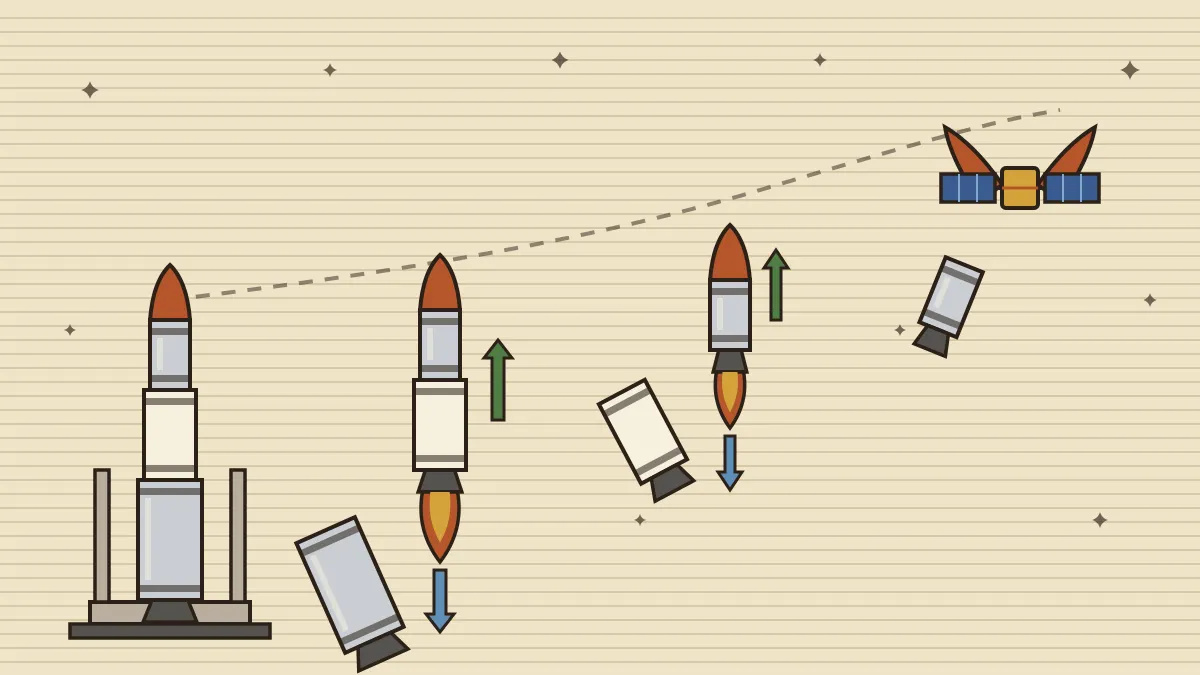
So every orbital rocket is a stack of stages fired in turn. An empty stage falls away and the next lights. Many Indian vehicles add strap-on boosters, extra motors on the sides that push hard at lift-off and are dropped early. The LVM3 weighs about 640 tonnes at lift-off while its satellite may weigh a few tonnes, so over 99 per cent of the machine is fuel and structure to be thrown away.
Solid, Liquid and Cryogenic Fuels
A propellant is the fuel and the oxidiser together. A rocket carries its own oxidiser because it flies where there is no air. ISRO's vehicles combine all three types below.
| Type | What it is | Strength | Weakness | Where ISRO uses it |
|---|---|---|---|---|
| Solid | A rubbery block of HTPB binder fuel, ammonium perchlorate oxidiser and aluminium powder | Simple, cheap, huge thrust at once, can be stored ready | Cannot be throttled or switched off once lit | First stage of PSLV and GSLV (S139), boosters of LVM3 (S200) |
| Storable liquid | UH25 fuel and nitrogen tetroxide (N₂O₄) oxidiser; they ignite on contact, so no igniter is needed | Can be throttled, stopped and restarted | Toxic and corrosive; lower exhaust speed than cryogenic | Vikas engine: PSLV second stage, GSLV strap-ons, LVM3 core |
| Cryogenic | Liquid oxygen (LOX) at about −183 °C with liquid hydrogen (LH₂) at about −253 °C | The best exhaust speed of the three, about 4.4 km/s | Very hard to build and handle | Upper stage of GSLV Mk II and LVM3 |
Why is the cryogenic engine prized? Liquid hydrogen has the lightest molecules, so its exhaust leaves the nozzle faster than any other chemical exhaust. A faster exhaust means more speed from every kilogram of fuel, which matters most in the upper stage. A cryogenic upper stage is what lets a GSLV lift a heavy satellite to geostationary transfer orbit. A solid motor has a lower exhaust speed per kilogram of propellant than a liquid one, so the claim that solid fuel gives more thrust per kilogram burned is false (see CAPF 2022 below).
The difficulty lies in the cold. Hydrogen stays liquid only below about 20 K, so tanks need heavy insulation and the fuel boils off. Metals turn brittle, seals fail and hydrogen leaks through the tiniest gaps. India bought Russian cryogenic stages for the early GSLV flights, and the indigenous CE-7.5 engine, built under ISRO's Cryogenic Upper Stage Project, flew successfully for the first time on 5 January 2014 on GSLV-D5. The larger CE-20 engine now drives the cryogenic stage of the LVM3.
Cryogenic describes the very low temperature. Semi-cryogenic engines burn kerosene with liquid oxygen, so only the oxidiser is chilled; Agnikul Cosmos flew a single-piece 3D-printed semi-cryogenic engine in May 2024, according to PIB.
ISRO's Four Launch Vehicles, Side by Side
ISRO flies four launch vehicles, each built for a different job.
| Vehicle | Stages and engines | Size | Payload | Known for |
|---|---|---|---|---|
| PSLV (Polar Satellite Launch Vehicle) | Four stages, alternating solid, liquid, solid, liquid; in the XL form, six solid strap-ons | About 44 m; about 320 t (XL) | About 1,750 kg to sun-synchronous orbit | The workhorse: Chandrayaan-1 (2008), Mangalyaan (2013), 104 satellites in one flight (2017), Aditya-L1 (2023), SPADEX (December 2024) |
| GSLV Mk II | Three stages plus four liquid strap-ons: solid, liquid, then the indigenous cryogenic stage | 51.73 m; 420 t | 2,250 kg to GTO | Communication and navigation satellites; GSLV-D5 (2014) proved the home-built cryogenic engine |
| LVM3 (Launch Vehicle Mark 3) | Two S200 solid boosters, an L110 liquid core (twin Vikas engines) and a C25 cryogenic upper stage | 43.5 m; about 640 t | About 4,000 kg to GTO, about 8,000 kg to LEO | Chandrayaan-3 (14 July 2023); the human-rated version is planned for Gaganyaan |
| SSLV (Small Satellite Launch Vehicle) | Three solid stages and a liquid Velocity Trimming Module that fine-tunes the final speed | 34 m; about 120 t | About 500 kg to a 500 km low orbit | On-demand launches of small satellites; EOS-08 in August 2024 |
The pattern to see in the table is solid for lift-off, liquid for control, cryogenic for the last push. Solid motors give cheap thrust while the rocket is heaviest; liquid stages can be throttled and re-lit; the cryogenic stage squeezes the most speed from the lightest fuel.
PIB records that Skyroot's Vikram-S in November 2022 was India's first privately developed rocket and the first private launch authorised by IN-SPACe, and that Agnikul Cosmos in May 2024 launched from India's first private launch pad, Dhanush, at Sriharikota. The Vikram-I orbital flight of 18 July 2026 followed. The reforms also reach ISRO's own rockets: HAL and L&T were contracted in September 2022 to build five PSLV-XL vehicles, and SSLV technology went to HAL in September 2025. Our note on Vikram-I covers the flight.
How UPSC Has Asked It: Past Papers Solved
UPSC asks this topic in two forms: the physics behind a rocket, and match-the-mission questions on ISRO's vehicles.
Which one of the following PSLVs, launched by ISRO, is not correctly matched with their Missions? PSLV — Mission
(a) PSLV C60 — SPADEX (b) PSLV C59 — Proba-3 (c) PSLV C58 — XPoSat (d) PSLV C57 — DS-SAR
Answer: (d). PSLV-C57 launched Aditya-L1 in September 2023. The DS-SAR satellite flew on PSLV-C56 in July 2023. The other three pairs are correct: SPADEX (December 2024), Proba-3 (December 2024) and XPoSat (January 2024).
Which of the following is India's first privately developed rocket launched by ISRO recently?
(a) Skyroot (b) Prarambh (c) Bazoomq (d) Vikram-S
Answer: (d). Vikram-S flew in November 2022 from Sriharikota. "Skyroot" is the company and "Prarambh" the mission name, the two tempting wrong options.
The unit of the ratio between thrust and impulse is same as that of
(a) frequency (b) speed (c) wavelength (d) acceleration
Answer: (a). Thrust is a force (newton). Impulse is force × time (newton second). Their ratio is 1 ÷ second, which is the unit of frequency (hertz).
The linear momentum of a particle is conserved if:
(a) the net force on it is maximum. (b) the net force on it is zero. (c) the net torque on it is zero. (d) the net work done on it is maximum.
Answer: (b). Momentum changes only under a net external force. Zero torque conserves angular momentum, which is the tempting wrong option (c). A rocket and its exhaust form one system with no net external force.
Consider the following statements. 1. Aluminium powder is used as a solid fuel for rocket engines. 2. Compared to liquid fuel propelled rocket engines, the thrust per amount of fuel burned is higher in solid fuel propelled rocket engines.
(a) 1 only (b) 2 only (c) Both 1 and 2 (d) Neither 1 nor 2
Answer: (a). Aluminium powder is a standard ingredient of solid propellant. Statement 2 is false: liquid propellants, above all LOX–LH₂, give more thrust per kilogram of fuel burned.
For ISRO questions, learn each vehicle by one signature mission: PSLV with Aditya-L1 and SPADEX, GSLV with the cryogenic stage, LVM3 with Chandrayaan-3, SSLV with small satellites. For physics, the answer is almost always momentum, not energy.
Practice MCQs (with answers)
- A rocket moves forward in space because
- it pushes against the air around it
- the hot gases it expels push it in the opposite direction
- the Earth's gravity pulls it
- the magnetic field of the Earth attracts it
- A rocket expels 20 kg of gas every second at a speed of 1,500 m/s. The thrust is
- 75 N
- 3,000 N
- 30,000 N
- 7,50,000 N
- A single-stage rocket would find it very hard to reach orbit mainly because
- its fuel would burn too slowly
- air resistance would be too small
- the engine would overheat on the pad
- it would have to carry its empty tanks and engines to full speed
- Which statement about the escape velocity from the Earth's surface is correct?
- It does not depend on the mass of the body projected
- It is greater for a heavier body
- It is the same on the Moon
- It depends on the direction of projection
- The cryogenic upper stage of the GSLV Mk II burns
- kerosene and liquid oxygen
- UH25 and nitrogen tetroxide
- liquid hydrogen and liquid oxygen
- HTPB and ammonium perchlorate
- The four stages of the PSLV use, in order,
- solid, liquid, solid, liquid
- liquid, solid, liquid, solid
- solid, solid, liquid, cryogenic
- liquid, liquid, liquid, liquid
- The Satish Dhawan Space Centre, from which ISRO launches its rockets, is located at
- Thumba
- Sriharikota
- Balasore
- Bengaluru
- Chandrayaan-3 was launched on the
- PSLV-XL
- GSLV Mk II
- SSLV
- LVM3
1-b, 2-c, 3-d, 4-a, 5-c, 6-a, 7-b, 8-d. Q2: thrust = 20 × 1,500 = 30,000 N. Q4: escape velocity depends only on the planet's mass and radius, so it is about 2.4 km/s on the Moon and the same for a feather or a satellite. Q5: kerosene with LOX is semi-cryogenic, and UH25 with N₂O₄ is the storable liquid of the Vikas engine. Q7: Thumba is the equatorial rocket station near Thiruvananthapuram.
Quick Revision
- Third law: gas pushes rocket as rocket pushes gas; works in vacuum. Thrust = (mass ejected per second) × (exhaust speed); must exceed weight at lift-off.
- Orbital velocity about 7.9 km/s at the surface, about 7.7 km/s at 400 km. Escape velocity 11.2 km/s = √2 × orbital; independent of the body's mass. Orbit needs about 9–10 km/s of engine work.
- Solid (HTPB, ammonium perchlorate, aluminium): simple, cannot be stopped. Storable liquid (UH25 + N₂O₄): Vikas engine. Cryogenic (LOX −183 °C + LH₂ −253 °C): best exhaust speed, hardest to build.
- CE-7.5 first flew successfully on GSLV-D5, 5 January 2014. Earlier GSLV flights used Russian cryogenic stages.
- PSLV: 4 stages, solid–liquid–solid–liquid. GSLV Mk II: indigenous cryogenic third stage. LVM3: S200 + L110 + C25; Chandrayaan-3 (14 July 2023). SSLV: three solid stages + VTM, about 500 kg.
- Private launches: Vikram-S (November 2022), Agnikul (May 2024), Vikram-I orbit (18 July 2026). Launch site: Sriharikota.
Frequently asked questions
How does a rocket work in space where there is no air?
A rocket works by Newton's third law. Its engine throws hot gas backward at high speed, and the gas pushes the rocket forward with an equal and opposite force. It needs no air to push against.
What is the difference between escape velocity and orbital velocity?
Orbital velocity, about 7.9 km/s near the surface and 7.7 km/s at 400 km height, is the speed needed to circle the Earth. Escape velocity, 11.2 km/s, is the speed needed to leave Earth's gravity for good. It is about 1.41 times the orbital velocity. A rocket can reach orbit without touching 11.2 km/s, because its engines keep pushing.
Why do rockets have stages?
A stage that has used up its fuel is only dead weight. By dropping it, the next stage has less mass to accelerate and gains more speed from the same fuel.
Why is a cryogenic engine difficult to build?
Cryogenic engines burn liquid oxygen at about minus 183 degrees Celsius and liquid hydrogen at about minus 253 degrees. The tanks need heavy insulation, the fuel boils off, many materials turn brittle at such cold, and hydrogen leaks easily. ISRO's indigenous cryogenic stage first flew successfully on GSLV-D5 on 5 January 2014.
What are PSLV, GSLV and LVM3 used for?
The PSLV is ISRO's workhorse for low and sun-synchronous orbits, and launched Chandrayaan-1, Mangalyaan and Aditya-L1. The GSLV Mk II, with its indigenous cryogenic stage, takes communication and navigation satellites to geostationary transfer orbit. The LVM3 is the heaviest, carrying about 4,000 kg to GTO, and launched Chandrayaan-3.
Related CDS / OTA Science topics
Science is a third of the CDS GS paper
Cavalier's CDS/OTA batches teach physics from first principles, with solved numericals, space current affairs and weekly PYQ tests.