On 23 November 2026 the Indian Council of Medical Research released the key findings of SAMPADA, a nutrition survey (2023-25) that covered more than 2 lakh people in 183 districts and tested over 1.7 lakh blood samples for haemoglobin. The news is good: anaemia is lower than in earlier national surveys, and severe anaemia is below 2% in most age groups. The same day the Prime Minister praised 1 crore HPV vaccine doses given to girls in under nine months. Both are preventive-health stories, and the first is pure blood science: what haemoglobin does, what a red cell needs to make it, and how the anaemias differ. UPSC asks about this chapter almost every year, usually as a one-line fact about haemoglobin, iron or carbon monoxide.
Haemoglobin: The Molecule That Carries the Oxygen
By Akanksha Kumari · Science faculty, The Cavalier · B.Tech, 15 years teaching Science
Blood carries oxygen because of one protein packed inside the red cell: haemoglobin (Hb). It makes up the bulk of a red blood cell's dry weight and gives the cell its colour. The red cell itself is a simple machine built for one job.
| Red blood cell | Fact |
|---|---|
| Shape | Biconcave disc: more surface for gas exchange, and it squeezes through narrow capillaries |
| Nucleus | Absent in mature mammalian red cells, which frees room for haemoglobin |
| Count | About 5 to 5.5 million per cubic millimetre of blood |
| Haemoglobin | About 12 to 16 g in every 100 mL of blood |
| Birth place and end | Red bone marrow in adults; life span about 120 days; destroyed in the spleen, the "graveyard of red cells" |
Each haemoglobin molecule is built of four protein chains (globin). Each chain holds one haem group, a ring with a single iron atom (Fe²⁺) at its centre. One iron binds one oxygen molecule, so one haemoglobin carries four O₂. Max Perutz worked out the structure and shared the 1962 Nobel Prize in Chemistry with John Kendrew, who solved myoglobin, the single-chain protein that stores oxygen in muscle.
Haemoglobin loads oxygen where it is plentiful (the lungs) and releases it where it is scarce. In a working muscle, extra CO₂, acid and heat make it let go of its oxygen. This is the Bohr effect, and it is why a hard-working muscle is automatically given more oxygen. The lung side is on our respiratory system page.
| Gas | How it travels in blood |
|---|---|
| Oxygen | About 97% bound to haemoglobin as oxyhaemoglobin; about 3% dissolved in plasma |
| Carbon dioxide | About 70% as bicarbonate in plasma; 20 to 25% attached to haemoglobin (carbamino-haemoglobin); about 7% dissolved |
| Carbon monoxide | Binds the same iron more than 200 times as tightly as oxygen, forming carboxyhaemoglobin that will not release it |
Haemoglobin carries both oxygen and carbon dioxide, and a student who remembers only "the oxygen pigment" loses the question (CDS 2019-I). Carbon monoxide from a closed room with a coal fire or an engine running in a garage kills quietly: the blood stays bright red but the cells are starved.
One gram of fully loaded haemoglobin binds about 1.34 mL of oxygen. A man has 15 g of haemoglobin in every 100 mL of blood. How much oxygen can 100 mL of his blood carry on haemoglobin? What if anaemia halves his haemoglobin?
The Red Cell Factory: Making, Ageing and Recycling
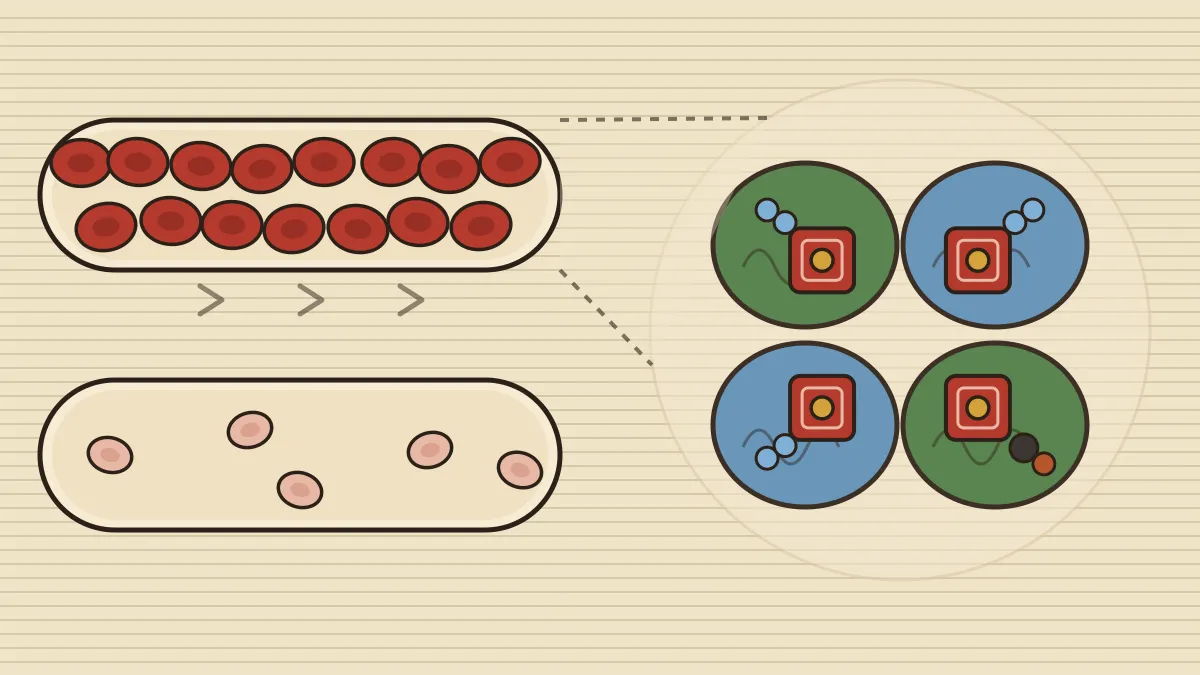
Each red cell lives only about four months, so the marrow keeps making them. The signal comes from the kidneys: when they sense low oxygen they release the hormone erythropoietin. Making a good cell needs three raw materials, and the anaemias are largely stories of one going missing.
| Raw material | Job | If it is missing |
|---|---|---|
| Iron | Centre of every haem group | Small, pale cells: iron-deficiency anaemia |
| Vitamin B12 (contains cobalt) | DNA synthesis as red cell precursors divide | Few, oversized, immature cells: megaloblastic anaemia |
| Folic acid | Same DNA step as B12 | Megaloblastic anaemia; in pregnancy, neural-tube defects in the baby |
Old red cells are swallowed by macrophages in the spleen and liver, and their iron is recycled: carried back to the marrow by transferrin and stored in the liver as ferritin. An adult holds only 3 to 4 g of iron, about two-thirds of it in haemoglobin, and loses a milligram or two a day. So iron deficiency in adults nearly always means blood loss or a poor diet. Women lose iron every month and need much more in pregnancy, which is why programmes target them.
The kidney signal also explains a defence fact. A soldier posted at Siachen or in Ladakh finds that after a few weeks his red cell count and haemoglobin rise, because low oxygen raised erythropoietin. That is why units are inducted to altitude in stages. Too many red cells is polycythaemia, and the thickened blood is a hazard of its own.
Anaemia: Definition, Cut-offs and Types
Anaemia is a fall in the haemoglobin level, or in the number of red cells, below the normal range for the person's age, sex and condition. The test is simple: measure haemoglobin in grams per decilitre (g/dL). The World Health Organization sets the cut-offs.
| Group | Anaemic if haemoglobin is below |
|---|---|
| Children 6 to 59 months | 11.0 g/dL |
| Pregnant women | 11.0 g/dL |
| Non-pregnant women (15 years and above) | 12.0 g/dL |
| Men (15 years and above) | 13.0 g/dL |
Severity follows the shortfall. For a non-pregnant woman, mild is 11.0 to 11.9, moderate 8.0 to 10.9 and severe below 8.0 g/dL.
| Type | Cause | What the red cells look like |
|---|---|---|
| Iron-deficiency | Poor intake, poor absorption, blood loss (heavy periods, hookworm in the gut) | Small and pale (microcytic, hypochromic). Spoon-shaped nails in long-standing cases |
| Megaloblastic | Lack of vitamin B12 or folate | Few, large, immature cells |
| Pernicious | The stomach lining fails to make intrinsic factor, so B12 cannot be absorbed even if the diet is rich in it | As megaloblastic, plus nerve damage |
| Aplastic | Bone marrow stops producing blood cells (some drugs, radiation, chemicals, viruses) | All cell lines fall. Marie Curie died of this form |
| Haemolytic | Red cells are destroyed faster than they are made: malaria parasites, Rh incompatibility, inherited defects | Jaundice, because haemoglobin breakdown makes bilirubin |
| Sickle cell | One amino acid in the beta chain is changed (valine in place of glutamic acid); the cell bends into a sickle in low oxygen and blocks capillaries | Crescent-shaped cells |
| Thalassaemia | Inherited fault that reduces the making of alpha or beta chains | Small, fragile cells |
The inherited ones are explained gene by gene on our blood groups page. India's National Sickle Cell Anaemia Elimination Mission (1 July 2023) aims to end the disease as a public-health problem by 2047. The malaria parasite, which bursts red cells as it multiplies, is covered in our malaria article.
Anaemia is not leukaemia (cancer of the white cells). Scurvy is vitamin C, anaemia is iron: CDS 2022-II put both side by side. Vitamin C helps iron absorption, but its lack does not by itself cause anaemia. B12 comes only from animal foods (milk, curd, eggs, fish, meat) or fortified products.
Iron on the Plate: What Gets Absorbed
Iron is absorbed in the first part of the small intestine, and the form matters.
- Haem iron (meat, fish, liver, eggs) is absorbed readily. Non-haem iron (green leafy vegetables, pulses, ragi, jaggery, dates) is absorbed poorly and unevenly.
- Helpers: vitamin C (lemon, amla, guava) makes non-haem iron easier to absorb. Cooking in an iron pan adds a little iron.
- Blockers: tannins in tea and coffee, phytates in raw bran, and a big dose of calcium at the same meal.
That is why India combines supplements, food and fortification: iron and folic acid (IFA) tablets, and iron-fortified rice through the public distribution system, midday meals and anganwadis. The balanced plate is covered on our human nutrition page.
Iron makes the haem, B12 and folate make the cell divide. Iron lack gives small pale cells; B12 or folate lack gives big immature cells.
India's Fight Against Anaemia, and What SAMPADA Found
Anaemia Mukt Bharat (AMB) began in 2018 under POSHAN Abhiyaan, as a 6×6×6 strategy (six age groups, six interventions, six institutional mechanisms) with the slogan Test, Treat, Talk. In 2026 it became the Anemia Mukt Bharat Abhiyaan: 7×7×7, adding low-birth-weight babies (0 to 6 months), an "Eating Right" food-based intervention and digital monitoring, and widening the slogan to Test, Treat, Talk and Track. Our earlier explainer covers it in full.
| Group in SAMPADA 2023-25 | Anaemia prevalence |
|---|---|
| Children, 12 to 59 months | 42% |
| Adolescent girls, 10 to 19 years | 46% |
| Women of reproductive age | 56% |
| Adolescent boys (10 to 19) and men (20 to 59) | 22 to 23% |
- Anaemia is lower than in earlier surveys, most of all among young children. NFHS-5 (2019-21) had reported about 57% of women aged 15 to 49 and 67% of children aged 6 to 59 months.
- Most anaemia is mild: about half of anaemic women, girls and children, and three-fourths of anaemic men. Severe anaemia is under 2% in most age groups.
- Iron deficiency explains about half of anaemia in women, girls and children. The rest comes from infections, inherited haemoglobin disorders and chronic inflammation.
- B12 and folate deficiency were about as common in people without anaemia as in those with it, so their part is limited. This is the surprise, because B12 is often blamed.
The survey used venous blood and automated analysers, which PIB calls the gold standard, and measured iron, folate and B12 in a sub-sample, so planners can tell a low haemoglobin caused by iron from one caused by something else. The lesson: anaemia needs tests, not guesses. The HPV campaign, by PIB's count, has reached nearly 87% of its annual target of about 1.2 crore 14-year-old girls. See our vaccine platforms page and article on the campaign.
How UPSC Has Asked It: Past Papers Solved
Actual CDS and NDA questions since 2018. UPSC keeps them short: what haemoglobin carries, what a red cell lacks, and what poisons the blood.
Which one of the following statements regarding haemoglobin is correct?
(a) Haemoglobin present in RBC can carry only oxygen but not carbon dioxide. (b) Haemoglobin of RBC can carry both oxygen and carbon dioxide. (c) Haemoglobin of RBC can carry only carbon dioxide. (d) Haemoglobin is only used for blood clotting and not for carrying gases.
Answer: (b). Haemoglobin carries oxygen from the lungs and also carries 20 to 25% of the carbon dioxide back as carbamino-haemoglobin. Option (a) is the tempting half-truth. Clotting is the work of platelets and plasma proteins.
Deficiency of iron causes
(a) Anaemia (b) Scurvy (c) Rickets (d) Cholera
Answer: (a). Without iron the haem cannot be made. Scurvy is vitamin C, rickets is vitamin D, and cholera is a bacterial infection, not a deficiency.
The poisonous nature of Carbon monoxide (CO) is due to its
(a) insolubility in water (b) ability to form a complex with haemoglobin (c) ability to reduce some metal oxides (d) property of having one sigma bond
Answer: (b). CO binds haemoglobin more than 200 times as strongly as oxygen and forms carboxyhaemoglobin, so the blood cannot deliver oxygen. Reducing metal oxides is a true property of CO, but it is not what makes it poisonous.
Which of the following activity a mammalian erythrocyte CANNOT perform?
(a) Diffusion of oxygen (b) Protein synthesis and cell division (c) Squeeze while passing through capillaries (d) Carry haemoglobin
Answer: (b). A mature mammalian red cell has no nucleus and no machinery for making protein, so it cannot synthesise protein or divide. It carries haemoglobin, lets oxygen diffuse in and out, and bends to pass through narrow capillaries.
Which one of the following is important for cartilage but NOT a globin protein?
(a) Haemoglobin (b) Myoglobin (c) Keratin (d) Collagen
Answer: (d). Haemoglobin and myoglobin are both globins. Collagen is the main protein of cartilage. Keratin is not a globin either, but it makes hair and nails, and is not important for cartilage, which is the clue that rules it out.
Each asks for one fact: no nucleus, carries O₂ and CO₂, iron makes it. CDS 2024-I (red cells have no nucleus) and CDS 2023-I (red cells in isotonic saline stay unchanged) fit the same pattern. Expect myoglobin, B12 or the Bohr effect next.
Practice MCQs (with answers)
- The iron-containing part of haemoglobin is called
- globin
- haem
- ferritin
- transferrin
- If fully loaded haemoglobin binds 1.34 mL of oxygen per gram, how much oxygen can 100 mL of blood with 15 g of haemoglobin carry on the haemoglobin?
- About 10 mL
- About 15 mL
- About 20 mL
- About 30 mL
- Pernicious anaemia is caused by
- lack of iron in the diet
- lack of vitamin C
- destruction of red cells by malaria parasites
- lack of intrinsic factor, so that vitamin B12 is not absorbed
- Absorption of iron from plant foods is helped by
- vitamin C, as in lemon juice or amla
- tannins in tea
- phytates in raw bran
- a large dose of calcium at the same meal
- A soldier stays at 5,000 m for several weeks. His red cell count will
- rise, because the kidneys release more erythropoietin
- fall, because the air is thin
- stay unchanged
- fall at first and then stay low
- According to the SAMPADA findings released on 23 November 2026, severe anaemia was seen in
- about 10% of people in all age groups
- about 5% of women only
- about 20% of children
- less than 2% of people in most age groups
- Small, pale red cells are the typical sign of
- vitamin B12 deficiency
- iron deficiency
- aplastic anaemia
- sickle cell disease
- The 2026 upgrade of Anaemia Mukt Bharat to a 7×7×7 strategy added, as a seventh target group,
- school teachers
- men over 60 years
- low-birth-weight babies of 0 to 6 months
- rural labourers
1-b, 2-c, 3-d, 4-a, 5-a, 6-d, 7-b, 8-c. Q2: 15 × 1.34 = 20.1 mL. Q3: the stomach lining makes intrinsic factor; without it B12 passes through unabsorbed even in a rich diet. Q5: low oxygen raises erythropoietin, so the marrow makes more red cells. Q7: B12 lack makes large cells, aplastic anaemia lowers all cell counts, and sickle cells are crescent-shaped. Q8: the other groups were not added.
Quick Revision
- Mature mammalian RBC: no nucleus, biconcave, about 5 to 5.5 million per mm³, life 120 days, made in red bone marrow, destroyed in the spleen. Kidneys release erythropoietin when oxygen is low.
- Haemoglobin = 4 globin chains + 4 haem groups, each with one Fe²⁺. Carries 4 O₂; about 97% of blood oxygen. Also carries 20 to 25% of CO₂. Normal 12 to 16 g per 100 mL. Perutz, Nobel 1962.
- CO binds more than 200 times as tightly as O₂. Myoglobin = one chain, stores O₂ in muscle. Bohr effect: more CO₂, acid or heat makes Hb release O₂.
- WHO cut-offs (g/dL): children 6-59 months 11; pregnant 11; non-pregnant women 12; men 13.
- Iron lack = small pale cells. B12 or folate lack = large immature cells (megaloblastic). Intrinsic factor lack = pernicious. Marrow failure = aplastic. Early destruction = haemolytic. Valine for glutamic acid = sickle cell.
- B12 only from animal foods (cobalt-containing). Vitamin C helps iron absorption; tea and phytates hinder it.
- AMB: launched 2018 under POSHAN Abhiyaan; 6×6×6 and Test, Treat, Talk; 2026 Abhiyaan 7×7×7 and Test, Treat, Talk, Track. Sickle Cell Mission: 1 July 2023, target 2047.
- SAMPADA (ICMR, released 23 Nov 2026): 2 lakh+ people, 183 districts; women 56%, adolescent girls 46%, children 12-59 months 42%, men and boys 22-23%; severe anaemia under 2%; iron deficiency about half; B12 and folate play a limited part.
Frequently asked questions
What is haemoglobin and what does it do?
Haemoglobin is the iron-containing protein inside red blood cells. It has four globin chains, each with a haem group holding one iron atom, so one molecule can carry four molecules of oxygen. It also carries 20 to 25% of the carbon dioxide produced by the body back to the lungs.
What are the main types of anaemia?
Iron-deficiency anaemia gives small pale red cells. Vitamin B12 or folate deficiency gives large immature cells (megaloblastic anaemia), and lack of intrinsic factor leads to pernicious anaemia. Aplastic anaemia is failure of the bone marrow, haemolytic anaemia is early destruction of red cells, and sickle cell disease and thalassaemia are inherited haemoglobin disorders.
At what haemoglobin level is a person anaemic?
The World Health Organization sets age, sex and pregnancy-specific cut-offs. A person is anaemic below 11 g/dL for children aged 6 to 59 months and pregnant women, below 12 g/dL for non-pregnant women, and below 13 g/dL for men. Severity is graded mild, moderate or severe by how far the level falls below the cut-off.
Why is carbon monoxide so dangerous?
Carbon monoxide binds to the iron in haemoglobin more than 200 times as strongly as oxygen does. The haemoglobin becomes carboxyhaemoglobin and can no longer carry oxygen, so tissues starve of oxygen even though the person is breathing. Poorly ventilated heaters and engines running in closed spaces are the usual sources.
What did the ICMR SAMPADA survey find about anaemia?
SAMPADA 2023-25, released on 23 November 2026, covered over 2 lakh people in 183 districts. It found lower anaemia than earlier national surveys, mostly mild, with severe anaemia under 2% in most age groups. Iron deficiency explained about half of the anaemia in women, adolescent girls and children, and B12 and folate deficiency played a limited part.
Related CDS / OTA Science topics
Biology is the most scoring third of CDS science
Cavalier's CDS/OTA batches teach physics, chemistry and biology from first principles, with weekly PYQ tests and a teacher to ask.