On 24 June 2026 the Indian Pharmacopoeia Commission held a national conference in Ghaziabad on the quality of blood and blood components, after IP 2026 added standards for them. The PIB release described the standards as a first among the world's pharmacopoeias. In September, on the 8th, the Ministry of Coal and Coal India marked the progress of the Thalassemia Bal Sewa Yojana, which funds bone-marrow transplants for children with inherited blood disorders. The first story is about what is in the bag. The second is about what is wrong in the genes. The exam links them through one topic: blood groups. UPSC asks the core of it every year, such as what the four types are, who the universal donor is, and how the Rh factor harms a baby.
Blood in Brief: The Fluid That Is Transfused
By Akanksha Kumari · Science faculty, The Cavalier · B.Tech, 15 years teaching Science
Blood is a connective tissue with a fluid matrix, plasma, and formed elements. Our blood components page covers the cells; here are the parts that matter for a transfusion.
| Part | Share / count | Why it matters for transfusion |
|---|---|---|
| Plasma | About 55% of blood; 90-92% water, 6-8% proteins | Carries the antibodies (globulins). Plasma without clotting factors is serum |
| Red blood cells | 5 to 5.5 million per mm³; live about 120 days | Carry the antigens that define the blood group |
| White blood cells | 6,000-8,000 per mm³ | B and T lymphocytes make the immune response; they make antibodies |
| Platelets | 1.5 to 3.5 lakh per mm³ | Fragments of megakaryocytes that start clotting |
A blood group is a statement about two things: the antigens on the surface of the red cells and the antibodies floating in the plasma. An antigen is a chemical that can trigger an immune response. An antibody is a protein made in response to it. A mismatch between the donor's cells and the recipient's antibodies makes the red cells clump (agglutinate) and burst, and that can kill.
Landsteiner and the ABO System
In 1900-01 the Austrian scientist Karl Landsteiner mixed the red cells and serum of his colleagues and saw that some combinations clumped and some did not. He sorted human blood into groups now called A, B and O. A fourth group, AB, was found in 1902 by two of his students, Decastello and Sturli. Landsteiner won the 1930 Nobel Prize in Physiology or Medicine. In 1940, with Alexander Wiener, he discovered the Rh factor. His birthday, 14 June, is observed as World Blood Donor Day.
The ABO groups depend on two sugar-based antigens, A and B, on the red cell. The plasma of each person carries natural antibodies against the antigens that person does not have.
| Group | Antigens on red cells | Antibodies in plasma |
|---|---|---|
| A | A | anti-B |
| B | B | anti-A |
| AB | A and B | None |
| O | None | anti-A and anti-B |
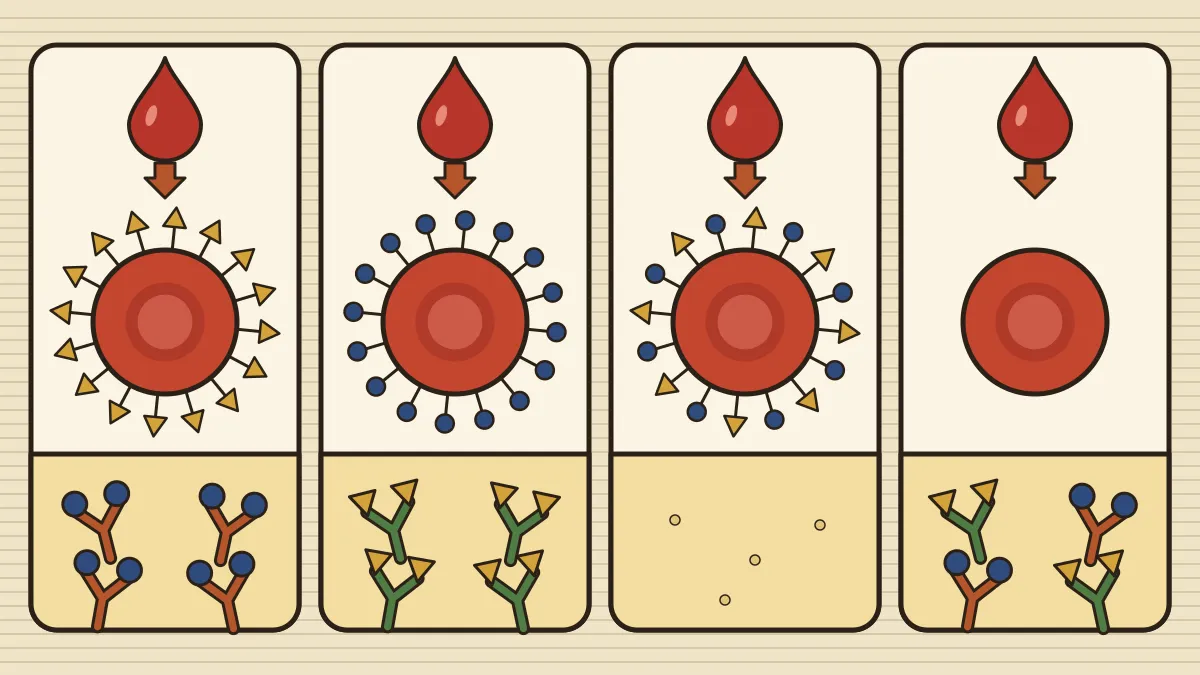
A neat memory aid: the antibody is always the "opposite" of the antigen. Your body does not attack its own antigens, so group AB has no antibodies and group O has both.
Who Can Give to Whom: Reading the Table Correctly
The rule for a transfusion of red cells is simple: the recipient's antibodies must not meet an antigen on the donor's cells. Work through it from the recipient's side.
| Recipient | Antibodies it has | Red cells it can safely receive |
|---|---|---|
| A | anti-B | A, O |
| B | anti-A | B, O |
| AB | None | A, B, AB, O |
| O | anti-A, anti-B | O only |
So O is the universal donor (O cells have no antigen to attack) and AB is the universal recipient (AB plasma has no antibody to attack). The Rh factor gives a second layer. A person who is Rh-negative should receive only Rh-negative blood. O-negative is therefore the safest red cell for an emergency when there is no time to test, and AB-positive is the group that can receive from every other.
Whole blood is separated into components, and the plasma carries antibodies. When plasma is transfused, the donor's antibodies meet the recipient's red cells, so the logic flips. AB plasma, with no antibodies, is the universal plasma donor, and O plasma, with both antibodies, can go only to O recipients. A question that says "universal donor" without saying "red cells" is usually about whole blood or red cells, so check the wording.
Inheritance: One Gene, Three Alleles, Four Groups
The ABO group is controlled by a single gene, I, on a human chromosome. It has three alleles: IA, IB and i. IA and IB each make a slightly different sugar on the red cell's membrane. The allele i makes no sugar. Every person has only two alleles, one from each parent, so the three alleles give six genotypes and four phenotypes (the four groups). Three alleles for one character is the standard example of multiple alleles. The genetics and DNA page has the Mendelian background.
| Genotype | Blood group | Reason |
|---|---|---|
| IAIA or IAi | A | IA is dominant over i |
| IBIB or IBi | B | IB is dominant over i |
| IAIB | AB | Co-dominance: both alleles express |
| ii | O | No antigen made |
The AB group is the standard example of co-dominance: in a heterozygote, both alleles express themselves fully and there is no blending. That is different from incomplete dominance, where the hybrid is in-between, as in the pink flowers of the four-o'clock plant.
A man of group A (IAi) marries a woman of group B (IBi). Which groups can their children have?
A woman of group O has a child of group AB. Is that possible?
The Rh Factor and Erythroblastosis Fetalis
The Rh antigen is named after the rhesus monkey. About 80% of people carry it (Rh-positive); the rest are Rh-negative. Unlike ABO antibodies, anti-Rh antibodies are not there naturally: an Rh-negative person makes them only after exposure to Rh-positive blood. That explains both the transfusion rule and the pregnancy problem.
- An Rh-negative mother carries an Rh-positive baby (the baby inherited the Rh gene from the father).
- During the first pregnancy the placenta keeps the two bloods apart, so the baby is usually safe.
- At delivery, a little foetal blood can enter the mother's circulation. Her immune system is sensitised and starts to make anti-Rh antibodies.
- In a later Rh-positive pregnancy, these antibodies cross the placenta and destroy the baby's red cells. The result is severe anaemia and jaundice, called erythroblastosis fetalis, and it can be fatal.
The prevention is to give the mother anti-Rh (anti-D) antibodies soon after the first delivery, typically within 72 hours, which destroys any foetal Rh-positive cells before her immune system can respond. If the mother is Rh-positive, or both parents are Rh-negative, there is no problem.
Watch the wording: the danger is an Rh-negative mother with an Rh-positive baby, it is the later baby that suffers, and the antibodies are given to the mother.
The Bombay Group and the Blood Bank
The Bombay blood group was found in 1952 in Bombay (now Mumbai) by Dr Y.M. Bhende. A person of this phenotype lacks the H substance, the base on which the A and B sugars are built, so the red cells carry neither A nor B antigen. In a routine test such a person looks like group O. But the plasma contains anti-H as well as anti-A and anti-B, so ordinary O blood will clump. The person can receive blood only from another Bombay-group donor. The group is rare, so finding a matching donor can take a registry.
A blood bank does not store only "whole blood". A bag of donated blood is spun in a centrifuge and split into components, so that one donation can help several patients: packed red cells (stored at 2-6 °C for up to about 42 days) for anaemia and blood loss, platelet concentrate (about 5 days, at room temperature with gentle shaking) for dengue and chemotherapy, and fresh frozen plasma (up to about a year) for clotting-factor deficiency.
The anticoagulant added to the bag is citrate, which binds calcium. Clotting needs calcium ions, so with them locked up the blood stays liquid. Each unit is screened for HIV, hepatitis B, hepatitis C, syphilis and malaria before use. Our HIV and AIDS article explains the virus behind the first test. India's National Voluntary Blood Donation Day is on 1 October, and World Blood Donor Day is on 14 June.
Haemophilia, Thalassaemia and Sickle Cell: Where Blood Meets Genes
| Disorder | Inheritance | What goes wrong | Treatment link |
|---|---|---|---|
| Haemophilia | X-linked recessive | A clotting factor is missing, so even a small cut bleeds for long | Replacement of the clotting factor; not a whole-blood disease |
| Thalassaemia | Autosomal recessive | Too few globin chains are made (alpha or beta), so haemoglobin is abnormal and anaemia follows | Repeated transfusions; bone-marrow transplant can cure |
| Sickle-cell anaemia | Autosomal recessive | One amino acid in the beta chain is swapped (glutamic acid to valine), and red cells bend into a sickle shape | Screening, hydroxyurea, transfusions |
Haemophilia shows the sex-linked pattern. The gene lies on the X chromosome, so a carrier mother passes it to half of her sons, who are affected because they have no second X to mask it. Half of her daughters are carriers. The disease ran through the descendants of Queen Victoria, who was a carrier.
Thalassaemia and sickle-cell anaemia are autosomal. A child is affected only when both parents are carriers who pass on the faulty gene. The contrast is neat: thalassaemia is a quantitative problem (too few globin molecules), and sickle-cell anaemia a qualitative one (a faulty globin).
The current-affairs link is strong. Under the Thalassemia Bal Sewa Yojana, Coal India gives up to ₹10 lakh per patient for a bone-marrow transplant at empanelled hospitals. PIB, 8 September 2026, said it now covers 21 hospitals and has funded over 1,050 transplants. On International Sickle Cell Day (19 June 2026), the President noted that the Sickle Cell Anaemia Elimination Mission had screened 7 crore people, finding about 2.5 lakh patients and over 20 lakh carriers. The circulatory background is in our circulatory system page, and antibodies and vaccines are in immunity and vaccination.
How UPSC Has Asked It: Past Papers Solved
Pure ABO questions are rare: only one direct question on the four groups has appeared since 2018. UPSC more often tests the red cell and the plasma as components. Haemoglobin and observance days also appear. Six real questions follow.
What are the four human blood types in ABO blood group typing?
(a) AO, BO, A and B (b) A, B, AB and O (c) A, AB, BO and O (d) AB, AO, B and O
Answer: (b). The four types are A, B, AB and O. "AO" and "BO" are genotypes (IAi and IBi) that both look like groups A and B, so they are not separate types.
Which one of the following is the theme of the World Blood Donor Day, 2018?
(a) Blood connects us all (b) Be there for someone else. Give blood. Share life (c) Give blood. Give now. Give often (d) Thank you for saving my life
Answer: (b). Options (a) and (c) are slogans from the 2016 and 2017 campaigns. Do not expect to memorise every theme, but know the date (14 June) and the person it honours, Karl Landsteiner.
Which cells in human body have no nucleus?
(a) Muscle cells (b) Phagocytic cells (c) Red blood cells (d) Ciliated cells
Answer: (c). Mature mammalian red cells lose the nucleus, which makes room for haemoglobin. Phagocytes such as neutrophils and monocytes are nucleated white cells.
From which among the following are blood clotting factors released?
(a) RBCs (b) Eosinophils (c) Platelets (d) Monocytes
Answer: (c). An injury makes platelets release factors that start the clotting cascade, ending in fibrin from fibrinogen under the action of thrombin.
Which of the following activity a mammalian erythrocyte CANNOT perform?
(a) Diffusion of oxygen (b) Protein synthesis and cell division (c) Squeeze while passing through capillaries (d) Carry haemoglobin
Answer: (b). With no nucleus and few organelles, a mature mammalian red cell cannot make proteins or divide. New red cells are made in the red bone marrow. Its flexible biconcave shape does let it squeeze through capillaries.
Which one of the following statements regarding haemoglobin is correct?
(a) Haemoglobin present in RBC can carry only oxygen but not carbon dioxide. (b) Haemoglobin of RBC can carry both oxygen and carbon dioxide. (c) Haemoglobin of RBC can carry only carbon dioxide. (d) Haemoglobin is only used for blood clotting and not for carrying gases.
Answer: (b). Haemoglobin carries oxygen, and also about 20-25% of the carbon dioxide, which attaches to its protein part. Most of the rest is carried as bicarbonate in the plasma. The tempting option (a) is only the half of the story most students remember.
Expect one factual line per paper, such as which cell has no nucleus, which cell starts clotting, or what the four groups are. A deeper question on antigens and antibodies would be the next step, so master the group table, the plasma trap and the Rh sequence.
Practice MCQs (with answers)
- A person whose red cells carry both A and B antigens belongs to group
- O
- A
- AB
- B
- The plasma of which group contains neither anti-A nor anti-B antibodies?
- AB
- O
- A
- B
- A man of group A (IAi) marries a woman of group B (IBi). Which blood group is impossible among their children?
- O
- AB
- A
- None of these; all are possible
- Erythroblastosis fetalis is most likely to affect
- the first Rh-positive child of every Rh-negative mother, always
- a later Rh-positive child, after the Rh-negative mother has made anti-Rh antibodies
- any child of an Rh-positive mother
- an Rh-negative child of an Rh-negative mother
- A person with the Bombay blood group can safely receive blood from
- group O donors only
- another Bombay-group donor only
- group AB donors only
- any ABO group
- Karl Landsteiner received the Nobel Prize for the discovery of blood groups in
- 1900
- 1921
- 1945
- 1930
- For a transfusion of plasma, the universal donor group is
- AB
- O
- B
- A
- Haemophilia is inherited as
- an autosomal dominant trait
- an autosomal recessive trait
- an X-linked recessive trait
- a Y-linked trait
1-c, 2-a, 3-d, 4-b, 5-b, 6-d, 7-a, 8-c. Q3: the cross gives AB, A, B and O in equal numbers, so none is impossible. Q4: the damage needs sensitisation first, so it is the later pregnancy that is at risk. Q5: the Bombay group has anti-H as well as anti-A and anti-B, so ordinary O blood will clump. Q6: the discovery was in 1900-01, but the Nobel came in 1930. Q7: plasma reverses the rule, because the donor's antibodies meet the recipient's cells, and AB plasma has none. Q8: the gene lies on the X chromosome, which is why mostly males are affected.
Quick Revision
- Landsteiner: A, B, O (1900-01); AB by Decastello and Sturli (1902); Nobel 1930; Rh with Wiener (1940). 14 June = World Blood Donor Day; 1 October = National Voluntary Blood Donation Day.
- Antigens on red cells, antibodies in plasma. A: A, anti-B. B: B, anti-A. AB: A and B, no antibodies. O: none, anti-A and anti-B.
- O = universal red-cell donor, AB = universal recipient. For plasma it reverses: AB plasma is the universal donor. O-negative is the emergency red cell.
- ABO gene I: alleles IA, IB, i; six genotypes, four phenotypes; IA and IB are co-dominant, both dominant over i; multiple alleles.
- Rh: named for the rhesus monkey; about 80% are positive. Danger is an Rh-negative mother with an Rh-positive baby in a later pregnancy. Prevention: anti-Rh antibodies to the mother after delivery.
- Bombay group (1952, Bhende, Mumbai): no H, A or B; looks like O but can take only Bombay-group blood.
- Components: red cells, platelets, plasma; citrate binds calcium. Haemophilia: X-linked recessive. Thalassaemia: too few globin chains. Sickle-cell: glutamic acid to valine. TBSY: up to ₹10 lakh per transplant.
Frequently asked questions
Why is O the universal donor and AB the universal recipient?
Group O red cells carry neither A nor B antigen, so a recipient's antibodies have nothing to attack. Group AB plasma has no anti-A or anti-B, so an AB person can receive red cells of any ABO group. The Rh factor must match too, which is why O-negative is the safest emergency blood.
How many ABO groups are there and how are they inherited?
Four: A, B, AB and O. They come from three alleles of one gene, IA, IB and i, which combine into six genotypes. IA and IB are co-dominant and both dominate i.
What is Rh incompatibility and how is it prevented?
It arises when an Rh-negative mother carries an Rh-positive baby. At the first delivery, a little foetal blood can reach the mother, who makes anti-Rh antibodies. In a later Rh-positive pregnancy these antibodies cross the placenta and destroy the baby's red cells, causing erythroblastosis fetalis. Giving anti-Rh antibodies to the mother soon after the first delivery prevents it.
What is the Bombay blood group?
It is a rare phenotype first found in Bombay in 1952, in which the red cells lack the H substance and so carry no A or B antigen. It looks like group O in routine tests, but the person's plasma has anti-H as well as anti-A and anti-B. Such a person can receive blood only from another Bombay-group donor.
Why do thalassaemia patients need repeated blood transfusions?
In thalassaemia too few alpha or beta globin chains are made, so the haemoglobin is abnormal and red cells are weak. The resulting anaemia is managed by repeated transfusions, and a bone-marrow transplant can cure it. India's Thalassemia Bal Sewa Yojana funds such transplants for children.
Related CDS / OTA Science topics
Blood and genetics questions are short, factual and very scoreable
Cavalier's CDS/OTA batches turn NCERT biology into exam-ready notes, diagrams and weekly PYQ drills.