On 17 November 2026 the President of India inaugurated the year-long Golden Jubilee celebrations of the ICMR-National Institute of Malaria Research, the institute in Delhi that studies the parasite, its mosquitoes and the way the disease spreads. The timing is apt. In August 2026 the Health Ministry reported that malaria cases and deaths fell by nearly 80% between 2015 and 2025, that the number of high-burden districts dropped from 155 to 33, and that 160 districts reported zero indigenous cases from 2022 to 2025. Yet the disease still kills hundreds of thousands of people worldwide each year. UPSC has asked about malaria in the NDA 2025-I and CDS 2026-II papers, and the questions reward one skill: knowing which stage of the parasite sits in which host.
Who Found What: Laveran, Ross and Grassi
By Akanksha Kumari · Science faculty, The Cavalier · B.Tech, 15 years teaching Science
The word comes from the Italian mal'aria, "bad air". For centuries people blamed marshy vapours, and the real cause took two discoveries separated by 17 years.
| Year | Scientist | Discovery |
|---|---|---|
| 17th century | Peruvian healers, then European missionaries | Bark of the cinchona tree brings down malarial fever; its alkaloid is later named quinine |
| 1880 | Alphonse Laveran, French army surgeon, Algeria | Sees the parasite inside the red blood cells of a patient. Nobel Prize in Physiology or Medicine, 1907 |
| 1897 | Ronald Ross, British army doctor, Secunderabad | Finds the parasite in the stomach wall of an Anopheles mosquito that had fed on a patient. Nobel Prize, 1902 |
| 1898 | Giovanni Battista Grassi and colleagues, Italy | Trace the complete human malaria cycle in Anopheles mosquitoes |
| 1939–48 | Paul Müller, Switzerland | Shows that DDT kills insects; Nobel Prize, 1948 |
| 2015 | Tu Youyou, China | Isolates artemisinin from the sweet wormwood plant; shares the Nobel Prize |
Laveran found the parasite in blood. Ross found it in the mosquito. Neither "discovered the cure": quinine was in use long before both. 20 August, the date of Ross's discovery, is observed as World Mosquito Day.
The Life Cycle: Two Hosts, Three Habitats
Malaria is caused by Plasmodium, a single-celled protozoan, not a bacterium or a virus. It lives in two hosts. Humans are the intermediate host, where the parasite multiplies asexually. The female Anopheles mosquito is the definitive host, because the parasite's sexual reproduction happens in her gut. She is also the vector, the carrier that moves the parasite between people. Only females bite, since they need a blood meal to develop their eggs.
| Step | Stage and where it lives | What happens |
|---|---|---|
| 1 | Sporozoites in the mosquito's salivary glands | The infective form. A bite injects them into the human bloodstream |
| 2 | Liver cells | The sporozoites reach the liver within a short time. Each multiplies into thousands of merozoites. No symptoms yet |
| 3 | Red blood cells (RBCs) | Merozoites enter RBCs and grow through a ring stage to a schizont, which divides into new merozoites |
| 4 | Bursting RBCs | Cells rupture together and release merozoites plus a pigment, haemozoin. This causes the chill, fever and sweating. The released merozoites invade fresh RBCs, and the cycle repeats |
| 5 | Some RBCs | A few merozoites turn into gametocytes, the sexual forms. These cause no symptoms but carry the infection onward |
| 6 | Mosquito's gut | A biting female sucks up gametocytes. Male and female gametes fuse into a zygote, which becomes an oocyst on the gut wall and releases sporozoites that move to the salivary glands |
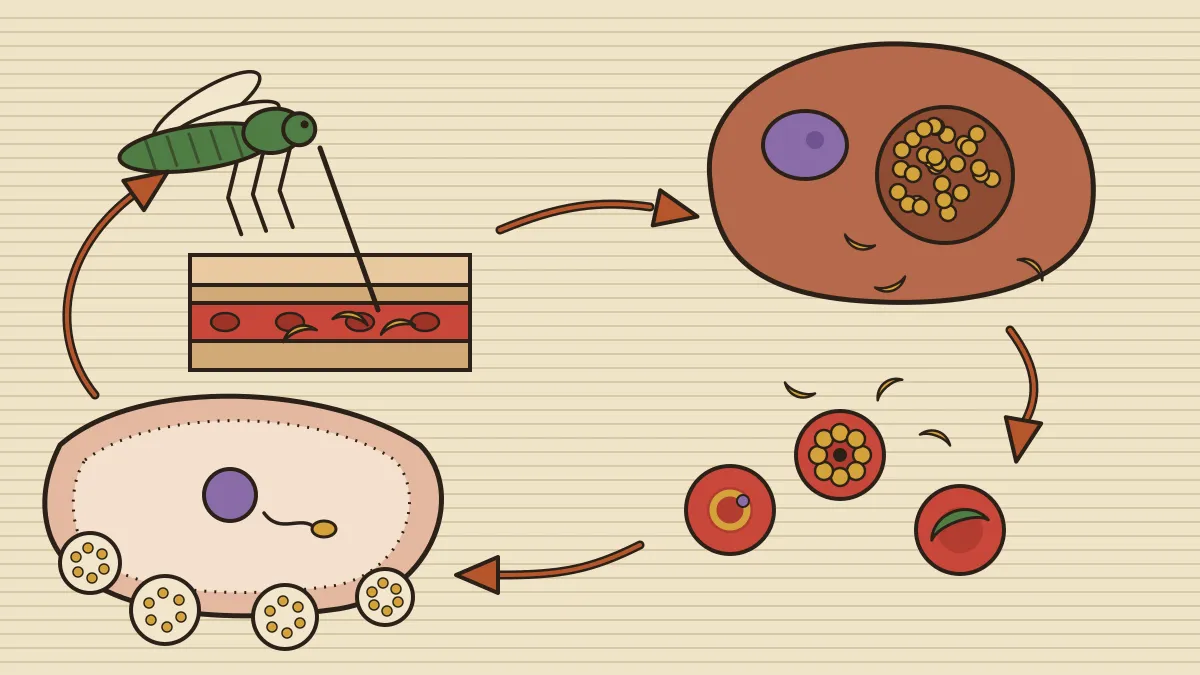
The liver phase has a practical meaning. A person who has just been bitten has no parasites in the blood and tests negative, so a malaria test in the first days after a bite proves nothing. The incubation period, from bite to first fever, is usually about 10 to 15 days, and can be longer for some species.
Asexual multiplication (schizogony) happens in human liver cells and RBCs. Sexual reproduction (gamete fusion) happens in the mosquito. So the mosquito is the definitive host, not "just a carrier".
The Five Human Species and the Fever Pattern
Five species infect humans. P. falciparum and P. vivax cause most Indian cases. Many school courses name only three; the other two are worth knowing for the full list.
| Species | Fever cycle | Key feature |
|---|---|---|
| P. falciparum | Irregular (malignant tertian) | The deadliest. Infected RBCs stick to the walls of small blood vessels, which can block circulation to the brain (cerebral malaria) and kidneys. No dormant liver stage |
| P. vivax | Every 48 hours (tertian) | Rarely fatal but relapses, because some parasites sleep in the liver as hypnozoites |
| P. ovale | Every 48 hours | Also forms hypnozoites; mainly in Africa |
| P. malariae | Every 72 hours (quartan) | Slow, can persist at a low level for years |
| P. knowlesi | Every 24 hours | A monkey (macaque) parasite that also infects humans in South-East Asia |
Two points are easy to lose marks on. First, a fever that returns every second or third day is the signature of synchronised RBC rupture, though school books say "every three to four days", counting the days inclusively. Second, vivax relapse is why a patient treated for the blood stage can fall ill again months later: the hypnozoites in the liver were never touched. A separate drug, primaquine, clears them.
The host's genes also matter. People who carry one copy of the sickle-cell gene (HbS) are partly protected against falciparum malaria, which explains why the gene stays common in malarial regions, including tribal belts of central and eastern India. People whose red cells lack the Duffy antigen resist vivax, because the parasite uses that molecule as its door into the cell. The inheritance pattern is explained on our page on Mendel's laws and human inheritance.
Malaria does not spread only by mosquito bite. It can also cross the placenta from mother to foetus, pass through an infected blood transfusion, and spread through shared needles. The nearby topic of blood typing and transfusion safety is covered in our blood groups article.
Knowing the Vector
Several mosquitoes live around us, and only Anopheles carries malaria. Aedes spreads dengue and chikungunya, and Culex spreads filariasis and Japanese encephalitis. Our overview of viral, bacterial and protozoan diseases sets the whole list out side by side.
- Resting posture. An adult Anopheles rests with its body tilted at an angle, abdomen pointing up. A Culex rests parallel to the surface.
- Larvae. Anopheles larvae lie flat just under the water surface because they have no breathing siphon. They breed in clean, still water, from paddy fields and pits to rain-filled containers.
- Biting time. Mostly at dusk and through the night, which is why bed nets work.
- Indian species. A. culicifacies is the main rural vector, A. stephensi breeds in cities (water tanks and construction sites), and A. minimus and A. fluviatilis operate in hill and forest areas.
Drugs, Vaccines and How Malaria Is Fought
| Tool | How it works |
|---|---|
| Quinine | Alkaloid from cinchona bark; the oldest drug, now reserved for severe cases |
| Chloroquine | Synthetic drug of the 1940s; still used for vivax, but falciparum resistance appeared in the late 1950s |
| Artemisinin | From the plant Artemisia annua; the fastest-acting drug, always given as an artemisinin combination therapy (ACT) with a partner drug to slow resistance |
| Primaquine | Destroys liver hypnozoites and gametocytes: the "radical cure" for vivax |
| Insecticide-treated nets | Long-lasting insecticidal nets (LLINs) stop bites during the night |
| Indoor residual spraying | Insecticide on the inside walls kills mosquitoes that rest there after feeding |
| Source reduction and biological control | Draining stagnant water, oiling ponds, stocking Gambusia (mosquito fish) and guppies that eat larvae, and spraying the bacterium Bacillus thuringiensis israelensis. See our page on microbes in human welfare for more on biological control |
Diagnosis is by a Giemsa-stained blood smear under the microscope, or by a rapid diagnostic test (RDT) that detects parasite proteins in a drop of blood within minutes. Vaccines arrived late because the parasite changes its surface proteins and hides inside cells. RTS,S (recommended by WHO in 2021) and R21/Matrix-M (recommended in October 2023, with the Serum Institute of India as manufacturer) both target the sporozoite's surface protein. They are given to young children in African countries with high transmission, and neither gives complete protection. How vaccines train the immune system in general is explained under immunity and vaccination. India's own newest vector-borne vaccine story is in our article on the dengue vaccine approval.
India's Elimination Drive and the Terms UPSC Uses
At independence in 1947 India had an estimated 7.5 crore (75 million) cases and about 8 lakh deaths a year, according to a PIB review of December 2024. DDT spraying under the national control and eradication programmes of the 1950s cut cases sharply, but the gains did not last: mosquitoes became resistant and the effort slackened. Control is now run by the National Centre for Vector Borne Diseases Control (NCVBDC), which also handles dengue, chikungunya, filariasis, kala-azar and Japanese encephalitis.
The National Framework for Malaria Elimination 2016-2030 gives a roadmap to zero indigenous cases by 2027 and malaria elimination by 2030, which the 2023-2027 National Strategic Plan carries forward. The August 2026 review noted that 33 high-burden districts in nine States and Union Territories still accounted for 64% of cases and 54% of deaths in 2025. The states reviewed were Mizoram, Odisha, Tripura, Assam, Andhra Pradesh, Andaman and Nicobar Islands, Chhattisgarh, Jharkhand and Maharashtra. The working strategy is Test, Treat and Track: test every fever early, give complete treatment, and record every case so that the response can be targeted.
| Term | Meaning |
|---|---|
| API (Annual Parasite Incidence) | Confirmed cases per 1,000 population in a year |
| ABER (Annual Blood Examination Rate) | Blood slides examined per 100 population in a year: it measures how hard the system is looking, not how many are sick |
| SPR (Slide Positivity Rate) | Share of examined slides that turn out positive |
| Indigenous case | Caught locally, as opposed to imported from elsewhere |
| Elimination | Zero indigenous cases in a defined area. Eradication means zero everywhere in the world |
Globally, WHO certifies a country malaria-free after at least three consecutive years of zero indigenous cases and a proven system to prevent return. The Maldives (2015) and Sri Lanka (2016) earned it in India's neighbourhood. China was certified on 30 June 2021, after about 70 years of effort, which UPSC asked in CDS 2021-II. WHO's global estimates still run to roughly 260 million cases and 600,000 deaths a year, most of them African children under five.
A district with a high ABER can show many "cases" simply because more people were tested, and asymptomatic people found in mass screening should be reported separately. Falling API with steady testing is the real sign of progress, which is why the August 2026 review asked states to check duplicate testing.
How UPSC Has Asked It: Past Papers Solved
These are actual CDS and NDA questions since 2020. The pattern is short and factual: the organism, the vector, the way it spreads, and one recent-news item.
The vector of malaria parasites is
(a) Male Anopheles mosquito (b) Male Culex mosquito (c) Female Anopheles mosquito (d) Female Culex mosquito
Answer: (c). Only the female needs blood to develop her eggs, so only she bites. Culex is the tempting wrong choice: it carries filariasis and Japanese encephalitis, not malaria.
Which of the following pairs is/are correctly matched? 1. Malaria – Plasmodium. 2. TB – Mycobacterium. Select the answer using the code given below:
(a) 1 only (b) 2 only (c) Both 1 and 2 (d) Neither 1 nor 2
Answer: (c). Malaria is caused by the protozoan Plasmodium, and tuberculosis by the bacterium Mycobacterium tuberculosis. Many candidates doubt the first pair because they remember malaria as a "mosquito disease"; the mosquito is only the carrier.
Consider the following statements associated with Malaria: 1. Only the female Anopheles mosquitoes take human blood for reproduction. 2. Plasmodium can pass across the placenta from mother to foetus.
(a) 1 only (b) 2 only (c) Both 1 and 2 (d) Neither 1 nor 2
Answer: (c). Statement 1 is true: the female needs the blood meal for egg development. Statement 2 is also true: congenital malaria happens when the parasite crosses the placenta.
Which one of the following countries has recently been awarded a malaria-free certification by the WHO?
(a) Pakistan (b) Bhutan (c) China (d) Nepal
Answer: (c). WHO certified China on 30 June 2021. Pakistan, Bhutan and Nepal had not been certified.
'Sleeping sickness' is caused by
(a) Trypanosoma (b) Leishmania (c) Plasmodium (d) Paramecium
Answer: (a). Trypanosoma is spread by the tsetse fly. Plasmodium is the malaria parasite, and Leishmania causes kala-azar. All three are protozoans, which is why the options tempt, but each has its own vector.
Which one among the following pairs of diseases and their types is not correctly matched?
(a) Polio – Viral disease (b) Athlete's foot – Fungal disease (c) Dengue fever – Non-viral disease (d) Whooping cough – Bacterial disease
Answer: (c). Dengue is caused by a virus that Aedes mosquitoes carry. The question reuses the same trick as malaria: a mosquito-borne disease is not a "mosquito disease" in type. Malaria is protozoal, dengue is viral.
Match three things for every disease: pathogen type (virus, bacterium, protozoan), named organism, and vector or route. Malaria: protozoan, Plasmodium, female Anopheles. Dengue: virus, Aedes. Sleeping sickness: protozoan, Trypanosoma, tsetse fly. Most one-line questions are just this table with one cell changed.
Practice MCQs (with answers)
- In the life cycle of Plasmodium, the infective stage injected by the mosquito is the
- merozoite
- gametocyte
- sporozoite
- trophozoite
- Sexual reproduction of the malarial parasite takes place in
- human liver cells
- human red blood cells
- the human spleen
- the gut of the female Anopheles
- Relapse of malaria months after treatment is characteristic of
- P. falciparum
- P. vivax
- P. malariae in all patients
- none of these
- Ronald Ross demonstrated the role of the mosquito in malaria transmission in
- 1880
- 1907
- 1897
- 1948
- Which drug is derived from the plant Artemisia annua?
- Quinine
- Chloroquine
- Primaquine
- Artemisinin
- The chill and fever of malaria coincide with
- the bursting of infected red blood cells
- the entry of sporozoites into the liver
- the formation of oocysts in the mosquito
- the formation of gametes in the mosquito
- Annual Parasite Incidence (API) is expressed as
- cases per 100 population
- cases per 1,000 population per year
- slides examined per 100 population
- positive slides per 100 examined
- Which of the following helps to reduce malaria by biological control of mosquito larvae?
- Gambusia fish
- DDT spraying
- Mosquito nets
- Primaquine tablets
1-c, 2-d, 3-b, 4-c, 5-d, 6-a, 7-b, 8-a. Q2: the sexual stage, fusion of male and female gametes, occurs in the mosquito gut, which makes the mosquito the definitive host. Q3: P. vivax (and P. ovale) leave hypnozoites in the liver. Q4: 1880 is Laveran's sighting of the parasite, 1907 his Nobel, and 1948 Müller's DDT Nobel. Q7: the denominator is 1,000, not 100; slides per 100 is ABER, and positives per 100 examined is SPR. Q8: DDT is chemical control and nets are physical protection.
Quick Revision
- Cause: protozoan Plasmodium. Vector: female Anopheles. Five human species: falciparum (deadliest), vivax, ovale, malariae, knowlesi.
- Cycle: sporozoites (bite) → liver → merozoites → RBCs (ring → schizont) → burst, fever → gametocytes → mosquito gut → zygote → oocyst → sporozoites in salivary glands.
- Human = intermediate host (asexual). Mosquito = definitive host (sexual). Fever cycle: vivax/ovale 48 h, malariae 72 h, knowlesi 24 h, falciparum irregular.
- Laveran 1880 (parasite in blood; Nobel 1907). Ross 1897 (mosquito; Nobel 1902). Grassi 1898. Müller (DDT; 1948). Tu Youyou (artemisinin; 2015).
- Drugs: quinine (cinchona), chloroquine, ACT (artemisinin plus partner), primaquine (liver hypnozoites). Vaccines: RTS,S (2021), R21 (2023).
- Protection: sickle-cell trait (falciparum), Duffy-negative RBCs (vivax). Congenital malaria crosses the placenta.
- India: 7.5 crore cases a year at independence (PIB estimate); about 80% fall in 2015-2025; 33 high-burden districts; zero indigenous cases target 2027, elimination 2030; NCVBDC; Test, Treat, Track.
- API per 1,000; ABER per 100; SPR = positives ÷ examined. WHO malaria-free: three years of zero indigenous cases; China 30 June 2021.
Frequently asked questions
Which mosquito spreads malaria?
Only the female Anopheles mosquito spreads malaria. She picks up the Plasmodium parasite when she bites an infected person and passes it on when she bites the next one. Culex and Aedes mosquitoes carry other diseases such as filariasis and dengue.
Why is the mosquito called the definitive host of Plasmodium?
A definitive host is the one in which the parasite reproduces sexually. In Plasmodium, male and female gametes fuse in the gut of the female Anopheles, so the mosquito is the definitive host. Humans are the intermediate host, where the parasite multiplies asexually in liver cells and red blood cells.
Why does vivax malaria come back after treatment?
Plasmodium vivax and Plasmodium ovale can leave dormant forms called hypnozoites in liver cells. These are not killed by drugs that clear the blood stage, so they can wake months later and cause a relapse. The drug primaquine is used to destroy them.
What is the difference between malaria elimination and eradication?
Elimination means no locally caught (indigenous) cases in a country or area, though imported cases may still appear. Eradication means the parasite has been removed from the whole world. WHO certifies a country malaria-free after at least three consecutive years of zero indigenous cases. India's targets are zero indigenous cases by 2027 and elimination by 2030.
What is the Test, Treat and Track strategy?
It is the core approach of India's malaria programme. Every fever case is tested early, every confirmed case gets complete treatment, and every case is recorded and followed so that health workers can target high-burden districts and villages with the right response.
Related CDS / OTA Science topics
Disease questions repeat every year, and malaria leads the list
Cavalier's CDS/OTA batches teach biology from first principles, with diagrams, life-cycle drills and weekly PYQ tests.