By Col Manoj Batra (Retd) · SSB faculty, The Cavalier · Senior GTO (retd), 20 SSB
The Regiment of Artillery is the Army's firepower: guns, howitzers and rockets that hit the enemy before the infantry and tanks close in. Almost every modern Indian gun is 155 mm, so a defence GK paper does not ask the calibre. It asks who designed it, who builds it, and whether it is towed or self-propelled.
This page is the gun-by-gun detail under Army weapon systems. It explains the vocabulary first, then each gun in one table, then the rockets, then the Regiment itself. An officer on the SSB board is expected to know the kit of his own arm.
Gun, Howitzer or Rocket: Three Ways to Send a Shell
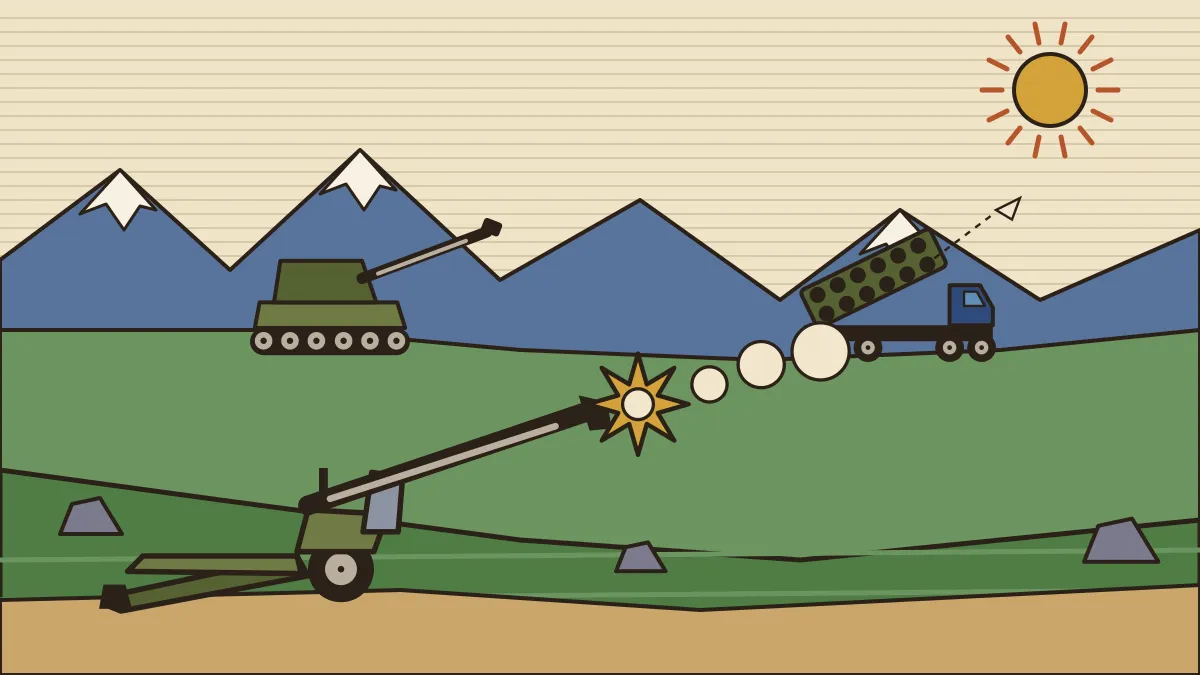
Gun. A long barrel, high muzzle speed and a fairly flat path. It reaches far and can fire at targets in a straight line. Howitzer. A shorter barrel fired at high angles, so the shell drops steeply behind hills and walls. Rocket system. A launcher of tubes that fires a salvo of self-propelled rockets with no recoil, covering a wide area quickly.
Modern 155 mm pieces do both jobs, which is why the Army's own releases simply say "artillery gun" or "gun system", and why books use "gun" and "howitzer" loosely. Guns are also described by how they move. Towed guns hang behind a truck. Self-propelled guns carry the barrel on a tracked or wheeled hull. Ultra-light howitzers are built to be carried by helicopter into mountains.
Reading "155 mm/52 cal"
A gun name has two numbers. 155 mm is the calibre, the bore diameter, which also fixes the shell size. 52 cal is the barrel length measured in calibres, so the barrel is 52 times 155 mm, about 8 metres long. A longer barrel keeps the propellant gas pushing the shell for longer, which gives more range.
| Name | Barrel length | Guns that carry it |
|---|---|---|
| 155 mm/39 cal | about 6.0 m | Bofors FH-77B, M777 |
| 155 mm/45 cal | about 7.0 m | Dhanush, Sharang |
| 155 mm/52 cal | about 8.1 m | ATAGS, K9 Vajra-T |
The Army's gun story is the climb from 39 to 45 to 52 calibre. PIB says ATAGS will "replace the vintage and smaller calibre guns". Dhanush's published maximum range is 38 km (Department of Defence Production), against the older Bofors it grew from.
The Guns, One by One
| Gun | Calibre | Origin and maker | Type |
|---|---|---|---|
| Bofors FH-77B | 155 mm/39 | Sweden, AB Bofors; imported | Towed |
| Dhanush | 155 mm/45 | Bofors-pattern design; built by AWEIL at Gun Carriage Factory, Jabalpur | Towed |
| ATAGS | 155 mm/52 | DRDO (ARDE, Pune); Bharat Forge; towing vehicles by Tata Advanced Systems | Towed |
| K9 Vajra-T | 155 mm/52 | South Korean K9 design (Hanwha); built by L&T at Hazira | Self-propelled, tracked |
| M777 | 155 mm/39 | BAE Systems, United States; imported, Mahindra assembly | Towed, ultra-light |
| Sharang | 130 mm upgunned to 155 mm/45 | Soviet-origin M-46 gun, rebuilt by the ordnance factories (AWEIL) | Towed |
Bofors FH-77B. The Swedish 155 mm/39 cal gun, of which India acquired 414 between 1987 and 1991 (NIOS), and the most famous name in Indian artillery, for good and bad reasons. Press and Army accounts remember it as the mainstay of the Kargil war of 1999, when it was also used to fire directly at enemy positions. PIB's own record of that war honours the whole Regiment: Point 5140 at Dras was renamed "Gun Hill" in July 2022 as a tribute to the Gunners of Operation Vijay, and PIB calls their fire "the key factor in early completion of operations".
Dhanush. "Desi Bofors": an upgraded, longer-barrelled version of the Bofors design, made at the Gun Carriage Factory, Jabalpur, now part of AWEIL after the 2021 split of the Ordnance Factory Board. It is 155 mm/45 cal with a 38 km maximum range. The first six guns were handed over at Jabalpur on 8 April 2019, the first lot of a 114-gun order (PTI). On 27 March 2026 the Defence Acquisition Council cleared the Dhanush Gun System again for the Army.
ATAGS. The Advanced Towed Artillery Gun System is the Army's first big fully Indian design, developed by DRDO's Armament Research and Development Establishment, Pune. On 26 March 2025 the Ministry signed about ₹6,900 crore of contracts, with Bharat Forge for the 155 mm/52 cal guns and Tata Advanced Systems for the 6x6 gun-towing vehicles. PIB calls it the first major procurement of towed guns from the private sector. Press reports count 307 guns, shared between the two firms.
PIB names Bharat Forge for the guns and Tata Advanced Systems for the towing vehicles. Press reports say both firms build guns (about 60:40) and quote 307 guns, a figure PIB did not print. Answer from the PIB wording if a question names only one firm.
K9 Vajra-T. A self-propelled gun on tracks, a South Korean design built by Larsen & Toubro at its Armoured Systems Complex, Hazira, Gujarat, in a partnership with Hanwha. The "T" is for tracked. L&T won the first order, for 100 guns, in May 2017 and completed those deliveries in February 2021. On 20 December 2024 the Ministry signed ₹7,628.70 crore for more guns under Buy (Indian); press reports say 100. PIB adds that the gun can work in sub-zero, high-altitude areas.
M777. An American ultra-light howitzer from BAE Systems. India signed for 145 in 2016 through the US Foreign Military Sales route; BAE Systems says the first 25 came fully built and the other 120 were to be assembled in India with Mahindra. Light weight is the point: a gun that heavy-lift helicopters such as the Chinook (see IAF helicopter units) can move across mountain ridges.
Sharang. A low-cost upgrade, not a new gun: old 130 mm M-46 field guns are rebored and fitted with 155 mm/45 cal barrels. The ordnance factories signed the upgrade in October 2018 and handed the first gun to the Army at DefExpo in February 2020 (press).
- 20 Dec 2024: contract for more K9 Vajra-T guns, ₹7,628.70 crore.
- 26 Mar 2025: ATAGS and gun-towing vehicle contracts, about ₹6,900 crore.
- 27 Mar 2026: DAC clears the Dhanush Gun System for the Army.
Rockets: Pinaka and the Heavy Launchers
Pinaka is the Army's indigenous multi-barrel rocket launcher, designed by DRDO (ARDE with HEMRL). Its guided long-range rocket (LRGR) was test-fired from the in-service launcher on 29 December 2025 to a maximum range of 120 km, and on 8 July 2026 for a user-defined minimum range of 60 km. PIB says this lets "Pinaka variants of different range" fire from the same launcher. See our Pinaka LRGR explainer.
On 6 February 2025 the Ministry signed ₹10,147 crore for two Pinaka rocket types: Area Denial Munition Type-1 (DPICM) and the HEPF Mk-1 (Enhanced), plus a software upgrade for the SHAKTI artillery system. PIB flagged off the first tranche of guided Pinaka rockets for Armenia on 18 January 2026.
Smerch is the Russian heavy multiple rocket launcher, which PIB shows beside Pinaka, K9 Vajra and Dhanush among the firepower in the Army Day parade of January 2026. For BrahMos and the missile family, which the Army also fields, see missiles of India.
The Regiment of Artillery and Its Training
The Regiment of Artillery traces to 5 (Bombay) Mountain Battery, raised on 28 September 1827. That date is Gunners' Day; the Army Chief's greetings in 2025 were for the 199th. The Regiment's motto is "Sarvatra" (Everywhere), shared with the Engineers. Its officers are trained at the School of Artillery, Devlali (Deolali), and the Regiment's records sit at the Artillery Centres at Nasik Road and Hyderabad. Our Army arms and services page puts the Regiment beside the other combat support arms.
Two newer names are worth knowing. At Kargil Vijay Diwas 2025 the Army Chief spoke of "Shaktibaan" artillery regiments and "Divyastra" batteries as part of the force's transformation (PIB). In August 2026 the Ministry signed about ₹1,577 crore with Tata Advanced Systems and NIBE for loiter munitions for Artillery Regiments; our explainer shows how it changes the gunner's job.
Operation Sindoor and the Modernisation Direction
PIB listed the weapons employed in Operation Sindoor that were shown at the Army Day parade of January 2026: BrahMos, Pinaka, the M777 ultra-light howitzer, the Akash system and L-70 guns. A PIB release of 8 May 2025 says Pakistan used mortars and heavy-calibre artillery along the Line of Control in several Jammu and Kashmir sectors and that India responded to halt the fire. Beyond what PIB has published, the Army has not released gun-level detail. Read the campaign on wars and operations.
The direction is plain from the table: more 155 mm/52 cal guns, more Indian designs and more private-sector makers. In November 2023 the Defence Acquisition Council cleared a Towed Gun System to replace the Indian Field Gun, and PIB's 2024 review records AWEIL test-firing an indigenous 155x52 cal towed gun at Balasore. Group-discussion boards like this theme: see GD topics. Tank generations are on main battle tanks, rifles on infantry weapons and Army helicopters on Army aviation.
Exam pins
- 155 mm/52 cal: bore 155 mm; barrel is 52 times the bore. Longer barrel, longer range.
- Dhanush: Bofors-based, 155 mm/45 cal, Gun Carriage Factory Jabalpur, 38 km maximum range.
- ATAGS: DRDO (ARDE Pune), 155 mm/52 cal; contracts of 26 Mar 2025, about ₹6,900 crore.
- K9 Vajra-T: South Korean design, L&T at Hazira; ₹7,628.70 crore on 20 Dec 2024.
- Hazira = first private-sector howitzer unit (L&T); do not choose Surat.
- M777: American, BAE Systems, ultra-light; 145 ordered in 2016.
- Sharang: 130 mm M-46 upgunned to 155 mm.
- Pinaka: multi-barrel rocket launcher by DRDO; LRGR tested at 120 km maximum, 60 km minimum.
- Smerch: Russian heavy rocket launcher; Pinaka is Indian.
- Gunners' Day, 28 September = 5 (Bombay) Mountain Battery, 1827; School of Artillery at Devlali.
Asked in past papers
Gun questions are matching questions: which weapon is which type, and who made it. Study more on the NDA and CDS past-paper pages.
Which one of the following manufacturers is engaged in upgradation of the Swedish 155-mm Bofors Howitzer under the project 'Dhanush'?
(a) Bharat Electronics Limited (b) Ordnance Factory Board (c) Bharat Dynamics Limited (d) Mishra Dhatu Nigam
Answer: (b). Dhanush came from the ordnance factories, which the Board then ran (now AWEIL). BEL makes electronics and BDL makes missiles, which is the tempting wrong pair.
India's first private sector Howitzer gun-making unit is located at
(a) Surat (b) Kolkata (c) Hazira (d) Sahibabad
Answer: (c). L&T's complex at Hazira builds the K9 Vajra-T. Surat is next door, which is the trap.
Pinaka, developed in India, is a
(a) battle tank. (b) multi-barrel rocket launcher. (c) anti-tank guided missile. (d) armoured utility vehicle.
Answer: (b). Pinaka is DRDO's rocket launcher. It is not a missile in the exam sense; PIB calls it a rocket system, and the guided LRGR is a rocket.
The terms 'Pinaka and Smerch' mentioned in news recently refer to
(a) Cruise missiles (b) Nuclear-powered submarines (c) Rocket launcher systems (d) Weaponised drones
Answer: (c). Pinaka is Indian and Smerch is a Russian heavy launcher; both are rocket artillery.
Learn each gun as a triple: type, maker, origin. UPSC likes the Dhanush-Bofors link, the Hazira answer and the "rocket launcher, not missile" answer for Pinaka. For the newest contracts read our daily defence notes.
Practice MCQs (with answers)
- The Dhanush gun is an upgraded version of which foreign gun?
- American M777
- Swedish Bofors FH-77B
- South Korean K9 Thunder
- Soviet M-46
- A gun described as 155 mm/45 cal has a barrel roughly
- 4.5 m long
- 5.5 m long
- 7 m long
- 9 m long
- Sharang is the name for the upgrade of the 130 mm M-46 field gun to
- 155 mm/45 cal
- 155 mm/52 cal
- 105 mm/37 cal
- 214 mm
- Which of these is a licence-built, tracked, self-propelled gun?
- Dhanush
- ATAGS
- M777
- K9 Vajra-T
- Which of these is a rocket launcher rather than a gun?
- Pinaka
- Dhanush
- ATAGS
- Sharang
- Gunners' Day, 28 September, marks the raising of
- the School of Artillery, Devlali
- the Artillery Centre, Nasik Road
- the first Pinaka regiment
- 5 (Bombay) Mountain Battery
1-b, 2-c, 3-a, 4-d, 5-a, 6-d. Q2: 45 times 155 mm is about 6.98 m. Q3: the M-46 became a 155 mm/45 cal gun, so the 52 cal option is the trap. Q4: Dhanush and ATAGS are Indian-made towed guns and M777 is American and towed; only K9 is tracked. Q6: 1827 is the battery's raising, not the School's.
Where to Go Next
For the career behind the guns, read career in the Indian Army. Boards ask "know your arm" and indigenisation, so prepare with our SSB interview tips. Our NDA coaching batches cover defence GK with weekly tests and SSB training, and graduates can see the CDS course.
Frequently asked questions
What is the difference between a gun and a howitzer?
A gun has a long barrel and a flat path, a howitzer has a shorter barrel and fires at high angles, and a rocket system fires a salvo from tubes. Modern 155 mm pieces do the work of both, so the Army calls them artillery guns or gun systems.
What does 155 mm/52 cal mean?
155 mm is the bore diameter and 52 cal means the barrel is 52 times that long, about 8 metres. A longer barrel gives more range. Dhanush is 155 mm/45 cal, and ATAGS and K9 Vajra-T are 155 mm/52 cal.
Is Dhanush the Bofors gun?
Dhanush is an upgraded, Indian-made version of the Swedish Bofors design, built at the Gun Carriage Factory, Jabalpur, now under AWEIL. It is 155 mm/45 cal with a published maximum range of 38 km. The original Bofors FH-77B was imported from Sweden.
Which artillery gun is fully indigenous?
ATAGS, designed by DRDO's ARDE at Pune, is the Army's fully Indian-designed 155 mm/52 cal towed gun. The March 2025 contracts went to Bharat Forge for the guns and Tata Advanced Systems for the towing vehicles. K9 Vajra-T and M777 are foreign designs.
When is Gunners' Day in the Indian Army?
Gunners' Day is on 28 September, the day 5 (Bombay) Mountain Battery was raised in 1827. The 199th was marked in 2025. The Regiment of Artillery trains at the School of Artillery, Devlali.
More in Army Weapon Systems
← Back to Army Weapon Systems · Defence GK home
Sources: pib.gov.in/PressReleasePage.aspx?PRID=2115365 · pib.gov.in/PressReleasePage.aspx?PRID=2086514 · pib.gov.in/PressReleasePage.aspx?PRID=2209588 · ddpmod.gov.in/hi/node/7211
Preparing for NDA?
Cavalier's NDA batches cover Maths and the GAT, defence GK included, with daily practice, weekly tests and SSB training on our own GTO ground.