By Col Manoj Batra (Retd) · SSB faculty, The Cavalier · Senior GTO (retd), 20 SSB
Below Army Headquarters in New Delhi, the Indian Army is run through seven commands: six operational commands that hold the fighting corps, and one training command, ARTRAC, that writes doctrine and runs the Army's schools. Each is headed by a Lieutenant General with the title GOC-in-C. If a defence GK paper asks you for a headquarters, a year of raising or the odd one out among command names, it is asking about this table.
This is the section page for the Army's commands in our Defence GK library. It gives all seven side by side, the order in which they were raised, the trap that catches most candidates, and a short guide to each command's own page. It sits under the Indian Army hub, which covers the Army as a whole.
What a Command Is
A command is the largest field headquarters of the Army. It sits directly below Army HQ and above the corps. Army HQ plans, raises, trains and equips; the command runs operations, logistics and administration in its own part of the country. Its head is the General Officer Commanding-in-Chief (GOC-in-C), a Lieutenant General, and the Army also calls him the Army Commander.
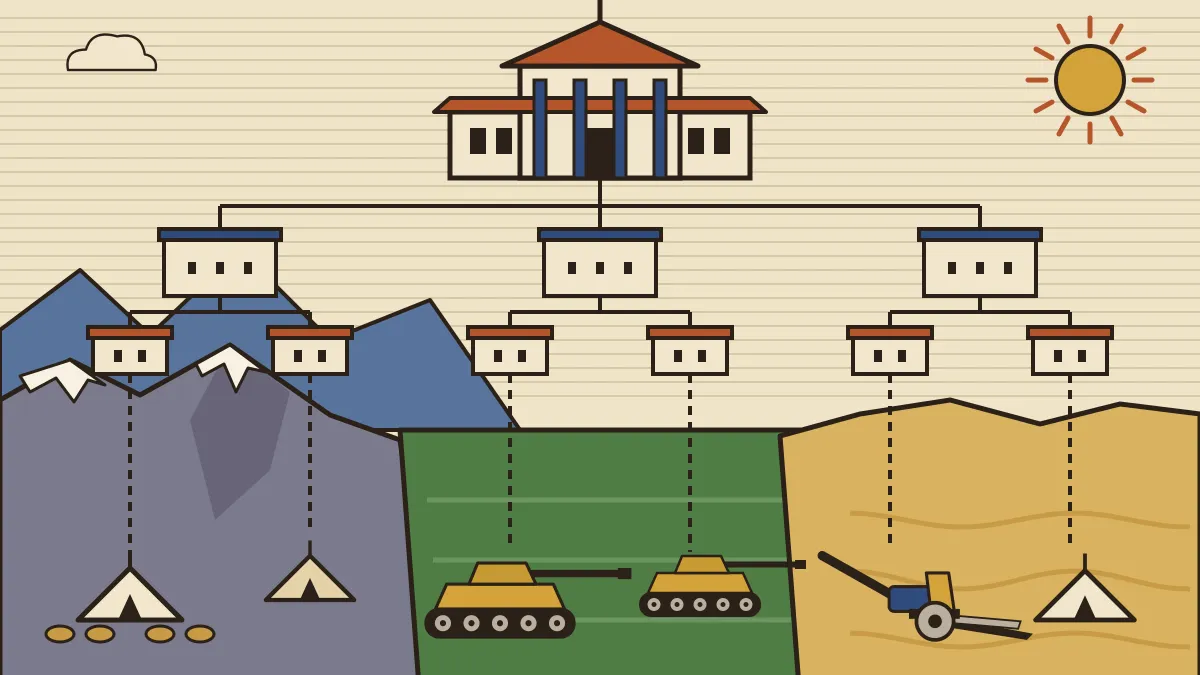
- Command headquartersGOC-in-C · Lt Gen
- CorpsGOC · Lt Gen
- DivisionGOC · Maj Gen
- BrigadeCommander · Brigadier
- DivisionGOC · Maj Gen
- CorpsGOC · Lt Gen
The number of corps differs from command to command, and the Army publishes few details, so we name a corps only where the Army's own pages do. The Army's page for Northern Command says it began with two corps, later grew to four, and received the Strike One Corps in Eastern Ladakh. A command also holds static formations, the Areas and Sub Areas that run cantonments, depots and training centres: Central Command's page lists a Uttar Bharat Area and a Madhya Bharat Area, for example. The levels below are on the coming hierarchy pages.
The GOC-in-C heads a command. The GOC heads a corps (Lt Gen) or a division (Maj Gen). The COAS, a General, heads the whole Army from Army HQ. The Navy's counterpart of a GOC-in-C is the FOC-in-C and the Air Force's is the AOC-in-C.
The Seven Commands at a Glance
This is the table to learn. The headquarters and years are those given on the Army's own command pages; the GOC-in-C is filled in from our who's-who record, so it updates when the post changes hands.
| Command | Headquarters | Raised | Type | GOC-in-C |
|---|---|---|---|---|
| Northern | Udhampur (J&K) | 17 Jun 1972 | Operational | Lt Gen Pratik Sharma |
| Western | Chandimandir (near Chandigarh) | 15 Sep 1947 as Delhi and East Punjab Command; Western Command from Jan 1948 | Operational | Lt Gen Pushpendra Pal Singh |
| Eastern | Fort William, Kolkata | 1 Nov 1920 | Operational | Lt Gen VMB Krishnan |
| Southern | Pune | 1 Apr 1895 (as Bombay Command) | Operational | Lt Gen Rajesh Pushkar |
| Central | Lucknow | 1 May 1963 | Operational | Lt Gen Sanjay Mitra |
| South Western | Jaipur | 15 Apr 2005 (operational 15 Aug 2005) | Operational | Lt Gen Mohit Malhotra |
| Army Training Command (ARTRAC) | Shimla | 1 Oct 1991 at Mhow | Training | Lt Gen Shrinjay Pratap Singh |
Books disagree on several of these: Southern is often given as 1895 without the "Bombay Command" detail, Western as 1947 or 1948, and Eastern as 1895 because the Army's history page traces its roots to the end of the Bengal Presidency Army that year. The Army's own pages give 1 November 1920 as the date Eastern Command was formed, and UPSC follows official figures. Questions on the "largest command" are also risky: Central Command's page calls it geographically the largest, while Southern Command's page says it covers about 41% of the country's land area. Read the options before you pick one.
Oldest to Youngest: How the Commands Came About
The seven commands were not designed together. They arrived in four waves, which makes the order easy to remember as a story.
| Year | Command | What the Army's own pages record |
|---|---|---|
| 1895 | Southern | With the Presidency armies abolished, Bombay Command was set up at Pune on 1 April 1895, and that date is the command's raising day. The Army calls it its oldest field formation |
| 1920 | Eastern | Formed on 1 November 1920 with summer HQ at Nainital and winter HQ at Lucknow; Ranchi from March 1947, Lucknow again from February 1955 |
| 1947–48 | Western | Raised after Partition as the Delhi and East Punjab Command and renamed Western Command on 18 January 1948. Lt Gen K.M. Cariappa took over as GOC-in-C on 20 January 1948, and the Army calls it the first Army command of independent India |
| 1963 | Central | Raised at Lucknow on 1 May 1963 after the 1962 Chinese aggression, to guard the central sector of the Line of Actual Control. First GOC-in-C: Lt Gen Kanwar Bahadur Singh |
| 1972 | Northern | The Rawalpindi-based Northern Command went to Pakistan at Partition. The experience of 1948, 1962, 1965 and 1971 led to a new one at Udhampur on 17 June 1972. First GOC-in-C: Lt Gen P.S. Bhagat, VC |
| 1991 | ARTRAC | Came into being on 1 October 1991 at Mhow and shifted to Shimla on 31 March 1993 |
| 2005 | South Western | Formally raised on 15 April 2005 and operationalised on 15 August 2005 at Jaipur; the Army calls it the "Seventh Command" |
Three details earn marks. South Western is the youngest, and ARTRAC, at 1991, is the youngest before it. Western traces its birth to Partition, and Northern is not the old Rawalpindi command: the 1972 command is a new one. Finally, Southern is the oldest and Western is the first command of independent India: the two get confused because both are old.
The Army's formation signs and slogans are favourite recall items. The Army pages give these:
| Command | What the Army's page says |
|---|---|
| Northern | Formation sign built on Dhruva, the North Star, over red and black stripes; the Army's text calls it "Always in Combat" and "Forever in Ops" |
| Western | Credo: "Ever Westwards"; the Army calls it "the Land of the Brave" |
| Central | Known as Surya Command, with the Sun (Surya) as its insignia; 13 Category A training establishments and 18 regimental centres lie within it |
| Southern | The Crux, better known as the Southern Cross |
| South Western | A silver streak and a seven-pointed star, "heralding the Seventh Command" |
Where Each Command Stands
Each command owns a front. The Army's pages describe them this way, and nothing here goes beyond what the Army itself has published.
- Northern guards the borders with China and Pakistan: the Line of Control, the Line of Actual Control and the Actual Ground Position Line, across J&K and Ladakh, from the Siachen Glacier to cold desert and forest. The Army's page lists Operation Sadbhavana among its activities.
- Western works from the heights of Kargil and Drass to the plains of Punjab and the deserts of Rajasthan. Operation Vijay and Operation Parakram appear on its page.
- Eastern covers the Eastern Theatre: the peaks of Sikkim and Arunachal, the hill tracts of Nagaland, Manipur, Mizoram, Tripura and Meghalaya, and the plains of Assam and Bengal. That is why there is no separate North Eastern Command.
- Southern has its HQ at Pune and, in the Army's words, eleven states and four Union Territories under it, about 41% of the country's land area. It is the command that traces itself to the old Bombay Command of 1895.
- Central spans eight states from Himachal Pradesh and Uttarakhand to Odisha. It is responsible for the central sector along the LAC and the Nepal border, and the Army says over 500 km of the China border falls to it.
- South Western was raised at Jaipur in 2005. It hosted the 78th Army Day parade there in January 2026, per PIB.
- ARTRAC has no front. Its role is to frame concepts and doctrines of warfare, act as the nodal agency for institutional training and evolve joint doctrines with the other services.
- 15 Jan 2026: the Army Day parade was held at Jaipur, hosted by South Western Command.
- 1 Apr 2026: new GOC-in-Cs took over Western and Eastern Commands.
- 1 Jul 2026: new GOC-in-Cs took over Southern and South Western Commands.
- 1 Oct 2026: new GOC-in-Cs took over Central Command and ARTRAC.
Which Is NOT a Command of the Indian Army
"Which of the following is not a command of the Indian Army?" is the commonest form this topic takes. The wrong options are built from words that sound right, so learn the short list of false friends.
| Name offered | Is it an Army command? | What it actually is |
|---|---|---|
| North Eastern Command | No | No such command. The North-East belongs to Eastern Command, headquartered at Fort William, Kolkata |
| Northern Air Command | No | No such command in the Air Force either: the IAF has Western, Eastern, Southern, South Western, Central, Training and Maintenance Commands |
| Southern Naval Command | No | The Navy's training command at Kochi. The Army's training command is ARTRAC |
| Andaman and Nicobar Command | No | The first tri-service command, set up in 2001 at Port Blair |
| Strategic Forces Command | No | A tri-service command that handles the nuclear forces; not part of the Army |
| Theatre commands | Not yet an Army structure | Proposed joint commands; see below |
The words Northern, Western, Eastern, Southern and Central are used by more than one service, so a direction alone proves nothing. Ask which service owns the full name. The false option nearly always borrows its geography from the Navy or Air Force, or invents a direction (North Eastern, Northern Air) that no service uses.
Do not mix up Western Command (HQ Chandimandir, Army), Western Naval Command (Mumbai) and Western Air Command (Delhi). The Navy side is on Navy commands, the Air Force side on Air Force commands. The Navy hub is here and the Air Force hub here. The tri-service command is on Andaman and Nicobar Command and our explainer on India's only tri-service command.
Commands, Theatre Commands and the Plan to Merge Them
The seven Army commands are single-service commands. A theatre command would put the Army, Navy and Air Force units of one region under a single commander. The idea has been under official discussion for years, and our theatre commands page records only what has been announced. On 7 November 2026 the Army's own website still shows these seven commands as its structure. If theatre commands are notified, the Army's commands would change, and the table above would be revised on this page.
The CDS has no operational command of any service: see the rank equivalence page for the matching ranks in all three services, and our explainer on the COAS and the Army's command structure for the chain from Chief to command.
Guide: One Page for Every Command
Each command has its own page in this section. Start with the one nearest to where you are posted, or the front your exam target cares about.
| Page | What it covers |
|---|---|
| Northern Command | Udhampur, the 1972 raising, the J&K and Ladakh front and its operations |
| Western Command | Chandimandir, Delhi and East Punjab Command, Cariappa's 1948 takeover and the Punjab, Rajasthan and Kargil sectors |
| Eastern Command | Fort William, the 1920 raising, the North-East and Sikkim fronts, and the long history from Nainital to Kolkata |
| Southern Command | Pune, the 1895 Bombay Command, the Southern Cross sign and the command's wide area |
| Central Command | Lucknow, the 1963 raising, Surya Command, the central sector and its training establishments and regimental centres |
| South Western Command | Jaipur, the 2005 raising, the seventh-command insignia and the 2026 Army Day parade |
| Army Training Command | ARTRAC at Shimla: raised at Mhow in 1991, its doctrine role and the schools and academies it steers |
Once you know the commands, the Indian Army hub shows how they fit with the Chief, Army HQ and the arms and services. For borders and operations, the defence notes carry the current-affairs side, and the Indian Coast Guard is the fourth uniformed service under the Ministry of Defence.
Exam pins
- The Indian Army has seven commands: six operational and one training (ARTRAC). A command is headed by a Lt Gen, the GOC-in-C.
- Headquarters: Northern, Udhampur; Western, Chandimandir; Eastern, Fort William, Kolkata; Southern, Pune; Central, Lucknow; South Western, Jaipur; ARTRAC, Shimla.
- Youngest command: South Western, raised 15 April 2005, the "Seventh Command". The training command ARTRAC dates from 1 October 1991.
- ARTRAC was raised at Mhow and moved to Shimla on 31 March 1993.
- Southern Command's origin is 1 April 1895, as Bombay Command at Pune: the Army's oldest field formation.
- Western Command was raised in 1947 as the Delhi and East Punjab Command and renamed in January 1948; Cariappa was its GOC-in-C from 20 January 1948.
- Northern Command was raised on 17 June 1972, with Lt Gen P.S. Bhagat, VC, as its first GOC-in-C.
- Central Command was raised at Lucknow on 1 May 1963 after the 1962 war and is called Surya Command.
- There is no North Eastern Command: Eastern Command covers the North-East.
- The Andaman and Nicobar Command and the Strategic Forces Command are tri-service commands, not Army commands.
- Southern Naval Command is the Navy's training command; the IAF has no "Northern Air Command".
Asked in past papers
Direct questions on Army commands are rare in the official papers we checked, but the same trap appears for the Air Force and the tri-service command, and training places and Army operations are asked often. Here are four that train the same habits.
Which of the following is NOT a command of the Indian Air Force?
(a) Training Command (b) Southern Air Command (c) Eastern Air Command (d) Northern Air Command
Answer: (d). The IAF has Western, Eastern, Southern, South Western, Central, Training and Maintenance Commands, and no Northern one. Northern Command is an Army formation. The same method works for Army questions: break each option into direction plus service.
Which one of the following best describes the Andaman & Nicobar Island Command?
(a) A cyber security command (b) A unified command comprising Army, Navy, Air Force and Coast Guard (c) A unified command comprising Navy and the Coast Guard (d) One of the commands of the Indian Navy
Answer: (b). It is the tri-service command at Port Blair. Option (d) tempts because a naval officer often heads it; we hold no official key for this question, and this answer is from the official description of the command.
Which one of the following pairs of military training institute of India and location is not correctly matched?
(a) Army War College : Mhow (b) High Altitude Warfare School : Gulmarg (c) Army Air Defence College : Pune (d) Rashtriya Indian Military College : Dehradun
Answer: (c). The Army Air Defence College is at Gopalpur in Odisha. The Army War College is at Mhow, the town where ARTRAC was first raised in 1991, so the place name is a double hint.
Operation Sadbhavna is an initiative of
(a) Indian Army (b) Indian Navy (c) Indian Air Force (d) Indian Army and UN Peacekeeping Mission
Answer: (a). Operation Sadbhavana is an Indian Army programme, and the Army's Northern Command page lists it among its activities. Option (d) adds a United Nations link that does not exist.
Practice MCQs (with answers)
- Which is the youngest command of the Indian Army?
- Army Training Command
- Northern Command
- South Western Command
- Central Command
- Which of the following is NOT a command of the Indian Army?
- North Eastern Command
- Central Command
- Southern Command
- South Western Command
- Army Training Command (ARTRAC) was raised at Mhow and shifted in 1993 to
- Pune
- Shimla
- Jaipur
- Lucknow
- Which of the following command and headquarters pairs is correct?
- Central Command : Pune
- Southern Command : Lucknow
- Eastern Command : Shillong
- Northern Command : Udhampur
- Which Army command was first raised in 1947 as the Delhi and East Punjab Command?
- Western Command
- Central Command
- Eastern Command
- Northern Command
- Eastern Command has its headquarters at
- Guwahati
- Ranchi
- Fort William, Kolkata
- Shillong
1-c, 2-a, 3-b, 4-d, 5-a, 6-c. Q1: ARTRAC dates from 1991 and Northern from 1972, but South Western was formally raised on 15 April 2005. Q2: the North-East is covered by Eastern Command; all the other names are real. Q4: Central is at Lucknow, Southern at Pune and Eastern at Kolkata; Shillong is the IAF's Eastern Air Command. Q5: Western Command took its name in January 1948. Q6: Guwahati and Shillong are well-known North-East cities, which is why they tempt; Ranchi was the HQ only from 1947 to 1955.
Where to Go Next
The career in the Indian Army page shows where the commissions that end up in these commands begin, and boards ask "know your service", so read our SSB interview tips with this page open. For the exam side, the NDA study material and past-paper pages are the next stop. Our NDA coaching batches cover defence GK with weekly tests and SSB training.
Frequently asked questions
How many commands does the Indian Army have?
The Indian Army has seven commands: six operational and one training command. The operational commands are Northern, Western, Eastern, Southern, Central and South Western; the training command is the Army Training Command, ARTRAC. Each is headed by a Lieutenant General called the GOC-in-C.
Which is the youngest command of the Indian Army?
South Western Command, with its headquarters at Jaipur, is the youngest. The Army records that it was formally raised on 15 April 2005 and operationalised on 15 August 2005. It is called the Seventh Command. The Army Training Command, raised on 1 October 1991, is the next youngest.
Is there a North Eastern Command in the Indian Army?
No. The North-East is covered by Eastern Command, headquartered at Fort William in Kolkata, and its area runs from Sikkim and Arunachal Pradesh to Nagaland, Manipur, Mizoram, Tripura, Meghalaya, Assam and Bengal. "North Eastern Command" is a common false option in "which is not a command" questions.
Where is the headquarters of Army Training Command?
ARTRAC is headquartered at Shimla in Himachal Pradesh. The Army records that it came into being on 1 October 1991 at Mhow in Madhya Pradesh and shifted to Shimla on 31 March 1993. Its role is to formulate doctrines and be the nodal agency for institutional training.
Who heads an Army command and what is the rank?
A command is headed by a General Officer Commanding-in-Chief, or GOC-in-C, who holds the rank of Lieutenant General. Northern Command is currently headed by Lt Gen Pratik Sharma. Below the command, corps are also headed by Lieutenant Generals, and divisions by Major Generals.
← Back to Indian Army · Defence GK home
Sources: indianarmy.nic.in/command/command/history-northern-command · indianarmy.nic.in/command/command/home-western-command · indianarmy.nic.in/command/command/home-south-western-command · indianarmy.nic.in/command/command/an-introduction-artrac-command
Preparing for NDA?
Cavalier's NDA batches cover Maths and the GAT, defence GK included, with daily practice, weekly tests and SSB training on our own GTO ground.