By Col Vijayant Thakur (Retd) · Defence faculty, The Cavalier
When a news report says "No. 17 Squadron at Air Force Station Ambala", it names three levels of the Air Force in one breath. The station is the base, the squadron is the unit that owns the aircraft and pilots, and each squadron is split into flights. Above them stand the wing, the command and Air Headquarters. Examiners ask who commands each level, which rank sits where, and what a squadron's number and nickname stand for.
This page gives the chain from the top down, with the rank at each level, using the Air Force's own description and what PIB has published. It sits under the Indian Air Force hub in our Defence GK library. The seven commands themselves are on Air Force commands; the aircraft types are on flying squadrons.
The Chain: Air HQ to a Flight
The top of the chain is Air Headquarters at Vayu Bhawan, New Delhi, under the Chief of the Air Staff, an Air Chief Marshal (now ACM Ashutosh Dixit). Air HQ sets policy and plans; it does not run bases. The work is done by commands, and below a command the Air Force is organised on a simple rule: a station is a place, a squadron is a fighting unit, and a wing is the formation that ties the two together.
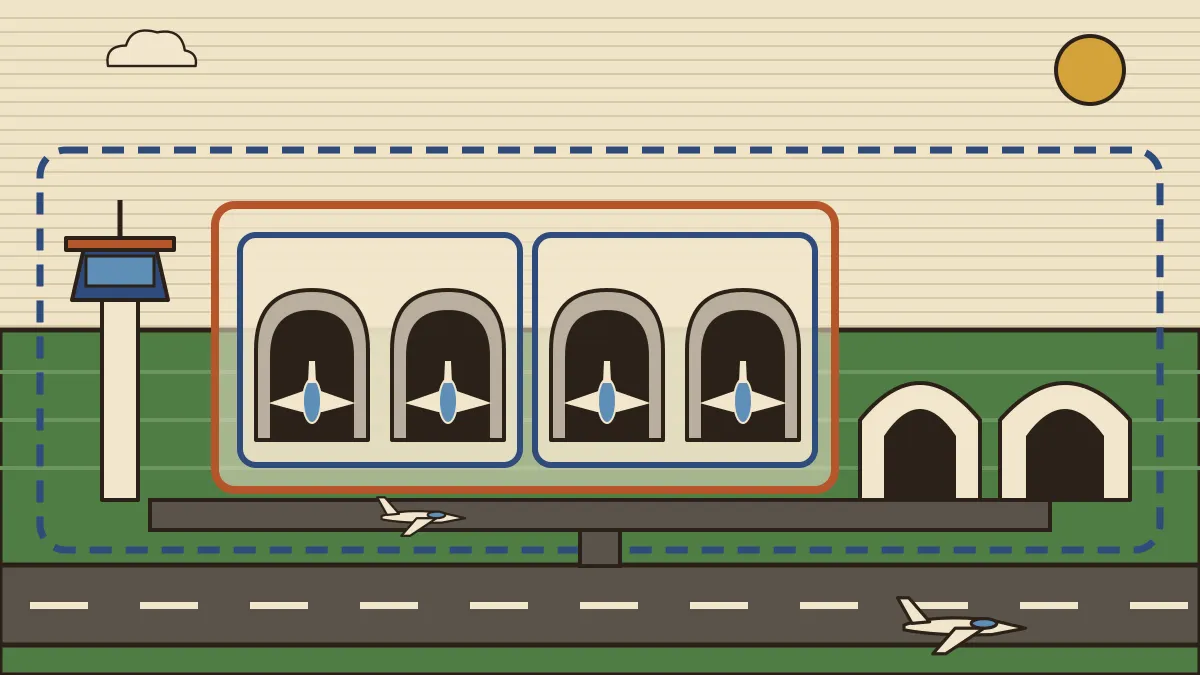
- Air Headquarters, Vayu Bhawan, New DelhiChief of the Air Staff · Air Chief Marshal
- Command (7)5 operational + 2 functional · AOC-in-C · Air Marshal
- Wingtwo or three squadrons and units · textbook: Group Captain
- Air Force Stationthe base · Group Captain; Air Commodore at larger stations
- Squadronthe flying unit · textbook: Wing Commander; PIB names Group Captains
- Flighta sub-division of the squadron · textbook: Squadron Leader
- Sectionthe smallest unit · textbook: Flight Lieutenant
- Flighta sub-division of the squadron · textbook: Squadron Leader
- Squadronthe flying unit · textbook: Wing Commander; PIB names Group Captains
- Air Force Stationthe base · Group Captain; Air Commodore at larger stations
- Wingtwo or three squadrons and units · textbook: Group Captain
- Command (7)5 operational + 2 functional · AOC-in-C · Air Marshal
The textbook chain above (wing under a Group Captain, squadron under a Wing Commander, flight under a Squadron Leader, section under a Flight Lieutenant) is how the Air Force's structure is described in standard study texts. Practice is looser. PIB names a Group Captain as the commanding officer of a Su-30MKI squadron (2021), a C-130J squadron (2022) and No. 17 Squadron (2021 and 2025). A textbook-style question on "the rank that heads a squadron" expects Wing Commander; a real news item may show a Group Captain. No source we use fixes one rule, so read the stem.
Who Commands What
The Air Force borrows its ranks from the Royal Air Force, so the safest habit is to translate each level into an Army rank. The ladder itself is on rank equivalence and our Air Force ranks page.
| Level | Head | Rank | Army rank it matches |
|---|---|---|---|
| Air Headquarters | Chief of the Air Staff | Air Chief Marshal | General |
| Command | Air Officer Commanding-in-Chief (AOC-in-C) | Air Marshal | Lieutenant General |
| Wing | Wing head (textbook: a Group Captain) | Group Captain | Colonel |
| Air Force Station | Station Commander, or Air Officer Commanding at larger stations | Group Captain; Air Commodore | Colonel; Brigadier |
| Squadron | Commanding Officer | Wing Commander in textbooks; PIB also names Group Captains | Lieutenant Colonel (Colonel) |
| Flight | Flight commander | Squadron Leader | Major |
| Section | Section leader | Flight Lieutenant | Captain |
The station column is the one to read closely. PIB's reports call the head of several stations the Station Commander and give the rank as Group Captain: Air Force Station Faridabad (December 2025) and Prahladpur, Delhi (August 2025). At a larger station the head is styled Air Officer Commanding, and PIB (September 2021) shows an Air Commodore as the AOC of Air Force Station Tughlakabad. That is why the title "AOC" appears at two levels, and why the AOC-in-C of a command is a different post: the "in-Chief" marks the Air Marshal.
The most common slip. A Wing Commander is a mid-ranking officer who usually commands a squadron. The head of a wing is a Group Captain, one rank higher. Also remember that Squadron Leader is a Major, not a Lieutenant Colonel.
Air Force Station and Wing
An Air Force Station is the base: runway, hangars, tower, stores, workshops, housing and the people who run them. It belongs to one command. Some stations hold flying squadrons; others hold no aircraft at all and exist to train, repair or supply.
A wing sits between the squadrons and the station. A standard study text describes it as a formation of two or three squadrons and helicopter units, together with forward base support units, usually under a Group Captain. Textbooks also give counts of wings and forward base units, but the Air Force publishes no current figure, so do not learn one.
A Forward Base Support Unit (FBSU) is a small base that supports squadrons operating from forward airfields. PIB's year-end review for 2024 records that the Cabinet Committee on Security approved, on 18 July 2024, a joint-user airfield and an Air Force FBSU at Minicoy and the expansion of the airfield at Agatti, both in Lakshadweep, with an FBSU there too.
| Unit type | What it does | Example the Air Force has published |
|---|---|---|
| Flying squadron | Owns the aircraft and pilots; carries out the primary task of the force | No. 101 Squadron at Air Force Station Hasimara |
| Forward Base Support Unit | Supports flying from forward airfields | FBSUs approved at Minicoy and Agatti (CCS, 18 Jul 2024) |
| Training unit | Trains specialists and aircrew; most come under Training Command | Garud Regimental Training Centre, AFS Chandinagar (PIB, 2021 and 2026) |
| Depot and maintenance unit | Repair, stores and logistics; falls under Maintenance Command | A depot at AFS Prahladpur, Delhi (PIB, Aug 2025) |
The difference between flying units and ground units is the one to carry away. Flying squadrons and helicopter units fight; everything else exists to keep them flying. The two functional commands (Training and Maintenance) hold the training and repair units, while the five operational commands hold the squadrons. The Air Force's special forces, the Garud Commando Force, are a separate branch whose recruits train at the Garud centre named above.
Squadron and Flight
A squadron is the basic flying unit. It is based at an air force station, comes under a wing and is divided into flights; each flight has two sections, and a section holds three aircraft. That is the textbook arithmetic behind a classic fighter squadron of about 18 aircraft. Modern squadrons differ with the aircraft and the role, and the sanctioned and actual counts of fighter squadrons, with dates and sources, are on the flying squadrons page.
| Level | Led by | Rough size (textbook) |
|---|---|---|
| Squadron | Wing Commander (or Group Captain) | About 18 aircraft in a classic fighter squadron |
| Flight | Squadron Leader | Two sections |
| Section | Flight Lieutenant | Three aircraft |
The Air Force itself began as a flight. PIB records that on 1 April 1933 the IAF's first operational flight, "A" Flight, took off from Drigh Road (now in Karachi, Pakistan) with six RAF-trained officers, 19 Havai Sepoys and four Westland Wapiti IIA biplanes, the nucleus of the planned No. 1 (Army Co-operation) Squadron. "B" Flight followed in April 1936 and "C" Flight in June 1938, which brought No. 1 Squadron to full strength. So the very first squadron was built from flights, one at a time.
The Indian Air Force was established on 8 October 1932 (Air Force Day). The first operational flight, and the start of No. 1 Squadron's story, is 1 April 1933. Both are right; read what the question asks.
Squadron Numbers, Nicknames and Number Plates
Every squadron has a number and many carry a nickname that the unit or the Air Force uses. When a squadron is retired, its aircraft go but its number plate is kept, so the same number can be raised again with new aircraft and the same history. That is what "resurrecting" a squadron means. It is also why a number does not tell you the aircraft: No. 101 has flown Harvards, Spitfires, Vampires, Su-7s and MiG-21Ms, and now flies the Rafale (PIB).
| Squadron | Nickname | Fact to remember |
|---|---|---|
| No. 1 | None in PIB | Traces to "A" Flight, 1 April 1933, Drigh Road |
| No. 17 | Golden Arrows | Flew MiG-21s in the 1999 Kargil operations and earned Battle Honours (PIB). Re-raised at Ambala on 10 Sep 2019 (ANI); first Rafale squadron, inducted 10 Sep 2020 |
| No. 101 | Falcons | Formed 1 May 1949 at Palam; second Rafale squadron, inducted at Hasimara on 28 Jul 2021 (PIB) |
| No. 45 | Flying Daggers | First squadron to induct the Tejas (1 Jul 2016, PIB) |
| No. 18 | Flying Bullets (Air Force's command history) | Second Tejas squadron, May 2020 (PIB) |
PIB's Kargil Vijay Diwas release of July 2024 calls No. 17 the "Golden Arrows", flying the MiG-21 Type 96 from Bhisiana, and says it has won more honours and awards than any other Air Force unit. The Rafale induction pages for No. 101 (2021) call it the "Falcons of Chamb and Akhnoor". For aircraft types by role, see the fighter jets page; for the air defence units that sit beside the squadrons, see air defence.
A higher number is not always a newer squadron: No. 101 was formed in 1949 (PIB) yet flies the Rafale beside No. 17, while No. 45 and No. 18 fly the Tejas. Learn each as a number, a nickname and an aircraft, with the date the aircraft arrived.
The Same Idea in Army and Navy
The Air Force chain maps neatly onto the other two services, which is how SSB and the written papers frame it. The Army's corresponding ladder is corps, division, brigade and battalion, and the Navy groups its ships into fleets (see naval fleet operations).
| Idea | Air Force | Army | Navy |
|---|---|---|---|
| Regional headquarters | Command (Air Marshal) | Command (Lt Gen) | Command (Vice Admiral) |
| Fighting unit | Squadron | Battalion or regiment | Ship or squadron of ships |
| Base | Air Force Station | Cantonment or station | Naval base |
The ranks that head these levels line up on the rank equivalence table. If you are aiming at the Air Force, the officer branches and the AFCAT route are on our career in the Indian Air Force page, and the paper itself is covered in AFCAT coaching at The Cavalier.
Exam pins
- Air Headquarters is at Vayu Bhawan, New Delhi, under the Chief of the Air Staff (Air Chief Marshal).
- Chain: Air HQ, command, wing, air force station, squadron, flight, section.
- A command is headed by an AOC-in-C, an Air Marshal (Army: GOC-in-C; Navy: FOC-in-C).
- PIB shows a Group Captain as Station Commander at several stations, and an Air Commodore as Air Officer Commanding at larger ones.
- Textbooks give a squadron to a Wing Commander; PIB also names Group Captains as commanding officers.
- Textbook: a flight is led by a Squadron Leader, a section by a Flight Lieutenant; the Air Force publishes no squadron strength.
- Squadron Leader = Major, Wing Commander = Lt Colonel, Group Captain = Colonel, Air Commodore = Brigadier.
- First operational flight: 1 April 1933, Drigh Road, four Wapiti biplanes; Air Force established 8 October 1932.
- No. 17 Golden Arrows was resurrected on 10 Sep 2019 at Ambala and inducted the Rafale on 10 Sep 2020; No. 101 Falcons followed on 28 Jul 2021 at Hasimara.
- First Tejas squadron: No. 45 Flying Daggers; second: No. 18.
- A resurrected squadron keeps its number plate and history.
Asked in past papers
Direct questions on this chain are rare. Fewer than three past-paper questions sit squarely on it, but the two that do are the whole logic of the ranks.
Which one of the following is not a correct ascending order of commissioned ranks in the defence forces of India?
(a) Lieutenant, Captain, Major, Lieutenant Colonel, Colonel, Brigadier, Major General, Lieutenant General, General (b) Flying Officer, Flight Lieutenant, Squadron Leader, Wing Commander, Group Captain, Air Commodore, Air Vice Marshal, Air Marshal, Air Chief Marshal (c) Flying Officer, Flight Lieutenant, Squadron Leader, Group Captain, Wing Commander, Air Commodore, Air Vice Marshal, Air Marshal, Air Chief Marshal (d) Sub Lieutenant, Lieutenant, Lieutenant Commander, Commander, Captain, Commodore, Rear Admiral, Vice Admiral, Admiral
Answer: (c). Wing Commander ranks below Group Captain, and (c) swaps them. The tempting option is (b), which looks unusual only because Air Force names are unfamiliar. In this page's chain, the Wing Commander heads the squadron and the Group Captain the station or wing above it.
Which one among the following is the equivalent rank of 'Wing Commander' of Indian Air Force in Indian Army?
(a) Lieutenant (b) Captain (c) Lieutenant Colonel (d) Colonel
Answer: (c). Wing Commander equals Lieutenant Colonel, which is why textbooks make the squadron the Lieutenant Colonel's level of command. The tempting wrong option is (d): the Colonel's equivalent is the Group Captain, one rank higher. The stored key for this paper is blank; the answer is from the official rank equivalence.
The papers test rank translation, not the organisation chart. Memorise the ladder in order (Flying Officer, Flight Lieutenant, Squadron Leader, Wing Commander, Group Captain, Air Commodore) and attach one job to each of the top four. Practise more on our AFCAT, NDA past-paper pages, and revise the topic with the defence awareness notes.
Practice MCQs (with answers)
- Air Headquarters of the Indian Air Force is at
- Subroto Park, New Delhi
- Bengaluru
- Vayu Bhawan, New Delhi
- Nagpur
- In the standard description of the Air Force structure, a flight is commanded by a
- Flight Lieutenant
- Squadron Leader
- Group Captain
- Air Commodore
- The Army equivalent of a Wing Commander is
- Lieutenant Colonel
- Major
- Colonel
- Brigadier
- The first operational flight of the Indian Air Force took off on 1 April 1933 from
- Ambala
- Hindon
- Jodhpur
- Drigh Road
- Which squadron was resurrected at Ambala on 10 September 2019 and became the first to fly the Rafale?
- No. 45
- No. 101
- No. 17
- No. 18
- Forward Base Support Units were approved by the Cabinet Committee on Security in July 2024 for
- Port Blair and Car Nicobar
- Leh and Nyoma
- Minicoy and Jaisalmer
- Minicoy and Agatti
1-c, 2-b, 3-a, 4-d, 5-c, 6-d. Q1: Subroto Park is Western Air Command, not Air HQ. Q3: a Colonel's equal is a Group Captain, the tempting option. Q4: Drigh Road is in Karachi, now in Pakistan. Q5: No. 101 is the second Rafale squadron, inducted at Hasimara in 2021. Q6: the approvals named Minicoy and Agatti in Lakshadweep.
Frequently asked questions
What is the hierarchy of the Indian Air Force?
From the top, Air Headquarters in New Delhi sits over seven commands. Below a command are wings and air force stations, then squadrons, then flights and sections. Each level has its own commander, from an Air Marshal at command level down to a Flight Lieutenant leading a section.
Who commands an Air Force Station?
PIB reports name a Group Captain as the Station Commander of several stations, and an Air Commodore as the Air Officer Commanding at a larger station. The rank depends on the size of the station.
What is the difference between an air force station and a squadron?
An air force station is the base, with runway, hangars and support services, and it belongs to a command. A squadron is the flying unit based there, with its own aircraft and pilots, usually under a Wing Commander. One station can host more than one squadron.
What does it mean to resurrect a squadron?
When a squadron is retired, its number plate is kept. Resurrecting it means raising the same number again, usually with new aircraft. No. 17 Squadron, the Golden Arrows, was resurrected at Ambala on 10 September 2019 to become the first Rafale squadron.
Which rank commands a fighter squadron in the IAF?
A fighter squadron is described as commanded by a Wing Commander, the Army equivalent of a Lieutenant Colonel. PIB has also named Group Captains as commanding officers of some squadrons, so both ranks appear in practice.
More in Indian Air Force
← Back to Indian Air Force · Defence GK home
Sources: static.pib.gov.in/WriteReadData/specificdocs/documents/2024/oct/doc2024107411201.pdf · pib.gov.in/PressReleasePage.aspx?PRID=2201603 · pib.gov.in/PressReleasePage.aspx?PRID=1757327 · pib.gov.in/PressReleasePage.aspx?PRID=1740021
Aiming for the Air Force?
Cavalier's AFCAT batches cover general awareness, military aptitude, numerical ability and English, then prepare you for the AFSB.