By Col Vijayant Thakur (Retd) · Defence faculty, The Cavalier
The Indian Air Force splits the country's airspace into five operational commands: Western (New Delhi), South Western (Gandhinagar), Central (Prayagraj), Eastern (Shillong) and Southern (Thiruvananthapuram). Each one controls the air bases and squadrons of its own region and answers to Air Headquarters. Each is headed by an Air Officer Commanding-in-Chief (AOC-in-C), an Air Marshal.
Papers ask for the headquarters, the year of raising, the youngest command or which command owns a place such as Jodhpur or Tezpur. The seven-command overview is on Indian Air Force commands, and the two non-regional ones are on Training and Maintenance Commands.
The Five Operational Commands at a Glance
Learn this table first. Dates and headquarters are from the Air Force's own command histories, and the AOC-in-C column fills in from our who's-who record.
| Command | Headquarters | Raised | Area, in broad terms | AOC-in-C |
|---|---|---|---|---|
| Western | Subroto Park, New Delhi | 22 Jul 1949 as Operational Command; renamed 10 Jun 1963 | The capital region and the northern and western sectors: J&K, Ladakh, Siachen, the Punjab belt | Air Mshl George Thomas |
| South Western | Gandhinagar | 23 Jul 1980 at Jodhpur | Most of Rajasthan, all of Gujarat, later also the Pune, Mumbai and Goa units | Air Mshl PV Shivanand |
| Central | Bamrauli, Prayagraj | Mar 1962 at Kolkata | The Indo-Nepal boundary, from the mountains in the north to the Gangetic plains and central highlands | Air Mshl Tarun Chaudhry |
| Eastern | Shillong | 1 Dec 1959 at Kolkata | 12 states: the seven north-eastern states, Sikkim, West Bengal, Bihar, parts of Odisha and Jharkhand | Air Mshl Mehtab Singh Deswal |
| Southern | Thiruvananthapuram | 19 Jul 1984 | Peninsular India, with the Andaman and Nicobar and Lakshadweep islands as the original mandate | Air Mshl Jasvir Singh Mann |
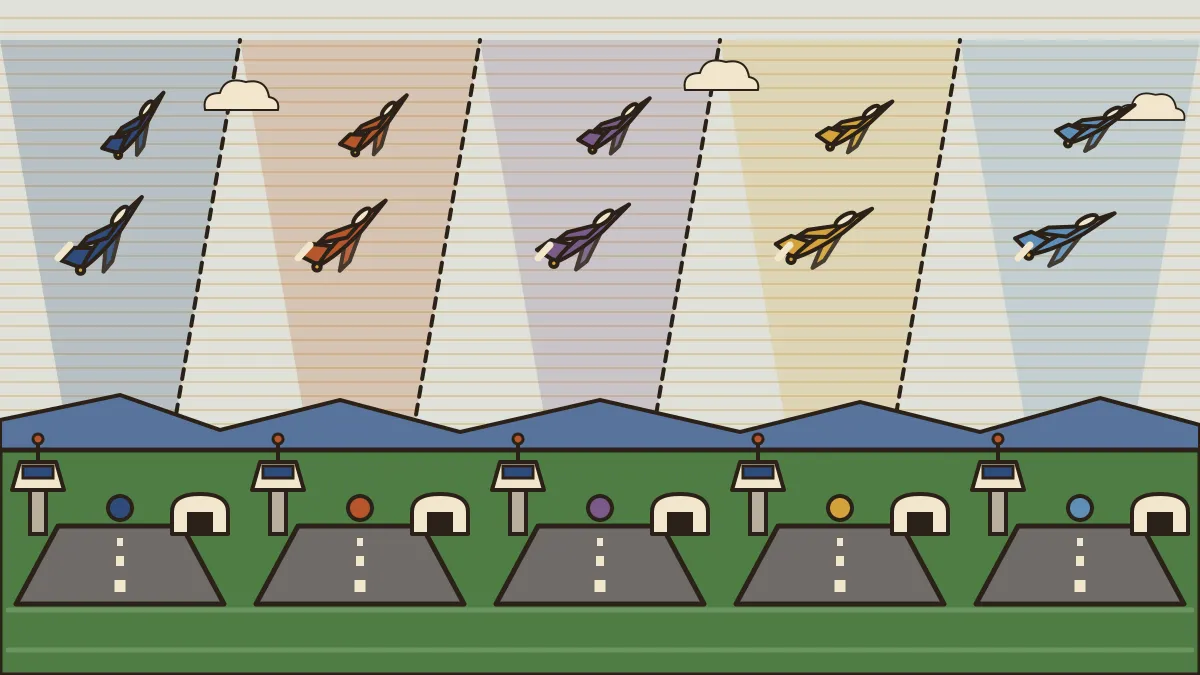
Central is at Prayagraj, the city older papers call Allahabad (the Air Force's own page still says Bamrauli, Allahabad). South Western began at Jodhpur but sits at Gandhinagar, not Ahmedabad or Jaipur. Southern is at Thiruvananthapuram, not Chennai or Bengaluru.
The figures above follow the Air Force's own pages and PIB, and UPSC follows official figures. Even so, books disagree. Western: 1949 is the Operational Command, 1963 the name Western Air Command. South Western: the group dates from 1972, the command from 1980. Central: the Air Force's history gives March 1962 for raising and February 1966 for the move to Allahabad, but its Eastern Air Command page describes a 10 June 1963 redesignation, so you may see 1963 in some books. In a direct question, pick the year attached to the word "command".
Western Air Command
Western Air Command (WAC) traces its lineage furthest back. In the first years of independence the flying units sat under the No. 1 Operational Group, which became the Operational Command on 22 July 1949. It took the name Western Air Command on 10 June 1963, once other operational commands had been formed and each given a defined area. Its headquarters is at Subroto Park, New Delhi. The Air Force says it has over 50 bases under it and has taken part in every major operation since independence.
The Air Force's account of WAC reads like a list of the country's wars. Learn the links:
| Event | What WAC did |
|---|---|
| 1947-48 and 1962 | Airlift and air maintenance in J&K and Ladakh, including an air bridge to Leh |
| 1965 | Pakistan's pre-emptive attack of 1 September hit three WAC air bases and two radar stations; fighters from Pathankot, which became known as the "Sabre Killer" station, hit back |
| 1971 | 4,509 of the IAF's 11,549 sorties in the 14-day war were flown in WAC |
| 1984 onward | Operation Meghdoot: the air link to Siachen from 13 April 1984, at heights up to 6,400 m |
| 1999 | Operation Safed Sagar (Kargil): air strikes from 26 May to 12 July, with extra fighters and armed Mi-17s at Srinagar and Awantipur |
| 2020 | Operation Snow Leopard, eastern Ladakh (Galwan Valley) |
Publicly named stations: Pathankot, Halwara, Srinagar and Awantipur appear in the Air Force's own history of the command. Palam and Hindan, the air stations near Delhi, appear beside HQ WAC in PIB's Yoga Day release of June 2025, which gives no station list. Operation Sindoor appears in PIB's record of WAC only in its aftermath: on 31 January 2026 Headquarters WAC held a gallantry-awards felicitation for air warriors, and in February 2026 its AOC-in-C drew lessons from the operation at a joint-operations conclave. Operational detail is not public; our Operation Sindoor explainer covers what the Government has announced.
There is no Northern Air Command: the north belongs to WAC, while the Army does have a Northern Command, on our Army commands page.
South Western Air Command
South Western Air Command (SWAC) was carved out of WAC. It began as No. 1 Operational Group at Jodhpur on 21 September 1972 and was renamed South Western Air Command on 23 July 1980. Its first area was most of Rajasthan and the whole of Gujarat. In a mid-1980s expansion the units at Pune and Mumbai were transferred to it from Central Air Command, and the Goa area of Southern Air Command was added, which the Air Force describes as putting the whole south-western part of the country under SWAC's air defence umbrella.
The headquarters moved from Jodhpur to Gandhinagar: the new HQ was inaugurated on 1 May 1998. The motto is "Jai Shree Varte Veeram". Stations named in the Air Force's history and in PIB include Jodhpur, Jamnagar, Bhuj, Naliya, Jaisalmer and Uttarlai. The Air Force records that in Operation Parakram (from December 2001) fighters were deployed at forward bases including Naliya, Uttarlai, Jamnagar, Bhuj and Jaisalmer, which the Air Force calls its longest ever deployment.
After the Bhuj earthquake of 26 January 2001, SWAC ran Operation Vayu Sahayata and kept the damaged Bhuj air station working as an air bridge. Exercises are often held in its area: see our explainers on Tarang Shakti at Jodhpur and Veer Guardian at Jodhpur. PIB placed Vayu Shakti-2026, the Air Force's firepower demonstration, at the Pokhran firing range, Jaisalmer, on 27 February 2026.
Central Air Command
Central Air Command (CAC) was formed in March 1962 at Rani Kutir, Kolkata, when the area of the old No. 1 Operational Group was split in two after the China war began to loom. Its task was to keep vigil along the Indo-Nepal boundary. Kolkata sat too far east for that job, so in February 1966 the headquarters shifted to Bamrauli, Allahabad, now Prayagraj. The Air Force describes the area as running from the snow-capped mountains in the north to the Gangetic plains and the central highlands. The motto is "Damniyah Atmashatravah" (vanquish the enemy).
The Air Force's history credits CAC with the Canberra reconnaissance missions of 1962 and the Tangail para drop of 11 and 12 December 1971. In Operation Cactus (Maldives, 3 November 1988) an Army parachute battalion was airlifted in two IL-76s of No. 44 Squadron, which then kept an air bridge between Agra and Hulule. Operation Maitri, the relief effort after the Nepal earthquake, ran from 25 April to 5 June 2015 and is described as the Air Force's longest relief operation on foreign soil.
Central Air Command has also been a stepping stone to the top: see our IAF leadership explainer for how its former AOC-in-C reached the Chief's chair.
Eastern Air Command
Eastern Air Command (EAC) controls air operations over 12 states: the seven north-eastern states, Sikkim, West Bengal, Bihar and parts of Odisha and Jharkhand, over three lakh square kilometres. Its area includes a 6,300 km international boundary with China, Nepal, Bhutan, Myanmar and Bangladesh. The motto is "Samareshu Parakram".
The No. 1 Operational Group was upgraded and renamed Eastern Air Command on 1 December 1959, after the Chinese occupation of Tibet and the border activity of 1959. It was raised at Rani Kutir, Kolkata, with AVM K L Sondhi as first AOC-in-C, and moved the same day to Fort William to sit beside the Army's Eastern Command. After the 1962 war the need for more transport support in the east, and for separate commands elsewhere, led to a full command at Shillong: on 10 June 1963 a No. 1 Group that had been formed at Tezpur moved there and became HQ Eastern Air Command, working at first from Second World War barracks at Nonglyer village.
Stations named by the Air Force and PIB include Tezpur (the Best Flying Station of EAC in a 2021 PIB report), Hasimara (where No. 101 Squadron received the Rafale on 28 July 2021, per PIB), Jorhat and Salua (a non-flying station). The airlift role is old: in 1962 it kept forward posts in the North East Frontier Agency supplied. The Vijaynagar Advanced Landing Ground in Arunachal Pradesh is in Arunachal Pradesh, one of the seven north-eastern states in its area; a CDS paper asked where it is.
- 1 May 2026: a new AOC-in-C takes over Western Air Command (the Air Force's own page).
- 1 Jun 2026: a new AOC-in-C takes over Central Air Command (PIB).
- 1 Jul 2026: new AOCs-in-C take over South Western and Southern Air Commands (PIB).
- 1 Nov 2026: a new AOC-in-C takes over Eastern Air Command, as the previous holder becomes Vice Chief of the Air Staff (PIB). All five operational commands thus changed hands within six months.
Southern Air Command
Southern Air Command (SAC) is the youngest command. The Air Force records that it was established on 19 July 1984 in response to the changed situation around the southern peninsula: superpower rivalry in the Indian Ocean and the ethnic troubles in Sri Lanka. Planners wanted to defend the island territories and protect the exclusive economic zone, so SAC was given the geographical area of peninsular India, extending to the Andaman and Nicobar Islands and the Lakshadweep Islands. Once the Andaman and Nicobar Command was formed, the island units went under it.
Prime Minister Indira Gandhi inaugurated the headquarters on 20 July 1984 at Belhaven Palace, once a Travancore palace, with Air Marshal T J Desa as first AOC-in-C. The headquarters moved to its own building at Akkulam on 8 August 1996.
The Air Force's history names Sulur (home of 43 Wing and the Sarang helicopter team), Thanjavur, Thiruvananthapuram and Agatti in Lakshadweep among the sites in SAC's original plan or relief work. SAC controlled the air side of Operation Pawan, the Indian Peace Keeping Force in Sri Lanka, from July 1987 to September 1989, and the Air Force credits it with the air operations of Operation Cactus in the Maldives. In December 2004 an An-32 from SAC was the first relief aircraft to land at Car Nicobar after the tsunami.
The Navy has a Southern Naval Command too, so always check the service; see Navy commands.
Where the Commands Sit in the Chain
Each command is a layer between Air Headquarters and the air bases. Below it come wings and stations, then squadrons, covered on stations, wings and squadrons. The Army and Navy follow the same regional logic. India has also discussed merging single-service commands into theatre commands; our theatre commands page records only what has been officially announced.
| Direction | Air Force command HQ | Army command HQ | Navy command HQ |
|---|---|---|---|
| Western | New Delhi | Chandimandir | Mumbai |
| Eastern | Shillong | Kolkata | Visakhapatnam |
| Southern | Thiruvananthapuram | Pune | Kochi |
| Central | Prayagraj | Lucknow | none |
| South Western | Gandhinagar | Jaipur | none |
| Northern | none | Udhampur | none |
Cavalier's AFCAT coaching batches cover general awareness, which includes this structure, along with reasoning, numerical ability and English. For the career, see career in the Indian Air Force; for the NDA entry, NDA coaching. More: the AFCAT defence awareness notes, our Air Force Commanders' Conference explainer and the SSB interview tips, where knowing your service's structure helps.
Exam pins
- Five operational commands: Western, South Western, Central, Eastern, Southern. There is no Northern Air Command.
- Headquarters: New Delhi (Western), Gandhinagar (South Western), Prayagraj (Central), Shillong (Eastern), Thiruvananthapuram (Southern).
- An AOC-in-C is an Air Marshal.
- Western: Operational Command 22 Jul 1949, renamed 10 Jun 1963; HQ at Subroto Park; over 50 bases.
- Eastern: 1 Dec 1959; 12 states; 6,300 km boundary; motto Samareshu Parakram.
- Central: Mar 1962 at Kolkata; shifted to Allahabad Feb 1966; guards the Indo-Nepal boundary; motto Damniyah Atmashatravah.
- South Western: 23 Jul 1980 at Jodhpur; HQ to Gandhinagar 1 May 1998; motto Jai Shree Varte Veeram.
- Southern: 19 Jul 1984, the youngest; Air Marshal T J Desa first AOC-in-C; HQ moved from Belhaven Palace to Akkulam in 1996.
- Operation Meghdoot (Siachen, from 1984) and Operation Safed Sagar (Kargil, 1999) were WAC operations; Operation Parakram deployments were in SWAC's area.
Asked in past papers
Direct questions on a command's headquarters are rare, but the same bases, operations and "belongs to which service" ideas recur. Two are real papers; the two AFCAT ones are marked model-paper practice, not past papers.
Which of the following is NOT a command of the Indian Air Force?
(a) Training Command (b) Southern Air Command (c) Eastern Air Command (d) Northern Air Command
Answer: (d). The IAF's operational commands are Western, South Western, Central, Eastern and Southern, plus Training and Maintenance. Northern Command belongs to the Army, which is why (d) tempts.
Name the Indian Air Force Operation during the Kargil conflict of 1999.
(a) Operation Safed Sagar (b) Operation Meghdoot (c) Operation Tiger Hill (d) Operation Jeevan Rakshak
Answer: (a). Safed Sagar ran from 26 May to 12 July 1999 and was mounted from the Western Air Command area. Meghdoot (b) is the Siachen operation of 1984, the tempting wrong option.
The Vijaynagar Advanced Landing Ground of the Indian Air Force, which was reopened recently, is located in
(a) Jammu and Kashmir (b) Arunachal Pradesh (c) Karnataka (d) Himachal Pradesh
Answer: (b). Vijaynagar is in Arunachal Pradesh, within the north-eastern states that Eastern Air Command covers. The stored key agrees.
Which of the following statements about 'Vayu Shakti-2026' is/are correct? I. The exercise took place in Jaisalmer, Rajasthan. II. Advanced fighter aircraft of the Indian Air Force, including Rafale, HAL Tejas and Mirage 2000 carried out strikes. III. Boeing Apache and Boeing Chinook helicopters participated in this exercise.
(a) I, II and III (b) I and III only (c) II and III only (d) I only
Answer: (a). PIB's release of 27 February 2026 places the exercise at the Pokhran firing range, Jaisalmer, names Rafale, Su-30MKI, Tejas and Mirage 2000 among the strike aircraft, and says Apache and Chinook helicopters took part. Jaisalmer lies in the South Western Air Command area.
Practice MCQs (with answers)
- Which Air Force command has its headquarters at Gandhinagar?
- Western Air Command
- Central Air Command
- South Western Air Command
- Southern Air Command
- Which is the youngest operational command of the Indian Air Force?
- Southern Air Command
- South Western Air Command
- Eastern Air Command
- Central Air Command
- The headquarters of Central Air Command is at
- Lucknow
- Kolkata
- Agra
- Prayagraj
- Eastern Air Command was raised on
- 22 July 1949
- 1 December 1959
- 10 June 1963
- 19 July 1984
- The Air Force's Operation Meghdoot, the air link to Siachen, was run by
- Southern Air Command
- Central Air Command
- Eastern Air Command
- Western Air Command
- Which of these pairs of command and headquarters is correct?
- Southern Air Command : Chennai
- Eastern Air Command : Guwahati
- Western Air Command : Udhampur
- South Western Air Command : Gandhinagar
1-c, 2-a, 3-d, 4-b, 5-d, 6-d. Q1: Western is at New Delhi, Central at Prayagraj and Southern at Thiruvananthapuram. Q2: Southern was established in 1984; South Western, named in 1980, is the next youngest. Q3: Lucknow is the Army's Central Command, Kolkata was CAC's first home and Agra is a station. Q4: 22 July 1949 is the Operational Command that became Western, 10 June 1963 is its renaming, and 19 July 1984 is Southern. Q5: Siachen is in the north, Western Air Command's area. Q6: Southern is at Thiruvananthapuram, Eastern at Shillong; Udhampur is the Army's Northern Command.
Frequently asked questions
Which are the operational commands of the Indian Air Force?
The Indian Air Force has five operational commands: Western (New Delhi), South Western (Gandhinagar), Central (Prayagraj), Eastern (Shillong) and Southern (Thiruvananthapuram). Each controls the air bases and squadrons of one region and is headed by an AOC-in-C, an Air Marshal. Training and Maintenance Commands are the two functional commands.
Where is the headquarters of Central Air Command?
Central Air Command is headquartered at Bamrauli in Prayagraj, which was called Allahabad until 2018. It was formed in March 1962 at Kolkata to watch the Indo-Nepal boundary, and the headquarters moved to Allahabad in February 1966.
Which is the youngest command of the Indian Air Force?
Southern Air Command, with its headquarters at Thiruvananthapuram, is the youngest. The Air Force records that it was established on 19 July 1984, and Indira Gandhi inaugurated its headquarters the next day. South Western Air Command, named on 23 July 1980, is the next youngest.
Which command of the IAF covers the North East?
Eastern Air Command, headquartered at Shillong, covers the seven north-eastern states along with Sikkim, West Bengal, Bihar and parts of Odisha and Jharkhand. In all, it controls air operations over 12 states and a 6,300 km international boundary, according to the Air Force.
Why is South Western Air Command headquartered at Gandhinagar and not Jodhpur?
South Western Air Command began at Jodhpur as No. 1 Operational Group in 1972 and was named a command in 1980. As its area and operational importance grew, Air Headquarters moved the command headquarters to Gandhinagar, where the new headquarters was inaugurated on 1 May 1998. Jodhpur remains an important air station in its area.
More in Air Force Commands
← Back to Air Force Commands · Defence GK home
Sources: indianairforce.nic.in/commands · pib.gov.in/PressReleasePage.aspx?PRID=1740021 · pib.gov.in/PressReleasePage.aspx?PRID=2129669 · pib.gov.in/PressReleasePage.aspx?PRID=2233725
Aiming for the Air Force?
Cavalier's AFCAT batches cover general awareness, military aptitude, numerical ability and English, then prepare you for the AFSB.