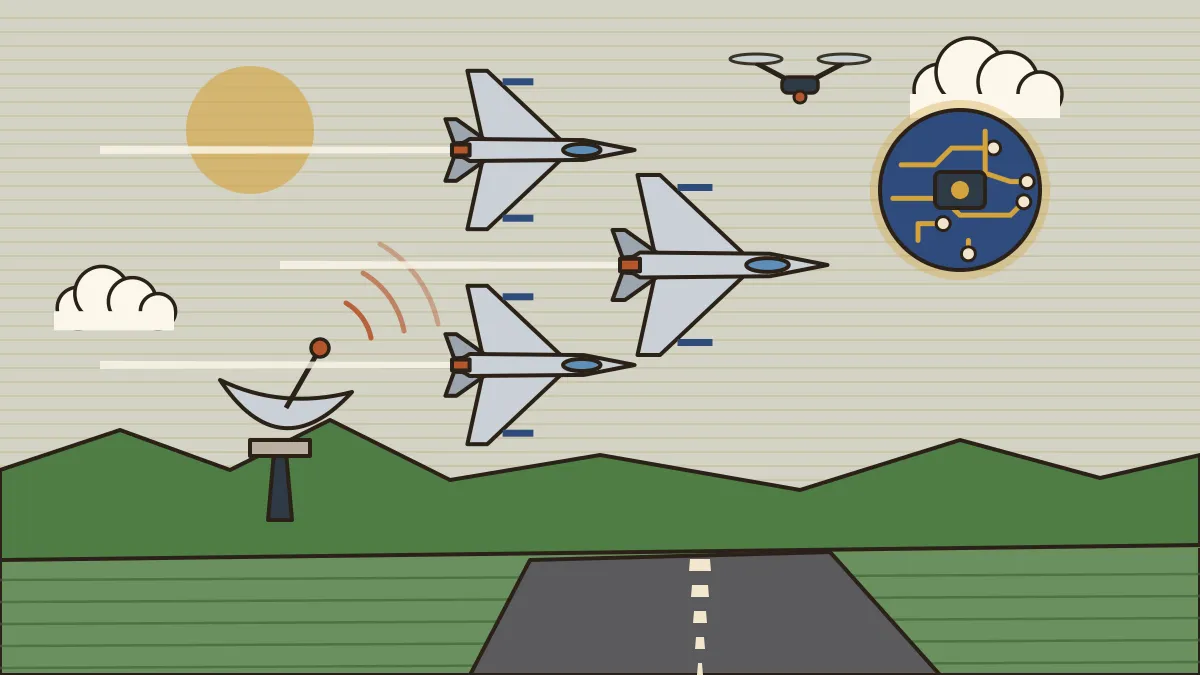
Air forces have always been the services that arrive first and decide quickly, and on 12 November 2026 the Raksha Mantri used the Air Force Commanders' Conference to ask a pointed question: when the next conflict begins, who will have the surprise, and who will be surprised?
Rajnath Singh addressed the senior leadership of the Indian Air Force (IAF) in New Delhi on the first day of a two-day conference. His message had three parts. The forces must master the element of surprise in both its offensive and defensive forms. The IAF must build dedicated doctrines for electronic, cyber and space warfare. And jointness, the habit of the three Services planning and fighting as one, must keep guiding military planning. He also launched a suite of artificial intelligence (AI) applications that the IAF built for itself.
This article reads the speech closely, explains the ideas behind each phrase, and sets them against the structures that make jointness real in India: the Chief of Defence Staff, the Department of Military Affairs and the debate about theatre commands.
The conference at a glance
| Item | Detail (PIB, 12 November 2026) |
|---|---|
| Event | Air Force Commanders' Conference, New Delhi, 12–13 November 2026 |
| Addressed by | Raksha Mantri Shri Rajnath Singh |
| Also present | Raksha Rajya Mantri Shri Sanjay Seth; Chief of the Air Staff, Air Chief Marshal Ashutosh Dixit; Defence Secretary Rajesh Kumar Singh; Secretary (Defence Production) Sanjeev Kumar; Secretary (Defence Finance) Vishvajit Sahay |
| Attended by | Air Officers Commanding-in-Chief of all IAF commands, Principal Staff Officers and Director Generals |
| Theme | "The Year of Empowerment: Maximising Efficiency Through Decentralisation" |
| Launch | Suite of in-house AI applications by the IAF's AI Centre of Excellence under UDAAN |
The release describes the conference as a forum where the IAF's senior leadership discusses issues of operations, maintenance and administration. Commanders' conferences are the way a service takes stock: the heads of every command meet the chief and his principal staff, and the political leadership attends the inaugural session to set direction. The IAF holds such a conference at Air Headquarters from time to time, and Raksha Mantri has addressed earlier editions, including the one on 19 November 2024.
Surprise: the principle of war, now with two faces
Surprise is one of the classical principles of war, along with selection and maintenance of the aim, concentration of force, economy of effort, security, offensive action and flexibility. It means striking in a way, at a time or at a place the enemy does not expect, so that his reactions come too late.
The Raksha Mantri's wording was careful. He asked the Defence Forces to strengthen both the offensive and defensive dimensions of surprise. The first is the familiar one: build capabilities and methods that leave the adversary no time to react or recover. Military theorists call the cycle an enemy uses to respond the OODA loop (observe, orient, decide, act), an idea from the American air force officer John Boyd. Surprise works by getting inside that loop.
The second dimension is the less obvious one: making sure we are never caught off guard by an unexpected move. For that, the speech stressed intelligence and surveillance, tighter integration among systems, and the ability to identify threats before they unfold. In plain terms, a force that can see early cannot be surprised, and a force that cannot be surprised can afford to be bold.
He also said surprise can take conventional and electronic forms. The electronic form is the one an NDA student should dwell on. It covers jamming, spoofing, deception and attacks on communications and navigation signals, and it can neutralise expensive platforms without a shot being fired.
Drones, air defence and what recent wars have shown
The Raksha Mantri said contemporary conflicts are leaving the traditional battlefield and moving into non-contact domains, where missiles, drones and advanced weapon systems carry the weight. Referring to the Russia-Ukraine and Israel-Hamas conflicts, he said that drones and air defence systems have become critical components of modern warfare. He asked the Commanders to prepare for kamikaze drones, surveillance and counter-drone operations.
Three terms deserve a line each.
- Kamikaze drone. A one-way attack drone, also called a loitering munition, that flies to a target area, waits and then dives onto its target.
- Surveillance drone. An unarmed or lightly armed aircraft that watches an area for long periods and feeds the picture to commanders.
- Counter-drone (counter-UAS). The mix of sensors, jammers, guns and missiles used to detect and defeat hostile drones.
The IAF has been working on this problem in public. In September 2026 it held its first Dronathon at the Pokhran Field Firing Range and demonstrated an indigenous Unmanned Traffic Management system, as we explained in our report on Vayu UTtaM at Pokhran. The Raksha Mantri also credited the lessons of Operation Sindoor: the IAF's doctrines and operational methods, during and after the operation, now show a stronger emphasis on drones and air defence systems. He appreciated the professionalism, restraint and judgement of the air warriors, and said those lessons are shaping the pace and direction of the changes under way.
For background, Operation Sindoor began on 7 May 2025, after the Pahalgam terror attack. In its aftermath, Pakistan launched drone and unmanned combat aircraft attacks on Indian airbases and logistics sites. PIB's account of the operation credits a layered air-defence grid, including the indigenous Akash missile system, with defeating them, coordinated through an integrated command-and-control system. That is the experience behind today's stress on drones and air defence.
New domains: electronic, cyber and space
The most concrete instruction in the speech was for the IAF to develop dedicated doctrines and architectures for electronic, cyber and space warfare, and to build them into "institutional thinking, planning and operational processes".
A doctrine is a service's agreed way of thinking about war: what air power is for, how it is organised and how it is used. An architecture, in this sense, is the set of systems, networks and command arrangements that put the doctrine into practice. A doctrine without an architecture is a book. An architecture without a doctrine is expensive equipment that nobody knows how to use together.
The Raksha Mantri's most quotable idea was that victory in future conflicts will depend not merely on the number of aircraft, but on technological sophistication, speed of response and precision of preparation. That is a significant statement for a service that has often discussed its declining squadron strength. It does not make numbers irrelevant. It says that a smaller force with better sensors, software and connections can beat a bigger one that is slow to see and decide.
AI from inside the force: what UDAAN is
As part of the conference, the Raksha Mantri launched a suite of AI applications developed in-house by the AI Centre of Excellence of the IAF's Unit for Digitisation, Automation, Artificial Intelligence and Application Networking (UDAAN).
- What they do. They will be used to automate and speed up tasks in three areas: operations, administration and aerospace safety.
- Where they run. They are deployed on the IAF's secure network, which means sensitive data does not leave the service's own systems.
- Why it matters. Building such tools in-house keeps control of the code and the data, allows quick changes when users ask, and avoids dependence on outside suppliers for software that touches operations.
The release does not list the individual applications, so do not assume what each does. The broader direction is clear, however. It matches the Raksha Mantri's request that the IAF keep training its air warriors in emerging technologies and make use of the technical knowledge that young recruits bring. He argued that their skills could improve decision-making and organisational development.
Jointness: the thread running through the speech
The speech returned repeatedly to jointness and integration. The Raksha Mantri said the Defence Forces are going through a transformative phase that covers organisational structures, jointness and integration, and operational concepts. He congratulated the forces for the synergy and integration shown by all three Services during Operation Sindoor, and said jointness must continue to guide planning and execution.
To follow the argument, you need three layers of vocabulary.
- Jointness means the Army, Navy and Air Force cooperate: joint planning, joint training, shared doctrine.
- Integration goes further and builds common structures, so that the Services work inside one organisation rather than alongside each other.
- Theatreisation is the end point: a single commander controlling land, sea and air forces in a geographic theatre.
India has been building these layers for a quarter-century.
| Year | Step |
|---|---|
| 1 Oct 2001 | HQ Integrated Defence Staff raised after the Kargil Review Committee and a Group of Ministers' report; the secretariat for tri-service planning |
| 2001 | Andaman & Nicobar Command, the tri-service geographic command at Port Blair |
| 2003 | Strategic Forces Command, the functional tri-service command that manages the nuclear arsenal |
| 24 Dec 2019 | Cabinet approves the post of Chief of Defence Staff, in the rank of four-star General, and the creation of the Department of Military Affairs (DMA) |
| 1 Jan 2020 | CDS office formed; General Bipin Rawat becomes the first CDS |
| 2025 | Ministry of Defence declares a Year of Reforms, with jointness and integration and the establishment of integrated theatre commands as stated focus areas |
The CDS wears three hats: Permanent Chairman of the Chiefs of Staff Committee, Secretary of the DMA, and principal military adviser to the Raksha Mantri on tri-service matters. He is first among equals and does not command the Services in operations. Our report on the silver jubilee of HQ IDS tells the story of how an institution was built in 2001 for an officer who did not exist until 2019.
On theatre commands, be careful. Integrated theatre commands remain a stated goal of the reforms, but the PIB release on this conference does not announce any, and this article does not report their number, names or locations. Treat any specific map you read elsewhere as unconfirmed. For the exam, know the concept and the two existing tri-service commands, not rumoured maps.
Agniveers' second tour and the human side of readiness
The speech also touched on people. On the Second Tour of Duty for Agniveers, the Raksha Mantri said the decision followed feedback from the Defence Forces, and that it shows the Government's commitment to bringing the Services' suggestions into policy. He expressed confidence that the initiative would further strengthen all three Services.
This is the Cabinet decision of 4 November 2026: the Agniveers who are not among the 25% retained on merit may take another two-year engagement, after which they can be enrolled as regular soldiers, subject to willingness and selection criteria. We have set out the details in our report on the Agnipath pathway. He had also spoken of it on 7 November 2026 at Air Force Station Bagdogra.
The theme: decentralisation and empowerment
The conference theme, "The Year of Empowerment: Maximising Efficiency Through Decentralisation", looks like an administrative slogan, but it connects to the same logic as surprise. A force that must send every decision up a long chain cannot act in a time the enemy cannot match. Decentralised execution, meaning that commanders at lower levels have the authority and information to act within the commander's intent, is how fast forces operate. The release does not describe specific measures under the theme, so do not attribute any to it.
Where the IAF stands: a quick map
To answer questions on this subject you need the structure in your head.
- Raised: 8 October 1932, observed as Air Force Day.
- Head: the Chief of the Air Staff (CAS), an Air Chief Marshal, at Air Headquarters, New Delhi. The release names the current CAS as Air Chief Marshal Ashutosh Dixit.
- Seven commands: five operational, Western (New Delhi), Eastern (Shillong), Central (Prayagraj), South Western (Gandhinagar) and Southern (Thiruvananthapuram), and two functional, Training (Bengaluru) and Maintenance (Nagpur). Each is led by an Air Officer Commanding-in-Chief (AOC-in-C), an Air Marshal. Our Defence GK page on the IAF's commands gives the full list.
- Who attends a commanders' conference: the AOCs-in-C, the Principal Staff Officers at Air HQ and the Director Generals, as this release records.
What to watch next
- The second day. The release says the two-day conference will discuss operations, maintenance and administration. Watch for further PIB notes on outcomes.
- Doctrine documents. Whether the IAF publishes or announces new doctrines for electronic, cyber and space will show how quickly the Raksha Mantri's instruction is acted on.
- Theatre commands. Any official announcement will be the thing to watch; the debate has run since 2019.
- AI adoption. More details of the UDAAN applications, and whether other Services build similar in-house tools.
🔑 Revision block
The event. Air Force Commanders' Conference, New Delhi, 12 November 2026 (two days); addressed by Raksha Mantri Rajnath Singh; Raksha Rajya Mantri Sanjay Seth, CAS Air Chief Marshal Ashutosh Dixit and Defence Secretary Rajesh Kumar Singh present. Theme: Year of Empowerment: Maximising Efficiency Through Decentralisation.
Three messages. (1) Master the element of surprise in both offence and defence, conventional and electronic. (2) Build dedicated doctrines and architectures for electronic, cyber and space warfare. (3) Let jointness and integration guide planning and execution.
Threats named. Kamikaze drones, surveillance and counter-drone operations; examples from Russia-Ukraine and Israel-Hamas; lessons of Operation Sindoor (7 May 2025) on drones and air defence.
AI launch. In-house applications from the AI Centre of Excellence of UDAAN (Unit for Digitisation, Automation, Artificial Intelligence and Application Networking) for operations, administration and aerospace safety; run on the IAF's secure network.
Jointness timeline. HQ IDS 1 Oct 2001; A&N Command 2001; SFC 2003; CDS and DMA approved 24 Dec 2019; CDS office 1 Jan 2020 (Gen Bipin Rawat); 2025 Year of Reforms. Theatre commands: not announced in this release.
Agniveers. Second Tour of Duty decision followed Services' feedback (Cabinet, 4 Nov 2026).
IAF map. Raised 8 Oct 1932; seven commands (5 operational, 2 functional); each under an AOC-in-C.
🎯 Practice MCQs
Q1. The Air Force Commanders' Conference of 12 November 2026 was addressed in New Delhi by:
(a) The Prime Minister
(b) The Chief of Defence Staff
(c) The Raksha Rajya Mantri
(d) The Raksha Mantri
→ (d)
Raksha Mantri Rajnath Singh addressed the conference. The Raksha Rajya Mantri, Sanjay Seth, attended the inaugural session.
Q2. The in-house AI applications launched at the conference were developed by:
(a) DRDO's Defence Institute of Advanced Technology
(b) The AI Centre of Excellence of the IAF's UDAAN
(c) HQ Integrated Defence Staff
(d) The Defence Cyber Agency
→ (b)
UDAAN stands for Unit for Digitisation, Automation, Artificial Intelligence and Application Networking. The applications run on the IAF's secure network.
Q3. Consider the following statements about the Raksha Mantri's address:
1. He asked the Services to strengthen both the offensive and defensive dimensions of the element of surprise.
2. He announced that integrated theatre commands will be set up within the year.
Which of the statements given above is/are correct?
(a) 1 only
(b) 2 only
(c) Both 1 and 2
(d) Neither 1 nor 2
→ (a)
The first point is in the PIB release of 12 November 2026. The release asked for doctrines for electronic, cyber and space domains but announced no theatre commands.
Q4. The Chief of Defence Staff, created on the Cabinet's approval of 24 December 2019, is also the:
(a) Chief of the Integrated Defence Staff
(b) Commander-in-Chief of the Andaman & Nicobar Command
(c) Secretary of the Department of Military Affairs
(d) Chairman of the Strategic Forces Command
→ (c)
The CDS is Permanent Chairman of the Chiefs of Staff Committee, Secretary of the DMA and principal military adviser to the Raksha Mantri. The CISC and the A&N Command head are different officers.
Q5. Headquarters Integrated Defence Staff was established in:
(a) 1999
(b) 2001
(c) 2003
(d) 2019
→ (b)
HQ IDS was raised on 1 October 2001. The Strategic Forces Command followed in 2003, and the CDS post in 2019.
Q6. Which of the following is a tri-service geographic command of India?
(a) Strategic Forces Command
(b) Southern Air Command
(c) Training Command
(d) Andaman & Nicobar Command
→ (d)
The A&N Command at Port Blair, set up in 2001, is the only tri-service geographic command. The Strategic Forces Command is a functional tri-service command. The other two are IAF commands.
Q7. In the IAF, the head of an operational or functional command is styled:
(a) Commander-in-Chief
(b) Principal Staff Officer
(c) Air Officer Commanding-in-Chief
(d) Director General
→ (c)
Each of the seven IAF commands is led by an Air Officer Commanding-in-Chief, an Air Marshal. Principal Staff Officers and Directors General serve at Air Headquarters.
Q8. Which of the following is NOT one of the Raksha Mantri's named emerging threats at the conference?
(a) Hypersonic glide vehicles
(b) Kamikaze drones
(c) Counter-drone operations
(d) Surveillance drones
→ (a)
The release named kamikaze drones, surveillance and counter-drone operations. Hypersonic weapons were not mentioned in it, although the 2025 Year of Reforms did list hypersonics among the emerging technologies.
📋 How this gets asked (PYQ pattern)
Armed-forces questions in the NDA general ability paper draw on this kind of story in three recurring ways.
The first is the organisation question: which body sits where, who heads it and what it is called. Commands, ranks and the titles of their heads (AOC-in-C, CAS, CDS, CISC) appear again and again, and Q4, Q6 and Q7 above test exactly that. Expect near-miss options built from sister titles.
The second is the concept question: terms such as jointness, integration, theatre command, doctrine, loitering munition and counter-UAS. The examiner often asks which statement defines a term correctly, or which item does not belong in a list, as in Q8.
The third is the dated-fact question: when a body was created and by what decision. Keep the timeline in the revision block, 2001, 2003, 2019 and 2020, ready. The fresh hooks this cycle are the 12 November 2026 conference, UDAAN and the three-part message on surprise, new domains and jointness.
Preparing for NDA? Draw the higher-defence chain on one page: President, Cabinet Committee on Security, Raksha Mantri, CDS, three Chiefs, command heads, and learn it with our Defence GK guide to the tri-services organisation. Build the base with our NDA study material, follow the daily NDA current affairs, and train with serving-standard faculty in the upcoming Cavalier courses in Delhi.
Source: PIB / Ministry of Defence, "Element of Surprise, Technological Superiority & Jointness key to enhancing operational readiness against emerging threats: Raksha Mantri at Air Force Commanders' Conference", 12 November 2026; PIB, "Raksha Mantri addresses Air Force Commanders' Conference", 19 November 2024; PIB, "Ministry of Defence declares 2025 as Year of Reforms", 1 January 2025; PIB, "Operation SINDOOR: Forging One Force", 18 May 2025; PIB, "HQ Integrated Defence Staff celebrates its 25th Raising Day", 1 October 2025. CDS and DMA dates cross-checked with the Cabinet decision of 24 December 2019 and standard references.
✍️ Written by Col Vijayant Thakur — Veteran, Indian Army; SSB & defence-studies faculty at The Cavalier. Reviewed by the Cavalier Faculty Desk.