On 16 November 2026, PIB reported that Dr Jitendra Singh, Union Minister of State (Independent Charge) for Science and Technology, visited the Trieste component of the International Centre for Genetic Engineering and Biotechnology (ICGEB) in Italy. ICGEB is an intergovernmental research organisation with components in Trieste, New Delhi and Cape Town, and the Department of Biotechnology supports the New Delhi centre, whose work covers vaccines, diagnostics and genome editing. Every one of those fields rests on one technique: moving a piece of DNA from one organism into another and making it work. That is recombinant DNA technology. UPSC asked about it in CDS 2026-II, and it sits behind the insulin, Bt cotton and PCR questions of earlier years.
The Idea: Cut, Paste, Copy
By Akanksha Kumari · Science faculty, The Cavalier · B.Tech, 15 years teaching Science
Breeders have always moved genes, but only by crossing whole plants or animals, and a cross brings thousands of unwanted genes along with the wanted one (our plant breeding page shows the five-step routine). Genetic engineering removes that limit: you pick out one gene and place only that in the target organism.
Paul Berg first joined DNA from two sources in a test tube in 1972 (Nobel Prize in Chemistry, 1980, shared). The working version came from Stanley Cohen and Herbert Boyer in 1972-73. Boyer had enzymes that cut DNA at fixed spots and leave "sticky ends". Cohen could take small rings of DNA called plasmids out of bacteria and put them back into others. Together they cut an antibiotic-resistance gene out of one plasmid, pasted it into another and put that into E. coli, which copied it at every division: the first gene cloning.
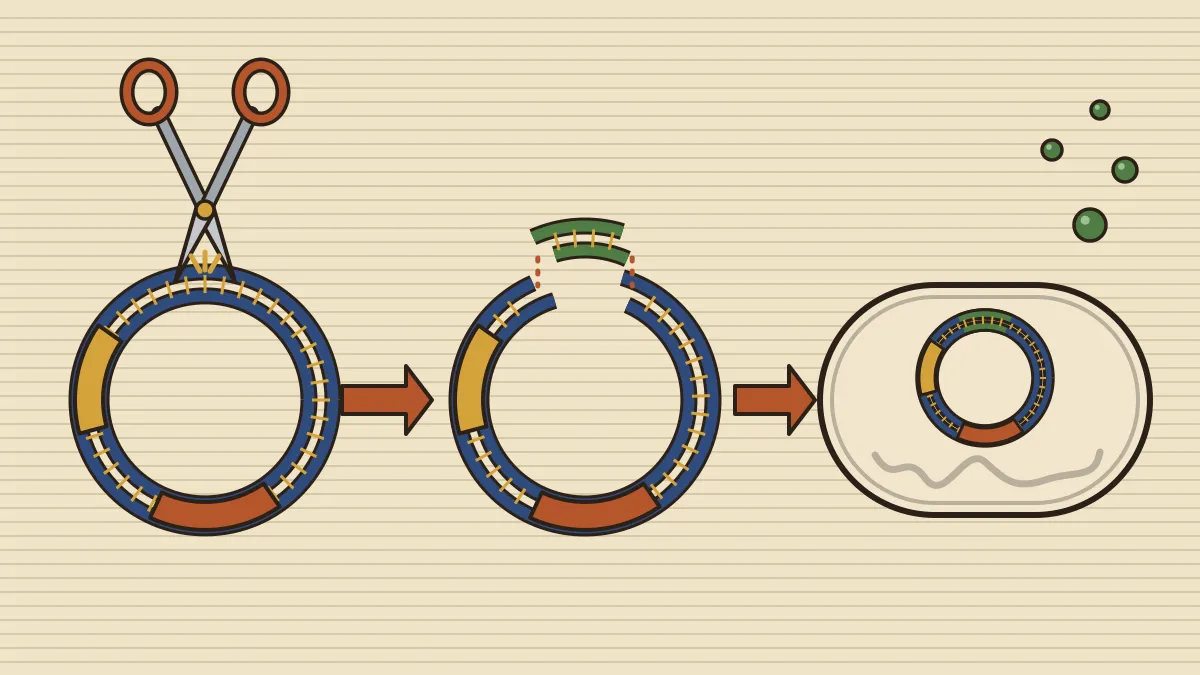
Three actions drive it: cut the DNA carrying the wanted gene, join it to a carrier (vector) and introduce that into a host cell, and maintain it there so the host copies it. A stray piece of DNA cannot copy itself, because it lacks an origin of replication. Attached to a vector that has one, the gene is copied whenever the vector is, and the copies form a clone.
Molecular Scissors and Glue: Restriction Enzymes and Ligase
In 1963, two enzymes that stop viruses (bacteriophages) from growing in E. coli were isolated. One added methyl groups to DNA. The other cut DNA: the restriction endonuclease, a bacterial defence against viral DNA. The first one to cut at a specific sequence, Hind II, followed about five years later, and Arber, Nathans and Smith shared the 1978 Nobel Prize in Physiology or Medicine for this work. More than 900 such enzymes are known, from over 230 bacterial strains.
| Tool | What it does | Remember |
|---|---|---|
| Restriction endonuclease | Cuts DNA inside, at one particular recognition sequence | "Molecular scissors"; a nuclease that cuts within the strand |
| Exonuclease | Removes nucleotides from the ends of DNA | Not used to make fragments for cloning |
| DNA ligase | Joins the cut ends of DNA | "Molecular glue"; seals the sugar-phosphate backbone |
| Vector | Carries the gene into the host and copies it | Plasmid, bacteriophage, or a disarmed pathogen |
Naming. EcoRI: "E" is the genus (Escherichia), "co" the species (coli), "R" the strain (RY13), and "I" says it was the first enzyme isolated from that strain. Hind II comes from Haemophilus influenzae and BamHI from Bacillus amyloliquefaciens.
Palindromes and sticky ends. Each enzyme recognises a short palindrome (usually four to six base pairs): it reads the same on both strands when each is read 5′ to 3′.
The cut is staggered, so each fragment ends in a short single-stranded sticky end, which forms hydrogen bonds with a matching end. Any two pieces cut with the same enzyme have matching ends, whether the DNA came from a human, a plant or a bacterium. Add ligase and the strands are sealed into recombinant DNA. That is why the vector and the source DNA must be cut with the same enzyme.
1. Some enzymes (such as SmaI) cut straight across and leave blunt ends, which are harder to join. 2. A circular plasmid cut at n sites gives n fragments, but linear DNA gives n + 1. One cut merely opens a plasmid into a line, which is why vectors have one or very few cutting sites.
Vectors and Hosts: How the Gene Gets In and Gets Found
Plasmids are small circular DNA rings that copy themselves independently of the bacterial chromosome, some at one or two copies per cell, others at 15 to 100 or more. A laboratory vector is engineered with three features.
- Origin of replication (ori). The start-point for copying; it also sets the copy number.
- Selectable marker. Usually an antibiotic-resistance gene (ampicillin, tetracycline). Ordinary E. coli has none, so on an antibiotic plate only cells that took up the vector survive.
- Cloning site. A recognition sequence for a common enzyme, ideally just one, so cutting does not chop the vector to pieces.
The classic vector is pBR322, with an ampicillin-resistance gene (ampR), a tetracycline-resistance gene (tetR), an ori, and unique sites for EcoRI, HindIII and BamHI. The BamHI site lies inside the tetracycline gene, which gives a neat test for success.
A gene is ligated into the BamHI site of pBR322 and given to E. coli. How do you spot the recombinants?
A faster colour test places the insert inside the gene for β-galactosidase. With a colour-forming substrate, colonies without an insert turn blue, and colonies with an insert stay colourless. For plants, the disarmed Ti plasmid of Agrobacterium tumefaciens delivers genes, and for animals, disarmed retroviruses do.
Getting in. DNA cannot slip through a membrane, so bacteria are made competent with a divalent cation such as calcium, chilled with the DNA, given a brief heat shock at 42 °C, and chilled again. Other routes are micro-injection into an animal cell's nucleus, the gene gun (DNA-coated gold or tungsten particles fired into plant cells) and disarmed pathogens. Plasmids are typical of bacteria, so comparing prokaryotic and eukaryotic cells is a useful warm-up, and microbes in human welfare covers the same E. coli.
Seeing and Copying DNA: Gel Electrophoresis and PCR
Gel electrophoresis sorts DNA fragments by size. DNA is negatively charged, so in an electric field it moves towards the anode through a jelly of agarose (a seaweed polymer) that acts as a sieve. Small fragments move farther, and big ones lag near the wells. Pure DNA is invisible, so the gel is stained with ethidium bromide and viewed under UV light as orange bands. A band can be cut out and the DNA recovered: elution.
PCR (polymerase chain reaction) copies a chosen DNA stretch in a tube, with no bacteria. Kary Mullis conceived it in 1983 and shared the 1993 Nobel Prize in Chemistry. You need template DNA, two chemically made primers that match the two ends of the target, the four nucleotides, and a heat-stable DNA polymerase. Each cycle has three steps.
| Step | Temperature (approx.) | What happens |
|---|---|---|
| 1. Denaturation | About 94–95 °C | Heat separates the double strand into two single strands |
| 2. Annealing | About 50–65 °C | Primers bind to their complementary sites on each strand |
| 3. Extension | About 72 °C | Polymerase extends each primer, copying the template |
The enzyme must survive 95 °C again and again, so PCR uses Taq polymerase from Thermus aquaticus, a hot-spring bacterium. Each cycle doubles the copies, so n cycles give 2n.
One target molecule goes through 30 PCR cycles. How many copies exist at the end?
PCR detects a few molecules of a pathogen's genetic material before symptoms appear, so it is used for early detection of HIV (see HIV and the immune system) and for finding mutations in suspected cancer patients.
What the Technology Delivers
| Application | How the technology is used | Fact to remember |
|---|---|---|
| Human insulin | DNA for the A and B chains is put into plasmids; E. coli makes each chain; they are joined by disulphide bonds | Eli Lilly's Humulin was the first recombinant medicine cleared for people (US FDA, October 1982) and was on sale by 1983 |
| Bt cotton | A cry gene (such as cry1Ac) from Bacillus thuringiensis is placed in the cotton plant | GEAC cleared it in 2002; India's only commercially grown GM crop |
| Gene therapy | A working gene is delivered to a patient's cells to make up for a faulty one | First clinical case in 1990: ADA deficiency in a four-year-old girl |
| Molecular diagnosis | PCR, DNA probes and ELISA detect infection or mutation early | PCR amplifies pathogen DNA; ELISA detects antigen–antibody reactions |
| Transgenic animals | A human gene is placed in an animal, which makes the human protein in its milk | Rosie the cow, 1997: human α-lactalbumin in her milk |
Insulin is the best exam example. Recombinant insulin is identical to the human hormone, unlike the older pig and cattle insulin (see the pancreas and insulin).
Bt cotton: the soil bacterium Bacillus thuringiensis stores a toxin as an inactive protoxin. When a bollworm eats it, the alkaline gut activates the toxin, which punches pores in the gut lining. The bacterium itself is safe. Different cry genes target different insects: cry1Ac for cotton bollworms, cry1Ab for the corn borer.
Gene therapy for ADA deficiency: the child lacks the enzyme adenosine deaminase. Lymphocytes are taken out, given a working gene by a retroviral vector, and returned. They do not live for ever, so treatment is repeated.
India's push is the BioE3 policy (Biotechnology for Economy, Environment and Employment); see BioE3 and biomanufacturing. The ICGEB visit highlighted India's first biofoundry for microbial biomanufacturing.
Rules and Risks: GEAC and Biopiracy
Could an engineered gene spread to wild relatives, harm other organisms or cause allergies? India's legal base is the Environment (Protection) Act, 1986, and the Rules of 1989 under it govern genetically engineered organisms. The Genetic Engineering Appraisal Committee (GEAC) in the Ministry of Environment, Forest and Climate Change decides on release and commercial use (older books say "Approval"). Research-stage work is reviewed by the Review Committee on Genetic Manipulation (RCGM) in the Department of Biotechnology. Our page on GM and gene-edited crops and India's biosafety rules has the latest position.
Biopiracy means using a country's biological resources or traditional knowledge without permission or payment. In 1997 a US company patented a "new" basmati variety derived from Indian farmers' varieties, and there have been attempts to patent uses of turmeric and neem.
Cut the gene and the vector with the same enzyme → join (ligase) → put into a competent host → select (marker) → copy (ori) → harvest the protein (bioreactor). PCR copies a stretch without a host; gel electrophoresis shows fragments by size.
How UPSC Has Asked It: Past Papers Solved
Actual CDS and CAPF questions: enzyme roles, GM organisms, biocontrol and the order of discoveries.
Which of the following statements is/are associated with role of enzymes in genetic engineering? 1. Exonucleases remove nucleotides from the ends of DNA. 2. Restriction endonucleases are used to form recombinant molecule of DNA.
(a) 1 only (b) 2 only (c) Both 1 and 2 (d) Neither 1 nor 2
Answer: (c). Exonucleases remove nucleotides from the ends, and restriction endonucleases cut inside at specific sites to make recombinant molecules. The tempting (b) wrongly throws out statement 1.
Which one of the following statements is not correct with regard to genetically modified organisms?
(a) In this technique a gene from one organism is isolated and transferred to the cell of another organism. (b) This technique has applications only in plants. (c) Genes for insect resistance may spread from crop plants to wild plants. (d) To produce a transgenic animal the novel genes are inserted at a very early stage of development.
Answer: (b). GM is used in bacteria (insulin), animals (Rosie the cow) and plants (Bt cotton), so "only in plants" is wrong.
Which one of the following is NOT a biocontrol agent?
(a) Bacillus thuringiensis (b) Ladybird beetle (c) Trichoderma (d) Aphid
Answer: (d). Bt kills caterpillar pests, ladybirds eat aphids and Trichoderma attacks plant pathogens. The aphid is the pest, not the controller.
Which one of the following is the correct chronology of invention/discovery in the field of Biotechnology?
(a) Discovery of Plasmid, Double Helical structure of DNA, DNA fingerprinting, cloning of Dolly (b) Double Helical structure of DNA, Discovery of Plasmid, DNA fingerprinting, cloning of Dolly (c) DNA fingerprinting, cloning of Dolly, Double Helical structure of DNA, Discovery of Plasmid (d) Double Helical structure of DNA, DNA fingerprinting, Discovery of Plasmid, cloning of Dolly
Answer: (a). Plasmid (term coined 1952), double helix (1953), DNA fingerprinting (1984), Dolly (1996). Options (b) and (d) swap the first two.
UPSC asks which tool does which job, what the example is (Bt, insulin, Dolly) and which sentence is false. Learn the one-line role of each tool and the biotechnology colour code (red = medical, green = agriculture, white = industrial, blue = marine).
Practice MCQs (with answers)
- Which enzyme joins the cut ends of a gene fragment and a vector?
- DNA ligase
- Taq polymerase
- Restriction endonuclease
- Exonuclease
- The sequence GAATTC is called a palindrome because it
- has equal numbers of A and T
- codes for a protein
- reads the same on both strands when each is read 5′ to 3′
- is found only in plasmids
- In a PCR cycle, heating the DNA to about 94 °C to separate its strands is called
- annealing
- denaturation
- extension
- ligation
- A gene is inserted into the BamHI site inside the tetracycline-resistance gene of pBR322. The recombinant bacteria will
- grow only on tetracycline
- grow on both ampicillin and tetracycline
- not grow on either
- grow on ampicillin but not on tetracycline
- In gel electrophoresis, DNA fragments move towards
- the cathode, because DNA is positively charged
- the cathode, because DNA is neutral
- the anode, because DNA is negatively charged
- neither electrode
- Ideally, how many copies of a DNA stretch exist after 10 PCR cycles starting from one molecule?
- 1,024
- 100
- 512
- 20
- The body that decides on the commercial release of genetically engineered crops in India is
- ICMR
- CSIR
- NITI Aayog
- GEAC
- Which of these is NOT a way of introducing recombinant DNA into a host cell?
- Micro-injection
- Gel electrophoresis
- Gene gun
- Heat shock of competent cells
1-a, 2-c, 3-b, 4-d, 5-c, 6-a, 7-d, 8-b. Q4: the insert breaks the tetracycline gene, so recombinants keep only ampicillin resistance. Q5: DNA is negatively charged, so it runs to the positive electrode. Q6: 210 = 1,024. Q8: electrophoresis only separates fragments by size.
Quick Revision
- Berg 1972 (first recombinant DNA; Nobel 1980). Cohen and Boyer 1972-73: first recombinant plasmid cloned in E. coli.
- Restriction endonuclease = scissors, cuts inside at a palindrome. Exonuclease = nibbles ends. Ligase = glue. EcoRI: GAATTC, cut between G and A, sticky end AATT. Use the same enzyme on vector and source.
- Vector: ori, selectable marker, one or few cloning sites. pBR322: ampR, tetR, BamHI inside tetR. Blue-white test (β-galactosidase). Ti plasmid for plants, retroviruses for animals.
- Electrophoresis: DNA runs to the anode; smaller fragments go farther.
- PCR: Mullis (Nobel 1993); denaturation, annealing, extension; Taq from Thermus aquaticus; 2n copies, 30 cycles ≈ 1 billion.
- Humulin (Eli Lilly, E. coli); Bt cotton (cry genes, GEAC 2002); ADA gene therapy 1990; Rosie the cow 1997.
- GEAC: Environment (Protection) Act 1986, Rules 1989, MoEFCC. RCGM: DBT. Basmati patent 1997. ICGEB: Trieste, New Delhi, Cape Town.
Frequently asked questions
What is recombinant DNA technology?
Recombinant DNA technology, or genetic engineering, cuts DNA from one source, joins it to a vector such as a plasmid, and puts it into a host cell where it is copied or expressed. Stanley Cohen and Herbert Boyer first achieved it in bacteria in 1972-73.
What are restriction enzymes and why do they leave sticky ends?
Restriction endonucleases are bacterial enzymes that cut DNA at a specific palindromic sequence of four to six base pairs. Many, like EcoRI, cut the two strands at slightly different points, leaving short single-stranded overhangs. These sticky ends pair with matching ends from any DNA cut by the same enzyme, so ligase can join them.
Why is Taq polymerase used in PCR?
PCR heats the DNA to about 94 to 95 degrees Celsius in every cycle to separate its strands, which would destroy an ordinary DNA polymerase. Taq polymerase comes from the hot-spring bacterium Thermus aquaticus and stays active through many cycles.
What is the role of a selectable marker in a cloning vector?
A selectable marker, usually an antibiotic-resistance gene, identifies the host cells that took up the vector. On a plate containing that antibiotic, only cells carrying the vector survive.
Who regulates genetically modified organisms in India?
The Genetic Engineering Appraisal Committee (GEAC) in the Ministry of Environment, Forest and Climate Change decides on release of genetically engineered organisms, under the Rules of 1989 framed under the Environment (Protection) Act, 1986. Bt cotton, cleared in 2002, remains India's only commercially cultivated GM crop.
Related CDS / OTA Science topics
Biology is a big share of the CDS science questions
Cavalier's CDS/OTA batches teach biology as diagrams, steps and PYQs, so processes like PCR and cloning become easy marks.