World Diabetes Day falls on 14 November, the birthday of Frederick Banting. In 1921, Banting and his student Charles Best extracted insulin from a dog's pancreas in Toronto and turned a fatal disease into a treatable one. For India the day is no formality. The ICMR-INDIAB national survey put the number of Indian adults with diabetes at about 10.1 crore, with another 13.6 crore in the pre-diabetic range. The organ at the centre of it all, the pancreas, is also the only gland UPSC can test from two chapters at once: digestion and hormones.
One Organ, Two Glands
The pancreas is a soft, elongated organ about 12–15 cm long. It lies behind the stomach, with its head in the C-shaped curve of the duodenum and its tail reaching towards the spleen. It is a mixed (heterocrine) gland, meaning it has two kinds of tissue doing two different jobs:
| Exocrine part | Endocrine part | |
|---|---|---|
| Tissue | Acini (clusters of secretory cells), about 98–99% of the organ | Islets of Langerhans, about 1–2%, a million or more tiny islands |
| Secretes | Pancreatic juice (enzymes + bicarbonate) | Hormones: insulin, glucagon, somatostatin |
| Delivered by | A duct into the duodenum | Directly into the blood (ductless) |
| Purpose | Digestion | Control of blood glucose |
The distinction between exocrine glands (with ducts) and endocrine glands (ductless) is itself a favourite one-liner. The pancreas and the gonads are the textbook examples of such mixed glands. The islets were first described in 1869 by Paul Langerhans, a German medical student, who did not know what they did.
The Exocrine Pancreas: The Strongest Digestive Juice
Food leaves the stomach as acidic chyme. In the duodenum it meets two fluids that arrive through a shared opening. The pancreatic duct and the common bile duct join to form the hepato-pancreatic ampulla, which is guarded by the sphincter of Oddi. Pancreatic juice is alkaline because of its bicarbonate, and together with bile it neutralises the acidic chyme. (NCERT Class 10 credits bile with making the food alkaline, so read the options in such questions carefully.) Pancreatic juice also carries enzymes for every major class of food:
| Enzyme (secreted as) | Digests | Into |
|---|---|---|
| Trypsinogen → trypsin | Proteins, proteoses, peptones | Dipeptides |
| Chymotrypsinogen → chymotrypsin; procarboxypeptidase → carboxypeptidase | Proteins and peptides | Dipeptides |
| Pancreatic amylase | Starch and glycogen | Disaccharides (maltose) |
| Lipase | Fats (triglycerides) | Diglycerides and monoglycerides |
| Nucleases | Nucleic acids | Nucleotides and nucleosides |
Protein-digesting enzymes leave the pancreas in an inactive form so they do not digest the organ itself. In the intestine, enterokinase (enteropeptidase) from the intestinal lining converts trypsinogen into trypsin, and trypsin then activates the others. If they switch on too early, inside the gland, the result is pancreatitis.
Two intestinal hormones control the flow:
- Secretin triggers the release of water and bicarbonate.
- Cholecystokinin (CCK) triggers the release of enzymes, and also makes the gall bladder release bile.
Note the contrast UPSC tests directly. Bile has no digestive enzymes. Its bile salts emulsify fat into small droplets and help activate lipase, but the actual digestion of fat is done by pancreatic and intestinal lipases (CDS 2023-I, below).
The full journey from mouth to colon is on our digestive system and enzymes page.
The Islets: Insulin, Glucagon and the Sugar Thermostat
Blood glucose in a healthy fasting adult stays roughly between 70 and 100 mg/dL. The islets keep it there with two hormones that work in opposite directions. Together they form a classic negative-feedback loop:
| Insulin | Glucagon | |
|---|---|---|
| Made by | β (beta) cells, the majority of islet cells | α (alpha) cells |
| Released when | Blood glucose rises (after a meal) | Blood glucose falls (fasting, exercise) |
| Main targets | Liver, muscle and fat cells | Liver |
| What it does | Helps cells take up glucose; liver and muscle store it as glycogen (glycogenesis); fat is stored | Breaks glycogen down to glucose (glycogenolysis); makes new glucose from amino acids and other sources (gluconeogenesis) |
| Net effect | Lowers blood sugar (hypoglycaemic) | Raises blood sugar (hyperglycaemic) |
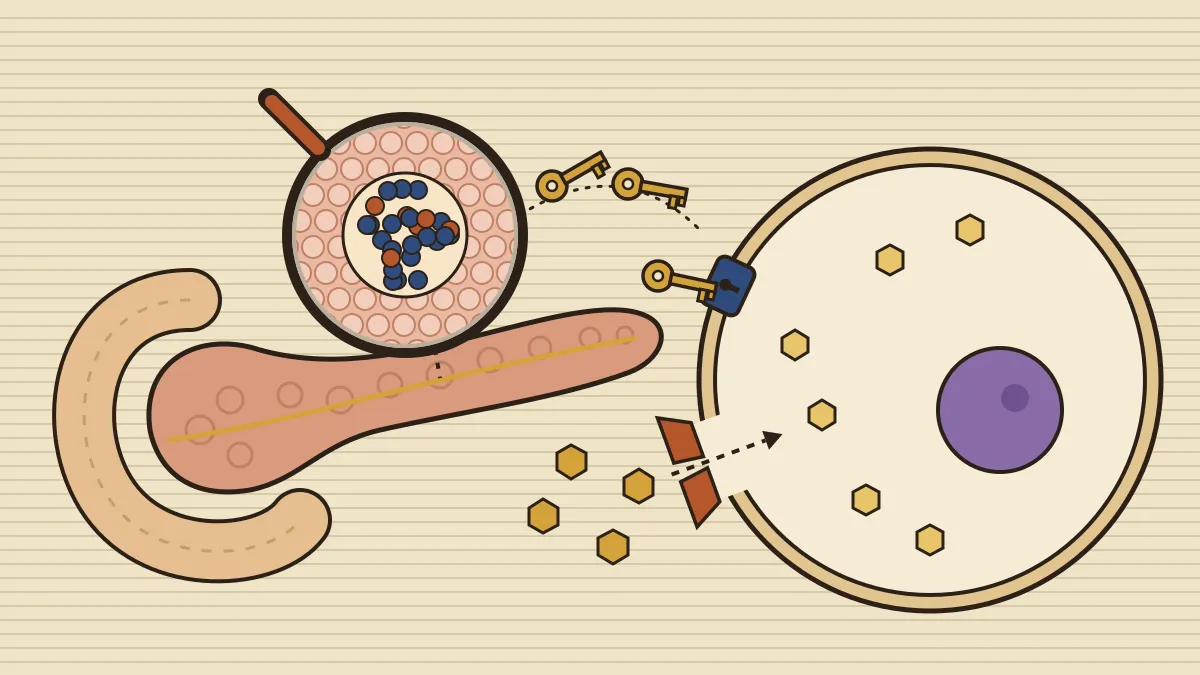
A third cell type, the δ (delta) cell, secretes somatostatin, which damps the release of both hormones. Several hormones can raise blood sugar: glucagon, adrenaline (in the fight-or-flight response), cortisol, growth hormone and thyroxine. Insulin is the only one that lowers it, which is why its failure is so serious.
Insulin is a small protein of 51 amino acids in two chains, A (21) and B (30), joined by disulphide bridges. The body first makes it as proinsulin, which contains an extra piece, the C-peptide, that is cut out before release. Frederick Sanger worked out insulin's full amino-acid sequence, the first protein ever sequenced, and won the 1958 Nobel Prize in Chemistry for it.
The other endocrine glands and their hormones are compared on our endocrine glands and hormones page.
From Toronto 1921 to E. coli Factories
Before 1921, a child with what we now call type 1 diabetes usually died within a year or two, kept alive only by near-starvation diets. In the summer of 1921, in J.J.R. Macleod's laboratory at the University of Toronto, the surgeon Frederick Banting and the student Charles Best tied off the pancreatic ducts of dogs. That made the enzyme-producing tissue waste away while the islets survived, and from the islets they extracted a substance that lowered blood sugar. The biochemist James Collip purified it. In January 1922, a 14-year-old named Leonard Thompson became the first person to be treated successfully with insulin.
The 1923 Nobel Prize in Physiology or Medicine went to Banting and Macleod, one of the fastest awards ever. Banting shared his half with Best, and Macleod shared his with Collip. Banting, Best and Collip sold their patent rights to the University of Toronto for one dollar each, so that insulin could be made widely and cheaply.
Recombinant insulin: an NCERT favourite
For sixty years, insulin came from the pancreas of slaughtered cattle and pigs. It was scarce, and some patients developed allergies to the slightly foreign protein. NCERT's Class 12 chapter on biotechnology tells the next step. In 1983, the American company Eli Lilly prepared two DNA sequences coding for the A and B chains of human insulin and inserted them into plasmids of E. coli. The bacteria produced the two chains separately, and these were extracted and joined by disulphide bonds to make human insulin. It was one of the first medicines made by recombinant DNA technology, and today almost all insulin is made this way.
World Diabetes Day was launched in 1991 by the International Diabetes Federation and the WHO. It became an official United Nations day in 2007, after a UN General Assembly resolution of December 2006. Its symbol is a blue circle, and the date, 14 November, is Banting's birthday.
Diabetes Mellitus: Types, Signs and the Numbers
When insulin is missing or the body stops responding to it, glucose stays in the blood instead of entering cells. This prolonged high blood sugar (hyperglycaemia) is diabetes mellitus. NCERT lists its key features: glucose is lost in the urine, and harmful compounds called ketone bodies form when the body burns fat for fuel.
| Type | Cause | Typical patient | Treatment |
|---|---|---|---|
| Type 1 | The immune system destroys the β cells, so no insulin is made (autoimmune) | Children and young adults | Insulin for life |
| Type 2 | Insulin resistance: cells respond poorly, and β cells slowly tire | Adults; linked to obesity, inactivity, family history. Most cases worldwide | Diet, exercise, oral drugs, insulin later |
| Gestational | Insulin resistance during pregnancy | Pregnant women | Diet, insulin; raises later type 2 risk |
Classic signs: frequent urination (polyuria), excessive thirst (polydipsia), excessive hunger (polyphagia), weight loss and sugar in the urine (glycosuria). Long-term damage falls on small and large blood vessels: the eyes (retinopathy), kidneys (nephropathy), nerves (neuropathy), heart and feet.
| Test (WHO/ADA criteria) | Diabetes | Pre-diabetes (ADA) |
|---|---|---|
| Fasting plasma glucose | ≥ 126 mg/dL | 100–125 mg/dL |
| 2 hours after 75 g glucose (OGTT) | ≥ 200 mg/dL | 140–199 mg/dL |
| HbA1c (glycated haemoglobin) | ≥ 6.5% | 5.7–6.4% |
HbA1c measures how much glucose has stuck to haemoglobin. Red blood cells live about 120 days, so it shows the average sugar of the past two to three months, not just today's reading.
Despite its name, diabetes insipidus has nothing to do with insulin or sugar. It is caused by a lack of ADH (vasopressin), the water-saving hormone made in the hypothalamus and released from the posterior pituitary. The kidneys cannot conserve water, so the patient passes large amounts of dilute urine and becomes dehydrated. "Mellitus" means honey-sweet; "insipidus" means tasteless.
India's burden. The ICMR-INDIAB national study (Lancet Diabetes & Endocrinology, 2023) found a diabetes prevalence of 11.4% (about 10.1 crore adults) and pre-diabetes of 15.3% (about 13.6 crore). Under the National Programme for Prevention and Control of Non-Communicable Diseases, people aged 30 and above are screened for diabetes and hypertension at primary-care centres. Our article on non-communicable diseases and the metabolic nexus covers diabetes, fatty liver and lifestyle disease together.
How UPSC Has Asked It: Past Papers Solved
These are actual CDS and NDA questions since 2018. The pancreas comes up through digestion (enzymes, neutralising acid, bile) and sugar metabolism (glycogen, hormones), usually with insulin planted as a distractor.
In the human digestive system, which one among the following is the role of the pancreas?
(a) Secretion of surfactants to break up lipid droplets (b) Storage and regulated release of bile (c) Secretion of lipase, amylase and protease (d) Neutralizing stomach acids
Answer: (c). Options (a) and (b) describe bile (emulsification) and the gall bladder (storage). The pancreas's defining role is supplying all three classes of digestive enzyme. Its bicarbonate does help neutralise acid, but the enzymes are what UPSC wanted.
Which one of the following statements regarding bile secreted by liver is not correct?
(a) Bile contains enzymes for digestion of lipids (b) Bile facilitates emulsification of fats (c) Bile neutralizes the acidic pH of the food coming from stomach (d) Bile makes the pH of the food alkaline and facilitates action of pancreatic enzymes
Answer: (a). Bile has no enzymes. It emulsifies fat so that pancreatic lipase can work. This is the single most repeated trap in the digestion chapter.
Which one of the following statements about starch and glycogen is correct?
(a) Both are found in plant cells (b) Both are found in animal cells (c) Starch is present in plant cells and glycogen is present in animal cells (d) Both are present in plant as well as animal cells
Answer: (c). Glycogen is "animal starch". Insulin drives the liver and muscles to store excess glucose as glycogen, and glucagon breaks it down again.
Which of the following statements regarding the similarity in glycogen in animal cell and starch in plant cell is/are NOT correct? 1. Both are mixtures of amylose and amylopectin. 2. Starch and glycogen both represent the storage form of carbohydrate in liver cells.
(a) 1 only (b) 2 only (c) Both 1 and 2 (d) Neither 1 nor 2
Answer: (c). Only starch is a mixture of amylose and amylopectin. Glycogen is a single, highly branched polymer. Starch is never stored in liver cells; glycogen is. Both statements are therefore wrong.
Which one of the following hormones increases the heartbeat in mammals?
(a) Insulin (b) Melatonin (c) Thyroxine (d) Adrenaline
Answer: (d). Adrenaline, the emergency hormone of the adrenal medulla, speeds up the heart and also raises blood glucose. Insulin is the distractor here; its job is the opposite one of lowering sugar.
Practice MCQs (with answers)
- The hormone insulin is secreted by
- α cells of the islets of Langerhans
- β cells of the islets of Langerhans
- acinar cells of the pancreas
- the adrenal cortex
- Trypsinogen is converted into active trypsin by
- pepsin
- bile salts
- enterokinase
- hydrochloric acid
- Which of the following raises blood glucose by breaking down liver glycogen?
- Glucagon
- Insulin
- Somatostatin
- ADH
- Insulin is made of
- one chain of 51 amino acids
- three chains linked by hydrogen bonds
- two chains of 30 amino acids each
- two chains (21 and 30 amino acids) linked by disulphide bridges
- Diabetes insipidus is caused by a deficiency of
- insulin
- antidiuretic hormone (vasopressin)
- thyroxine
- glucagon
- Which test reflects a person's average blood sugar over the previous two to three months?
- Fasting plasma glucose
- Random blood sugar
- HbA1c
- Urine sugar
- The Nobel Prize for the discovery of insulin (1923) was awarded to
- Banting and Macleod
- Banting and Best
- Best and Collip
- Sanger and Banting
- Human insulin produced by Eli Lilly using recombinant DNA was expressed in
- yeast cells
- cattle pancreas
- pig pancreas
- the bacterium E. coli
1-b, 2-c, 3-a, 4-d, 5-b, 6-c, 7-a, 8-d. Q7: Best was left out of the official award, and Banting shared his prize money with him. Q8: NCERT Class 12 describes Eli Lilly's 1983 work with plasmids of E. coli.
Quick Revision
- The pancreas is a mixed gland: exocrine acini (~98–99%) and endocrine islets of Langerhans (~1–2%; Langerhans, 1869).
- Pancreatic juice is alkaline (bicarbonate). Trypsinogen → trypsin by enterokinase; also amylase, lipase and nucleases. It enters the duodenum with bile through the ampulla (sphincter of Oddi). Controlled by secretin (bicarbonate) and CCK (enzymes, bile).
- Bile has no enzymes; it emulsifies fat.
- β cells → insulin (lowers sugar; glycogenesis). α cells → glucagon (raises sugar; glycogenolysis, gluconeogenesis). δ cells → somatostatin. Insulin is the only hormone that lowers blood sugar.
- Insulin: 51 amino acids (A 21 + B 30, disulphide bridges); proinsulin minus C-peptide; Sanger, Nobel 1958.
- Discovery: Banting and Best, Toronto, 1921; first patient January 1922; Nobel 1923 (Banting and Macleod). Recombinant human insulin: Eli Lilly, E. coli (NCERT: 1983).
- Type 1 = autoimmune, no insulin. Type 2 = insulin resistance (most cases). Diagnosis: FPG ≥ 126; OGTT ≥ 200; HbA1c ≥ 6.5%. Diabetes insipidus = ADH deficiency.
- World Diabetes Day: 14 November (Banting's birthday); IDF and WHO, 1991; UN day since 2007. ICMR-INDIAB: 11.4%, about 10.1 crore Indians.
Frequently asked questions
Why is the pancreas called both an exocrine and an endocrine gland?
Most of the pancreas is made of acini that secrete digestive enzymes through a duct into the duodenum, which is exocrine function. Scattered among them are about a million islets of Langerhans that release insulin, glucagon and somatostatin directly into the blood, which is endocrine function. A gland with both roles is called a mixed or heterocrine gland.
What is the difference between insulin and glucagon?
Insulin, from the beta cells of the islets, lowers blood glucose by helping cells absorb it and by making the liver and muscles store it as glycogen. Glucagon, from the alpha cells, raises blood glucose by breaking down liver glycogen and making new glucose. They work as an opposing pair to keep blood sugar steady.
Who discovered insulin?
Frederick Banting and Charles Best extracted insulin at the University of Toronto in 1921, in the laboratory of J.J.R. Macleod, and James Collip purified it. The first successful treatment of a patient was in January 1922. Banting and Macleod received the 1923 Nobel Prize in Physiology or Medicine.
What is the difference between type 1 and type 2 diabetes?
In type 1 diabetes the immune system destroys the insulin-making beta cells, so the patient needs insulin for life; it usually begins in childhood or youth. In type 2 diabetes the body's cells resist insulin and the beta cells slowly wear out. It accounts for most cases and is linked to obesity and inactivity.
Why is World Diabetes Day observed on 14 November?
14 November is the birthday of Frederick Banting, who co-discovered insulin in 1921. The International Diabetes Federation and the WHO started the day in 1991, and it became an official United Nations day in 2007. Its symbol is the blue circle.
Related CDS / OTA Science topics
Biology questions in CDS are short, factual and very scoreable
Cavalier's CDS/OTA batches turn NCERT biology into exam-ready notes, diagrams and weekly PYQ drills.