World AIDS Day falls on 1 December and has been observed since 1988. UNAIDS's 2026 fact sheet says 41.0 million people were living with HIV in 2025, 1.2 million were newly infected, 570,000 died of AIDS-related illnesses and 32.1 million were on treatment. India's estimate, released on World AIDS Day last year, is about 25.6 lakh people in 2024, an adult prevalence of 0.20%.
HIV is the exam's standard example of a virus that attacks the immune system itself. In the 33 CDS GK and NDA GAT papers in our archive (2018 to 2026) we counted 15 science questions on viruses, antibodies and vaccines. HIV or AIDS is named in only two, but the ideas under it (an RNA genome, antibiotics useless against viruses, lymphocytes making antibodies) decide most of the rest. Our immunity and vaccination page gives the lists; this article explains the mechanism.
The Immune System in One Page
Innate immunity is inborn and general: skin, mucus, stomach acid, the enzyme lysozyme in tears, and white cells that swallow germs. Adaptive immunity is learned and specific: it takes days to build the first time, but it remembers. HIV hits the adaptive layer at its control centre.
| Cell | Layer | Job |
|---|---|---|
| Neutrophil, macrophage | Innate | Swallow microbes (phagocytosis); macrophages also show germ fragments (antigens) to T cells |
| B lymphocyte → plasma cell | Adaptive | Makes antibodies, Y-shaped proteins that lock onto one antigen |
| Helper T cell (CD4+) | Adaptive | The commander: its chemical signals (cytokines) switch on B cells, killer T cells and macrophages |
| Killer T cell (CD8+) | Adaptive | Destroys body cells already infected with a virus |
| Memory cells | Adaptive | Remember an antigen, so a second attack meets a faster response |
All these cells arise from stem cells in the bone marrow. B cells mature there; T cells mature in the thymus. Our blood page lists the white cell types. "CD4" is just the name of a surface protein on helper T cells, and it is the protein HIV grabs.
B cells and killer T cells need orders from helper T cells. Remove the commander and both armies stand idle, untouched.
HIV: A Retrovirus That Writes RNA Back into DNA
AIDS (acquired immuno-deficiency syndrome) was first reported in June 1981, in young men in Los Angeles with an unusual pneumonia. In 1983 Françoise Barré-Sinoussi and Luc Montagnier at the Pasteur Institute, Paris, isolated the virus; it was named HIV in 1986, and they shared the 2008 Nobel Prize in Physiology or Medicine.
HIV is a retrovirus. A cell normally passes information DNA → RNA → protein. A retrovirus carries RNA and runs the first step backwards, making DNA from RNA with the enzyme reverse transcriptase, discovered by Howard Temin and David Baltimore in 1970 (Nobel Prize 1975).
| Part of HIV | What it is |
|---|---|
| Envelope | Lipid coat taken from the host cell, with spikes gp120 (the key to the CD4 lock) and gp41 |
| Genome | Two copies of single-stranded RNA |
| Enzymes | Reverse transcriptase, integrase, protease, each blocked by a class of drug |
How HIV Takes Over a CD4 Cell
HIV targets cells carrying CD4: mainly helper T cells and macrophages. Each step has a drug class that stops it.
| Step | What happens | Drug that blocks it |
|---|---|---|
| 1. Attachment | gp120 binds CD4, then a second receptor (CCR5 or CXCR4) | Entry inhibitors (maraviroc) |
| 2. Fusion | gp41 merges envelope and cell membrane; capsid enters | Fusion inhibitors (enfuvirtide) |
| 3. Reverse transcription | RNA is copied into double-stranded DNA | Tenofovir, lamivudine |
| 4. Integration | Integrase splices the DNA into a host chromosome: a provirus | Dolutegravir |
| 5. Production | The cell's own machinery makes viral RNA and proteins | None in routine use |
| 6. Budding | New virions bud out; protease cuts long proteins into working parts | Protease inhibitors; lenacapavir |
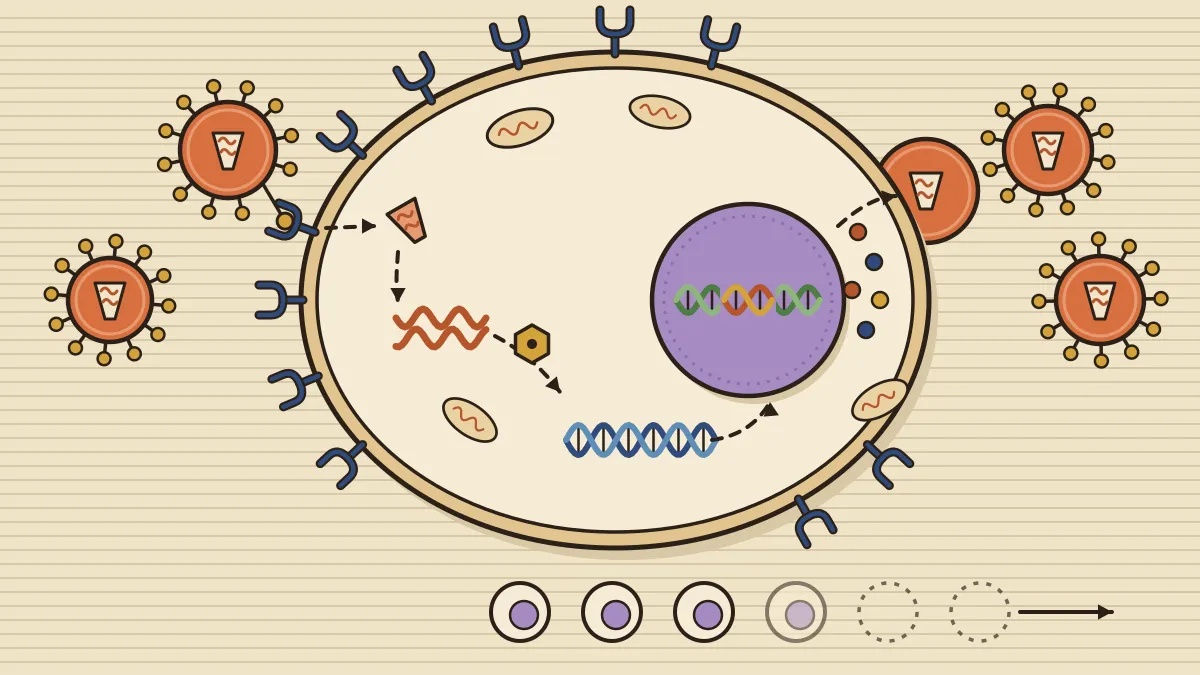
NCERT adds that HIV also enters macrophages, which keep producing virus like factories, while helper T cells are destroyed generation after generation.
Why HIV is so hard to beat
- It mutates fast. Reverse transcriptase does not proofread, and RNA is less stable than DNA. NCERT gives this as the reason RNA viruses evolve faster (CDS 2018-II). That is why treatment uses three drugs together.
- It hides. The provirus sleeps inside resting memory T cells, invisible to immunity and drugs, and reawakens if treatment stops.
- It attacks the commander. Any vaccine needs helper T cells to organise memory, and HIV infects those cells. No effective HIV vaccine exists yet.
From Infection to AIDS
HIV-positive is not the same as AIDS. HIV is the virus. AIDS is its late stage, a syndrome: a group of illnesses appearing together. Healthy adults have roughly 500 to 1,500 CD4 cells per mm³ of blood.
| Stage | When | What happens |
|---|---|---|
| Acute | First 2 to 4 weeks | Flu-like illness in many. Viral load is very high, so the person is highly infectious, yet antibody tests may still be negative |
| Chronic (latent) | About 10 years untreated; decades with treatment | Few symptoms; the CD4 count slowly falls. "Latent" refers to symptoms, not to the virus |
| AIDS | CD4 below 200 per mm³, or an AIDS-defining illness | Opportunistic infections and cancers take hold |
The virus itself rarely kills. Death comes from opportunistic infections, germs harmless to healthy people. They come from every pathogen group: tuberculosis (bacterium, the leading infectious killer of people with HIV), pneumocystis pneumonia and cryptococcal meningitis (fungi), toxoplasmosis (protozoan), and cancers such as Kaposi's sarcoma and cervical cancer. See India's TB target and BPaLM regimen and our viral and bacterial diseases page.
How It Spreads, How It Does Not
HIV passes only through fluids carrying enough virus: blood, semen, vaginal fluids and breast milk.
| HIV spreads by | HIV does not spread by |
|---|---|
| Unprotected sex with an infected partner | Touch, hugging, shared food or toilets |
| Infected blood, shared needles, unscreened organs | Coughing, saliva, tears or sweat |
| Mother to child: pregnancy, birth, breast milk | Mosquito bites (HIV cannot multiply in an insect) |
Without treatment an infected mother passes HIV to her baby in 15 to 45% of births. With antiretroviral drugs WHO puts the risk below 5%.
AIDS is not hereditary: a baby gets HIV from blood or milk, not genes. HIV-positive does not mean AIDS. Treatment controls HIV but does not cure it. NCERT's line that drugs only prolong life is dated: treatment now allows a near-normal lifespan, for life.
A person on treatment with an undetectable viral load cannot pass HIV on through sex (U=U). India's HIV and AIDS (Prevention and Control) Act, 2017, in force from 10 September 2018, bans discrimination in jobs, education and health care, requires informed consent and confidentiality, and creates a state ombudsman.
Testing and Treatment: From ELISA to ART
| Test | Detects | Notes |
|---|---|---|
| ELISA / rapid test | Antibodies | The test NCERT names. Misses infection in the window period, before antibodies form |
| NAT (PCR) | Viral RNA | Earliest, about 10 to 33 days after exposure; used for donated blood and infants |
| Western blot | Antibodies to single viral proteins | Old confirmatory test, now largely replaced by rapid-test sequences |
| CD4 count; viral load | Immune strength; RNA copies per mL | Staging; checking that treatment works |
Babies are the exception. The mother's IgG antibodies cross the placenta and stay for up to 18 months, so an antibody test can read positive in an uninfected infant. Doctors test for the virus itself (NAT).
Antiretroviral therapy (ART) combines three drugs, taken for life. Zidovudine (AZT) was approved in 1987, and triple therapy from 1996 made HIV manageable. India's first-line pill is tenofovir + lamivudine + dolutegravir (TLD). In 2001 the Indian company Cipla offered a three-drug combination at about $350 per patient per year, against $10,000 or more in rich countries.
- PEP: drugs started within 72 hours of a risky exposure, for 28 days. PrEP: drugs for uninfected people at high risk; in July 2025 WHO recommended lenacapavir, an injection needed twice a year.
- Cure: a handful of people have been cleared of HIV, nearly all after a stem-cell transplant from a donor with a rare CCR5 mutation, beginning with the "Berlin patient" Timothy Ray Brown (2007).
India's Programme: NACO, NACP and 95-95-95
The National AIDS Control Organisation (NACO), under the Ministry of Health and Family Welfare, runs the National AIDS Control Programme (NACP).
| Year | Milestone |
|---|---|
| 1986 | First HIV cases detected in India, among sex workers in Chennai |
| 1992 · 1999 · 2007 · 2012 | Start of NACP Phases I, II, III and IV |
| 2004 | Free ART begins (1 April), at eight centres in six states |
| 2017–18 | "Treat all" policy; HIV and AIDS Act passed (2017), in force (2018) |
| 2021 | NACP Phase V, April 2021 to March 2026: fully Centre-funded, ₹15,471.94 crore, aiming to cut new infections and AIDS deaths by 80% from the 2010 level |
NACO's head has written that the programme is moving into Phase VI (2026 to 2031), aimed at ending AIDS as a public health threat by 2030. The India HIV Estimates 2025 show about 25.6 lakh people with HIV in 2024, new infections down roughly half and AIDS deaths down about 81% since 2010. Prevalence is highest in Mizoram, Nagaland and Manipur.
The 95-95-95 cascade
UNAIDS's targets for 2025: 95% of people with HIV know their status, 95% of those are on treatment, and 95% of those on treatment are virally suppressed. Each 95% applies to the group before it.
Of 1,000 people with HIV, how many are suppressed if all targets are met? Compare the world's 2025 result of 88-89-95.
The world met the third 95 but missed the other two. India's NACO reports high viral suppression among those on treatment, but testing and treatment coverage are still below 95%.
How UPSC Has Asked It: Past Papers Solved
UPSC rarely names HIV. It asks the ideas underneath.
AIDS is caused by a virus whose genetic material is
(a) single stranded circular DNA (b) double stranded DNA (c) single stranded RNA (d) double stranded RNA
Answer: (c). HIV carries two copies of single-stranded RNA. Option (b) tempts because reverse transcriptase makes double-stranded DNA inside the cell, but that is the provirus, not the virus's own genome.
Which one of the following is caused by a bacterial pathogen?
(a) AIDS (b) Dengue fever (c) COVID-19 (d) Typhoid fever
Answer: (d). Typhoid is caused by the bacterium Salmonella typhi. AIDS, dengue and COVID-19 are viral. TB in AIDS patients is an opportunistic infection, not the cause of AIDS.
Which one among the following cells produces antibodies against a foreign antigen?
(a) Lymphocytes (b) Erythrocytes (c) Eosinophils (d) Platelets
Answer: (a). B lymphocytes become plasma cells that secrete antibodies. Eosinophils (c) act against parasites and allergies but make no antibodies.
An antibiotic is not useful against a virus whereas a vaccine is. Which one of the following is the most appropriate reason for this?
(a) An antibiotic can break RNA only, whereas virus has DNA. (b) An antibiotic is a carbohydrate in its chemical nature, whereas a vaccine is a protein which works well to kill a virus. (c) Only a vaccine can break the genetic material of a virus. (d) A virus does not use biochemical pathways which can be blocked by an antibiotic. But a vaccine can boost an immune system to fight the virus.
Answer: (d). Antibiotics block bacterial processes such as cell-wall building; a virus has none of its own. A vaccine works by training the immune system. Option (c) is wrong because a vaccine breaks nothing.
Which one of the following statements explains higher mutation rate and faster evolution found in RNA virus?
(a) RNA is relatively unstable compared to DNA. (b) Virus can multiply only within the living cell of a host. (c) Metabolic processes are absent in virus. (d) Virus can remain latent for a long period.
Answer: (a). NCERT gives exactly this reason. Options (b), (c) and (d) are true of viruses in general but say nothing about mutation rate.
Four of these five are about viruses as a class (RNA genome, fast mutation, antibiotics useless, viral not bacterial). Antibiotics work on bacteria only, vaccines train memory, and a virus has RNA or DNA but never both. For HIV add one word: retro.
Practice MCQs (with answers)
- Which enzyme copies HIV's RNA into DNA inside a host cell?
- Integrase
- Protease
- Reverse transcriptase
- DNA ligase
- AIDS is diagnosed in an HIV-positive adult when the CD4 count falls below
- 100 per mm³
- 200 per mm³
- 350 per mm³
- 500 per mm³
- A person newly infected with HIV has a negative antibody test. Which statement is correct?
- The blood is free of the virus
- The person cannot pass on the infection
- The person already has AIDS
- The person can pass on the virus during this window period
- Which disease is the leading infectious cause of death among people living with HIV?
- Tuberculosis
- Malaria
- Cholera
- Typhoid
- Which of the following does NOT spread HIV?
- Sharing used syringes
- Transfusion of infected blood
- A mosquito bite
- Breast milk from an infected mother
- If all three 95-95-95 targets are met among 1,000 people with HIV, how many have a suppressed viral load?
- 857
- 903
- 950
- 810
- Why can an antibody test mislead in a newborn of an HIV-positive mother?
- Newborns make no antibodies at all
- The mother's IgG crosses the placenta and persists in the baby
- The test detects only bacteria
- The virus cannot be seen in infants
- The 2008 Nobel Prize in Physiology or Medicine for discovering HIV went to
- Banting and Best
- Temin and Baltimore
- Jenner and Pasteur
- Barré-Sinoussi and Montagnier
1-c, 2-b, 3-d, 4-a, 5-c, 6-a, 7-b, 8-d. Q3: antibodies take weeks to appear, yet the person is highly infectious. Q6: 0.95 × 0.95 × 0.95 × 1,000 = 857; 903 is only the number on treatment. Q8: Temin and Baltimore found reverse transcriptase (Nobel 1975), not HIV.
Quick Revision
- Helper T cell (CD4+) commands B cells (antibodies), killer T cells and macrophages; T cells mature in the thymus.
- HIV: retrovirus, two copies of single-stranded RNA; reverse transcriptase makes DNA, integrase inserts the provirus. Found 1983 (Barré-Sinoussi, Montagnier; Nobel 2008).
- Cycle: gp120 binds CD4 → fusion → reverse transcription → integration → budding. Drugs: entry, RT, integrase (dolutegravir), protease. India's first-line pill: TLD.
- HIV-positive ≠ AIDS. AIDS: CD4 below 200 per mm³. Normal 500 to 1,500. TB is the leading killer.
- Spread: sex, blood and needles, mother to child (15–45% untreated, below 5% treated). Not mosquitoes or touch. Not hereditary. Tests: ELISA (antibodies, window period), NAT (RNA, earliest, infants). PEP within 72 hours.
- India: NACO, NACP from 1992, free ART 2004, HIV and AIDS Act 2017 (in force 10 September 2018), NACP-V 2021–26 (₹15,471.94 crore); 25.6 lakh with HIV (2024), 0.20%.
Frequently asked questions
What is the difference between HIV and AIDS?
HIV is the human immunodeficiency virus, which destroys helper T cells. AIDS is the late stage of untreated infection, when the CD4 count falls below 200 per mm³ or serious opportunistic infections appear. With treatment a person with HIV may never develop AIDS.
Which cells does HIV attack, and why does that cause AIDS?
HIV attacks cells with the CD4 protein, mainly helper T lymphocytes and macrophages. Helper T cells give orders to B cells and killer T cells, so losing them stops the adaptive immune system, and infections such as tuberculosis take hold.
How is HIV diagnosed?
Rapid tests or ELISA detect antibodies, and nucleic acid tests detect the virus's RNA. Antibody tests can miss infection during the first weeks, the window period. A CD4 count shows immune strength, and a viral load test shows whether treatment is working.
Can HIV spread through mosquito bites or touch?
No. HIV spreads only through blood, semen, vaginal fluids and breast milk, by unprotected sex, contaminated needles or blood, and from mother to child. It cannot multiply in a mosquito and does not spread by touch, hugging, shared food or coughing.
Why is there no vaccine or cure for HIV?
HIV mutates quickly, hides as a provirus inside long-lived immune cells, and attacks the helper T cells a vaccine depends on. Antiretroviral therapy suppresses the virus but cannot remove this hidden reservoir, so it must be taken for life.
Related CDS / OTA Science topics
Biology questions in CDS are short, factual and very scoreable
Cavalier's CDS/OTA batches turn NCERT biology into exam-ready notes, diagrams and weekly PYQ drills.