November is a month of plant hormones in action. Farmers across north India are sowing wheat, whose Rabi price the Cabinet fixed at ₹2,610 per quintal for 2027-28 on 30 September 2026. Chrysanthemums, which flower only as the nights lengthen, are filling the markets. And in April 2026 the food regulator FSSAI again told states to act against fruit ripened with calcium carbide or dipped in ethephon solution. The same few chemical messengers sit behind all three.
Our plant hormones and growth page gives the master list. This article goes narrower: the experiments behind each hormone, its commercial use, the ripening rules, and the two switches (day length and cold) that decide when a plant flowers.
Five Hormones, Five Accidents
By Akanksha Kumari · Science faculty, The Cavalier · B.Tech, 15 years teaching Science
Plants have no glands and no nerves, yet they coordinate growth over metres of stem. They use hormones (plant growth regulators): small molecules made in one place that act in tiny amounts elsewhere. All five major groups were found by accident, while people were explaining a sick rice field, a bending seedling or a basket of fruit. Unlike the animal hormones on our endocrine glands page, they come from no special gland.
| When | Who | What they noticed or did | What it showed |
|---|---|---|---|
| 1880 | Charles and Francis Darwin | Canary-grass seedlings were lit from one side. The tip was covered with an opaque cap in some, and cut off in others. | The tip senses light. Something travels down from it to make the lower part bend. |
| 1910s | Boysen-Jensen (Denmark) | Put a thin block of gelatin, then a sheet of mica, between the tip and the stem below. | The signal is chemical: it crossed gelatin but was stopped by mica. |
| 1926 | E. Kurosawa (Japan) | Healthy rice seedlings, treated with a filtrate of the fungus Gibberella fujikuroi, grew tall and spindly like bakanae ("foolish seedling") plants. | The fungus makes a growth chemical, later named gibberellic acid. |
| 1928 | Frits Went (Netherlands) | Stood cut oat tips on agar for about an hour, then placed the agar block on a headless seedling. | The chemical diffuses into agar and restarts growth. It was named auxin. |
| 1910 | H.H. Cousins | Ripe oranges in a store made bananas kept with them ripen faster. | A volatile substance, later identified as ethylene, passes between fruit. |
| 1955 | Miller and colleagues (after Skoog) | Tobacco tissue divided only if the medium held coconut milk or DNA. Miller crystallised the active substance from herring-sperm DNA. | Kinetin, the first cytokinin, a cell-division promoter. |
| Mid-1960s | Three separate teams | Purified inhibitors called inhibitor-B, abscission-II and dormin. | All three were one molecule: abscisic acid (ABA). |
Rows one, two and four form one detective story. Darwin located the sensor (the tip), Boysen-Jensen proved the message was chemical, and Went caught it in agar. Placed off-centre on a headless seedling in the dark, the block makes it curve away from the side that carries it, because that side grows faster.
Darwin: coleoptile tip. Went: agar block, auxin. Kurosawa: bakanae, gibberellin. Miller: kinetin. Cousins: oranges and bananas, ethylene. Auxin was first isolated from human urine.
What Each Hormone Does, and What It Is Sold For
Learn this table. The right-hand column is where "which hormone would you use to..." questions come from.
| Hormone | Made mostly in | Core job in the plant | Commercial use |
|---|---|---|---|
| Auxin (natural IAA; synthetic IBA, NAA, 2,4-D) | Growing tips of shoot and root | Cell elongation; apical dominance; phototropism | Rooting of cuttings (IBA, NAA); stops early fruit drop (NAA); seedless tomatoes; 2,4-D weed killer |
| Gibberellin (GA3 best known) | Embryos, young leaves, roots | Stem elongation; breaks seed and bud dormancy; bolting | Longer grape-bunch stalks and sugarcane stems; faster malting in brewing |
| Cytokinin (kinetin, zeatin) | Root tips, young fruits, developing buds | Cell division; new shoots; delays leaf ageing; overcomes apical dominance | Plant tissue culture; delaying ageing of cut leaves and flowers |
| Abscisic acid | Leaves, seeds | Closes stomata in drought; keeps seeds dormant; slows growth | Mainly a stress signal; the natural brake that opposes gibberellin |
| Ethylene (a gas) | Ripening fruit, ageing tissue | Ripening; leaf and flower fall; breaks dormancy | Ripening chambers; ethephon to ripen tomato and flower pineapple |
Auxin. A dab of rooting powder on a rose or hibiscus cutting is IBA or NAA. The same hormone, in a synthetic form, is also a weapon. 2,4-D kills broad-leaved (dicot) weeds but spares grasses and cereals, which is why it is used for weed-free lawns and wheat fields. Auxin also holds apical dominance: the growing tip suppresses the side buds. Snip the tip, as gardeners trimming a hedge do, and the side buds burst into branches. Cytokinin also pushes the side buds to grow.
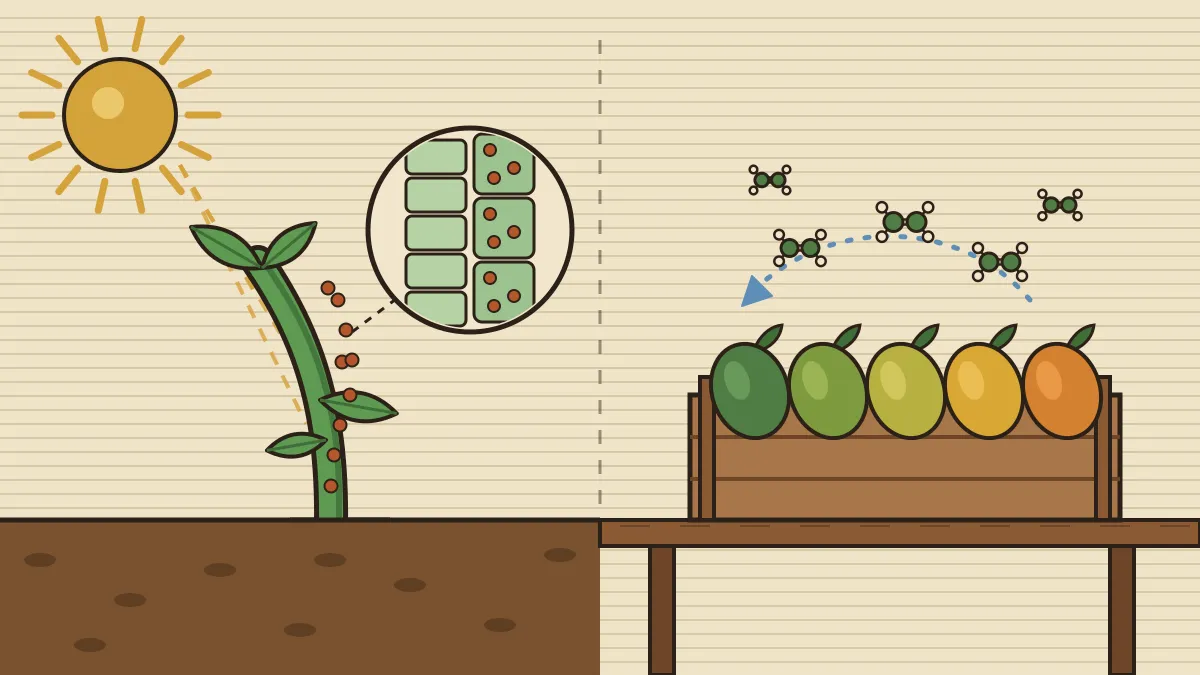
Gibberellin. The stretching hormone is also a dormancy-breaker. In rosette plants such as cabbage and beet, a burst of it makes the stem shoot up, called bolting, just before flowering. Growers use it to lengthen grape-bunch stalks and sugarcane stems, which store the sugar, and brewers use GA3 to speed up malting. Gibberellin and auxin can both trigger parthenocarpy, fruit that forms without fertilisation and so has no seeds.
The tissue-culture rule. In a laboratory dish the ratio of two hormones decides what a lump of cells (a callus) becomes. High auxin and low cytokinin makes roots. High cytokinin and low auxin makes shoots. This is how thousands of identical banana or orchid plantlets are grown from a few cells.
Abscisic acid is the stress hormone. In a drought it closes the stomata, saving water, and it keeps seeds dormant until conditions suit them, acting against gibberellin. When a question asks which hormone inhibits growth, this is the answer. ABA is the textbook inhibitor.
Ethylene, Ripening and the Carbide Ban
Ethylene is the only plant hormone that is a gas, which is how one ripe fruit can ripen its neighbours. Banana, mango, apple, papaya and tomato are climacteric fruit: as they ripen, respiration surges (the "respiratory climacteric") and they release a pulse of ethylene. Grapes, oranges and strawberries ripen only on the plant. This is why one rotten fruit spoils the basket.
Ethylene also breaks the dormancy of seeds and potato tubers and lifts deepwater rice leaves above a flood. Its usual source is ethephon, a liquid that the plant absorbs and that releases ethylene slowly. It is used to ripen tomato and to bring pineapple and mango into flower together.
| Calcium carbide ("masala") | Ethylene in a ripening chamber | |
|---|---|---|
| What it does | Reacts with moisture to give acetylene (CaC2 + 2H2O → C2H2 + Ca(OH)2), a gas that imitates ethylene | Switches on the fruit's own ripening programme |
| Safety | Commercial carbide can carry traces of arsenic and phosphorus. FSSAI cites mouth ulcers, gastric irritation and cancer risk | Allowed at up to 100 ppm in approved chambers |
| Legal status in India | Banned for ripening | Permitted under FSSAI's guidance and SOP |
FSSAI allows ethephon only as a source of ethylene gas inside a ripening chamber, run to the prescribed procedure. Dipping fruit in ethephon solution is not allowed, the practice its 2026 advisory targeted. In short, carbide gives acetylene (banned), and chambers give ethylene (allowed). Acetylene imitates ethylene because they are close relatives. Both are hydrocarbons, as our page on hydrocarbons and polymers explains: ethylene has a C=C double bond and acetylene a C≡C triple bond.
Tropisms and Nastic Movements: Telling Them Apart
Plants cannot walk, but they can move. A tropism is a directional growth movement: the plant part bends towards (positive) or away from (negative) the stimulus, and the direction depends on where the stimulus comes from. A nastic movement does not depend on the direction of the stimulus. Auxin is the usual messenger. In the Cholodny-Went model, light pushes auxin to the shaded side of the shoot, where it lengthens the cells, so the stem leans into the light. Our page on xylem and phloem shows the cells that carry out that elongation.
| Movement | Stimulus | Example |
|---|---|---|
| Phototropism | Light | Shoots bend towards light (positive) |
| Geotropism | Gravity | Roots grow down (positive); shoots grow up (negative) |
| Hydrotropism | Water | Roots grow towards moist soil |
| Thigmotropism | Touch or contact | Tendrils of pea and gourd coil around a support |
| Chemotropism | Chemicals | Pollen tube grows down the style towards the ovule |
| Nastic: epinasty, hyponasty | Not directional: faster growth on one surface | Opening of petals, curling of leaves |
| Nastic: turgor movement | Touch, darkness; change in water pressure in cells | Folding of Mimosa (touch-me-not) leaves; sleep movement of acacia leaflets; Venus flytrap closing |
(1) A shoot growing upward shows negative geotropism, even though it also bends to light. (2) Mimosa folds in seconds, too fast for growth. It is a turgor change in cells at the leaf base, and nastic because a touch from any side does it. (3) Roots, not flowers, are hydrotropic.
Photoperiodism: How a Plant Reads the Calendar
Photoperiodism is a plant's response to the length of day and night, and flowering is its best-known result. Garner and Allard showed in 1920 that Maryland Mammoth tobacco flowered only when days shortened. Plants fall into three groups.
| Type | Flowers when | Examples |
|---|---|---|
| Short-day plant (SDP) | Day is shorter than a critical length (so the night is long) | Chrysanthemum, cosmos, dahlia, soybean |
| Long-day plant (LDP) | Day is longer than a critical length | Radish, spinach, lettuce |
| Day-neutral plant (DNP) | Day length makes no difference | Cucumber, tomato, sunflower |
An SDP has a critical day length of 14 hours and an LDP one of 12 hours. Can both flower on the same day?
The surprise is that the plant is really counting the dark hours. Interrupt a long night of an SDP with a few minutes of light, a "night break", and it will not flower. The sensor is the pigment phytochrome, found by US Department of Agriculture scientists in the 1950s. It exists in two interchangeable forms: Pr absorbs red light and turns into Pfr, and Pfr absorbs far-red light and turns back. In darkness Pfr slowly reverts, and that reversal is, in effect, the clock.
The leaf measures the day, but the flower appears at the shoot tip, so a messenger called florigen must travel between them. Textbooks still call it hypothetical, though since 2007 experiments point to a protein called FT as its main component. Growers exploit all this: chrysanthemum beds are covered with black cloth to force early flowering, and lit at night to delay it.
Vernalisation: Flowering After Winter
Some plants need a spell of cold before they will flower. Vernalisation is the promotion of flowering by exposing a plant, or its soaked seeds, to low temperature, typically 1 to 10 °C for a few weeks. The word was popularised by the Soviet agronomist T.D. Lysenko in 1928. Winter wheat and biennials such as cabbage and beet depend on it. A biennial grows leaves in its first year, meets winter, and flowers in its second. Chilled seed lets it flower in one season.
In some biennials a gibberellin spray can stand in for the cold. Most wheat grown in India is a spring type, sown in the cool Rabi season, and needs no pre-chilled seed, which links back to the Rabi sowing in our lead. True winter wheat of colder countries is sown in autumn and must feel the winter first.
How UPSC Has Asked It: Past Papers Solved
These come from CDS and NDA papers (2021 to 2025) and the CAPF (AC) paper, which tests the same science.
A student was doing an experiment on increasing the cell division among plants. She asked her supervisor to suggest the specific plant hormone for the same. Had you been her supervisor, which plant hormone would you suggest?
(a) Abscisic acid (b) Gibberellins (c) Cytokinin (d) Auxin
Answer: (c). Cytokinin is the cell-division hormone. The tempting wrong option is auxin, which works with cytokinin but mainly enlarges cells, and gibberellin, which stretches the stem.
Which one among the following hormones inhibits the growth activity in plants?
(a) Auxins (b) Cytokinins (c) Abscisic acid (d) Gibberellins
Answer: (c). The other three are growth promoters. ABA is the stress hormone that closes stomata and keeps seeds dormant.
Which one among the following is not a plant hormone?
(a) Gibberellins (b) Abscisic acid (c) Auxins (d) Thyroxine
Answer: (d). Thyroxine is made by the animal thyroid gland. It is a trap that sounds like a growth hormone.
Shoots of plant show upward movement and it can be designated to be
(a) Negatively phototropic (b) Positively chemotropic (c) Positively hydrotropic (d) Negatively geotropic
Answer: (d). Upward means away from gravity, which is negative geotropism. Option (a) is wrong because shoots are positively phototropic: they grow towards light.
Bending of shoot of a plant towards light can be referred to as
(a) photonasty (b) positive phototropism (c) negative phototropism (d) photoperiodism
Answer: (b). Growth towards light, directed by where the light comes from, is positive phototropism. Photonasty is a non-directional response to light, and photoperiodism concerns day length.
Which one of the following pairs is not correctly matched?
(a) Positively phototropic: Shoot (b) Positively geotropic: Root (c) Chemotropic: Pollen tube (d) Hydrotropic: Flower
Answer: (d). Hydrotropism, growth towards water, is shown by roots. The other three pairs are correct.
Match a hormone to its job, pick the odd one out, or name a tropism: one-line facts every time.
Practice MCQs (with answers)
- Which hormone is used to induce roots on stem cuttings?
- Abscisic acid
- Gibberellic acid
- Indole-3-butyric acid
- Ethylene
- An experiment in which agar blocks that had held oat coleoptile tips were placed on headless seedlings is associated with
- Charles Darwin
- Frits Went
- E. Kurosawa
- Miller
- Calcium carbide is banned for ripening fruit because it releases a gas that imitates ethylene. The gas is
- acetylene
- methane
- ethane
- carbon monoxide
- A short-day plant will flower when
- it receives more than 14 hours of light every day
- the temperature falls below 10 °C
- far-red light is given in the middle of the day
- its uninterrupted dark period is longer than its critical length
- Spraying sugarcane with gibberellin is done mainly to
- increase the number of leaves
- lengthen the sugar-storing stems
- prevent root hair formation
- deepen seed dormancy
- The folding of the leaves of a touch-me-not plant when touched is an example of
- phototropism
- geotropism
- a nastic (turgor) movement
- chemotropism
- In a tissue-culture medium, a high auxin to cytokinin ratio mainly encourages
- shoot buds
- seed germination
- death of the callus
- root formation
- Vernalisation is
- promotion of flowering by exposure to low temperature
- promotion of flowering by short days
- ripening of fruit by ethylene
- removal of the shoot tip to induce branching
1-c, 2-b, 3-a, 4-d, 5-b, 6-c, 7-d, 8-a. Q1: IBA and NAA are rooting auxins; gibberellin and ethylene do not root cuttings. Q4: the plant measures the night, so the dark period must be long enough. Q6: Mimosa responds to touch from any direction through a change in water pressure, which makes it nastic, not a tropism. Q7: remember the rule "auxin up, roots; cytokinin up, shoots".
Quick Revision
- Discoveries: Darwin (1880): tip senses light. Boysen-Jensen: signal is chemical. Went (1928): agar block, auxin. Kurosawa (1926): gibberellin. Miller (1955): kinetin. Cousins (1910): ethylene. ABA: mid-1960s.
- Auxin: elongation, apical dominance, rooting (IBA, NAA), 2,4-D kills dicot weeds. Gibberellin: stem stretch, bolting, ends dormancy. Cytokinin: cell division, delays ageing. ABA: stress hormone, classic inhibitor.
- Ethylene: the only gas; ripens climacteric fruit; ethephon is its source. Tissue culture: high auxin gives roots, high cytokinin gives shoots.
- Ripening: carbide (acetylene) banned; ethylene up to 100 ppm in chambers; ethephon never as a dip.
- Tropisms are directional (photo, geo, hydro, thigmo, chemo); nastic movements are not (Mimosa, petals opening). Shoot up = negative geotropism.
- SDP (chrysanthemum, soybean), LDP (radish, spinach), DNP (tomato, cucumber). The dark period counts. Phytochrome Pr ⇄ Pfr. Vernalisation = cold promotes flowering (wheat, biennials).
Frequently asked questions
Who discovered auxin, and how?
Charles and Francis Darwin showed in 1880 that a grass seedling's tip senses light and sends a message down to the part that bends. Boysen-Jensen showed the message is chemical, and Frits Went caught it in agar blocks in 1928 and named it auxin.
Why is calcium carbide banned for ripening fruit?
Carbide reacts with moisture to give acetylene, which imitates ethylene but can leave the pulp raw, and commercial carbide may carry arsenic and phosphorus. FSSAI allows ethylene gas up to 100 ppm in approved ripening chambers instead.
What is the difference between a tropism and a nastic movement?
A tropism is a directional growth movement, so the part bends towards or away from the stimulus, as shoots do towards light. A nastic movement does not depend on the direction of the stimulus, as in touch-me-not leaves folding or petals opening.
Why do some plants flower only in short days?
Short-day plants such as chrysanthemum flower when the uninterrupted night is longer than a critical length. The pigment phytochrome lets the leaf measure that night, and a signal called florigen then travels to the shoot tip.
What is vernalisation and why does it matter for crops?
Vernalisation is the promotion of flowering by exposing a plant or its soaked seeds to low temperature, usually 1 to 10 °C. Winter wheat and biennials such as cabbage need it, and chilled seed lets a two-season crop flower in one season.
Related CDS / OTA Science topics
Plant biology is easy, scoreable recall in the GS paper
Cavalier's CDS/OTA batches teach biology as stories and diagrams you can recall in seconds, with weekly PYQ tests.