The Ministry of Tribal Affairs is running Janjatiya Gaurav Pakhwada from 1 to 15 November 2026. Health is part of that drive because sickle cell disease is common in several tribal communities. A PIB release of 24 September 2026 said India's National Sickle Cell Anaemia Elimination Mission had screened over 7.29 crore people, found over 20 lakh carriers and diagnosed 2.5 lakh patients. The word "carrier" is pure Mendel: a healthy person with one normal and one faulty copy of a gene. Genetics gives UPSC easy marks every year, because the rules are few and the questions short.
Mendel's Garden: Who, When and Why Peas
By Akanksha Kumari · Science faculty, The Cavalier · B.Tech, 15 years teaching Science
Gregor Johann Mendel (1822–1884), an Austrian monk, crossed garden peas (Pisum sativum) from 1856 to 1863 and reported the results in 1865. Nobody took notice. In 1900 de Vries, Correns and Tschermak rediscovered his laws independently, and Mendel became the father of genetics.
Peas were a clever choice: they are self-pollinating, so pure lines are easy to keep, they grow fast, and they show clear either/or traits. Mendel studied seven pairs (tall/dwarf, round/wrinkled seed, yellow/green seed, violet/white flower, axial/terminal flower, inflated/constricted pod, green/yellow pod) and counted large samples. His mathematical method was new and his idea of unblended factors went against the belief in blending, so the work was ignored for 35 years.
Learn six words. A gene is the unit of inheritance (Mendel's "factor"). Alleles are different forms of one gene, such as T and t. Two identical alleles (TT, tt) make an organism homozygous, and two different ones (Tt) heterozygous. The genotype is the allele combination and the phenotype is the visible trait. F1 and F2 are the first and second generations after the cross.
In 1902 Sutton and Boveri saw that chromosomes pair and separate exactly as Mendel's factors do. This is the chromosomal theory of inheritance. Our cell organelles page covers the nucleus that holds them.
One Trait at a Time: The 3:1 and 1:2:1
Cross a pure tall plant (TT) with a pure dwarf (tt). Every F1 plant is Tt and tall. Self-pollinate the F1 and the dwarf trait returns, whole and unblended, in one quarter of the F2. Two laws follow.
- Law of dominance. Factors occur in pairs, and when they differ, the dominant one hides the recessive.
- Law of segregation. The two alleles of a pair separate when gametes form, so each gamete carries only one. This is meiosis at work.
A tall plant could be TT or Tt. Mendel's test cross settles it: cross it with a homozygous recessive (tt). All tall offspring mean TT. A 1 : 1 mix of tall and dwarf means Tt.
| Cross | Phenotypic ratio | Genotypic ratio |
|---|---|---|
| Tt × Tt (monohybrid F2) | 3 : 1 | 1 : 2 : 1 |
| Tt × tt (test cross) | 1 : 1 | 1 : 1 |
| Rr × Rr, incomplete dominance | 1 : 2 : 1 | 1 : 2 : 1 |
| RrYy × RrYy (dihybrid F2) | 9 : 3 : 3 : 1 | Nine genotypes (1 : 2 : 1 : 2 : 4 : 2 : 1 : 2 : 1) |
| RrYy × rryy (dihybrid test cross) | 1 : 1 : 1 : 1 | 1 : 1 : 1 : 1 |
3 : 1 is the phenotypic ratio. The genotypic ratio of the same F2 is 1 : 2 : 1.
Two Traits Together: The 9:3:3:1
Cross pure round-yellow peas (RRYY) with wrinkled-green (rryy). The F1 (RrYy) are all round and yellow. Self them and the F2 gives 9 round-yellow : 3 wrinkled-yellow : 3 round-green : 1 wrinkled-green.
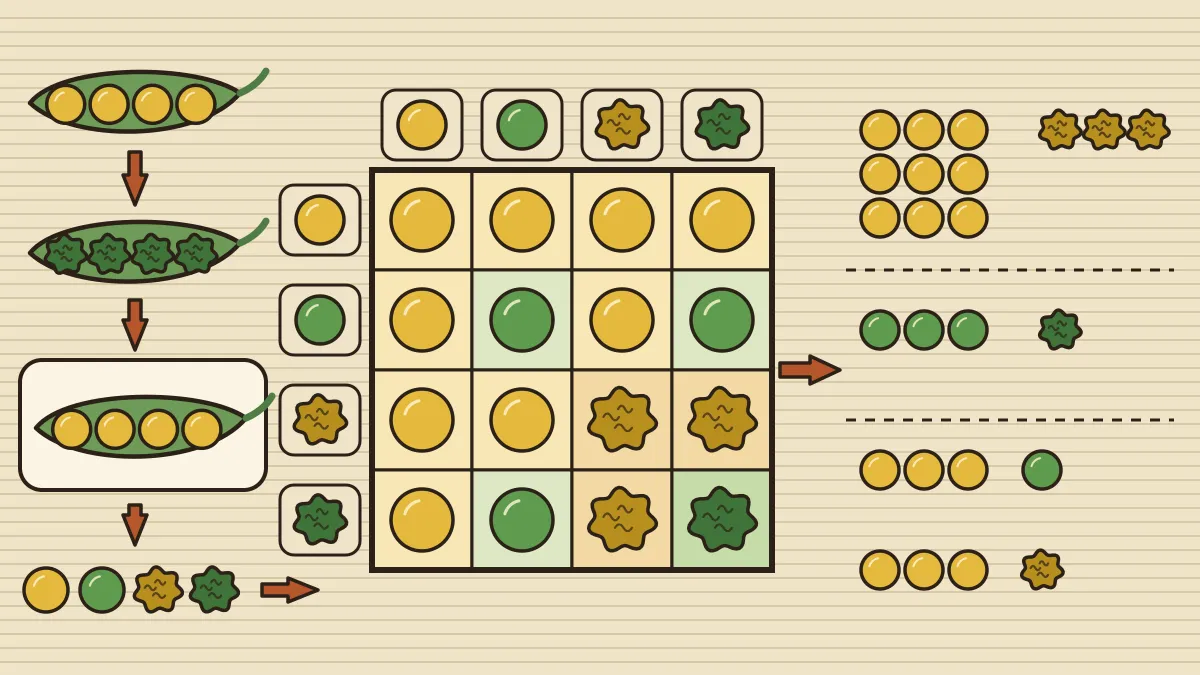
Treat each trait alone: yellow to green is 3 : 1, round to wrinkled is 3 : 1. Multiply, and (3 : 1) × (3 : 1) = 9 : 3 : 3 : 1. That works because of the third law.
- Law of independent assortment. In a hybrid for two traits, the pairs separate independently. RrYy therefore makes four gamete types, RY, Ry, rY and ry, 25% each.
What fraction of the F2 of RrYy × RrYy is wrinkled and green?
The law fails for genes on the same chromosome, which tend to travel together. This is linkage, found by Thomas Hunt Morgan in the fruit fly Drosophila (Nobel Prize, 1933). Crossing over still breaks links now and then (recombination). Morgan's student Sturtevant used the recombination rate to measure distance between genes and drew the first gene maps.
Where Mendel's Laws Bend
| Pattern | Heterozygote looks like | Example |
|---|---|---|
| Incomplete dominance | An in-between blend; F2 is 1 : 2 : 1 | Snapdragon: red × white gives pink |
| Co-dominance | Both traits show fully | IAIB gives blood group AB |
| Multiple alleles | Over two alleles in the population, but two per person | IA, IB, i for ABO |
| Polygenic | Many genes add up, plus environment: a smooth range | Human height, skin colour |
| Pleiotropy | One gene, several effects | Phenylketonuria: one enzyme fault causes intellectual disability and pale skin and hair |
The ABO crosses are worked in our blood groups and transfusion article.
In incomplete dominance the hybrid is a new intermediate shade (pink). In co-dominance it shows both parental traits side by side (AB).
Who Decides the Baby's Sex?
A human cell has 46 chromosomes: 22 pairs of autosomes and one pair of sex chromosomes. Women are XX and men XY. A woman's eggs all carry an X. A man's sperm are half X and half Y. An X sperm gives a girl, a Y sperm a boy, so the sperm decides the sex and each pregnancy is 50 : 50.
| Group | Mechanism | Who decides? |
|---|---|---|
| Humans, mammals, Drosophila | Male XY, female XX | The father's sperm |
| Grasshopper | Male XO, female XX | Sperm with or without an X |
| Birds | Female ZW, male ZZ | The mother's egg |
| Honeybee | Fertilised egg: diploid female (32). Unfertilised: haploid male drone (16) | Whether the egg is fertilised |
A drone has no father and cannot have sons, but he has a grandfather and grandsons.
Sex-Linked Disorders and Reading a Pedigree
A man has one X and no second copy to mask a faulty allele, so a recessive X-linked allele shows in every male who carries it. A woman is affected only when both her X chromosomes carry it.
- Red-green colour blindness: defective red or green cone cells. About 8% of men and 0.4% of women.
- Haemophilia: a clotting protein is missing, so cuts bleed on. Queen Victoria was a carrier and passed it into European royal families.
If the father is colour-blind and the mother pure normal, all sons are normal and all daughters carriers. The trait goes father to daughter to grandson: criss-cross inheritance.
Pedigrees trace a trait in a family tree (squares male, circles female, shaded affected). Two normal parents with an affected child mean a recessive trait. A trait that passes from a father to his son cannot be X-linked, because a son gets his father's Y, not his X.
Sickle cell disease is autosomal recessive, not sex-linked. One base change (GAG to GUG) puts valine for glutamic acid at position six of the beta-globin chain. Two carriers (HbAHbS) have a 25% chance of an affected child in each pregnancy, 50% of a carrier and 25% of a normal child. Hence the mission's focus on screening and counselling. Our blood groups article covers haemophilia, thalassaemia and sickle cell from the blood side.
When the Chromosome Count Goes Wrong
Mendelian disorders come from one faulty gene (sickle cell, haemophilia, colour blindness, PKU, thalassaemia). Chromosomal disorders come from a missing or extra chromosome. A mutation is a sudden change in DNA, and a point mutation alters one base, as in sickle cell (see how cancer begins). Chromosomal disorders usually start with non-disjunction, a pair failing to separate in meiosis. One extra chromosome is trisomy, one missing is monosomy, and an extra whole set is polyploidy, common in plants.
| Syndrome | Chromosomes | Key features |
|---|---|---|
| Down's | 47, trisomy 21 (Langdon Down, 1866) | Short, round head, broad palm with one crease, delayed development |
| Turner's | 45, X0, a female | Short, rudimentary ovaries, sterile |
| Klinefelter's | 47, XXY, a male | Tall, some breast development, sterile |
Down = three copies of 21. Turner = a girl with one X. Klinefelter = a boy with two X. Down's risk rises with the mother's age.
DNA in Brief: Where the Genes Live
A gene is a stretch of DNA coding for a protein. Watson and Crick proposed the double helix in 1953, relying on Photo 51, taken by Rosalind Franklin and Raymond Gosling. Watson, Crick and Wilkins shared the 1962 Nobel Prize. Adenine pairs with thymine (two hydrogen bonds), guanine with cytosine (three). Mitochondria and chloroplasts carry their own DNA, and since the egg supplies the mitochondria, mitochondrial DNA is inherited from the mother.
The genome is all of an organism's DNA. The Human Genome Project finished in 2003 (about three billion base pairs). In January 2025 India's GenomeIndia project announced 10,000 genomes sequenced and opened to researchers, which helps find variants common in Indian communities.
How UPSC Has Asked It: Past Papers Solved
Questions are short: alleles, a girl's chromosomes, DNA and one word that flips a statement. Ratio and sex-linked crosses are asked more in the NDA and State papers, so practise them below.
In human beings, the chromosomes that determine birth of a normal female child are
(a) one X chromosome from mother and one X chromosome from father (b) one X chromosome from mother and one Y chromosome from father (c) two X chromosomes from mother and one X chromosome from father (d) one X chromosome and one Y chromosome from father and one X chromosome from mother
Answer: (a). A girl is XX, one X from each parent. (b) is a boy. (c) and (d) count three sex chromosomes.
Different varieties of the same gene are called
(a) Genotypes (b) Sib pairs (c) Alleles (d) Isomers
Answer: (c). Alleles are forms of one gene. A genotype (a) is the whole combination, such as Tt.
Which one of the following statements about variations is not true?
(a) Variation is minimum in asexual reproduction (b) All variations in a species have equal chances of survival (c) Changes in genetic constitution result in variation (d) Variants can be selected by environmental factors
Answer: (b). The environment selects among variants, so their survival chances differ. (a), (c) and (d) are all true.
Which of the following statements is NOT correct?
(a) Hardy–Weinberg Principle says that allele frequencies in a population is unstable (b) Branching descent and natural selection are the two key concepts of Darwinian Theory of evolution (c) Lamarckism is based on inheritance of acquired character (d) The concept of mutation, gene flow, genetic drift, gene recombination and natural selection affect Hardy–Weinberg equilibrium
Answer: (a). The principle says allele frequencies stay constant when nothing disturbs the population. The forces listed in (d) are what disturb it.
Photo 51 refers to an image of
(a) a crater on the Moon (b) DNA molecules (c) the virus responsible for COVID-19 (d) the virus responsible for common cold
Answer: (b). Franklin and Gosling's X-ray picture of DNA, which helped Watson and Crick find the double helix.
Which is the correct base pairing found in a normal DNA molecule?
(a) Adenine pairs with Thymine (b) Adenine pairs with Guanine (c) Adenine pairs with Cytosine (d) Thymine pairs with Guanine
Answer: (a). A with T and G with C. In RNA, uracil replaces thymine.
Most are one-line facts. The rest hinge on a word such as "not true" or "unstable". Read the stem first, and for a negative stem hunt for the statement that breaks a rule you know.
Practice MCQs (with answers)
- A heterozygous tall pea plant (Tt) is crossed with a dwarf plant (tt). What fraction of the offspring will be tall?
- All
- One-half
- Three-quarters
- One-quarter
- The 9 : 3 : 3 : 1 ratio in a dihybrid cross is explained by Mendel's law of
- segregation
- dominance
- independent assortment
- linkage
- When pink snapdragons are crossed with each other, the offspring are
- 1 red : 2 pink : 1 white
- 3 red : 1 white
- all pink
- 1 pink : 1 white
- A colour-blind man marries a woman with normal vision whose father was colour-blind. The chance that a son of this couple is colour-blind is
- zero
- 25%
- 100%
- 50%
- In birds, the sex of the chick is decided by
- the cock's Y chromosome
- the temperature of the nest
- the Z or W chromosome in the hen's egg
- the number of chromosome sets
- The chromosome count of a woman with Turner's syndrome is
- 45, X0
- 47, XXY
- 47, with trisomy 21
- 46, XY
- A heterozygous tall pea plant is self-pollinated and gives 64 offspring. About how many are expected to be dwarf?
- 48
- 32
- 8
- 16
- Haemophilia is an example of
- an autosomal dominant disorder
- an X-linked recessive disorder
- a Y-linked disorder
- a trisomy
1-b, 2-c, 3-a, 4-d, 5-c, 6-a, 7-d, 8-b. Q4: the woman's colour-blind father gave her an Xc, so she is a carrier and half her sons are colour-blind. Q5: birds are ZW females, so the egg decides. Q7: a quarter of Tt × Tt is tt, and 64 ÷ 4 = 16.
Quick Revision
- Mendel: garden pea, 1856–63, reported 1865, rediscovered 1900. Dominance, segregation, independent assortment. Chromosomal theory: Sutton and Boveri (1902).
- Tt × Tt: phenotypes 3 : 1, genotypes 1 : 2 : 1. Test cross 1 : 1. Dihybrid 9 : 3 : 3 : 1; its test cross 1 : 1 : 1 : 1.
- Incomplete dominance: pink snapdragon, 1 : 2 : 1. Co-dominance: AB blood. Linkage: Morgan, Drosophila.
- Humans: 22 autosome pairs + XX/XY; sperm decides. Birds ZW female. Drone haploid (16).
- X-linked recessive: colour blindness (8% men, 0.4% women), haemophilia. Sickle cell and thalassaemia: autosomal recessive.
- Down = trisomy 21. Turner = 45, X0. Klinefelter = 47, XXY. Cause: non-disjunction.
- DNA: Watson and Crick 1953, Photo 51, A–T and G–C. Human genome about 3 billion base pairs. GenomeIndia: 10,000 genomes.
Frequently asked questions
What are Mendel's three laws of inheritance?
The law of dominance says that in a pair of unlike factors, one hides the other. The law of segregation says the two factors of a pair separate when gametes form. The law of independent assortment says factors for different traits separate independently of each other.
Why is the monohybrid F2 ratio 3:1 for phenotype but 1:2:1 for genotype?
In Tt × Tt the offspring are one-quarter TT, one-half Tt and one-quarter tt, a genotypic ratio of 1:2:1. TT and Tt both look tall, so the visible ratio is three tall to one dwarf.
Who decides the sex of a child, the father or the mother?
The father does. Every egg carries an X, while a sperm carries an X or a Y in equal numbers. An X sperm gives a girl and a Y sperm a boy, so each pregnancy has a 50 per cent chance of either. In birds the female is ZW, so the egg decides.
Why are colour blindness and haemophilia commoner in men?
Both come from recessive alleles on the X chromosome. A man has one X, so a single faulty allele shows in him. A woman has a second X that usually carries a normal allele, so she is mostly a carrier.
What is the difference between Down's, Turner's and Klinefelter's syndromes?
Down's syndrome is trisomy 21, giving 47 chromosomes. Turner's syndrome is a female with one X chromosome (45, X0), and Klinefelter's syndrome is a male with an extra X (47, XXY). All three come from non-disjunction in meiosis.
Related CDS / OTA Science topics
Biology is the most scoreable part of the science paper
Cavalier's CDS/OTA batches teach genetics with solved crosses, diagrams and weekly PYQ tests, so ratios stop being a guessing game.