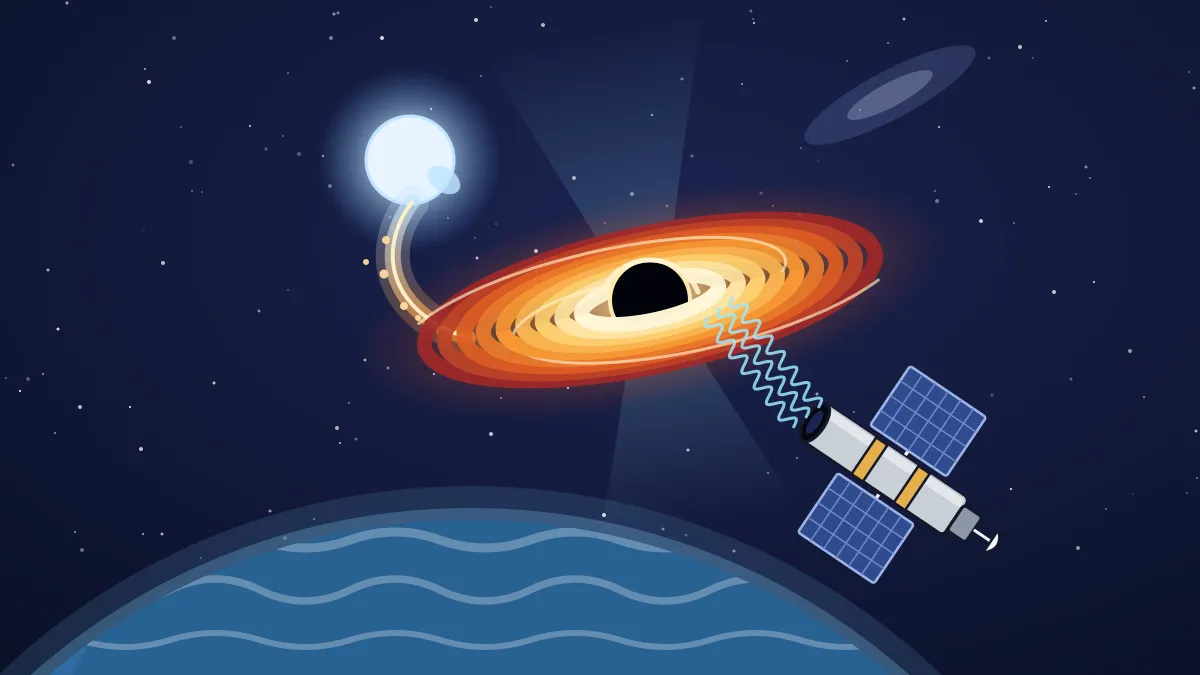
On 2 November 2026, the Ministry of Science & Technology announced that astronomers had worked out why one of the brightest X-ray sources in a nearby galaxy keeps changing. The object is NGC 4490 ULX-8, in the interacting galaxy pair NGC 4490 and NGC 4485. By tracking it with space telescopes over 24 years (2000 to 2024), the team found that it is most likely a stellar-mass black hole swallowing gas at or near the Eddington limit.
The news touches several physics topics at once: where X-rays sit in the electromagnetic spectrum, why they must be observed from space, how falling gas turns gravity into radiation, and what India's own X-ray satellites do.
The story in brief:
- Object: NGC 4490 ULX-8, an ultraluminous X-ray source (ULX) in a galaxy about 25 million light-years away.
- Data: 24 years of observations from Chandra, XMM-Newton and Swift.
- Verdict: a stellar-mass black hole feeding at or near the Eddington limit.
- Team: IIA, RRI and IUCAA, with a student from IISER Mohali; published in MNRAS.
The finding in plain language
Some X-ray sources in other galaxies are far brighter than any ordinary star. When such a source sits away from its galaxy's centre, astronomers call it an ultraluminous X-ray source. ULXs are thought to be a neutron star or a black hole pulling gas off a companion star. As the gas falls in, it heats up and glows in X-rays.
What the 24-year record showed, according to the release:
- ULX-8 stayed exceptionally bright throughout, though its brightness varied a lot.
- It did not show the dramatic switches between accretion states that many black-hole X-ray binaries show.
- Its X-ray emission looked like a persistently active, ultraluminous accretion flow.
That second point deserves a sentence of explanation. Black holes that feed on a companion star in our own galaxy often flip between a hard state (X-rays dominated by a hot cloud of electrons around the black hole) and a soft state (X-rays dominated by the glowing disc of gas). ULX-8 never made that flip in 24 years. Together with the brightness, that points to a steady, heavy feeding rate rather than an on-off one.
The paper behind the release (arXiv:2510.11415) adds detail. It used 39 observations: 14 from Chandra, 6 from XMM-Newton and 19 from Swift. ULX-8's X-ray luminosity averaged a few times 10³⁹ erg per second. A search for regular pulses found none, which argues against a neutron star. From the size of the inner disc, the authors estimate a black-hole mass of about 17 to 81 times the Sun's, depending on how fast it spins. The distance they adopt is 7.8 megaparsecs, about 25 million light-years.
The study was led by Tarang Vashisht (IISER Mohali) with Aru Beri of the Indian Institute of Astrophysics (IIA) and researchers from IUCAA and the Raman Research Institute (RRI). IIA and RRI are autonomous institutes of the Department of Science and Technology (DST); IUCAA, in Pune, is the University Grants Commission's inter-university centre for astronomy. The release names the journal as the "Monthly Notices of the Royal Astronomical Journal"; the journal is Monthly Notices of the Royal Astronomical Society (MNRAS).
X-rays in the electromagnetic spectrum
X-rays are electromagnetic waves. Röntgen discovered them on 8 November 1895, and he received the first Nobel Prize in Physics, in 1901. The spectrum is ordered by wavelength:
| Region | Approximate wavelength | Familiar use or source |
|---|---|---|
| Radio | longer than 1 m | Broadcasting, radio telescopes |
| Microwave | 1 mm to 1 m | Radar, ovens, cosmic microwave background |
| Infrared | 700 nm to 1 mm | Heat, remote controls, thermal imaging |
| Visible | 400 to 700 nm | Human vision |
| Ultraviolet | 10 to 400 nm | Sunburn, sterilisation |
| X-ray | 0.01 to 10 nm | Medical imaging, very hot gas |
| Gamma | shorter than 0.01 nm | Radioactive decay, gamma-ray bursts |
Going down the table, wavelength falls while frequency and photon energy rise. All of these travel at the same speed in vacuum, 3 × 10⁸ m/s. X-rays carry no charge, so electric and magnetic fields do not deflect them. They penetrate soft tissue, ionise gases and darken photographic film, which is why they suit medical imaging. Gamma rays overlap X-rays in energy; the usual textbook distinction is origin: gamma rays come from nuclei, X-rays from electrons (fast electrons stopping suddenly, or atoms losing inner-shell electrons). Our page on modern physics covers photons and the photoelectric effect behind all this.
Worked example. A photon's energy is E = hc/λ, which works out to 1.24 keV for λ = 1 nm. For λ = 0.1 nm, E = 1.24 ÷ 0.1 = 12.4 keV. A visible photon carries only about 2 to 3 eV, so one such X-ray photon holds thousands of times more energy.
Why X-ray astronomy has to leave the ground
The air above you has the mass of about 10 m of water. Nitrogen and oxygen atoms absorb X-rays strongly (by the photoelectric effect), so cosmic X-rays are stopped high in the atmosphere. Ground telescopes can use the visible and radio windows, but not X-rays. Detectors must be above roughly 100 km for the softer X-rays; balloons near 40 km catch only the hardest.
That is why X-ray astronomy began with rockets. In June 1962 a team led by Riccardo Giacconi flew an Aerobee rocket from White Sands, New Mexico, and found Scorpius X-1, the first X-ray source outside the Solar System. Giacconi shared the 2002 Nobel Prize in Physics for it. Satellites followed: Uhuru (1970), the first dedicated X-ray satellite, and then the three used in this study. Chandra (NASA) and XMM-Newton (ESA) were both launched in 1999, and Swift (NASA) in 2004.
X-rays also cannot be focused by an ordinary lens or mirror: they pass through or are absorbed. X-ray telescopes use grazing-incidence mirrors, nested metal shells that the X-rays skim at a very shallow angle, like a flat stone skipping on a pond.
How falling gas becomes X-rays
A neutron star or black hole is so compact that matter falling toward it releases enormous gravitational energy. Gas from the companion does not fall straight in; it carries angular momentum, so it spirals into an accretion disc and heats by friction as it loses that momentum.
Worked example: how much energy? A neutron star of 1.4 solar masses and radius 10 km releases GM/R ≈ 1.9 × 10¹⁶ J per kg of falling gas, about 20% of mc². Fusing hydrogen into helium releases only 0.7% of mc², about 6 × 10¹⁴ J/kg. Accretion onto a compact object is therefore roughly 30 times as efficient as fusion. For a non-spinning black hole the figure is about 6%.
How hot? The study measured inner-disc temperatures of about 1.0 to 1.6 keV, which is roughly 12 to 19 million kelvin (1 keV ≈ 1.16 × 10⁷ K). By Wien's law, λ_max = 2.9 × 10⁻³ m·K ÷ T, a body at 15 million K peaks near 0.19 nm: squarely in the X-ray band.
| Neutron star | Black hole | |
|---|---|---|
| Typical mass | about 1.4 solar masses | from about 3 solar masses upward |
| Surface | Yes, about 10 to 12 km radius | None; an event horizon instead |
| Signature | Regular X-ray pulses if magnetised (pulsar) | Smooth flickering, no pulses |
Our page on gravitation gives the idea behind the second column: a black hole is an object whose escape velocity at its surface reaches the speed of light. Its horizon radius is 2GM/c², about 3 km per solar mass. Our earlier piece on faint black holes covers black holes in general.
The Eddington limit, and why ULXs break it
Radiation pushes outward on infalling gas while gravity pulls inward. The luminosity at which the two forces balance is the Eddington limit:
L_Edd ≈ 1.3 × 10³¹ W × (M / M☉) (or 1.3 × 10³⁸ erg/s per solar mass).
A 10-solar-mass black hole therefore tops out near 10³² W, or 10³⁹ erg/s. A ULX is conventionally a source above 10³⁹ erg/s that is not at its galaxy's centre. That is the output of about 260,000 Suns, in X-rays alone. ULX-8's average of a few times 10³⁹ erg/s is roughly a million Suns.
So how does anything shine above its limit? There are three answers:
- A heavier black hole. An intermediate-mass black hole of hundreds to thousands of solar masses would have a higher limit.
- Super-Eddington feeding. The disc puffs up into a funnel, gas escapes as powerful outflows, and radiation is beamed along the funnel. The release names these as what the work helps to understand.
- A neutron star. In 2014, NASA's NuSTAR found regular 1.37-second pulses from the ULX M82 X-2, proving that some ULXs are neutron stars.
ULX-8's verdict is the second answer. The mass estimate shows how this works. A disc cannot extend inward past the innermost stable orbit, at 6GM/c² (3 horizon radii) for a non-spinning hole and much closer for a fast-spinning one. If the measured inner radius is about 150 km, a non-spinning hole of 17 solar masses fits (3 × 2.95 km × 17 ≈ 150 km), while a rapidly spinning one needs about 81. A spin guess therefore turns one radius into a range of masses.
AstroSat, and what it did not do here
India's X-ray astronomy began with Aryabhata (19 April 1975), the first Indian satellite, which carried an X-ray astronomy experiment. Today the main instruments are:
| Mission | Launch | What it does |
|---|---|---|
| AstroSat | 28 September 2015, PSLV-C30, Sriharikota | India's first dedicated multi-wavelength space observatory: ultraviolet to hard X-rays at once |
| XPoSat | 1 January 2024, PSLV-C58 | India's first dedicated X-ray polarimetry mission |
AstroSat has 5 main science payloads: UVIT (ultraviolet, led by IIA), SXT (soft X-ray telescope), LAXPC (large-area X-ray proportional counters) and CZTI (cadmium zinc telluride imager, hard X-rays), the last three from TIFR, and the SSM (Scanning Sky Monitor). It weighs about 1,513 kg and circles near 650 km in a near-equatorial orbit, and has already outlived its planned 5-year life. XPoSat carries POLIX, built at the Raman Research Institute, which measures X-ray polarisation in the 8 to 30 keV band, and XSPECT from the U R Rao Satellite Centre.
Do not confuse the two. This study used Chandra, XMM-Newton and Swift, not AstroSat. Looking ahead, the release names ESA's NewAthena (planned for about 2037) and India's proposed XSat, a next-generation timing and spectroscopy mission, as the next tools for ULXs.
🔑 Revision block
The news. 2 November 2026 (Ministry of Science & Technology): NGC 4490 ULX-8 tracked over 24 years (2000 to 2024); most likely a stellar-mass black hole at or near the Eddington limit.
The data. Chandra (NASA, 1999), XMM-Newton (ESA, 1999), Swift (NASA, 2004); 39 observations (14 + 6 + 19). Not AstroSat.
The team. IIA and RRI (DST autonomous institutes), IUCAA (UGC), student from IISER Mohali; journal MNRAS.
The object. ULX = non-central source above 10³⁹ erg/s. Galaxy pair NGC 4490/4485, about 25 million light-years. No state transitions, no pulses.
Physics to carry. X-rays: 0.01 to 10 nm, between ultraviolet and gamma; E = 1.24 keV ÷ λ(nm); not deflected by fields. Atmosphere blocks them, so detectors fly above about 100 km. L_Edd ≈ 1.3 × 10³¹ W per solar mass. Accretion efficiency about 20% (neutron star) versus 0.7% (fusion).
History and India. Röntgen 1895, Nobel 1901; Sco X-1 1962, Giacconi Nobel 2002; Aryabhata 1975; AstroSat 28 September 2015 (PSLV-C30); XPoSat 1 January 2024 (PSLV-C58; POLIX at RRI).
🎯 Practice MCQs
Q1. In the electromagnetic spectrum, X-rays lie between:
(a) infrared and visible light
(b) ultraviolet and gamma rays
(c) microwaves and infrared
(d) radio waves and microwaves
→ (b)
In order of decreasing wavelength: radio, microwave, infrared, visible, ultraviolet, X-ray, gamma.
Q2. Which of the following statements about X-rays is correct?
(a) They are deflected by a magnetic field
(b) They travel slower than visible light in vacuum
(c) They are emitted only by the nuclei of radioactive atoms
(d) They are electromagnetic waves that electric and magnetic fields do not deflect
→ (d)
X-rays are neutral photons. Emission from nuclei describes gamma rays, not X-rays.
Q3. Consider the following statements about the 2026 study of NGC 4490 ULX-8:
1. The source lies in a galaxy other than the Milky Way.
2. The 24 years of data came from India's AstroSat.
Which of the statements given above is/are correct?
(a) 1 only
(b) 2 only
(c) Both 1 and 2
(d) Neither 1 nor 2
→ (a)
ULX-8 is in the pair NGC 4490/4485. The data came from Chandra, XMM-Newton and Swift.
Q4. The Eddington limit is the luminosity at which:
(a) a star exhausts its hydrogen
(b) the event horizon of a black hole forms
(c) outward radiation pressure on infalling gas balances the inward pull of gravity
(d) an accretion disc reaches its highest temperature
→ (c)
Above it, radiation would push gas away faster than gravity pulls it in, unless outflows or beaming intervene.
Q5. An X-ray photon has a wavelength of 0.1 nm. Taking E = 1.24 keV ÷ λ (in nm), its energy is about:
(a) 0.0124 keV
(b) 0.124 keV
(c) 1.24 keV
(d) 12.4 keV
→ (d)
1.24 ÷ 0.1 = 12.4 keV.
Q6. Why must X-ray astronomy be carried out from above the Earth's atmosphere?
(a) X-ray sources are visible only at night
(b) The atmosphere absorbs X-rays
(c) X-rays cannot travel through space
(d) Ozone reflects X-rays back into space
→ (b)
Nitrogen and oxygen absorb X-rays, so detectors must be on rockets, high balloons (hard X-rays only) or satellites.
Q7. AstroSat, India's first dedicated multi-wavelength space observatory, was launched on 28 September 2015 by:
(a) GSLV-F05
(b) LVM3-M1
(c) PSLV-C30
(d) SLV-3
→ (c)
PSLV-C30 lifted AstroSat from Sriharikota. SLV-3 was India's first satellite launch vehicle, first successful in 1980.
Q8. Which payload of ISRO's XPoSat, built by the Raman Research Institute, measures X-ray polarisation?
(a) POLIX
(b) UVIT
(c) LAXPC
(d) XSPECT
→ (a)
POLIX measures polarisation at 8 to 30 keV. UVIT and LAXPC are AstroSat instruments; XSPECT, from the U R Rao Satellite Centre, does spectroscopy and timing.
📋 How this gets asked (PYQ pattern)
Physics questions on X-rays usually test one of four things. Spectrum order: arrange radio to gamma by wavelength, frequency or photon energy; the trap is reversing the direction. Properties and uses: not deflected by fields, penetrating power, medical imaging; the trap is confusing X-rays with cathode rays or gamma rays. Who discovered what and when: Röntgen, 1895, the first Physics Nobel. Space-science match-ups: AstroSat for astronomy, XPoSat for X-ray polarimetry, Aditya-L1 for the Sun.
The fresh hooks this cycle are NGC 4490 ULX-8, 24 years, Chandra, XMM-Newton and Swift, the Eddington limit and the IIA-RRI-IUCAA team. The trap to expect is an option that credits the work to AstroSat.
Preparing for NDA? Make one revision sheet of the electromagnetic spectrum with wavelength ranges, sources and uses, and add the latest space missions below it. Our NDA study material covers the physics behind each step, the daily NDA current affairs keeps the mission list current, and the upcoming Cavalier courses in Delhi prepare you for both the written paper and the SSB.
Source: PIB (Ministry of Science & Technology), "24 Years X-ray observations trace the mystery behind one of the brightest X-ray emitters in nearby galaxies", 2 November 2026 (Release ID 2331589); Vashisht, Beri et al., "Probing spectral variability in NGC 4490 ULX-8 over 24 years of XMM-Newton, Chandra and Swift-XRT observations", Monthly Notices of the Royal Astronomical Society (2026), arXiv:2510.11415 (observation counts, luminosity, pulse search, mass range and distance); ISRO mission pages for Aryabhata, AstroSat and XPoSat; ESA NewAthena schedule; the Chandra X-ray Center history of X-ray astronomy. Physical constants cross-checked with standard references.
✍️ Written by Col D.N. Sharma — Science & general-studies faculty at The Cavalier. Reviewed by the Cavalier Faculty Desk.