Green hydrogen is the energy story of the week. On 2 November 2026 the PIB issued a backgrounder on it ahead of the Bharat Renewable Energy Summit & Expo (2–5 November, New Delhi), which runs alongside the 4th International Conference on Green Hydrogen. The backgrounder calls it an emerging pillar of India's clean-energy transition: hydrogen made by splitting water with solar and wind power, to replace the fossil-fuel hydrogen that fertiliser plants and refineries use today. Behind it is plain NCERT chemistry: the lightest element, its isotopes, heavy water, and the reactions that decide whether a kilogram of hydrogen is clean or dirty. UPSC asks about hydrogen almost every year, and has already made green hydrogen a CDS question.
Hydrogen's Odd Place in the Periodic Table
Hydrogen has atomic number 1 and the configuration 1s¹: one proton and one electron, and in its commonest form no neutron at all. It is the lightest element and the most abundant in the universe, roughly three-quarters of ordinary matter by mass. The Sun shines by fusing it into helium (see our radioactivity and nuclear energy page). Henry Cavendish identified it in 1766, and Antoine Lavoisier named it hydrogen ("water-former") in 1783.
Hydrogen fits nowhere neatly (groups and periods are explained on our periodic table page). It sits at the top of Group 1 but set apart, because it behaves like two families.
| Resembles the alkali metals | Resembles the halogens |
|---|---|
| One valence electron (1s¹) | One electron short of a stable shell (helium has two) |
| Loses it to form H⁺, as Na forms Na⁺ | Gains one to form the hydride ion H⁻, as in NaH |
| Acts as a reducing agent | Exists as a diatomic molecule (H₂), like Cl₂, and forms covalent bonds |
But it is a non-metallic gas with an ionisation enthalpy far above any alkali metal's. H₂ is colourless, odourless and tasteless, about 14 times lighter than air, and barely soluble in water. It liquefies only at −253 °C. The H–H bond is strong (about 436 kJ/mol), so hydrogen is fairly unreactive at room temperature but burns once lit: 2H₂ + O₂ → 2H₂O, with a nearly invisible flame.
Hydrogen is not an alkali metal, only a Group 1 element by position. And the "colours" of hydrogen (grey, blue, green) are labels for how it was made. The gas itself is always colourless, as NDA 2022-I tested.
Protium, Deuterium and Tritium
Isotopes share a proton count but differ in neutrons (definitions on our isotopes page). Hydrogen is the only element whose isotopes have their own names, because the heaviest is three times as massive as the lightest.
| Isotope | Symbol | Protons + neutrons | Natural abundance | Nature |
|---|---|---|---|---|
| Protium | ¹H | 1 + 0 | About 99.98% | Stable |
| Deuterium | ²H or D | 1 + 1 | About 0.015% | Stable; discovered by Harold Urey (1931, Nobel Prize in Chemistry 1934) |
| Tritium | ³H or T | 1 + 2 | Only traces | Radioactive beta emitter, half-life about 12.3 years |
Tritium forms in the upper atmosphere when cosmic rays strike nitrogen, and in reactors. It decays to helium-3 by beta emission (the atomic number rises by one, as the group displacement law predicts). Its beta particles are too weak to cross skin or paper, so the danger lies in swallowing or inhaling it. With deuterium it makes the easiest fusion reaction (D + T → helium-4 + neutron), the one ITER is built around.
Heavy water is D₂O, water made with deuterium: chemically almost the same as ordinary water, but heavier.
| Property | Water (H₂O) | Heavy water (D₂O) |
|---|---|---|
| Molar mass | 18 g/mol | 20 g/mol |
| Freezing point | 0 °C | 3.82 °C |
| Boiling point | 100 °C | 101.4 °C |
| Density near room temperature | 1.00 g/cm³ | About 1.1 g/cm³ |
Deuterium is stable, so D₂O is not radioactive. "Tritiated water" (T₂O or HTO) is.
Its big job is as a moderator. It slows fast neutrons without absorbing many, so reactors can run on natural uranium instead of enriched fuel. India's pressurised heavy water reactors (PHWRs) work this way, and the Department of Atomic Energy's Heavy Water Board makes the D₂O. Only about one hydrogen atom in 6,400 is deuterium, so concentrating it is slow: exhaustive electrolysis, distillation and hydrogen sulphide–water exchange are used, and some fertiliser plants yield it as a by-product (NCERT).
How Hydrogen Is Made, and Why the Colour Matters
Pure hydrogen is not found in large quantities in nature, so it must be extracted from water or natural gas, and its climate impact depends on how. There are three routes.
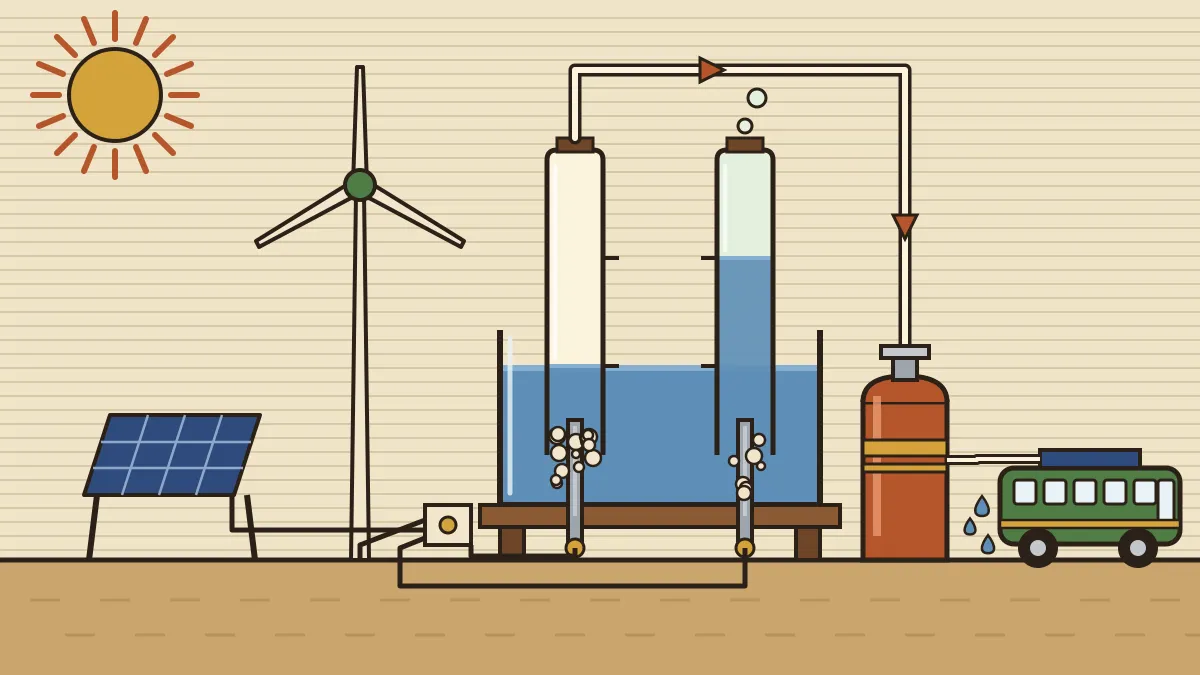
1. Electrolysis of water. A current splits water: 2H₂O → 2H₂ + O₂. Hydrogen forms at the cathode (negative electrode) and oxygen at the anode, and the gases are collected separately. Pure water conducts poorly, so an electrolyte or membrane carries the ions. Gas volumes come out 2 : 1.
How much water must be split to make 1 kg of hydrogen?
That matches the PIB's nine litres of demineralised water per kilogram. The real cost is electricity, roughly 50 kWh per kilogram, so cheap solar and wind power set the price.
2. Steam methane reforming (SMR). The industrial workhorse. Steam reacts with methane at 700–1,000 °C over a nickel catalyst: CH₄ + H₂O → CO + 3H₂. The water-gas shift then turns the carbon monoxide into more hydrogen: CO + H₂O → CO₂ + H₂. The CO + H₂ mixture is syngas. 3. Coal gasification passes steam over red-hot coke (C + H₂O → CO + H₂), a mixture called water gas.
Overall, CH₄ + 2H₂O → CO₂ + 4H₂. How much CO₂ per kilogram of hydrogen?
More than 95% of the world's hydrogen still comes from fossil fuels, and India's refineries and fertiliser plants use roughly 7 million tonnes a year, mostly from natural gas. The industry sorts it by colour.
| Label | How it is made | Carbon footprint |
|---|---|---|
| Grey | Natural gas by SMR | CO₂ released into the air |
| Brown or black | Coal or lignite gasification | Highest, roughly double grey |
| Blue | Grey hydrogen with carbon capture and storage | Much lower, but not zero |
| Green | Electrolysis powered by solar, wind or hydro | Very low |
| Pink | Electrolysis powered by nuclear energy | Low (India is also testing a nuclear-heat route at Kalpakkam) |
India's Green Hydrogen Standard (MNRE, August 2023) makes the label official: hydrogen is green only if emissions stay at or below 2 kg of CO₂ equivalent per kg of hydrogen, well-to-gate, averaged over 12 months. Our June explainer covers electrolyser catalysts.
Hydrogen as a Fuel: Energy, Fuel Cells and Storage
Per kilogram, hydrogen is the most energy-rich common fuel. Its calorific value is about 142,000 kJ/kg, which school textbooks round to 150,000, roughly three times that of petrol.
| Fuel | Calorific value (kJ/kg, approximate) |
|---|---|
| Hydrogen | 142,000–150,000 |
| LPG, CNG, methane | About 50,000–55,000 |
| Petrol, diesel | About 45,000 |
It burns to water alone and powers the cryogenic stage (liquid hydrogen and liquid oxygen) of rockets such as ISRO's GSLV Mk III. A fuel cell skips the flame altogether. Hydrogen enters at the anode and splits into H⁺ ions and electrons (H₂ → 2H⁺ + 2e⁻). The ions cross a membrane, the electrons go round an outside circuit as the current, and at the cathode they meet oxygen: O₂ + 4H⁺ + 4e⁻ → 2H₂O. The overall result is 2H₂ + O₂ → 2H₂O. A fuel cell turns roughly 40–60% of the fuel's energy into electricity, about double a petrol engine. A fuel-cell vehicle's only tailpipe emission is water, which CDS 2022-II asked.
Hydrogen wins per kilogram but loses per litre. At normal pressure a cubic metre holds only about one-third the energy of natural gas, and even liquid hydrogen holds roughly a quarter of petrol's energy per litre. That is the storage problem.
There are four ways to store it. Compressed gas in cylinders at 350–700 times atmospheric pressure. Liquid hydrogen at −253 °C, which needs heavy insulation. Solid storage: metals such as palladium soak up hundreds of times their own volume as non-stoichiometric hydrides (NDA 2019-II). Chemical carriers: ammonia and methanol are easier to ship, hence green methanol at ports such as Kandla (see our e-methanol article). Safety adds to the cost: hydrogen burns in air at 4% to 75% by volume, its tiny molecules leak through weak seals, and it can make steel brittle.
India's National Green Hydrogen Mission
| Feature | Detail |
|---|---|
| Approved | Union Cabinet, 4 January 2023; implemented by the Ministry of New and Renewable Energy (MNRE) |
| Outlay | Rs 19,744 crore, of which SIGHT (Strategic Interventions for Green Hydrogen Transition) takes Rs 17,490 crore; pilot projects Rs 1,466 crore; R&D Rs 400 crore; other components Rs 388 crore |
| 2030 target | At least 5 million tonnes a year of green hydrogen capacity (up to 10 million with exports), with about 125 GW of new renewable power |
| Promised gains | Over Rs 8 lakh crore of investment, 6 lakh jobs, Rs 1 lakh crore less fossil-fuel imports, and about 50 million tonnes less CO₂ a year |
| Support | SIGHT pays for domestic electrolyser manufacturing and for green hydrogen production; hubs at Kandla, Tuticorin and Paradip ports; plants commissioned by 31 December 2030 get 25 years of waiver on inter-state transmission charges |
By February 2026 only about 8,000 tonnes a year of green hydrogen capacity was commissioned: 8,000 ÷ 5,000,000 = 0.16% of the 2030 target. Incentives awarded so far cover 8.62 lakh tonnes a year, under a fifth of it.
The mission also builds demand, with a role for each ministry: petroleum (refineries, city gas), fertilisers (green ammonia), steel, road transport. India's first indigenous hydrogen train was inaugurated on the Jind–Sonipat section in July 2026, and a certification scheme (April 2025) lets buyers verify that hydrogen is truly green. The wider goals are energy security and net-zero by 2070.
How UPSC Has Asked It: Past Papers Solved
UPSC asks hydrogen as properties and isotopes, how it is made, and current affairs. Five questions, solved.
Consider the following statements regarding the properties of hydrogen and water: I. Tritium, the isotope of hydrogen, is radioactive and emits low energy alpha particles. II. In the gas phase, the structure of water is linear. III. The basic principle of a hydrogen economy is the transportation and storage of energy in the form of liquid or gaseous molecular hydrogen. Which of the statements given above are not correct?
(a) I and II only (b) II and III only (c) I and III only (d) II only
Answer: (a). I is wrong: tritium is a low-energy beta emitter. II is wrong: water is bent (about 104.5°), not linear. III is the NCERT definition of the hydrogen economy. Option (d) tempts if you spot only II.
Which one among the following statements for the gases mentioned below is not correct?
(a) Hydrogen has 3 isotopes (b) Helium is a commonly used gas in electric bulbs (c) Oxygen is used to burn fuel in rocket engines in spacecraft (d) Nitrogen can be used in gaseous form to replace air in food packaging
Answer: (b). Bulbs are filled with argon (often with some nitrogen) to protect the filament. Helium goes into balloons and cryogenics.
A very large volume of hydrogen can be accommodated by making
(a) non-metallic hydrides (b) hydrogen peroxide (c) non-stoichiometric hydrides (d) alkali metal hydrides
Answer: (c). Transition metals such as palladium form metallic (interstitial) hydrides with variable ratios and hold large volumes of hydrogen. Alkali metal hydrides are ionic with fixed formulae; non-metallic hydrides are molecular.
Water gas is a mixture of:
(a) CO₂ and H₂ (b) CO and H₂ (c) CO₂ and H₂O (d) CO and H₂O
Answer: (b). Steam over red-hot coke gives C + H₂O → CO + H₂. The same mixture is called syngas (NDA 2018-II asked that name). CO₂ appears only after the shift step. Hydrogen's other big exam link is ammonia: the Haber process, N₂ + 3H₂ → 2NH₃.
Recently, India's first green hydrogen-based advanced fuel cell electric vehicle (FCEV) was launched. It has no tailpipe emissions other than
(a) Hydrogen peroxide (b) Nitrogen (c) Oxygen (d) Water
Answer: (d). The cell runs 2H₂ + O₂ → 2H₂O. Hydrogen peroxide (H₂O₂) does not form.
Properties questions use "not correct" stems. Production questions repeat CO + H₂ = water gas = syngas. New government hydrogen news arrives as a one-line fact question.
Practice MCQs (with answers)
- The number of neutrons in a tritium nucleus is
- 0
- 1
- 3
- 2
- During the electrolysis of water, hydrogen is liberated at the
- cathode
- anode
- both electrodes
- electrolyte
- Heavy water is used in nuclear reactors as a
- fuel
- coolant only
- control rod
- moderator
- Hydrogen produced from natural gas by steam reforming, without carbon capture, is called
- green hydrogen
- grey hydrogen
- pink hydrogen
- turquoise hydrogen
- If 18 g of water is completely electrolysed, the mass of hydrogen obtained is
- 1 g
- 9 g
- 2 g
- 16 g
- Under India's Green Hydrogen Standard, hydrogen is called green if its emissions are at most
- 2 kg CO₂ equivalent per kg of hydrogen
- 5 kg CO₂ equivalent per kg of hydrogen
- 10 kg CO₂ equivalent per kg of hydrogen
- zero
- Which statement about heavy water is correct?
- It is radioactive
- It boils at a slightly higher temperature than ordinary water
- It contains tritium
- It is lighter than ordinary water
- In a hydrogen fuel cell, oxygen is reduced at the
- anode, forming hydrogen peroxide
- anode, forming water
- cathode, forming water
- cathode, forming hydrogen peroxide
1-d, 2-a, 3-d, 4-b, 5-c, 6-a, 7-b, 8-c. Q1: mass number 3 minus 1 proton leaves 2 neutrons. Q5: 36 g of water gives 4 g of hydrogen, so 18 g gives 2 g. Q7: D₂O boils at 101.4 °C and is stable, not radioactive. Q8: reduction always happens at the cathode, and the product is water.
Quick Revision
- Hydrogen: Z = 1, 1s¹; lightest; colourless, odourless; 14 times lighter than air; liquefies at −253 °C. Cavendish 1766; Lavoisier named it 1783. Top of Group 1 but not an alkali metal.
- Protium (0 neutrons, 99.98%), deuterium (1, 0.015%, Urey), tritium (2, radioactive beta emitter, half-life 12.3 years).
- Heavy water D₂O: not radioactive; freezes 3.82 °C, boils 101.4 °C; moderator in PHWRs (natural uranium).
- Electrolysis: cathode H₂, anode O₂, volumes 2 : 1; 9 kg water per kg H₂. SMR: CH₄ + H₂O → CO + 3H₂. CO + H₂ = water gas = syngas. Haber–Bosch: H₂ + N₂ → ammonia.
- Grey (gas), brown or black (coal), blue (with CCS), green (renewable electrolysis), pink (nuclear). India's green standard: ≤ 2 kg CO₂e per kg H₂ (Aug 2023).
- Calorific value per kg about 3 times petrol; per litre poor. Storage: compressed, liquid, metal hydrides (palladium), ammonia or methanol. Fuel cell: 2H₂ + O₂ → 2H₂O, only water emitted. Flammable range 4–75%.
- NGHM: Cabinet 4 January 2023; MNRE; Rs 19,744 crore (SIGHT Rs 17,490 crore); 5 million tonnes a year by 2030; net-zero 2070.
Frequently asked questions
What are the three isotopes of hydrogen?
The three isotopes are protium (one proton, no neutron), deuterium (one proton, one neutron) and tritium (one proton, two neutrons). Protium is about 99.98% of natural hydrogen, deuterium about 0.015%, and tritium only traces. Only tritium is radioactive.
What is heavy water and why is it used in nuclear reactors?
Heavy water is D₂O, water made with deuterium. It slows fast neutrons without absorbing many, so it works as a moderator, which lets India's pressurised heavy water reactors run on natural uranium.
What is the difference between grey, blue and green hydrogen?
Grey hydrogen is made from natural gas by steam reforming and releases carbon dioxide. Blue hydrogen is the same process with the carbon dioxide captured and stored. Green hydrogen is made by splitting water with renewable electricity. India defines it as at most 2 kg of CO₂ equivalent per kg of hydrogen.
What is the National Green Hydrogen Mission?
It is an MNRE mission approved by the Union Cabinet on 4 January 2023 with an outlay of Rs 19,744 crore. It aims for at least 5 million tonnes of green hydrogen capacity a year by 2030, and supports electrolyser manufacturing, production, pilots, hubs, standards and research.
Why is hydrogen hard to store?
Hydrogen has very high energy per kilogram but very low energy per litre, so it must be compressed to hundreds of atmospheres, liquefied at −253 °C, or held in metal hydrides or carriers like ammonia. It also leaks easily, burns over a wide range (4% to 75% in air) and can make steel brittle.
Related CDS / OTA Science topics
Science is a third of the CDS GS paper
Cavalier's CDS/OTA batches teach physics, chemistry and biology from first principles, with numericals and weekly PYQ tests.