On 13 November 2026, India Post released a commemorative stamp for Ram Bux Singh (1925–2016), a scientist from Uttar Pradesh who spent his life making cow dung burn cleanly. PIB's note on 16 November records that he inaugurated one of India's earliest successful gobar gas plants at Sitapur in 1957 and later ran, for 16 years, Asia's first Gobar Gas Research Station at Ajitmal. His work sits on a very ordinary chemistry chapter: how fuels burn. CDS and NDA draw on it nearly every year, from fire extinguishers and flame colours to biogas and calorific value. This article takes the chapter in the order a question tends to appear.
Combustion: Conditions, Ignition and Types
By Abhishek Thakur · Science faculty, The Cavalier · 15 years teaching NDA and CDS Science
Combustion is a chemical process in which a substance reacts with oxygen and gives off heat, and sometimes light as a flame or a glow. The substance that burns is combustible, and it is also called the fuel. Carbon in every form burns in oxygen to give carbon dioxide, and a hydrocarbon such as methane gives carbon dioxide and water: CH4 + 2O2 → CO2 + 2H2O + heat. The same idea explains why magnesium ribbon burns with a dazzling white light to leave white magnesium oxide (CDS 2023-I asked about exactly this reaction).
Three things are needed for a fire: fuel, oxygen (air) and heat enough to reach the fuel's ignition temperature. Remove any one and the fire goes out. The ignition temperature is the lowest temperature at which a substance catches fire. Substances with a very low ignition temperature, which catch fire easily with a flame, are called inflammable: petrol, alcohol and LPG are examples. A paper cup filled with water can be heated over a candle without burning, because the water carries away the heat, so the paper never reaches its ignition temperature.
| Type | What happens | Example |
|---|---|---|
| Rapid combustion | The material burns quickly, giving out heat and light | LPG on a kitchen stove |
| Spontaneous combustion | The material bursts into flames without any apparent cause, with no flame brought near it | Phosphorus in air; coal dust in mines; some forest fires |
| Explosion | A sudden reaction releasing heat, light, sound and a large volume of gas | A firecracker |
White phosphorus has an ignition temperature only a little above room temperature, so it is stored under water.
Complete and incomplete combustion. With plenty of air, a hydrocarbon burns completely to carbon dioxide and water. With limited air it burns incompletely and gives carbon monoxide and unburnt carbon (soot). Carbon monoxide is a poisonous gas that binds to haemoglobin, which is why it is dangerous to sleep in a closed room with a burning coal fire. Fuels such as coal and petroleum also contain nitrogen and sulphur, so their burning forms oxides of sulphur and nitrogen, which cause acid rain. Our air pollutants page covers these gases.
Putting Out a Fire: Why Not Always Water
Because a fire needs fuel, air and heat, an extinguisher works by cutting off the air, lowering the temperature of the fuel, or both. Water does the second job: it cools the burning material below its ignition temperature, and its vapour also shields the fuel from air. That is why water is the most common extinguisher, and why it is the wrong choice in two cases.
| Fire | Water? | Reason and better choice |
|---|---|---|
| Wood, paper, cloth | Yes | Cooling works; this is what the fire brigade uses |
| Oil or petrol | No | Water is heavier than oil, so it sinks below and the oil keeps burning on top, spreading the fire. Use CO2 or foam |
| Electrical equipment | No | Water conducts electricity and can shock those fighting the fire. Use CO2 |
Why CO2 is the best extinguisher for oil and electrical fires. Carbon dioxide is heavier than oxygen, so it settles over the fire like a blanket and cuts off the air. It does not harm electrical equipment. It is stored as a liquid under high pressure in cylinders, and when it is released it expands enormously and cools, so it also lowers the temperature of the fuel. Dry powders such as sodium bicarbonate or potassium bicarbonate also give off CO2 near a fire.
The soda-acid extinguisher, which UPSC asked about in CDS 2021-I and CDS 2023-I, uses a solution of sodium hydrogen carbonate (baking soda) and sulphuric acid. When the two are mixed, carbon dioxide gas builds up pressure and drives out a jet of water-based liquid. Like plain water, it suits ordinary fires, not oil or electrical ones. A blanket wrapped round a person whose clothes have caught fire also works by cutting off the air.
"Water is a good extinguisher for all fires" is a ready-made wrong option. Water fails for oil (it is denser, so it sinks) and for electrical fires (it conducts).
Inside a Flame: Three Zones
A flame appears only when a gaseous substance burns. Candle wax melts, rises through the wick and vaporises, so the vapour burns with a flame. Kerosene does the same. Charcoal does not vaporise, so it just glows red without a flame. Wood gives a flame at first because the volatile substances in it vaporise and burn.
| Zone of a candle flame | What happens there | Temperature and colour |
|---|---|---|
| Innermost (dark) zone | Unburnt wax vapour near the wick | Least hot; dark |
| Middle (luminous) zone | Partial combustion; tiny carbon particles glow | Moderately hot; yellow |
| Outermost (non-luminous) zone | Complete combustion with plenty of air | Hottest; blue |
Two simple experiments prove it. A glass slide held for a few seconds in the luminous zone picks up a black ring of unburnt carbon. A copper wire held just inside the outer zone turns red hot, showing that this part is the hottest. That is why goldsmiths blow through a pipe at the outermost zone of a flame to melt gold and silver.
The same logic explains the stove and the Bunsen burner. With the air hole open, enough oxygen enters, the fuel burns completely, and the flame is a clean, hot blue. With the air hole closed, combustion is incomplete, so the flame is yellow, smoky and sooty. Saturated hydrocarbons generally burn with a clean flame, whereas unsaturated compounds burn with a yellow flame and lots of black smoke. CDS 2022-I asked this directly. Our hydrocarbons page explains the difference between saturated and unsaturated carbon compounds.
Calorific Value: Ranking the Fuels
The calorific value of a fuel is the amount of heat energy produced on complete combustion of 1 kg of the fuel. Its unit is kilojoule per kilogram (kJ/kg). It measures how efficient a fuel is, and it decides which fuel to choose for a given job.
| Fuel | Calorific value (kJ/kg), NCERT Class 8 table |
|---|---|
| Cow dung cake | 6,000 – 8,000 |
| Wood | 17,000 – 22,000 |
| Coal | 25,000 – 33,000 |
| Biogas | 35,000 – 40,000 |
| Petrol, kerosene, diesel | About 45,000 |
| Methane, CNG | About 50,000 |
| LPG | About 55,000 |
| Hydrogen | About 1,50,000, the highest of all |
Do not memorise every number. Learn the ladder: dung cake and wood at the bottom, coal above them, liquid fuels next, gaseous fuels above these, and hydrogen far at the top. Hydrogen's value is about three times that of petrol.
In an experiment, 4.5 kg of a fuel was completely burnt and the heat produced was 1,80,000 kJ. Find its calorific value.
A boiler needs 3,00,000 kJ. How much coal (30,000 kJ/kg) and how much hydrogen (1,50,000 kJ/kg) are needed?
A good fuel is cheap and readily available, burns easily in air at a moderate rate, gives a large amount of heat (a high calorific value), is easy to transport and leaves no undesirable residue or polluting gases. No fuel meets every requirement, so we choose the best fit for each use. Burning carbon fuels also adds carbon dioxide (linked to global warming) and, from sulphur and nitrogen in the fuel, the gases that make acid rain.
| CNG | LPG | |
|---|---|---|
| Main component | Methane | A mixture of propane and butane |
| How it is stored | Compressed gas at very high pressure | Liquefied under moderate pressure in cylinders |
| On a leak | Lighter than air, so it disperses upward | Heavier than air, so it settles at floor level |
| Typical use | Vehicles, piped gas | Domestic cooking |
LPG has no smell of its own, so a strong-smelling chemical (ethyl mercaptan) is added to make leaks detectable. CNG is a cleaner fuel than petrol or diesel because it produces much smaller amounts of harmful products, which is why many Indian cities run buses and autos on it.
Biogas and Hydrogen: The Fuels of the Future
Biogas is what Ram Bux Singh spent a lifetime perfecting. Animal dung, crop residue, kitchen and vegetable waste or sewage is fed into a closed, air-tight tank, the digester. Bacteria break the material down in the absence of oxygen, a process called anaerobic digestion that goes through stages, ending with methane-producing bacteria (the methanogens). The gas collects in the dome or gas holder at the top and is piped to the kitchen.
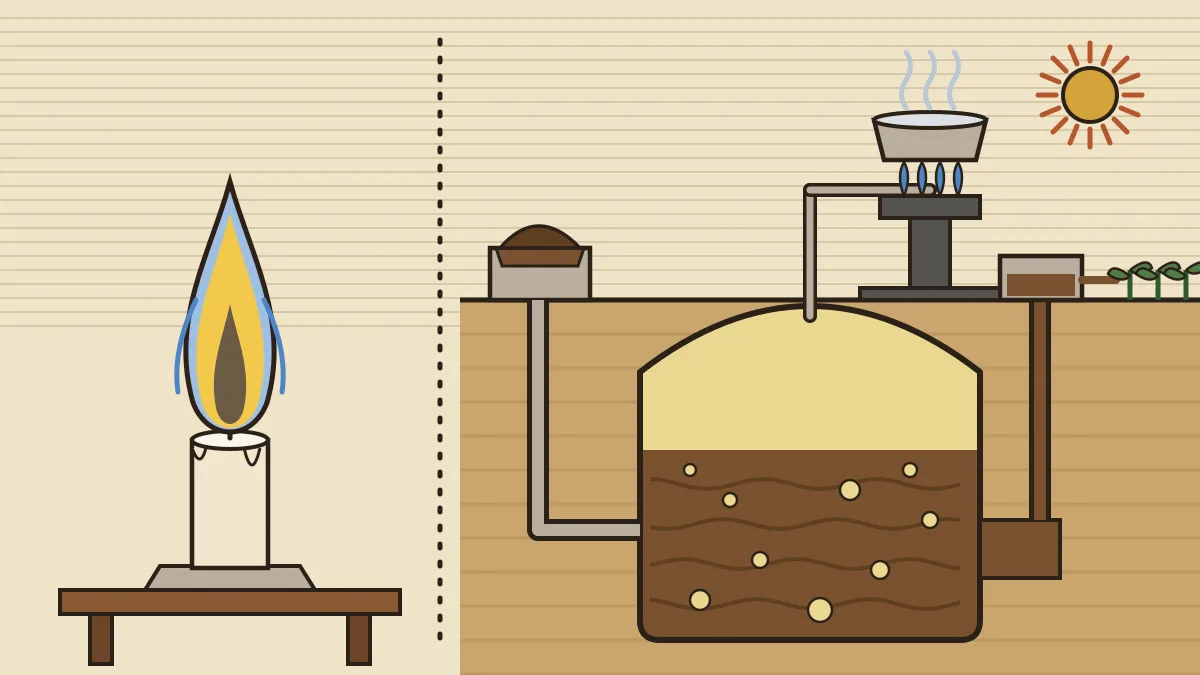
- Composition. Biogas is mostly methane, roughly 50 to 75 per cent, with carbon dioxide making up most of the rest and small traces of hydrogen sulphide and hydrogen. This is the line behind NDA 2019-II and NDA 2020-I.
- Burning. It burns with a clean blue flame, without smoke, and leaves no residue.
- The slurry. What is left in the digester is not waste. The slurry is an excellent manure, rich in nitrogen and phosphorus, and it is taken from the outlet and spread on the field. So the plant gives a fuel and a fertiliser together, and it reduces soil and water pollution from open dung heaps.
- Renewable. The raw material is replaced all the time, so biogas is a renewable energy source, unlike coal and petroleum.
- Weakness. It is hard to store in large quantities, so a statement that biogas has a "very high storage capacity" is false (NDA 2020-I).
Two common designs are the floating-drum plant and the fixed-dome plant. India now also produces compressed biogas, purified and bottled like CNG. Our explainer on GOBARdhan and the compressed biogas push covers the scheme, and the microbes in human welfare page covers the biology of the bacteria.
Hydrogen is the top of the calorific ladder, and burning it gives only water. That is why it is called a clean fuel, and it explains the world's interest in fuel cells. Its weaknesses are practical: it is very light and hard to store, and most of it today is made from natural gas, which releases carbon dioxide. Green hydrogen, made by splitting water with renewable electricity, avoids that. India's National Green Hydrogen Mission was approved in January 2023 with a target of 5 million tonnes a year by 2030. Our hydrogen page covers its isotopes and uses.
How UPSC Has Asked It: Past Papers Solved
UPSC asks this chapter as short factual statements. Here are five real questions.
While burning hydrocarbon fuels, if we see a yellow flame with lots of black smoke, it means that the fuel is:
(a) made of saturated hydrocarbons. (b) made of unsaturated hydrocarbons. (c) burning completely. (d) wet.
Answer: (b). Saturated hydrocarbons give a clean flame, and unsaturated ones give a yellow, sooty flame. A clean blue flame, not a smoky one, means complete combustion.
Which one of the following statements about biogas is not correct?
(a) It is mainly composed of methane gas. (b) It is a non-renewable source of energy. (c) It is formed by the decomposition of cow dung in the absence of oxygen. (d) It burns without smoke and leaves no residue.
Answer: (b). Biogas is renewable, because the dung and waste that feed the plant are produced again and again. The other three statements are correct.
Which one of the following is used in soda-acid fire extinguishers?
(a) Sodium chloride (b) Sodium hydrogen carbonate (c) Calcium hydroxide (d) Acetic acid
Answer: (b). Sodium hydrogen carbonate reacts with an acid (sulphuric acid in the extinguisher) to give carbon dioxide, which drives out the liquid.
Which one of the following statements is NOT correct?
(a) Biomass is a renewable source of energy (b) Gobar gas is produced when cow-dung, crop residues, vegetable waste and sewage are allowed to decompose in the absence of oxygen (c) Biogas generation reduces soil and water pollution (d) Storage capacity of biogas is very high
Answer: (d). Biogas is a gas that is difficult to store in large quantities. The other three statements are correct.
Which one of the following is the major constituent of biogas?
(a) Carbon dioxide (b) Nitrous oxide (c) Methane (d) Oxygen
Answer: (c). Biogas is mostly methane. Carbon dioxide is the second-largest component, which is the tempting wrong option.
The questions test one idea at a time: flame colour means how complete the combustion is; biogas means methane, anaerobic, renewable, hard to store; extinguishers mean cut the air or cool the fuel. Read the question for "not" and "except".
Practice MCQs (with answers)
- Water is NOT suitable for extinguishing a fire of
- wood
- paper
- petrol floating on the surface
- dry grass
- The lowest temperature at which a substance catches fire is called its
- ignition temperature
- boiling point
- melting point
- critical temperature
- The hottest part of a candle flame is the
- dark inner zone
- yellow luminous zone
- wick
- outermost non-luminous zone
- A Bunsen burner gives a clean blue flame when its air hole is
- closed
- open
- filled with water
- covered with a cloth
- The calorific value of a fuel is expressed in
- kilojoule per kilogram
- joule per second
- kilowatt hour
- degree Celsius per kilogram
- Which of these fuels has the highest calorific value per kilogram?
- LPG
- CNG
- Petrol
- Hydrogen
- The main constituent of CNG is
- propane
- methane
- butane
- ethylene
- The slurry left after the production of biogas is
- a toxic waste with no use
- pure methane
- a manure rich in plant nutrients
- a fuel of higher calorific value than the gas
1-c, 2-a, 3-d, 4-b, 5-a, 6-d, 7-b, 8-c. Q1: petrol is lighter than water, so water sinks below it and the fire spreads. Q3: the outermost zone has complete combustion and is hottest, while the inner zone holds unburnt vapour and is coolest. Q4: an open air hole supplies oxygen for complete combustion; a closed hole gives a smoky yellow flame. Q6: hydrogen is about 1,50,000 kJ/kg against about 45,000 for petrol.
Quick Revision
- Combustion = a substance reacts with oxygen and gives heat. Needs fuel, oxygen, heat to ignition temperature. Ignition temperature = lowest temperature at which a substance catches fire; inflammable substances have very low values.
- Types: rapid (LPG), spontaneous (phosphorus, coal dust), explosion (firecracker). Incomplete combustion gives carbon monoxide and soot.
- Water cools the fuel below ignition temperature but fails on oil (denser, sinks) and electrical fires (conducts). CO2 is best: heavier than oxygen, forms a blanket, cools as it expands. Soda-acid: sodium hydrogen carbonate with sulphuric acid.
- Flame zones: innermost dark (unburnt vapour, least hot), middle luminous (partial combustion, yellow), outermost non-luminous (complete combustion, hottest, blue). Goldsmiths use the outer zone.
- Open air hole: blue, clean flame. Closed air hole, or unsaturated compounds: yellow, sooty flame.
- Calorific value = heat from complete combustion of 1 kg; unit kJ/kg. Ladder: dung cake, wood, coal, liquid fuels (about 45,000), methane and CNG (about 50,000), LPG, hydrogen (about 1,50,000). Biogas about 35,000–40,000.
- CNG = methane; LPG = propane and butane. Biogas: methane about 50–75%, anaerobic digestion, renewable, slurry is manure, hard to store.
Frequently asked questions
What is the difference between rapid, spontaneous and explosive combustion?
In rapid combustion a material burns quickly with heat and light, as LPG does on a stove. In spontaneous combustion a material bursts into flames without any apparent cause, as white phosphorus does in air. An explosion is a sudden reaction that releases heat, light, sound and a large volume of gas, like a firecracker.
Why can't water be used on oil or electrical fires?
Water is heavier than oil, so it sinks below the burning oil, which continues to burn on top and may spread. Water also conducts electricity, so it can give a shock to people fighting an electrical fire. Carbon dioxide extinguishers are used for both cases.
What is calorific value and what is its unit?
Calorific value is the heat energy produced by the complete combustion of 1 kg of a fuel. Its unit is kilojoule per kilogram (kJ/kg). Hydrogen has the highest value among common fuels, at about 1,50,000 kJ/kg in the NCERT Class 8 table, while wood and cow dung cake are at the lower end.
What is biogas and what is it made of?
Biogas is a fuel gas produced when bacteria break down dung, crop residue or other organic waste in a closed tank without oxygen. It is mostly methane, roughly 50 to 75 per cent, with carbon dioxide and traces of other gases. It burns cleanly, and the slurry left behind is used as manure.
How is CNG different from LPG?
CNG is mostly methane and is stored as a compressed gas, mainly for vehicles and piped supply. LPG is a mixture of propane and butane that is liquefied in cylinders for cooking. CNG is lighter than air and disperses on a leak, while LPG is heavier and settles near the floor.
Related CDS / OTA Science topics
Science is a third of the CDS GS paper
Cavalier's CDS/OTA batches teach physics, chemistry and biology from first principles, with numericals and weekly PYQ tests.