On 17 November 2026, Union Agriculture Minister Shivraj Singh Chouhan released the third advance estimates for horticulture. They put production at a record 386.9 million tonnes (3,869.15 lakh tonnes) in 2025-26, up 4.36% on the 2024-25 final estimate and about 38% above the 280.7 million tonnes of 2013-14. The Economic Survey 2025-26 had already made the bigger point: in 2024-25 India's horticulture output of about 362 million tonnes overtook foodgrain output, and horticulture now supplies roughly a third of the value added by agriculture. The shift from wheat and rice towards fruit, vegetables and spices is a favourite UPSC theme. It sits where economy meets geography: the questions ask which crop, which state, which board and which scheme.
What Counts as Horticulture, and the Numbers
By Hitendra Deswal · Economics faculty, The Cavalier
Horticulture is the garden-style cultivation of high-value crops that are mostly perishable, grown on small areas and often on perennial plants. Government schemes group it into fruits, vegetables, root and tuber crops, mushrooms, spices, flowers, aromatic and medicinal plants, and the plantation crops coconut, cashew and cocoa. Wheat, rice, pulses and oilseeds are not horticulture. The decade of fast horticultural growth in the 1990s is often called the Golden Revolution, a term we sort out with the other "colour revolutions" in our article on Operation Flood and India's agricultural revolutions.
| Measure | Figure |
|---|---|
| Horticulture output, 2013-14 | 280.70 million tonnes |
| Horticulture output, 2024-25 (second advance estimates) | 367.72 million tonnes: fruits 114.51, vegetables 219.67, other horticultural crops 33.54 |
| Horticulture output, 2025-26 (third advance estimates, PIB, 17 Nov 2026) | 386.9 million tonnes, or 3,869.15 lakh tonnes (record); up 4.36% on the 2024-25 final estimate of 370.74 million tonnes (3,707.38 lakh tonnes) |
| Share of agricultural value added | About 33% |
| Average yield | 12.10 tonnes per hectare (2019-20) to 12.56 (2024-25) |
| World standing | Second to China in both fruits and vegetables; about 12-13% of world output in each, and in potatoes. Largest producer of dry onion (nearly 25% of the world's output) |
What share of the 2024-25 second-advance total of 367.72 million tonnes do fruits and vegetables make up?
Vegetables are the bulk of the basket by weight. India is also the world's largest producer of mango, banana and papaya among fruits and of ginger and okra among vegetables and spices. The Economic Survey names bananas in Maharashtra and Tamil Nadu as a success story, and the hill and north-eastern states as growing centres of diversification. For the wider farm picture, including the foodgrain side, see our overview of the agriculture economy.
Which Crop Grows Where
India sits across the tropics and has a Himalayan wall, so it grows both tropical and temperate fruit. Altitude and climate decide the crop, and the illustration below stacks them on one slope.
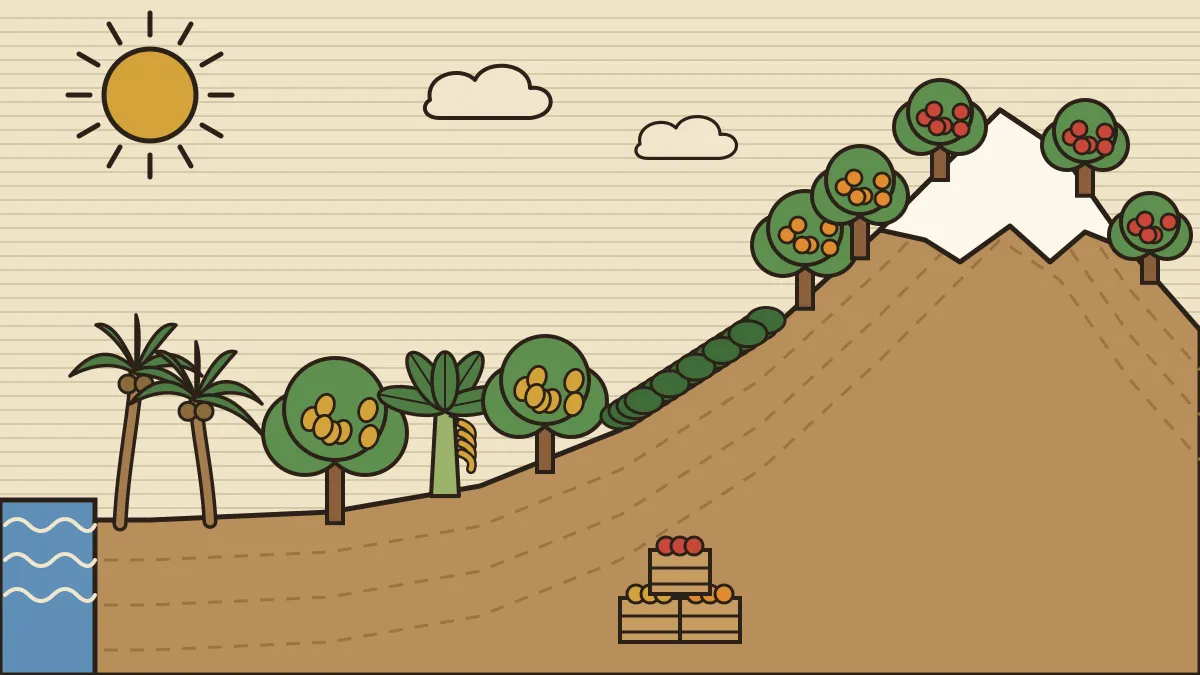
| Crop | Where it is famous |
|---|---|
| Mango | Maharashtra, Andhra Pradesh, Telangana, Uttar Pradesh, West Bengal |
| Banana | Kerala, Mizoram, Maharashtra, Tamil Nadu |
| Orange and mandarin | Nagpur (Maharashtra) and Cherrapunjee (Meghalaya) |
| Grapes | Andhra Pradesh, Telangana, Maharashtra |
| Litchi and guava | Uttar Pradesh and Bihar |
| Pineapple | Meghalaya |
| Apple, pear, apricot, walnut | Jammu and Kashmir, Himachal Pradesh |
| Saffron | Pampore, Kashmir |
A geographical indication tag links such crops to a place. The Rewa Sundarja mango's first export is explained in our article on GI tags, and the agency that handles fresh-produce exports is covered in the piece on APEDA and India's agricultural exports. Darjeeling tea was India's first product to receive a GI tag, in the early 2000s.
Citrus fruit does best in a Mediterranean climate: mild, wet winters and warm, dry summers. UPSC asked this in CDS 2019-II. Equatorial heat and constant rain suit rubber and oil palm, not oranges.
Plantation Crops and the Boards That Run Them
Plantation agriculture is a single-crop system on a large estate, with heavy capital, scientific management, a processing unit nearby and produce meant for the market. The British set up the first tea gardens in India and Sri Lanka, rubber estates in Malaysia and sugarcane estates in the West Indies. Plantations do not involve rearing animals for sale. That is ranching or dairying, and it is the sort of wrong statement UPSC slips into the options.
| Crop | Main states | Statutory body |
|---|---|---|
| Tea | Assam (the largest), West Bengal (Darjeeling and Dooars), Tamil Nadu (Nilgiris), Kerala | Tea Board, Kolkata (Tea Act, 1953) |
| Coffee | Karnataka (Kodagu, Chikmagalur), Kerala, Tamil Nadu | Coffee Board, Bengaluru (Coffee Act, 1942) |
| Rubber | Kerala (the bulk), then Tamil Nadu and Tripura | Rubber Board, Kottayam (Rubber Act, 1947) |
| Spices | Kerala (pepper, cardamom), Karnataka, Andhra Pradesh, Gujarat and Rajasthan (seed spices) | Spices Board, Kochi (Act of 1986) |
| Coconut | Kerala, Karnataka, Tamil Nadu, Andhra Pradesh | Coconut Development Board, Kochi (1981) |
Coffee comes in three species names the exam likes: Arabica (the high-grade species, said to have reached India from Yemen and first planted on the Baba Budan Hills in Karnataka), Robusta and Liberica. Tea thrives on well-drained hill slopes in a warm, humid climate, which is why the gardens climb the Nilgiris and the Darjeeling hills.
Tea, coffee, rubber, spices and tobacco boards sit under the Ministry of Commerce and Industry, because these are export crops. Fruits, vegetables, flowers, coconut and cashew are looked after by the Ministry of Agriculture under MIDH. The National Food Security Mission's commercial-crops component covers cotton, jute and sugarcane, not coffee.
Crop categories also confuse candidates. Ragi is a food crop (a millet), jute is a cash and fibre crop, and coconut is a plantation crop. Each is correctly matched in NDA 2021-II, below.
Ripening, Propagation and Why Fruit Goes Off
Horticulture is as much biology as economics, and the biology explains the price swings. Fruits fall into two groups.
- Climacteric fruits such as mango, banana, apple, papaya, guava and tomato keep ripening after harvest. A burst of the plant hormone ethylene triggers it. Traders pick them firm so that they survive transport, then ripen them in chambers with controlled ethylene. Our article on plant hormones explains how ethylene works.
- Non-climacteric fruits such as grapes, citrus fruit, pineapple and strawberry do not ripen further once picked, so they must be harvested ripe and sell fast.
Most horticultural plants are multiplied by vegetative propagation, so that every plant matches a good parent. Potato grows from tuber pieces carrying "eyes" (buds), ginger from rhizome pieces, onion from bulbs, sugarcane from stem cuttings with nodes, rose from cuttings, and the banana from suckers or tissue-culture plantlets. Mango and apple are grafted or budded onto a rootstock. The quality of this planting material is why the Clean Plant Programme exists. Plant-breeding methods that give hybrids and biofortified varieties are covered in our plant breeding article.
Perishability explains price volatility. The Economic Survey notes that prices of tomato, onion, potato and garlic fell by 20 to 40% in one year after a surge in the year before. Fresh produce arrives in seasonal gluts, cannot be stored for long, and reacts quickly to weather. The remedy is the cold chain: pre-cooling at the farm, a pack house, a refrigerated truck, a cold store and, for bananas and mangoes, a ripening chamber.
MIDH, NHB and the Schemes Behind the Growth
The Mission for Integrated Development of Horticulture (MIDH) is a centrally sponsored scheme that has run since 2014-15 for the holistic growth of the sector. It covers fruits, vegetables, root and tuber crops, mushrooms, spices, flowers, aromatic plants, coconut, cashew and cocoa. It bundles five schemes.
| Component | Detail |
|---|---|
| National Horticulture Mission (NHM) | Launched in 2005-06; nurseries, tissue-culture units, area expansion, post-harvest management |
| Horticulture Mission for North East and Himalayan States (HMNEH) | Began in 2001-02 for the north-east, extended to Himachal Pradesh, Jammu and Kashmir and Uttarakhand; folded into MIDH in 2014-15 |
| National Horticulture Board (NHB) | Set up in 1984; headquarters at Gurugram; builds production clusters, cold-chain and post-harvest infrastructure |
| Coconut Development Board (CDB) | Kochi |
| Central Institute of Horticulture (CIH) | Nagaland |
Centre : State = 60 : 40 in most states. For the north-eastern and Himalayan states the Centre pays 90%. The NHB, CDB, CIH and the national-level agencies are funded 100% by the Centre.
MIDH has brought an additional 15.66 lakh hectares under horticulture, according to the Economic Survey. Other levers include the Horticulture Cluster Development Programme, which plans 55 clusters (a pilot began with 12) to turn local strengths into global value chains, and Operation Greens, announced in the 2018-19 Budget to stabilise tomato, onion and potato prices and later widened to more perishables. MIDH is one of eight schemes under the umbrella Krishonnati Yojana. Government schemes for food and fertiliser are covered separately in the article on food security and the FCI.
How UPSC Has Asked It: Past Papers Solved
These are actual CDS and NDA questions since 2018. They test classification (what is a plantation crop), geography (where it grows) and the odd board or scheme.
Which of the following pairs of crop and product is/are correctly matched? 1. Food crop – Ragi. 2. Cash crop – Jute. 3. Plantation crop – Coconut.
(a) 1 only (b) 2 and 3 only (c) 1, 2 and 3 (d) 3 only
Answer: (c). Ragi is a millet eaten as food, jute is a fibre sold for cash, and coconut is a plantation crop. A candidate who doubts "coconut" is probably thinking of it as a fruit, but it is both.
Arabica, Robusta and Liberica are varieties of
(a) Coffee (b) Tea (c) Sugarcane (d) Cotton
Answer: (a). All three are coffee species or types. Tea is the tempting wrong answer because it is the other great beverage plantation crop.
Which one of the following States is not prominent for plantation agriculture?
(a) Rajasthan (b) Assam (c) Nagaland (d) Kerala
Answer: (a). Assam is the tea state and Kerala leads in rubber, spices and coconut. The hill states of the north-east, Nagaland among them, also have tea and coffee estates. Rajasthan's arid climate suits none of the estate crops.
Which one of the following statements about plantation agriculture is not correct?
(a) Plantation farm estates are scientifically managed. (b) Plantation farming requires heavy capital outlay. (c) Plantation farm lands have mainly foreign ownership and local labour. (d) Plantation farmers rear the animals for sale.
Answer: (d). Plantations are crop estates. Rearing animals for sale belongs to ranching and dairying. Statement (c) is the textbook description of the colonial plantation pattern, so it is not the odd one out.
Which one among the following is NOT included in the National Food Security Mission – Commercial Crops (NFSM-CC)?
(a) Cotton (b) Coffee (c) Jute (d) Sugar cane
Answer: (b). The commercial-crops component covers cotton, jute and sugarcane. Coffee has its own statutory board, the Coffee Board.
Which one of the following regions is an important supplier of citrus fruits?
(a) Equatorial region (b) Mediterranean region (c) Desert region (d) Subhumid region
Answer: (b). Citrus needs mild, wet winters and warm, dry summers, which is the Mediterranean climate. Desert and equatorial regions are the wrong extremes.
In which one among the following the vegetative propagation takes place through Eye Buds?
(a) Potato (b) Ginger (c) Onion (d) Sugarcane
Answer: (a). Each "eye" on a potato tuber is a bud that sprouts into a new plant. Ginger uses a rhizome, onion a bulb, and sugarcane the nodes of a stem cutting.
Three habits win these marks: classify every crop (food, cash, plantation, horticulture), pair it with one state (tea Assam, coffee Karnataka, rubber Kerala), and remember one institution (a board, or MIDH with its 60:40 and 90:10). Most options are built from swapping one of the three.
Practice MCQs (with answers)
- Which of the following is a plantation crop?
- Wheat
- Rubber
- Gram
- Mustard
- The plant hormone that triggers ripening of climacteric fruits is
- ethylene
- auxin
- cytokinin
- gibberellin
- The National Horticulture Board is headquartered at
- Kochi
- Bengaluru
- Kolkata
- Gurugram
- Under MIDH, the Centre's share of the outlay for the north-eastern and Himalayan states is
- 40%
- 60%
- 90%
- 100%
- Which of the following is NOT a climacteric fruit?
- Mango
- Banana
- Grape
- Apple
- The "Golden Revolution" is associated with
- oilseeds
- milk
- fish
- horticulture
- Banana is multiplied commercially mainly by
- suckers and tissue culture
- seeds
- grafting onto a rootstock
- leaf cuttings
- By weight, the largest group within India's horticulture production is
- fruits
- vegetables
- spices
- flowers
1-b, 2-a, 3-d, 4-c, 5-c, 6-d, 7-a, 8-b. Q3: Kochi houses the Coconut Development Board and the Spices Board, Bengaluru the Coffee Board and Kolkata the Tea Board; the NHB is at Gurugram. Q4: 90% for the north-east and Himalayan states, 60% elsewhere, 100% for central bodies such as NHB. Q5: grapes, like citrus fruit and pineapple, do not ripen after picking. Q8: in the 2024-25 estimates vegetables were about 220 of 368 million tonnes.
Quick Revision
- Horticulture: fruits, vegetables, root and tuber crops, mushrooms, spices, flowers, aromatic and medicinal plants, plus coconut, cashew and cocoa. It overtook foodgrains in 2024-25 (Economic Survey 2025-26).
- Output: 280.7 Mt (2013-14) → 367.7 Mt (2024-25, second advance; fruits 114.5, vegetables 219.7) → 386.9 Mt = 3,869.15 lakh t (2025-26, PIB, 17 Nov 2026; 2024-25 final 370.74 Mt). About 33% of agricultural value added.
- India: second to China in fruits and vegetables; largest producer of mango, banana, papaya, ginger, okra and dry onion.
- Tea: Assam. Coffee: Karnataka (Arabica, Robusta, Liberica). Rubber: Kerala. Spices Board and Coconut Development Board: Kochi. Tea, coffee, rubber and spices boards: Commerce Ministry.
- Plantation: estate, single crop, capital, science, export; no animal rearing. Ragi is food, jute is cash, coconut is plantation. NFSM-CC: cotton, jute, sugarcane.
- Climacteric (ethylene): mango, banana, apple, papaya, tomato. Non-climacteric: grape, citrus, pineapple. Citrus likes a Mediterranean climate.
- MIDH from 2014-15: NHM (2005-06), HMNEH, NHB (1984, Gurugram), CDB, CIH Nagaland. 60:40; 90:10 for NE and Himalayan states; 100% for NHB and the rest.
- Operation Greens (2018-19 Budget): TOP crops. Horticulture Cluster Development Programme: 55 clusters. Krishonnati Yojana umbrella holds MIDH.
Frequently asked questions
Which crops count as horticulture in India?
Horticulture covers fruits, vegetables, root and tuber crops, mushrooms, spices, flowers, aromatic and medicinal plants, and plantation crops such as coconut, cashew and cocoa. Foodgrains, pulses and oilseeds are not horticulture.
Has horticulture production overtaken foodgrain production in India?
Yes. The Economic Survey 2025-26 reports that horticulture production of about 362 million tonnes in 2024-25 surpassed foodgrain production. The government's third advance estimates released on 17 November 2026 put horticulture at a record 386.9 million tonnes for 2025-26.
What is the funding pattern of the Mission for Integrated Development of Horticulture?
The Centre contributes 60% of the outlay in most states, and the states 40%. For the north-eastern and Himalayan states, the Centre pays 90%. For the National Horticulture Board, the Coconut Development Board, the Central Institute of Horticulture in Nagaland and the national-level agencies, the Centre pays 100%.
What is the difference between climacteric and non-climacteric fruits?
Climacteric fruits, such as mango, banana, apple and papaya, continue to ripen after being picked because a rise in ethylene triggers ripening. Non-climacteric fruits, such as grapes, citrus fruit and pineapple, do not ripen further after harvest, so they must be picked ripe.
Which ministry looks after tea, coffee and rubber?
Tea, coffee, rubber, spices and tobacco are looked after by their statutory boards, which come under the Ministry of Commerce and Industry. Fruits, vegetables, flowers, coconut and cashew come under the Ministry of Agriculture and Farmers Welfare, mainly through MIDH.
Related CDS / OTA Economics topics
Agriculture questions are the easiest marks in CDS economy
Cavalier's CDS/OTA batches turn the Economic Survey and school-level geography into short notes, tables and weekly PYQ drills.