On 6 November 2026 the Food Ministry announced that it has doubled the rice sale target under OMSS (D), from 25 lakh tonnes (LMT) to 50 LMT for 2026-27. By 31 October, 25 LMT had already been sold through e-auctions, against 11 LMT in the same months last year. The same release made weekly rice and paddy stock disclosure compulsory for all traders and millers, and cleared five southern states to impose stock limits until 31 January 2027. Each move is a lever in a system built over sixty years, and UPSC asks about MSP, the PDS and the Food Security Act in the CDS paper almost every cycle.
What Food Security Means
By Hitendra Deswal · Economics faculty, The Cavalier
Food security means more than two square meals. It has three dimensions: availability (production within the country, imports and the previous year's stock in government granaries), accessibility (food within reach of every person) and affordability (enough money to buy safe, nutritious food). Food security exists only when all three hold.
India's memory of its absence is the Bengal famine of 1943, in which about thirty lakh people died. Amartya Sen showed that rice availability that year had not collapsed; prices had, and labourers could not afford grain. Famine, he argued, is a failure of entitlement, not only of supply. So Indian policy works at both ends: stock the grain (FCI, buffer stocks) and put it within reach (PDS, NFSA). Rationing began in the 1940s and was strengthened in the 1960s as the Green Revolution took off (see Operation Flood and the agricultural revolutions). Since then India has avoided famine, even in bad monsoon years.
FCI, MSP and Procurement: Filling the Central Pool
The Food Corporation of India (FCI) was set up in 1965 under the Food Corporations Act, 1964. It procures wheat and rice, stores them and moves them to states; this grain forms the central pool. The Agricultural Prices Commission was created the same year and renamed the Commission for Agricultural Costs and Prices (CACP) in 1985.
| Link in the chain | Who does it | What it means |
|---|---|---|
| Price recommendation | CACP | Advises the Centre on the MSP for 22 mandated crops, and the fair and remunerative price (FRP) for sugarcane |
| Price announcement | Cabinet Committee on Economic Affairs | The MSP is declared before sowing, so a farmer can plan |
| Procurement | FCI and state agencies | Buy at MSP the grain offered by farmers, mainly wheat and rice |
| Distribution | States, through fair price shops | Sold or given to entitled households at the issue price |
The MSP is a price floor (CDS 2019-II asked for exactly that: MSP for jowar is an example of a price floor). It is the price at which the government is willing to buy, not what every farmer automatically gets. If the market pays more, the farmer sells in the market. The 22 crops are 14 kharif, 6 rabi and 2 commercial (jute, copra). In practice, buying is concentrated in wheat and rice and in a few states such as Punjab, Haryana and Madhya Pradesh, while pulses, oilseeds and millets get less. See PM-AASHA and the Rabi MSP for 2027-28 for efforts to widen that base, and our agricultural economy page for cropping seasons.
Since 1997-98 the Decentralised Procurement (DCP) scheme lets willing states procure, store and distribute grain themselves. They hand any surplus to the central pool, and FCI covers any deficit. DCP lowers transport costs and brings MSP benefits to local farmers. Storage is being decentralised too: see godowns at the village through PACS.
Buffer Stocks and OMSS(D): The Price Stabiliser
A buffer stock is the reserve of foodgrains, mainly wheat and rice, that the government holds so that it can (a) feed the PDS and (b) step in when prices rise or the harvest fails. The Centre fixes minimum buffer norms for four dates a year, and the norms change with the season:
| Date | Wheat (LMT) | Rice (LMT) | Total (LMT) |
|---|---|---|---|
| 1 April | 74.6 | 135.8 | 210.4 |
| 1 July | 275.8 | 135.4 | 411.2 |
| 1 October | 205.2 | 102.5 | 307.7 |
| 1 January | 138.0 | 76.1 | 214.1 |
The norm peaks on 1 July because rabi wheat procured in April to June has just come in, and falls as stock is issued. A strategic reserve of about 30 lakh tonnes of wheat and 20 lakh tonnes of rice sits on top. Learn the logic, not the table: the norm is a floor, and stock above it is surplus.
On 1 July the central pool holds 620 LMT of wheat and rice. How much is above the buffer norm?
Excess stock is a cost as well as a comfort: storing grain has a high carrying cost (interest, storage, losses to pests and spoilage). The fix is to sell. Under the Open Market Sale Scheme (Domestic), OMSS(D), FCI sells wheat and rice from the central pool in the open market, mostly by e-auction to private traders, millers and cooperatives at a reserve price, and to states and ethanol distilleries. The extra supply cools prices, so it is a classic tool against cereal inflation (see our page on inflation).
The November 2026 announcement now reads clearly. With rice prices firming, the Centre doubled the OMSS(D) rice target to 50 LMT and sent extra Bharat Rice to NAFED, NCCF and Kendriya Bhandar for retail sale, especially in the south. Because hoarding worsens a shortage, it also required weekly stock disclosure in six categories (basmati, non-basmati premium, non-basmati, parboiled, broken rice and paddy), with action under Sections 6 and 7 of the Essential Commodities Act, 1955 for defaulters. The five southern states were cleared to impose their own stock limits.
MSP protects the producer (a floor). Issue price and OMSS(D) protect the consumer. The gap between FCI's cost and its issue price is the food subsidy.
The PDS and the National Food Security Act, 2013
The Public Distribution System (PDS) sells grain through about 5 lakh fair price shops (ration shops). It is a joint effort. The Centre buys, stores and allots the grain through FCI, and the states identify the beneficiaries, issue ration cards and run the shops. The PDS has changed form over the decades:
| Stage | Idea |
|---|---|
| Until 1992 | Universal PDS: everyone with a ration card, poor or not |
| 1992 | Revamped PDS in 1,700 remote and backward blocks |
| June 1997 | Targeted PDS (TPDS): for the first time, different prices for poor (BPL) and non-poor (APL) |
| 2000 | Antyodaya Anna Yojana (AAY), for the poorest of the poor: 25 kg a month per family at first, raised to 35 kg in 2002 |
| 2013 | National Food Security Act turns the TPDS from a scheme into a legal right |
The NFSA 2013 covers up to 75% of the rural and 50% of the urban population, about 67% of the country (the figure CDS 2020-II quoted). It has two groups of households:
| Group | Entitlement |
|---|---|
| Antyodaya (AAY) households | 35 kg per household per month |
| Priority households | 5 kg per person per month |
The original prices were ₹3 a kg for rice, ₹2 for wheat and ₹1 for coarse cereals, now overtaken by free grain. It adds more than grain. The eldest woman of the household, aged 18 or above, is the head for the ration card. Pregnant and lactating women get a free meal and a maternity benefit of at least ₹6,000, and children aged six months to 14 years get meals through anganwadis and schools. There is a grievance system and a food security allowance if grain is not supplied. See also our poverty and development page.
Centre: procures, stores, allots grain to states, fixes the central issue price. States: identify the households, issue ration cards, run fair price shops, may add items such as pulses and edible oil. This split is why "both Centre and State identify beneficiaries" is a false statement (CDS 2023-II).
Free Grain, ONORC and a Leak-Proof Ration
The Pradhan Mantri Garib Kalyan Anna Yojana (PMGKAY) began in 2020 as Covid relief: an extra 5 kg of free grain per person on top of the NFSA quota. From 1 January 2023 the NFSA grain itself was made free of cost for AAY and priority households under the PMGKAY name, and the Cabinet then extended free grain for five years from 1 January 2024, that is up to 31 December 2028, for about 81.35 crore beneficiaries. The Centre bears the whole cost, estimated at ₹11.8 lakh crore.
Two reforms plug the leaks that the old PDS was known for (diversion to the open market, poor-quality grain, fake cards):
- One Nation One Ration Card (ONORC) makes the NFSA entitlement portable. A migrant worker can collect the same quota from any fair price shop in the country, using the same card with biometric verification. It began as a pilot in four states in August 2019 and reached all 36 States and UTs by 2022, which matters for migrant workers.
- Digitisation. Aadhaar-seeded cards and electronic point-of-sale devices cut ghost beneficiaries. The newest step is CBDC-based direct benefit transfer under PMGKAY, launched in August 2026 (see our explainer).
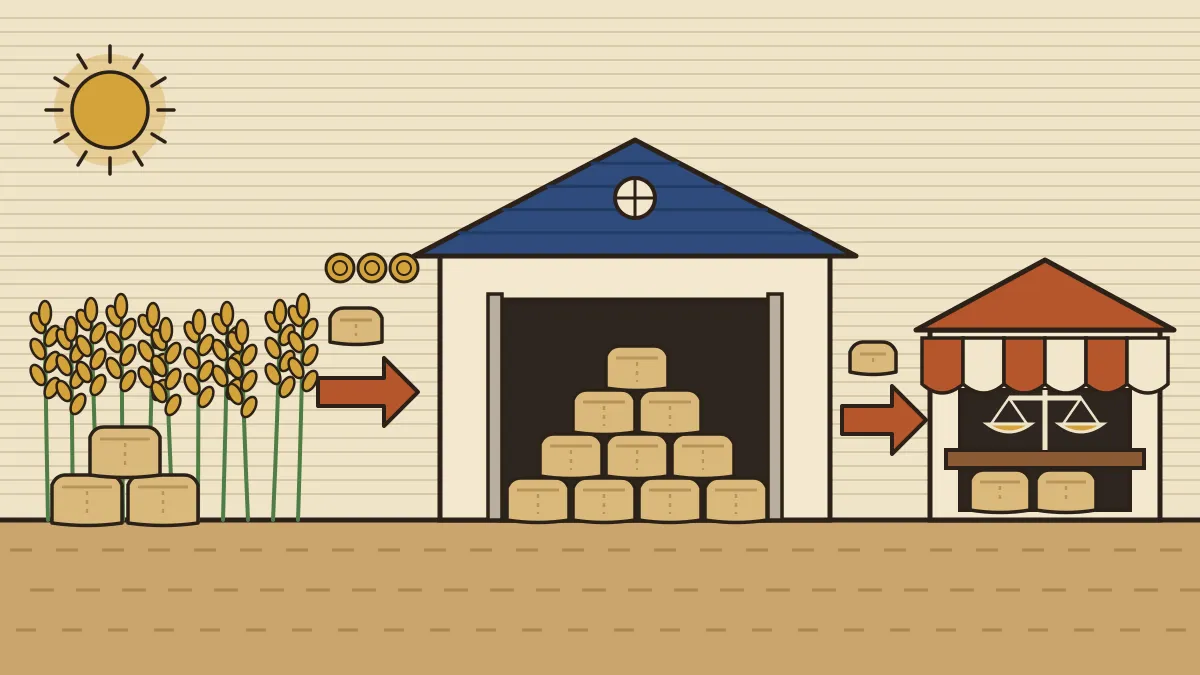
CACP advises → MSP is announced → FCI procures → buffer stock and storage → PDS (NFSA entitlements, PMGKAY free grain, ONORC portability) → and when prices rise, OMSS(D) sells the surplus.
How UPSC Has Asked It: Past Papers Solved
UPSC rarely asks for numbers here; it asks who does what, and what is a right as opposed to a scheme.
Which one of the following statements with regard to the National Food Security Act is not correct?
(a) The Act was enacted in the year 2013. (b) The Act was rolled out in the year 2014. (c) The Act legally entitles 67 percent of the population to receive highly subsidised food grains. (d) The Act is not being implemented in all the States/Union Territories.
Answer: (d). The NFSA was passed in 2013, covers about 67% of the population and applies in every State and UT. Statement (d) is false.
Consider the following statements about the Public Distribution System: 1. The Public Distribution System is operated under the joint responsibility of Centre and State/Union Territories. 2. Food Corporation of India has assumed the responsibility for procurement, storage and transportation of food grains to the State Governments. 3. Both Centre and State have the joint responsibility to identify eligible beneficiaries. 4. Some States also distribute additional items of mass consumption through the PDS outlets such as pulses, edible oil, etc.
(a) 2 and 3 only (b) 1, 2 and 4 (c) 1 and 2 only (d) 3 and 4 only
Answer: (b). Statement 3 is the trap: the Centre allots grain but the States identify the beneficiaries. The others describe the split of work correctly.
Which one of the following is an example of a price floor?
(a) Minimum Support Price (MSP) for Jowar in India (b) Subsidy given to farmers to buy fertilizers (c) Price paid by people to buy goods from ration shops (d) Maximum Retail Price (MRP) printed on the covers/packets of goods sold in India
Answer: (a). A floor is a minimum, which is the MSP. The MRP is a ceiling, and the ration price is a subsidised issue price, so (c) tempts.
Which one of the following was not a part of the strategies followed by the Government of India to increase food grain production in India immediately after Independence?
(a) Intensification of cropping over already cultivated land (b) Increasing cultivable area by bringing cultivable and fallow land under plough (c) Using high-yielding varieties (HYV) seeds (d) Switching over from cash crops to food crops
Answer: (c). The early strategy extended and intensified cultivation and shifted land from cash crops to food crops. HYV seeds came only with the Green Revolution of the mid-1960s.
Which of the following strategies is/are adopted for implementing the POSHAN Abhiyaan? 1. Inter-sectoral convergence for better service delivery 2. Use of technology (ICT) for real-time growth monitoring of women and children
(a) 1 only (b) 2 only (c) Both 1 and 2 (d) Neither 1 nor 2
Answer: (c). POSHAN Abhiyaan, the nutrition mission, uses convergence and real-time ICT monitoring.
Expect a statement question on who identifies, who procures, what is a floor. When two statements describe the Centre and the State, check which one the question gives each job.
Practice MCQs (with answers)
- The Food Corporation of India was established in
- 1950
- 1965
- 1975
- 1991
- The Minimum Support Price is recommended by the
- Reserve Bank of India
- NITI Aayog
- Commission for Agricultural Costs and Prices
- Food Corporation of India
- Under the Open Market Sale Scheme (Domestic), FCI
- buys grain from farmers at the MSP
- exports surplus rice abroad
- distributes free grain to NFSA households
- sells foodgrain from the central pool in the open market to check price rise
- Under the National Food Security Act, 2013, the head of the household for issuing the ration card is the
- eldest woman aged 18 or above
- eldest male member
- village sarpanch
- youngest adult member
- Under NFSA, an Antyodaya household is entitled to how much foodgrain per month?
- 5 kg per household
- 20 kg per household
- 25 kg per household
- 35 kg per household
- The Targeted Public Distribution System was introduced in
- June 1997
- 1965
- 2013
- 2019
- One Nation One Ration Card allows
- one uniform price of grain in all states
- ration cards to be issued by the Centre instead of the States
- a beneficiary to draw the entitlement from any fair price shop in the country
- a household to hold ration cards in two states
- Under the Decentralised Procurement scheme, grain is procured, stored and distributed by
- FCI alone
- the State Government or its agencies
- NAFED alone
- private traders
1-b, 2-c, 3-d, 4-a, 5-d, 6-a, 7-c, 8-b. Q3: (a) is procurement and (c) is PMGKAY. Q7: ONORC is about portability, not price. Q8: DCP puts the states in charge, with FCI taking the surplus.
Quick Revision
- Food security = availability, accessibility, affordability. Bengal famine 1943: an entitlement failure (Sen).
- FCI: 1965 (Food Corporations Act 1964); buys, stores, moves grain. CACP recommends MSP (22 crops + sugarcane FRP); MSP is a price floor, announced before sowing.
- DCP (1997-98): states procure, store and distribute; surplus goes to the central pool.
- Buffer norms are quarterly (1 April, 1 July, 1 October, 1 January); the 1 July norm is the highest (411.2 LMT). Strategic reserve: about 30 LT wheat, 20 LT rice.
- OMSS(D): FCI sells grain in the open market to cool prices. 6 Nov 2026: rice target doubled to 50 LMT; weekly stock disclosure; stock limits in five southern states to 31 Jan 2027; Essential Commodities Act, 1955.
- NFSA 2013: 75% rural + 50% urban (about 67%); priority households 5 kg per person; AAY 35 kg per household; eldest woman is household head; states identify beneficiaries. Original prices ₹3/₹2/₹1.
- PDS: universal → RPDS (1992) → TPDS (June 1997) → AAY (2000) → NFSA (2013).
- PMGKAY free grain to about 81.35 crore until 31 December 2028. ONORC portability in all 36 States/UTs.
Frequently asked questions
What does the Food Corporation of India do?
FCI was set up in 1965 under the Food Corporations Act, 1964. It buys wheat and rice from farmers at the minimum support price, stores the grain, moves it across the country and supplies it to states for the public distribution system. Its stock is the central pool, India's buffer stock.
What is a buffer stock and why does India keep one?
A buffer stock is the reserve of wheat and rice the government holds beyond what the PDS needs. It protects against bad harvests and lets the government sell grain to cool prices when they rise. The Centre fixes minimum norms for four dates every year, and stock above the norm is surplus.
What is OMSS(D)?
The Open Market Sale Scheme (Domestic) is the route through which FCI sells wheat and rice from the central pool in the open market, mostly by e-auction. On 6 November 2026 the Government doubled the 2026-27 rice sale target under the scheme from 25 to 50 lakh tonnes.
What does the National Food Security Act, 2013 guarantee?
It makes access to subsidised grain a legal right for up to 75 percent of the rural and 50 percent of the urban population. Priority households get 5 kg of grain per person per month and Antyodaya households get 35 kg per household. It also provides meals for pregnant women, lactating mothers and children.
Is free ration under PMGKAY available until 2028?
Yes. After the Covid-era scheme, the Cabinet extended free foodgrains for AAY and priority households for five years from 1 January 2024, which runs to 31 December 2028, covering about 81.35 crore beneficiaries. The grain is the NFSA quota, now supplied free of cost.
Related CDS / OTA Economics topics
Economy and schemes are an easy GS score
Cavalier's CDS/OTA batches turn schemes and institutions into one-page flow charts, with weekly PYQ tests.