On 13 November 2026, Union Minister of State Dr. Jitendra Singh, visiting Elettra Sincrotrone Trieste in Italy, announced that India will be a co-partner in the Elettra 2.0 programme, which includes rebuilding the India-centric research beamlines at that machine. The commitment is more than 7 million euros over five years from 2026–27, according to a PIB release of 14 November. Indian scientists have done experiments at Elettra since 1998, and India is its second-largest user after Italy. A synchrotron is a ring-shaped machine that makes extremely bright light from fast electrons. Its physics is a direct extension of a Class 12 topic, a charged particle moving in a magnetic field, and UPSC asks about both that topic and X-ray properties.
A Charged Particle in a Magnetic Field
By Abhishek Thakur · Science faculty, The Cavalier · 15 years teaching NDA and CDS Science
Every accelerator rests on two facts about a charge q moving at speed v. An electric field pushes along its own direction, so it can speed the particle up. A magnetic field exerts the force F = qvB sin θ, always at right angles to the motion. A force at right angles does no work, so a magnetic field changes a particle's direction but never its speed. That is why accelerators use electric fields to give energy and magnets to steer.
If the particle enters the field at right angles (θ = 90°), the magnetic force acts as the centripetal force, and the path is a circle. Setting qvB = mv²/r gives:
The second line is the surprise: the time for one lap does not depend on how fast the particle goes. A faster particle moves on a bigger circle, but exactly in step. Lawrence's cyclotron uses this fact. If the velocity has a component along the field, the path becomes a helix. Our page on circular motion covers the centripetal-force idea.
A proton (m = 1.67 × 10⁻²⁷ kg, q = 1.6 × 10⁻¹⁹ C) moves at 3 × 10⁷ m/s perpendicular to a 1.0 T field. Find the radius, the frequency and the energy.
If v is parallel or antiparallel to B (sin θ = 0), the force is zero and the particle goes straight on. The force is greatest when v ⊥ B. Neutral rays such as X-rays and gamma rays are not deflected by electric or magnetic fields at all.
Linac, Cyclotron, Synchrotron: Three Ways to Add Energy
To push a particle to high energy, you must keep pushing it with an electric field. The three classic machines differ in how they keep the particle in the pushing field.
| Machine | Path | How it works | Limit |
|---|---|---|---|
| Linear accelerator (linac) | Straight line | A chain of electrodes with an alternating electric field gives the particle a push at every gap | Needs great length for high energy: the Stanford linac (SLAC) is about 3 km long |
| Cyclotron (E.O. Lawrence, 1932) | Spiral between two D-shaped hollow electrodes ("dees") | A fixed magnetic field bends the particle; a fixed-frequency electric field across the gap pushes it twice per lap. The radius grows as it speeds up, but the frequency stays the same | At speeds near that of light the mass rises (relativity), the lap time lengthens and the particle falls out of step |
| Synchrotron | Fixed circle (a ring) | Ring of bending magnets; the magnetic field is raised as the particle gains momentum, and the electric field's frequency is adjusted, so the radius stays constant | Charged particles radiate energy as they bend (next section) |
Lawrence won the 1939 Nobel Prize in Physics for the cyclotron. Cyclotrons are still working machines: hospitals use them to produce short-lived isotopes such as fluorine-18 for PET scans (see our radioactivity article). In India the Variable Energy Cyclotron Centre at Kolkata runs one for nuclear research. The synchrotron idea was worked out independently by Vladimir Veksler and Edwin McMillan in the mid-1940s. It replaced the huge solid magnet of the cyclotron with a thin ring of magnets, which made much higher energies affordable.
Light From Bending Electrons: Synchrotron Radiation
Any charged particle that is accelerated gives off electromagnetic radiation, and bending counts as acceleration, since the direction of velocity changes. A slow electron radiates very little. An electron travelling at almost the speed of light (a "relativistic" electron) radiates strongly, and the light comes out as a thin beam along the tangent to the circle, like water off a spinning wheel. It was first seen in 1947 as a glow from a small synchrotron at General Electric in the USA, and was at first a nuisance that drained the beam's energy. Today it is the product.
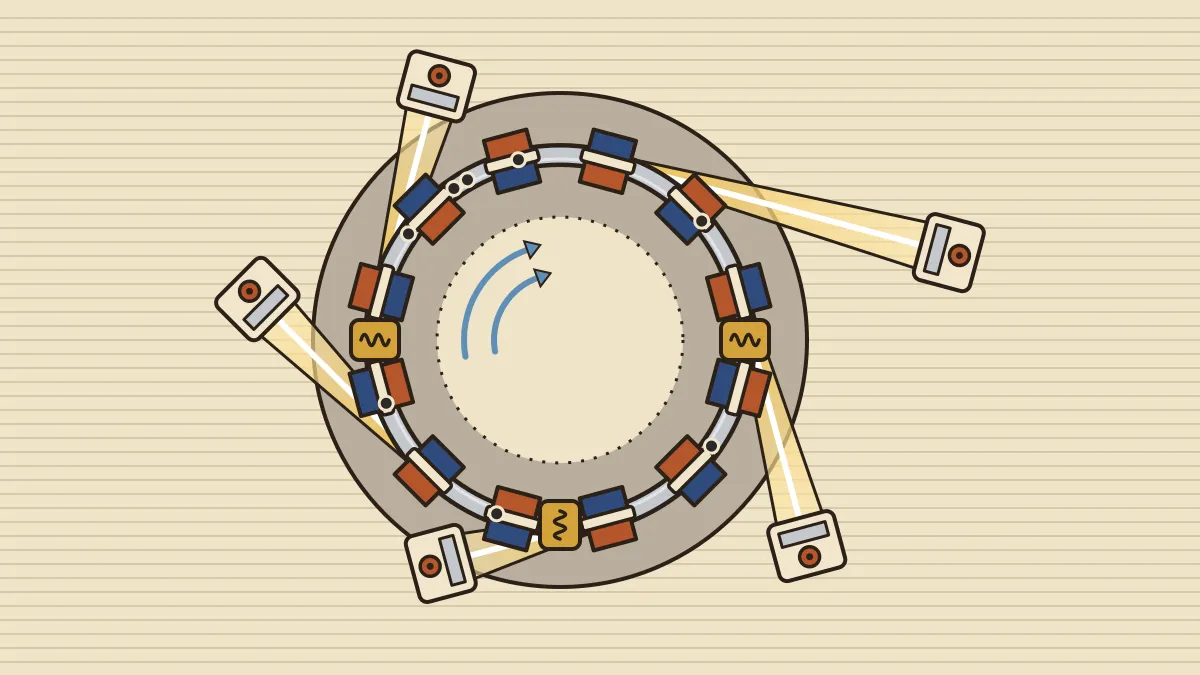
Why do electrons give out so much more than protons? For the same energy and ring radius, the energy radiated per lap is inversely proportional to the fourth power of the particle's mass. A proton is about 1,836 times heavier than an electron, so an electron radiates roughly 1013 times more. A ring of electrons is a natural light source. A ring of protons, as at the LHC, loses little.
| Property of synchrotron light | Why it helps |
|---|---|
| Spans infrared to hard X-rays | One machine serves chemists, physicists and biologists; scientists pick the wavelength they need |
| Extremely intense: millions of times brighter than a laboratory X-ray tube | Tiny samples can be studied in seconds, not days |
| Sharply collimated and polarised | A thin, clean beam can be aimed at a speck of material |
| Emitted in short pulses | Fast processes such as a chemical reaction can be followed |
A modern light source is really a storage ring. Electrons are speeded up in a linac and a booster ring, then stored in the main ring at fixed energy. They lose energy at every bend, and a radio-frequency cavity tops it up each lap. Along the straight sections, undulators make electrons zig-zag and give even brighter beams, and each beam goes down a beamline to its own experiment. For where this light sits on the spectrum, see our electromagnetic spectrum page.
What the Light Does, and India's Machines
X-rays have a wavelength of about 1 Å (10−10 m), the same as the spacing between atoms. So a crystal diffracts them, as described by Bragg's law, nλ = 2d sin θ. For example, for λ = 1 Å and a plane spacing d = 2 Å, the first-order reflection (n = 1) comes at sin θ = 1 ÷ 4 = 0.25, so θ ≈ 14.5°. By recording the pattern, scientists can work out where each atom sits. The uses follow:
- Protein crystallography. Most protein structures are solved with synchrotron X-rays. The 2009 Nobel Prize in Chemistry (Venkatraman Ramakrishnan, Thomas Steitz and Ada Yonath) for the structure of the ribosome relied on these beams.
- Materials and chemistry. Batteries, catalysts and metals are scanned while they work, and samples are squeezed under high pressure.
- Cultural heritage. X-ray fluorescence from the beam identifies pigments and inks without damaging a painting or manuscript. It was used to read the erased text of the Archimedes Palimpsest.
| Facility | Where | Key facts |
|---|---|---|
| Indus-1 | RRCAT, Indore (Department of Atomic Energy) | Electron synchrotron of 450 MeV: light mainly in the ultraviolet and soft X-ray range |
| Indus-2 | RRCAT, Indore | Electron synchrotron of 2.5 GeV: hard X-rays for diffraction and imaging experiments |
| Elettra (Sincrotrone Trieste) | Trieste, Italy | India's XRD2 and Xpress beamlines (about ₹22 crore from the Department of Science and Technology, opened on 20 October 2016); to be replaced by μXRD (protein crystallography) and Xpress-SB (high pressure) |
| PETRA III (DESY, Germany) | Hamburg, Germany | Dedicated Indian beamline, supported by DST |
India's own national facility at Indore (Indus-1 and Indus-2) runs round-the-clock for researchers from universities, IITs and national laboratories. At Elettra, Indian groups have sent more than 1,100 proposals, second only to Italy's, and about 50–60 Indian scientists travel to Trieste each year. Ring machines are one kind of mega-science. India's work on another, the FAIR accelerator in Germany, is covered in our beam-catcher article.
Bigger Rings: The LHC and the Higgs Boson
The Large Hadron Collider (LHC) at CERN, near Geneva, is a synchrotron for protons, in a tunnel about 27 km round and roughly 100 m underground. It is the largest machine ever built. It began running in 2008. Two proton beams circle in opposite directions and are made to collide at four points. Because protons radiate little, they can be taken to enormous energy: the machine was designed for 7 TeV per beam. Its bending magnets are superconducting electromagnets cooled by liquid helium to about 1.9 K (−271 °C), with a field of about 8.3 T. The same ideas of electromagnet and field appear on our induction page.
Find the bending radius for a 7 TeV proton in an 8.3 T field.
The higher the energy, the bigger the ring, unless the magnets are stronger. That is the answer to "why so large?" On 4 July 2012 the ATLAS and CMS experiments at the LHC announced the discovery of a new particle with a mass of about 125 GeV, matching the Higgs boson. It is the particle linked to the Higgs field, through which other fundamental particles acquire mass. Peter Higgs and François Englert shared the 2013 Nobel Prize in Physics.
India has long supplied magnets, electronics and software to CERN's experiments, and became an Associate Member State of CERN on 16 January 2017. Associate membership lets India take part in the CERN Council, but without a vote.
How UPSC Has Asked It: Past Papers Solved
The questions fall into three groups: the force on a moving charge, properties of X-rays, and big-science facts (the Higgs). UPSC repeats the X-ray deflection question almost every year.
A charged particle moves through a magnetic field B with a velocity v. Which one of the following statements is true for the force (F) experienced by the particle?
(a) F is maximum when v and B are parallel to each other. (b) F is maximum when v and B are anti-parallel to each other. (c) F is maximum when v and B are perpendicular to each other. (d) The force F is independent of the angle between v and B.
Answer: (c). F = qvB sin θ is largest at θ = 90°. Parallel or antiparallel motion (θ = 0° or 180°) gives zero force, so (a), (b) and (d) are wrong.
A positive charge is moving towards south in a space where magnetic field is pointing in the north direction. The moving charge will experience:
(a) a deflecting force towards north direction. (b) a deflecting force towards east direction. (c) a deflecting force towards west direction. (d) no deflecting force.
Answer: (d). The velocity (south) is antiparallel to the field (north), so sin θ = 0 and the force is zero. The tempting options (b) and (c) apply only if the motion is at an angle to the field.
An X-ray beam can be deflected by :
(a) An electric field (b) A magnetic field (c) An electric as well as a magnetic field (d) Neither an electric field nor a magnetic field
Answer: (d). X-rays are photons: no charge, so neither field deflects them. CDS 2025-II (Q27) and CDS 2020-I (Q8) asked the same idea.
X-rays can be used to: 1. Inspect welded joints between two metal parts of a machine 2. Study structure of crystals
(a) 1 only (b) 2 only (c) Both 1 and 2 (d) Neither 1 nor 2
Answer: (c). Radiography shows hidden cracks in welds, and X-ray diffraction reveals crystal structure, the basis of synchrotron crystallography.
The rest mass of Higgs boson is estimated to be close to
(a) 0.5 MeV (b) 900 MeV (c) 100 GeV (d) 1000 GeV
Answer: (c). The Higgs boson mass is about 125 GeV, closest to 100 GeV. 0.5 MeV is the electron's mass and about 900 MeV is near a proton's.
If a stem has a neutral ray (X-ray, gamma ray, light), the answer is "not deflected". If a stem gives an angle between v and B, compute sin θ first.
Practice MCQs (with answers)
- A charged particle enters a uniform magnetic field at right angles to it. Its path is
- a straight line
- a parabola
- a circle
- a widening spiral
- The frequency of revolution of a charged particle in a uniform magnetic field depends on
- its speed
- its charge, mass and the field only
- the radius of its path
- its kinetic energy
- Which machine raises the magnetic field as the particles gain momentum, to keep the orbit radius fixed?
- Linear accelerator
- Cyclotron
- Van de Graaff generator
- Synchrotron
- India's Indus-2 synchrotron is located at
- Indore
- Mumbai
- Kolkata
- Hyderabad
- Synchrotron radiation from a ring of electrons leaves
- along the magnetic field
- backwards along the beam
- along the tangent to the orbit
- equally towards the centre
- The Large Hadron Collider is operated by CERN near
- Hamburg
- Geneva
- Trieste
- Darmstadt
- The LHC accelerates protons rather than electrons mainly because
- electrons lose far more energy as synchrotron radiation
- protons are neutral
- electrons are heavier
- protons cannot be bent by magnets
- India became an Associate Member State of CERN in
- 1998
- 2004
- 2012
- 2017
1-c, 2-b, 3-d, 4-a, 5-c, 6-b, 7-a, 8-d. Q2: f = qB ÷ 2πm has no v or r in it. Q3: a cyclotron keeps B fixed; only a synchrotron ramps it. Q7: electrons are about 1,836 times lighter, and the radiated energy per lap goes as the inverse fourth power of mass, so protons lose far less.
Quick Revision
- Magnetic force F = qvB sin θ, perpendicular to motion, does no work. Circle: r = mv ÷ qB; frequency f = qB ÷ 2πm, independent of speed.
- Linac: straight; cyclotron (Lawrence, 1932; Nobel 1939): spiral, fixed B and f; synchrotron: ring, B and frequency varied; limit for cyclotron is relativistic mass increase.
- Bending a relativistic electron gives synchrotron radiation, along the tangent; first seen 1947; spans infrared to X-rays; intense, collimated, polarised, pulsed. Energy loss per lap goes as 1/mass⁴, so electrons radiate about 1013 times more than protons.
- X-ray wavelength about 1 Å; Bragg's law nλ = 2d sin θ; protein crystallography, materials, heritage science. X-rays are not deflected by electric or magnetic fields.
- India: Indus-1 (450 MeV) and Indus-2 (2.5 GeV) at RRCAT, Indore. Elettra 2.0 (Trieste): more than €7 million over five years from 2026–27; India second-largest user; XRD2 and Xpress to be replaced by μXRD and Xpress-SB.
- LHC: CERN, Geneva; about 27 km; protons; 7 TeV design; superconducting magnets at about 1.9 K and 8.3 T. Higgs boson: announced 4 July 2012, about 125 GeV; Nobel 2013 (Higgs, Englert). India: CERN Associate Member since 16 January 2017.
Frequently asked questions
What is a synchrotron?
A synchrotron is a ring-shaped particle accelerator in which magnets bend fast charged particles into a circle. When relativistic electrons are bent, they give off intense light, called synchrotron radiation, that ranges from infrared to X-rays. Scientists use this light to study the structure of proteins, materials and heritage objects.
What is the difference between a cyclotron and a synchrotron?
A cyclotron uses a fixed magnetic field and a fixed-frequency electric field, so particles spiral outward between two D-shaped electrodes. It fails near the speed of light, when relativistic mass increase throws the particles out of step. A synchrotron keeps particles on a fixed ring and raises the magnetic field as they gain momentum.
Why do electrons give off light when they go round a ring?
Any accelerated charge radiates, and a particle moving in a circle is constantly changing direction, so it is accelerating. Light electrons at nearly the speed of light radiate strongly and the beam leaves along the tangent to the ring. The energy lost is replaced by radio-frequency cavities in the ring.
What synchrotron facilities does India have?
India's national synchrotron facility is at the Raja Ramanna Centre for Advanced Technology, Indore, with Indus-1 (450 MeV) and Indus-2 (2.5 GeV). Indian researchers also use Elettra in Trieste, Italy, and a dedicated Indian beamline at PETRA III in Germany. On 13 November 2026, India committed over 7 million euros over five years to Elettra 2.0.
What did the LHC discover in 2012?
On 4 July 2012, the ATLAS and CMS experiments at CERN's Large Hadron Collider announced the discovery of a new particle with a mass of about 125 GeV, consistent with the Higgs boson. The Higgs field explains how other fundamental particles acquire mass. Peter Higgs and François Englert shared the 2013 Nobel Prize in Physics.
Related CDS / OTA Science topics
Physics is a third of the CDS GS paper
Cavalier's CDS/OTA batches teach physics from first principles, with numericals and weekly PYQ tests.