On 4 November 2026 the Union Cabinet approved a Rs 14,500 crore Viability Gap Funding scheme for 92 GWh of grid-scale energy storage: 60 GWh of hydro pumped storage, 30 GWh of battery storage and 2 GWh of other technologies (PIB). In a pumped-storage plant, falling water turns a turbine, and the turbine turns a generator. Coal, nuclear and hydro stations all work the same way: they move a magnet past a coil. That is electromagnetic induction, found by Faraday in 1831. Add the transformer, which steps voltage up for the long journey and down again for your home, and you have the machinery behind the grid. CDS and NDA ask about it every year, mostly as rule-of-hand questions and one-line concepts, sometimes a numerical.
From Oersted to Faraday and Lenz
By Abhishek Thakur · Science faculty, The Cavalier · 15 years teaching NDA and CDS Science
For a long time electricity and magnetism were thought to be unrelated. In 1820 Hans Christian Oersted of Denmark noticed that a current-carrying wire deflects a compass needle: a current produces a magnetic field. Our page on magnetic effects of current and magnetism covers that half. The reverse question was: can magnetism produce a current? Michael Faraday in England (1831) and Joseph Henry in the USA showed that it can, but only when the field changes.
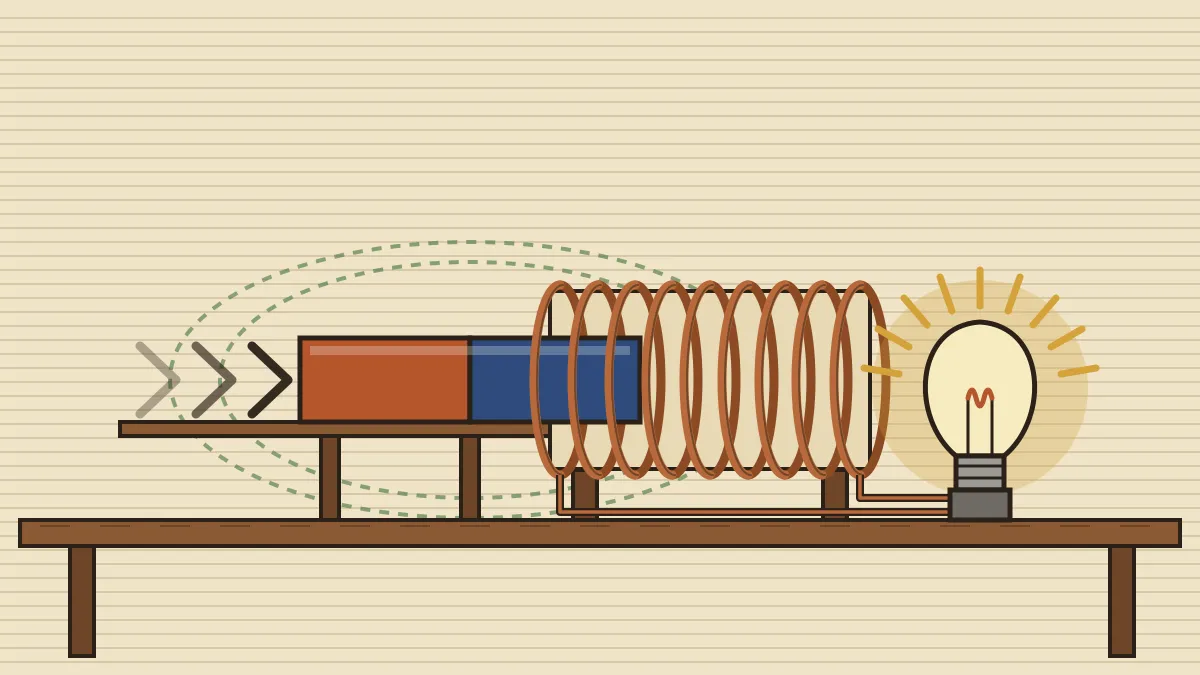
Faraday's experiments reduce to three observations. A magnet pushed into a coil makes a galvanometer needle jump; pulling it out makes it jump the other way; a magnet held still does nothing. Moving the coil instead of the magnet gives the same result, so only relative motion matters. A second coil carrying a changing current can replace the magnet.
The idea that explains them all is magnetic flux, Φ = B A cos θ, the amount of field passing through a coil's area. Its SI unit is the weber (Wb). Faraday's law says that an emf is induced in a coil whenever the flux through it changes, and its size is:
A coil of 100 turns has its flux fall from 0.02 Wb to 0.005 Wb in 0.1 s. Find the induced emf.
In 1834 the German physicist Heinrich Lenz supplied the direction. Lenz's law: the induced current flows in the direction that opposes the change that produced it. Push a north pole towards a coil and the coil's near face becomes a north pole too, repelling the magnet. The work you do against that push becomes the electrical energy, so Lenz's law is conservation of energy applied to induction, and explains the minus sign in Faraday's law.
| Rule / law | What it gives | Fingers |
|---|---|---|
| Faraday's law | The magnitude of the induced emf | None |
| Lenz's law | The direction: it opposes the change in flux | None |
| Fleming's right-hand rule | Direction of the induced current in a moving conductor (generator) | Thumb = motion, forefinger = field, middle finger = current |
| Fleming's left-hand rule | Direction of the force on a current-carrying conductor (motor) | Thumb = force, forefinger = field, middle finger = current |
| Right-hand thumb rule | Direction of the magnetic field around a straight current | Thumb = current, curled fingers = field |
A generator turns motion into current (right-hand rule, Faraday). A motor turns current into motion (left-hand rule). The word "induced" in a question is the clue to the right-hand rule.
AC and DC Generators
A generator converts mechanical energy into electrical energy. Its coil (the armature) rotates in a magnetic field, so the flux through it keeps changing. For N turns, area A, field B and angular speed ω:
The emf is zero when the coil is perpendicular to the field (flux at its maximum but momentarily not changing) and peaks when it is parallel to the field (flux changing fastest). The output reverses twice every turn, so it is alternating current.
A 200-turn coil of area 0.05 m² rotates at 50 revolutions per second in a field of 0.2 T. Find the peak and rms emf.
| Feature | AC generator | DC generator |
|---|---|---|
| Connection to outside circuit | Two slip rings with brushes | A split-ring commutator with brushes |
| Output | Alternates in direction every half turn | Direction fixed (pulsating but one-way) |
| Principle | Both work on Faraday's law of electromagnetic induction | |
The commutator reverses the connection every half turn, just as the coil's emf reverses, so the outside circuit sees current in one direction. In big power stations the coil is usually fixed and the electromagnet rotates, but the physics is the same. A turbine supplies the rotation, driven by falling water (hydro, including pumped storage), by steam from coal (thermal) or by steam from nuclear fuel. Solar cells and batteries are the exceptions: they give DC directly, with no generator.
A two-pole generator makes one cycle per rotation, so for 50 Hz it must turn 50 times a second.
India uses 50 Hz (the USA 60 Hz), so the current reverses 100 times a second, once every 1/100 s, because each cycle has two reversals. Household supply is 230 V. Our pages on circuits and power consumption and work, energy and power numericals cover the units used here.
Transformers and the Turns Ratio
A transformer changes an alternating voltage using mutual induction. Two insulated coils, the primary (Np turns) and the secondary (Ns turns), are wound on a soft-iron core. Alternating current in the primary makes an alternating flux that induces an emf in the secondary. For an ideal transformer:
In a step-up transformer Ns > Np: voltage rises and current falls, so power stays the same. It sits at the power station. A step-down transformer (Ns < Np) does the opposite, in sub-stations, phone chargers and doorbells.
A transformer has 2,000 turns in its primary and 100 in its secondary. The primary is connected to a 230 V AC supply, and the secondary delivers 2 A. Find the secondary voltage and the primary current.
Read such questions as ratios: stepping 11 kV up to a 220 kV line needs Ns/Np = 20, and the current falls twentyfold.
It does not create energy. If voltage goes up by 20, current goes down by 20 and the power is the same. A transformer also works only on AC. A steady DC makes a steady flux, and without a changing flux there is no induced emf.
Real transformers are over 95% efficient, not 100%. Efficiency = (power out ÷ power in) × 100, so 1.9 kW from 2 kW is 95%. Four losses, each with a remedy:
- Copper loss (I²R in the winding): thick wire.
- Eddy-current loss (currents in the core): a laminated core of thin insulated sheets.
- Hysteresis loss (core re-magnetised every cycle): soft iron.
- Flux leakage: coils wound over each other on a closed core.
Why Power Travels at High Voltage
A power station delivers power P = V × I, and a wire of resistance R wastes I²R as heat. Raise the voltage and the current falls; because the loss goes as the square of the current, the saving is dramatic.
1 MW is sent along a line of total resistance 10 Ω. Compare the loss at 10 kV and at 100 kV.
So the generator's output (around 11 kV) is stepped up to a few hundred kilovolts, sent to a sub-station near the city, stepped down for distribution, and brought to 230 V for the home. AC wins for this job because a transformer changes its voltage so easily. India's long lines run at 765 kV AC, and its longest links use HVDC at 800 kV, which loses less over very long distances. The five regional grids were joined into one synchronised national grid in 2013, the "One Nation One Grid" of our explainer on the national power grid and transmission. The storage scheme in the news will smooth out solar and wind power; see our grid-scale storage explainer.
Eddy Currents and the Induction Cooktop
Induction does not need a neat coil. A solid metal sheet in a changing magnetic field has circular currents induced inside it. They look like whirlpools, so they are called eddy currents (or Foucault currents). By Lenz's law they oppose the change that causes them, and in metal they are large enough to heat it.
They are a nuisance in transformer and motor cores, where they waste energy (the remedy is lamination), and useful in induction furnaces that melt metal, electromagnetic brakes on trains and induction cooktops.
An induction cooktop hides a flat coil under a glass-ceramic top. The coil carries alternating current at a high frequency (tens of kilohertz). The changing flux induces eddy currents in the base of the pan, and the pan heats itself. The glass is not heated directly. The pan must be magnetic iron or steel, since aluminium or copper pans work poorly. It is the same I²R heating we met on our page on fuses and the heating effect, only here the current flows inside the pan.
How UPSC Has Asked It: Past Papers Solved
Real CDS and NDA questions since 2021.
The rule to determine the direction of a current induced in a coil due to its rotation in a magnetic field is:
(a) Right-Hand Thumb Rule. (b) Fleming's Left-Hand Rule. (c) Fleming's Right-Hand Rule. (d) Hund's Rule.
Answer: (c). A rotating coil is a generator, so the right-hand rule applies. The left-hand rule is for motors, and Hund's rule belongs to chemistry.
According to Fleming's right-hand rule, if the forefinger indicates the direction of magnetic field and thumb shows the direction of motion of conductor, then the stretched middle finger will predict the direction of
(a) force acting on the conductor (b) electric field (c) induced current (d) current
Answer: (c). Middle finger = induced current. Plain "current" (d) is the trap: that is the left-hand rule's wording.
A DC generator works on the principle of
(a) Ohm's law (b) Joule's law of heating (c) Faraday's laws of electromagnetic induction (d) None of the above
Answer: (c). Every generator, AC or DC, relies on induction. The commutator only decides whether the output alternates.
Ms. Rani decides to convert her AC generator into a DC generator. Which one of the following she would need to use?
(a) A split-ring type commutator (b) Slip rings and brushes (c) A stronger magnetic field (d) A rectangular wire loop
Answer: (a). Slip rings (b) are what the AC machine already has. Field strength or loop shape changes only the size of the emf.
The AC mains domestic supply current in India changes direction in every
(a) 50 s (b) 1/100 s (c) 100 s (d) 1/50 s
Answer: (b). Two reversals per cycle at 50 Hz means 100 reversals a second. Option (d) is the time for a full cycle.
Consider the following statements about the microphone and the speaker of a mobile phone: 1. The microphone converts sound to a mechanical signal. 2. The microphone converts sound to an electrical signal. 3. The speaker converts a mechanical signal to sound. 4. The speaker converts an electrical signal to sound.
(a) 1 and 3 (b) 1 and 4 (c) 2 and 3 (d) 2 and 4
Answer: (d). A microphone turns sound into an electrical signal and a speaker does the reverse. A dynamic microphone's coil moves in a magnetic field: induction at work.
Most questions ask which rule, which principle, which part, not a calculation. Fix the three hand rules, slip ring against commutator, and 100 reversals a second. Numericals (turns ratio, I²R loss) appear less often but are easy marks if you have practised them.
Practice MCQs (with answers)
- The statement that an induced current always opposes the change that causes it is known as
- Ampere's law
- Coulomb's law
- Lenz's law
- Gauss's law
- Which of these cannot be stepped up by a transformer?
- A steady DC voltage
- A 50 Hz AC voltage
- A 1 kHz AC voltage
- An alternating voltage of 11 kV
- A transformer has 500 turns in its primary and 50 in its secondary. If 220 V AC is applied to the primary, the secondary voltage is
- 2,200 V
- 110 V
- 2.2 V
- 22 V
- The core of a transformer is made of thin insulated sheets mainly to reduce
- the weight of the copper
- eddy-current loss
- the resistance of the primary
- the output voltage
- In a transmission line the current is doubled while the resistance stays the same. The heat loss in the line becomes
- two times
- half
- unchanged
- four times
- To produce a 50 Hz supply, a two-pole alternator must rotate at
- 3,000 rpm
- 1,500 rpm
- 50 rpm
- 6,000 rpm
- An induction cooktop heats a steel pan mainly by
- infrared radiation from a hot plate
- a gas flame below the glass
- eddy currents induced in the pan
- electrolysis of the food
- In 1820, which scientist showed that an electric current deflects a compass needle?
- Faraday
- Oersted
- Lenz
- Henry
1-c, 2-a, 3-d, 4-b, 5-d, 6-a, 7-c, 8-b. Q2: a steady DC gives a constant flux, so no emf is induced in the secondary. Q3: 220 × 50 ÷ 500 = 22 V, a step-down. Q5: loss = I²R, so doubling I gives 2² = 4 times the loss. Q6: 50 rotations a second × 60 = 3,000 rpm for one pair of poles. Q8: Oersted found that a current makes a field in 1820, and Faraday found the reverse in 1831.
Quick Revision
- Timeline: Oersted 1820; Faraday 1831 and Henry; Lenz 1834.
- Faraday's law: ε = N × change of flux ÷ time. Flux Φ = BA cos θ, unit weber. Current flows only while flux changes. Lenz: opposes the change; conservation of energy.
- Fleming right-hand (generator): thumb motion, forefinger field, middle induced current. Left-hand (motor): thumb force. Right-hand thumb rule: field around a wire.
- Generator: peak ε = NBAω; rms = 0.707 × peak. AC = slip rings; DC = split-ring commutator. Both use induction.
- India's mains: 50 Hz (USA 60 Hz); 230 V; reverses every 1/100 s. Two-pole alternator at 3,000 rpm.
- Transformer: mutual induction, AC only. Vs/Vp = Ns/Np = Ip/Is. Step-up: Ns > Np, voltage up, current down. Losses: copper, eddy, hysteresis, flux leakage. Laminated soft-iron core.
- Transmission: loss = I²R; voltage ×10 means loss ÷100. Eddy currents: heat solid metal; furnaces, train brakes, cooktops. 4 Nov 2026: Rs 14,500 crore VGF for 92 GWh storage.
Frequently asked questions
What is electromagnetic induction?
Electromagnetic induction is the production of an emf, and a current in a closed circuit, by a changing magnetic flux. Faraday discovered it in 1831. A moving magnet, a rotating coil or a changing current in a nearby coil can all cause it.
What is the difference between Faraday's law and Lenz's law?
Faraday's law gives the size of the induced emf, which equals the rate of change of magnetic flux (multiplied by the number of turns). Lenz's law gives its direction: the induced current flows so as to oppose the change in flux that produced it. Lenz's law follows from conservation of energy.
Why can a transformer work only with alternating current?
A transformer works by mutual induction, which needs a changing flux. Alternating current gives a changing flux and so induces an emf in the secondary. A steady direct current gives a constant flux and no induced emf.
Why is electricity transmitted at high voltage?
For a given power, higher voltage means lower current. Heat lost in the wires is I squared times R, so raising the voltage ten times cuts the loss a hundred times. Transformers raise the voltage at the power station and lower it near homes.
What frequency is used for electricity in India?
India's supply has a frequency of 50 hertz, so the current changes direction 100 times a second. The domestic voltage is 230 volts. The United States uses 60 hertz.
Related CDS / OTA Science topics
Science is a third of the CDS GS paper
Cavalier's CDS/OTA batches teach physics, chemistry and biology from first principles, with numericals and weekly PYQ tests.