On 13 November 2026 the Press Information Bureau released a backgrounder on India's renewable energy journey. One number stands out. India's installed solar capacity has reached about 175 GW (as of 31 October 2026), up from just 2.8 GW in 2014. In 2025 India added more than 37 GW, making it the world's second-largest solar growth market, ahead of the 34 GW added by the United States. Under PM-Surya Ghar, 65.26 lakh households now have rooftop panels. Each panel is a slab of treated silicon with no moving part and no fuel. This article explains how that slab turns light into current, and it ties together three topics UPSC keeps returning to: semiconductors, the photoelectric family of effects, and renewable energy.
Silicon, the Band Gap and Doping
By Akanksha Kumari · Science faculty, The Cavalier · B.Tech, 15 years teaching Science
In a solid, the energy levels of billions of atoms merge into two broad bands. The valence band holds the electrons that bind the atoms together. The conduction band above it is where electrons can roam and carry current. Between them lies the band gap (Eg), a range of forbidden energies. Its size decides what kind of material you have.
| Material | The two bands | Result |
|---|---|---|
| Conductor (copper) | Bands overlap | Electrons move freely |
| Semiconductor (silicon, germanium) | Small gap: silicon 1.1 eV, germanium 0.7 eV | A little energy lifts electrons across; conductivity in between |
| Insulator (diamond, glass) | Large gap, above about 3 eV | Almost no electrons reach the conduction band |
Silicon is in group 14 of the periodic table (see our periodic table page), so each atom has four valence electrons and shares one with each of four neighbours in a diamond-like crystal. At room temperature, heat frees only a few electrons. Each one leaves behind a vacancy called a hole, which acts like a positive charge as neighbouring electrons hop into it. Pure silicon is a poor conductor. The remedy is doping: replacing a tiny fraction of the silicon atoms, a few parts per million, with an impurity atom.
| n-type | p-type | |
|---|---|---|
| Dopant | Group 15 (five valence electrons): phosphorus, arsenic, antimony | Group 13 (three valence electrons): boron, aluminium, gallium |
| What happens | Four electrons bond; the fifth stays free | Three bonds fill; a hole is left |
| Dopant is called | Donor | Acceptor |
| Majority carriers | Electrons | Holes |
| Net charge | Neutral | Neutral |
Doping adds free carriers, not net charge. Each phosphorus atom brings an extra proton along with its extra electron, so both n-type and p-type crystals are electrically neutral. The statement "a p-type semiconductor is positively charged" is false.
A semiconductor's resistance falls as it heats, opposite to a metal, because heat creates more carriers. The same doped silicon makes chips too, as in our article on the Sanand semiconductor units.
The p-n Junction: Where Light Becomes Voltage
A solar cell is a large, flat p-n junction: a very thin n-type layer on a thicker p-type wafer. At the boundary three things happen, in order.
- A built-in field forms. Electrons from the n side drift across and fill holes on the p side. This leaves positive ions on the n side and negative ions on the p side, a strip of the order of a tenth of a micrometre wide with almost no free carriers: the depletion region. Its electric field points from n to p, and the potential difference across it, the barrier potential, is about 0.7 V for silicon (0.3 V for germanium).
- Light creates pairs. A photon with energy above the band gap breaks a bond and makes one electron-hole pair.
- The field separates them. It sweeps the electron to the n side and the hole to the p side. The n side becomes the negative terminal, the p side the positive terminal. Connect a bulb across them and electrons flow round the outside circuit to the back contact, where they meet holes again.
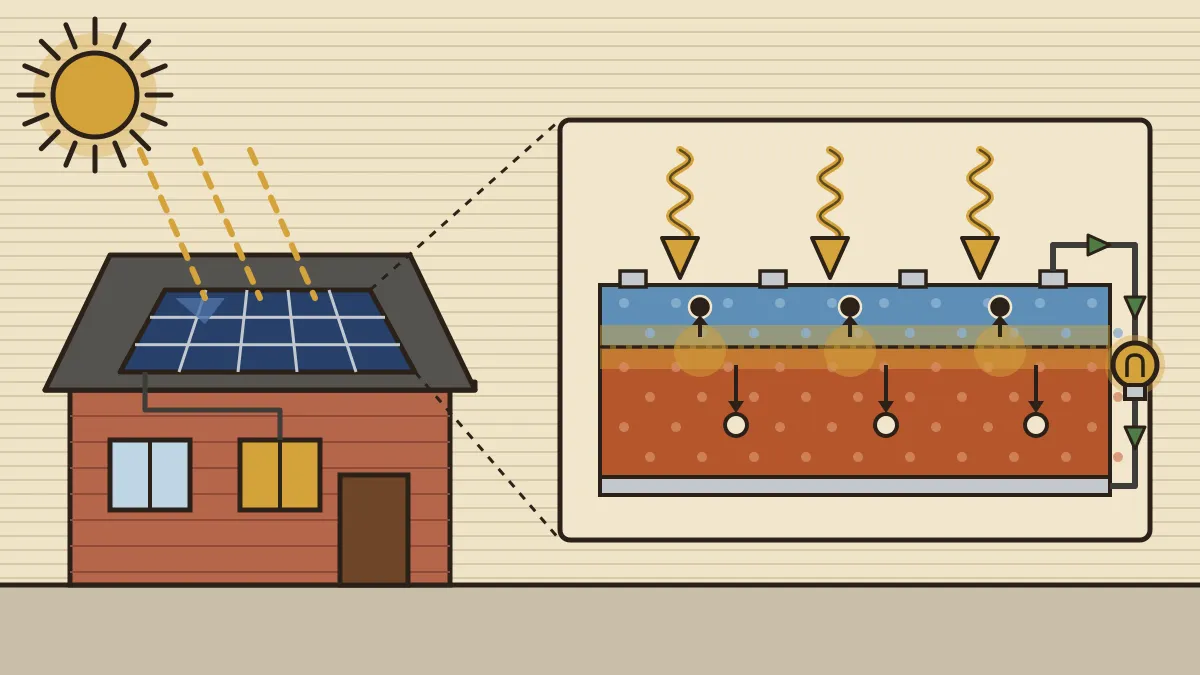
The three steps, generation, separation and collection, are the whole story. No chemical reaction occurs and nothing is used up, which is why a cell differs from the batteries on our electrochemical cells page. A battery stores chemical energy; a solar cell converts incoming light and stops the moment the light stops. The same junction is used four ways, and UPSC likes to ask which is which.
| Device | Bias | What it does |
|---|---|---|
| Solar cell | None (it is the source) | Light in, electrical energy out |
| Photodiode | Reverse | Detects light; current varies with intensity |
| LED | Forward | Electrical energy in, light out |
| Zener diode | Reverse, at breakdown | Holds a steady voltage |
A solar cell's I-V curve lies in the fourth quadrant because the cell supplies current. An ordinary diode is non-ohmic: its current is not proportional to voltage.
One Photon, One Electron: Photovoltaic versus Photoelectric
In 1905 Albert Einstein proposed that light arrives in packets, or photons, each with energy E = hν. One photon frees at most one electron, and only if its energy is large enough. He received the 1921 Nobel Prize in Physics for the law of the photoelectric effect, not for relativity. The same idea explains both effects below.
| Point | Photoelectric effect | Photovoltaic effect |
|---|---|---|
| Electrons | Leave a metal surface into the space outside | Stay inside the semiconductor |
| Energy test | Photon energy above the work function (threshold frequency) | Photon energy above the band gap |
| Needs | A clean metal, usually in a vacuum | A p-n junction to separate the charges |
| Output | Photocurrent in a vacuum tube | Voltage and current from the cell itself |
| History | Noticed by Hertz (1887), explained by Einstein (1905) | Edmond Becquerel (1839) |
Edmond Becquerel, the father of Henri Becquerel who found radioactivity (see our radioactivity page), saw a voltage when light fell on electrodes in a liquid in 1839. The first practical silicon solar cell came from Bell Laboratories in 1954, at about 6% efficiency.
Silicon's band gap is 1.1 eV. What is the longest wavelength that can create an electron-hole pair? (E in eV = 1240 ÷ λ in nm.)
A green photon (500 nm) carries 1240 ÷ 500 = 2.48 eV. Only 1.1 eV is used to lift one electron across; the other 1.38 eV, more than half, becomes heat.
How Much Sunlight Becomes Power?
The Sun delivers about 1.36 kW per square metre above the atmosphere (the solar constant). Panels are rated at 1,000 W per square metre, roughly a clear day at ground level. A cell's efficiency is electrical power out divided by light power in.
A 1.7 m² panel is 20% efficient. What does it give in full sun? A 3 kW rooftop system works at full rating for the equivalent of 5 hours a day. How many units (kWh) does it make in a 30-day month?
Why not 100%? Photons below the band gap are not absorbed, photons above it waste the excess as heat, some carriers recombine before reaching the contacts, and some light is reflected. For a single-junction cell, William Shockley and Hans Queisser showed in 1961 that no design can beat about 33%, at a band gap near 1.3 to 1.4 eV. Silicon, at 1.1 eV, tops out nearer 29%. Silicon panels on sale today deliver roughly 20-24%, which is why engineers stack two materials, each tuned to a different part of the spectrum.
A hot panel is a less efficient panel. Output falls by roughly 0.3 to 0.4% for each degree Celsius above 25 °C, because the voltage drops as the cell warms.
The cell works on the visible and near-infrared part of the spectrum; our electromagnetic spectrum page shows how photon energy rises from infrared to ultraviolet.
Cell, Module, Array and the Types of Panel
One silicon cell gives only about 0.5 to 0.6 volt under load. So cells are wired up in stages. A module has 60, 72 or more cells in series (voltages add) under glass, with bypass diodes that let current skirt a shaded cell, and it is rated in watt-peak (Wp). An array joins modules in series for higher voltage and in parallel for higher current. Shade on one cell can cut the output of a whole string, which is why the bypass diodes matter.
| Type | Made of | Notes |
|---|---|---|
| Monocrystalline silicon | One silicon crystal grown as an ingot and sliced | Dark, uniform; highest efficiency of the common types (about 20-24%); market leader |
| Polycrystalline silicon | Molten silicon cast into blocks of many small crystals | Blue, speckled; cheaper, a little less efficient; losing share |
| Thin film | Layers a few micrometres thick of cadmium telluride, CIGS or amorphous silicon | Light, can be flexible; lower efficiency; cadmium needs careful disposal |
| Perovskite and tandem | Perovskite-structure crystals, often stacked on silicon | Laboratory cells above 26% alone and above 34% on silicon; durability and lead content are open problems |
Inverter, Solar Thermal and the Grid
A cell produces direct current (DC). Homes and the grid run on alternating current (AC) at 50 Hz. The inverter converts one to the other and keeps the array at its maximum-power point. A grid-connected inverter shuts itself off in a blackout so that no power flows back to line workers. An off-grid system adds a charge controller and a battery, because panels give nothing at night.
Solar thermal is a different technology: it turns sunlight into heat, not electricity. Rooftop water heaters and solar cookers are the familiar forms, and concentrating plants use mirrors to make steam for a turbine. PV also works in diffuse light; concentrating plants need strong direct sunlight.
The PIB backgrounder puts India's total installed capacity at around 560 GW (October 2026), of which 308 GW (55%) was non-fossil as of 31 July 2026. For coal, hydro and wind beside solar, see our energy resources page.
India's Solar Push and the International Solar Alliance
| Initiative | What it does |
|---|---|
| International Solar Alliance (30 Nov 2015) | Launched by India and France at the Paris climate conference (COP21); headquarters in Gurugram; opened to all UN members in 2020 |
| PM-KUSUM (2019) | Solar pumps and small solar plants for farmers |
| PLI for high-efficiency solar modules (approved April 2021 with ₹4,500 crore; outlay raised to ₹24,000 crore in 2022) | Rewards factories for modules and their parts, to cut import dependence |
| ALMM (Approved List of Models and Manufacturers) | MNRE list: covered projects must buy modules (cells too, from June 2026) from listed makers |
| PM-Surya Ghar: Muft Bijli Yojana (Feb 2024) | ₹75,021 crore for 1 crore households; 65.26 lakh covered and 19.1 GW of rooftop solar commissioned (PIB, November 2026) |
| PM Surya Sarovar Yojana (approved 31 July 2026) | ₹5,070 crore for floating solar with storage; target 5,000 MW |
Our article on PM-Surya Ghar explains how a household gets connected, and the agrivoltaics article covers PM-KUSUM and farm-top panels. Manufacturing is the gap: India installs more panels than it makes cells for, which explains PLI and ALMM, in the same spirit as the PLI schemes in other industries. Two landmarks come up in quizzes: Modhera in Gujarat, India's first 24x7 solar-powered village, and the Gandhi Solar Park at the United Nations headquarters in New York.
How UPSC Has Asked It: Past Papers Solved
Real CDS and NDA questions. UPSC asks which device converts light into electricity, who explained the photoelectric effect, and a steady stream of solar current affairs.
In which one of the following devices, the light energy is converted into the electrical energy?
(a) Light-emitting diode (b) Laser diode (c) Solar cell (d) Transistor
Answer: (c). A solar cell turns light into electrical energy. The LED and laser diode do the reverse, which is the tempting wrong pair.
Who among the following has explained the phenomenon of photoelectric effect?
(a) Max Planck (b) Albert Einstein (c) Neils Bohr (d) Ernest Rutherford
Answer: (b). Einstein, in 1905, using photons. Planck introduced the energy quantum in 1900 for black-body radiation, which is why he tempts.
Which one of the following devices is non-ohmic?
(a) Conducting copper coil (b) Electric heating coil (c) Semiconductor diode (d) Rheostat
Answer: (c). A diode's current is almost zero in reverse and rises steeply in forward, so it is not proportional to voltage. Copper coils, heating coils and rheostats follow Ohm's law at steady temperature.
Which one of the following allotropes of carbon is isomorphous with crystalline silicon?
(a) Coke (b) Diamond (c) Graphite (d) Coal
Answer: (b). Crystalline silicon has the diamond-cubic arrangement, each atom bonded to four neighbours. Graphite's atoms lie in flat sheets.
Which one among the following villages was recently declared as India's first 24x7 solar-powered village?
(a) Mawlynnong, Meghalaya (b) Modhera, Gujarat (c) Ziro village, Arunachal Pradesh (d) Malana, Himachal Pradesh
Answer: (b). Modhera, home of the Sun Temple. Mawlynnong is known as a clean village, Ziro for its valley and festival, Malana for its isolation.
'Gandhi Solar Park' is located at
(a) New York (b) Vladivostok (c) Thimphu (d) Houston
Answer: (a). It is at the United Nations headquarters in New York, a gift from India.
Diode questions ask which way a device converts (solar cell takes light in; LED sends it out). Photoelectric questions are almost always "who": Einstein. Solar current affairs wants a number, a scheme or a place.
Practice MCQs (with answers)
- A solar cell converts
- electrical energy into light
- light into electrical energy
- heat into sound
- chemical energy into electrical energy
- An n-type semiconductor is made by doping silicon with
- boron
- aluminium
- phosphorus
- gallium
- A p-type silicon crystal is
- positively charged overall
- negatively charged overall
- rich in free neutrons
- electrically neutral
- In a working solar cell, the junction field sweeps electrons towards the
- n side, which becomes the negative terminal
- p side, which becomes the negative terminal
- p side, which becomes the positive terminal
- n side, which becomes the positive terminal
- Silicon has a band gap of about 1.1 eV. Which photon will NOT create an electron-hole pair in it?
- Infrared of 0.8 eV
- Red light of 1.8 eV
- Green light of 2.5 eV
- Violet light of 3.1 eV
- A 2 m² panel of 18% efficiency in sunlight of 1,000 W/m² gives
- 180 W
- 1,000 W
- 2,000 W
- 360 W
- The device that changes the DC output of a solar array into AC is the
- transformer
- rectifier
- inverter
- charge controller
- The International Solar Alliance was launched at the climate conference held in
- Kyoto
- Paris
- Copenhagen
- Glasgow
1-b, 2-c, 3-d, 4-a, 5-a, 6-d, 7-c, 8-b. Q3: doping adds carriers, not charge. Q4: electrons go to the n side, which becomes negative. Q5: the photon must exceed the gap, so 0.8 eV is too weak and passes through. Q6: light power is 2 × 1,000 = 2,000 W, and 18% of it is 360 W. Q7: a rectifier does the reverse, AC to DC.
Quick Revision
- PIB, 13 Nov 2026: solar about 175 GW (31 Oct 2026) from 2.8 GW in 2014; 37 GW added in 2025, making India the second-largest solar growth market (the US added 34 GW); total installed power about 560 GW, 55% non-fossil; PM-Surya Ghar 65.26 lakh households, 19.1 GW.
- Silicon: group 14, four valence electrons, band gap 1.1 eV (germanium 0.7 eV). Insulators: gap above about 3 eV.
- n-type: phosphorus or arsenic, electrons majority. p-type: boron, aluminium or gallium, holes majority. Both neutral.
- Depletion region about 0.1 micrometre; barrier potential 0.7 V for Si. Light makes a pair, the field separates it: n side negative, p side positive.
- Photon must exceed the band gap (photovoltaic) or the work function (photoelectric). Einstein 1905, Nobel 1921. Edmond Becquerel 1839. Bell Labs silicon cell 1954.
- Single-junction limit about 33%; silicon about 29%; commercial panels 20-24%. Heat lowers output.
- Cell 0.5-0.6 V; series adds voltage, parallel adds current; inverter: DC to AC. Solar cell: no bias; photodiode: reverse; LED: forward.
- ISA 30 Nov 2015, Paris, Gurugram HQ. PM-KUSUM 2019. Solar PLI approved April 2021 (₹4,500 crore, later ₹24,000 crore). Modhera: first 24x7 solar village.
Frequently asked questions
How does a solar cell produce electricity?
A solar cell is a p-n junction made of silicon. When a photon with more energy than the band gap hits it, an electron-hole pair forms. The built-in field at the junction pushes electrons to the n side and holes to the p side, giving a voltage that drives current through an outside circuit.
What is the difference between the photovoltaic and the photoelectric effect?
In the photoelectric effect, light knocks electrons out of a metal surface when its energy exceeds the work function. In the photovoltaic effect, light frees electrons inside a semiconductor when its energy exceeds the band gap, and a p-n junction separates the charges to give a voltage. Einstein explained the first in 1905.
Why can a solar panel never be 100% efficient?
Light weaker than the band gap passes through unused, and light stronger than the gap loses its extra energy as heat. Some carriers recombine and some light reflects. For a single junction the theoretical ceiling is about 33%, and commercial silicon panels deliver about 20 to 24%.
Does a solar panel work in cloudy weather or at night?
A panel works in cloudy weather because it also uses diffuse light, though its output falls with the light. At night it produces nothing, so grid systems rely on other sources or on storage in the evening.
What is the International Solar Alliance?
The International Solar Alliance is an organisation launched by India and France on 30 November 2015 at the Paris climate conference. Its headquarters are in Gurugram, Haryana. It was first meant for sun-rich countries between the tropics and was opened to all UN member states in 2020.
Related CDS / OTA Science topics
Science is a third of the CDS GS paper
Cavalier's CDS/OTA batches teach physics, chemistry and biology from first principles, with numericals and weekly PYQ tests.