On 4 November 2026 the Union Cabinet approved a Rs 14,500 crore Viability Gap Funding scheme to build 92 GWh of grid-scale energy storage between FY 2026-27 and 2030-31. The plan has three parts: 60 GWh of pumped storage, 30 GWh of battery energy storage systems (BESS) and 2 GWh of other storage technologies. Battery projects must meet a 40% domestic content requirement, so more of the cells and packs must be made in India. Behind the numbers is one Class 12 idea: a spontaneous redox reaction can push electrons through a wire. UPSC asks about it as anode and cathode, primary and secondary cells, electrolysis and fuel cells.
How a Galvanic Cell Works
Drop zinc into copper sulphate solution and the zinc dissolves while red-brown copper settles on it; electrons jump straight across and the energy is lost as heat. A galvanic (voltaic) cell separates the two halves of this reaction so that the electrons must travel through an outside wire. That moving charge is the current. The first practical version was built by John Frederic Daniell in 1836.
In the Daniell cell, a zinc plate stands in zinc sulphate solution and a copper plate stands in copper sulphate solution. A salt bridge (a gel tube of an inert salt such as potassium chloride) joins the solutions, and a wire joins the plates.
| Part | What happens | Sign in a galvanic cell |
|---|---|---|
| Anode (zinc) | Oxidation: Zn → Zn²⁺ + 2e⁻. The plate loses mass. | Negative (the electrons start here) |
| Cathode (copper) | Reduction: Cu²⁺ + 2e⁻ → Cu. The plate gains mass. | Positive (the electrons arrive here) |
| External wire | Electrons flow from anode to cathode; conventional current runs the opposite way | - |
| Salt bridge | Completes the circuit and keeps both solutions electrically neutral: anions drift towards the anode compartment, cations towards the cathode compartment | - |
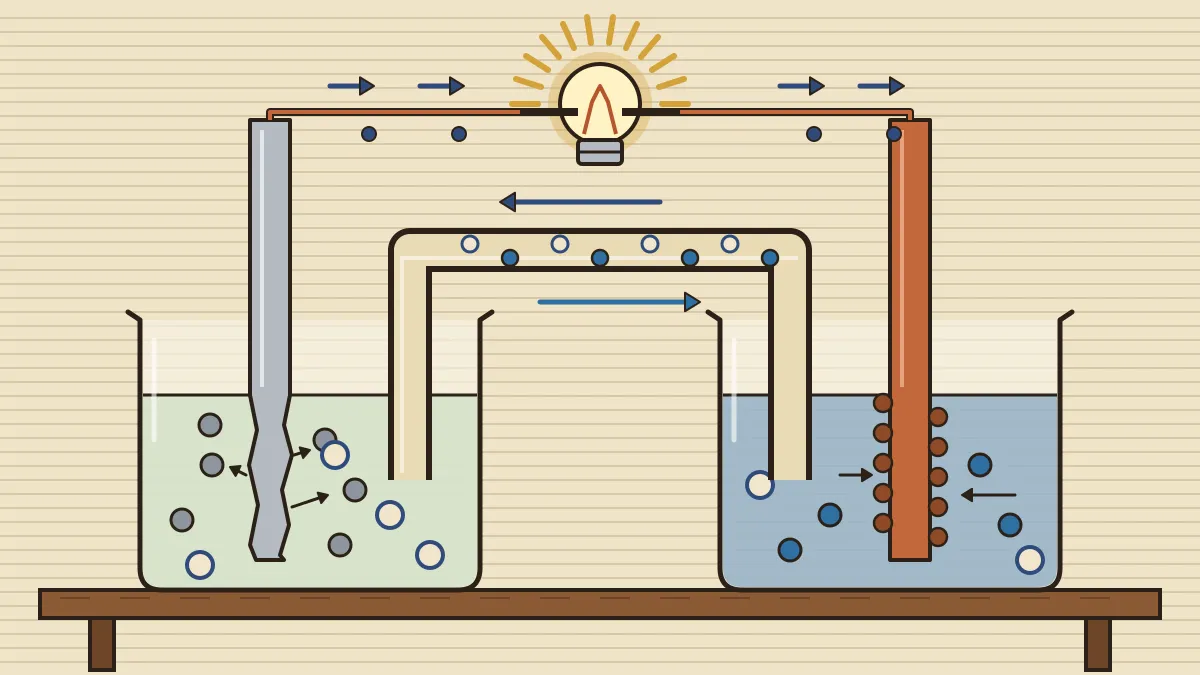
The cell potential (emf) is the difference between the two electrode potentials. It is measured in volts, which are joules per coulomb, so emf is energy per unit charge and not a force.
The standard reduction potentials are Cu²⁺/Cu = +0.34 V and Zn²⁺/Zn = −0.76 V. Find the cell emf.
Oxidation is always at the anode and reduction always at the cathode. What changes is the sign. In a galvanic cell the anode is negative. In an electrolytic cell (an outside battery forces the reaction) the anode is positive. Memory aid: AN OX, RED CAT.
Alessandro Volta built the first battery, the voltaic pile of zinc and copper discs, in 1800. A cell is one unit; a battery is strictly several cells joined together. For the circuit the battery drives, see electric circuits. The ranking of zinc above copper comes from the reactivity series.
Primary Cells: Use Once and Throw
In a primary cell the reaction cannot be reversed efficiently, so once the reactants are used up the cell is finished. A secondary cell can be recharged: forcing current backwards through it reverses the reaction and restores the reactants. This single distinction is what CDS 2026-I asked (see the past papers).
The common dry cell in torches and wall clocks is a zinc-carbon (Leclanché-type) cell. Georges Leclanché invented the wet version in 1866, and the sealed "dry" form followed in the 1880s.
- Anode: the zinc container, which slowly dissolves.
- Cathode: a graphite (carbon) rod in the centre, surrounded by manganese dioxide (MnO₂) mixed with carbon powder.
- Electrolyte: a moist paste of ammonium chloride and zinc chloride, not a free-flowing liquid, which is why it is called "dry".
- Voltage: about 1.5 V, falling steadily as it is used.
The alkaline cell uses the same zinc and MnO₂ but with potassium hydroxide as the electrolyte. It also gives 1.5 V, lasts longer and delivers current better, and its zinc container does not eat itself while the cell sits on a shelf. Watches and hearing aids use small button cells of silver oxide, zinc-air or lithium.
Rechargeable Cells: Lead-acid, Ni-Cd, Lithium-ion
Lead-acid accumulator. Invented by Gaston Planté in 1859, it is still the starter battery of most cars and the heart of home inverters. The anode is spongy lead, the cathode is a grid packed with lead dioxide (PbO₂), and the electrolyte is about 35-40% dilute sulphuric acid. Each cell gives about 2 V, so a 12 V car battery has six cells in series. While discharging, both plates turn into lead sulphate and acid is used up:
Lead-acid cells are cheap and give the surge current an engine needs, but they are heavy.
Nickel-cadmium (Ni-Cd). Developed by Waldemar Jungner in 1899, it has a cadmium anode, a nickel oxide-hydroxide cathode and potassium hydroxide electrolyte, and gives about 1.2 V. Cadmium is toxic, and the cell suffers the memory effect, losing capacity if recharged before it is fully discharged.
Lithium-ion. Lithium is the lightest metal and has a very strongly negative electrode potential, so it packs a lot of energy into little weight. In a lithium-ion cell the anode is graphite, the cathode is a lithium metal oxide (cobalt oxide, iron phosphate, or a nickel-manganese-cobalt mixture), and the electrolyte is a lithium salt in an organic solvent. During discharge, lithium ions travel from anode to cathode through the electrolyte while electrons travel through the outside circuit. Charging sends them back, which is why the design is called a "rocking-chair" battery. The nominal voltage is about 3.6-3.7 V. The 2019 Nobel Prize in Chemistry went to John Goodenough, Stanley Whittingham and Akira Yoshino for developing lithium-ion batteries.
| Cell | Voltage per cell | Energy per kg (approx.) | Key points |
|---|---|---|---|
| Lead-acid | 2.0 V | 30-50 Wh/kg | Cheap, heavy, high surge current; starter and inverter batteries |
| Ni-Cd | 1.2 V | 40-60 Wh/kg | Rugged; toxic cadmium; memory effect |
| Lithium-ion | 3.6-3.7 V (3.2 V for iron phosphate) | 150-250 Wh/kg | Light, no memory effect; needs lithium, and often cobalt and nickel |
| Sodium-ion | About 3 V | 100-160 Wh/kg | Uses abundant sodium; good for stationary storage and low-cost vehicles |
The metals in these cells explain the resource news. India's position is covered in our explainer on critical minerals, and the vehicle side in India's EV push.
Sodium-ion, Fuel Cells and Grid Storage
Sodium-ion batteries work like lithium-ion ones but shuttle sodium ions. Sodium is cheap and found everywhere in common salt, and these cells need neither lithium nor cobalt. They store less energy per kilogram, which matters little for a battery beside a solar farm, so they suit stationary storage and cheap vehicles.
A fuel cell differs from a battery in one respect: the fuel is not stored inside but fed in continuously from outside, so it keeps producing current as long as fuel arrives. In a hydrogen fuel cell, hydrogen is oxidised at the anode and oxygen is reduced at the cathode, and the only product is water. Fuel cells supplied electricity and drinking water on the Apollo moon missions. Their efficiency (roughly 40-60%) is about double that of a petrol engine. The hydrogen itself is covered in hydrogen, its isotopes and uses.
Now return to the Cabinet decision. Solar and wind produce power only when the sun shines and the wind blows, so storage must shift energy to the evening peak. India needs 411 GWh of grid storage by 2031-32, says PIB. The 92 GWh will equal 170% of today's grid-scale capacity, and the total investment is expected to be Rs 97,600 crore. Pumped storage is a mechanical "water battery" (explained here), while BESS means chemical cells, mostly lithium-ion, in containers. The factory side is in Advanced Chemistry Cell batteries.
Electrolysis: The Reaction Run Backwards
In an electrolytic cell, an outside source drives current through a molten compound or solution and forces a non-spontaneous reaction. Cations go to the cathode and are reduced, anions go to the anode and are oxidised.
Faraday's laws link charge to mass. The mass of a substance deposited is proportional to the charge passed (Q = I × t), and equal charges deposit masses in the ratio of their equivalent weights. One mole of electrons carries one faraday, F ≈ 96,500 coulombs.
A current of 2 A is passed for 965 seconds through copper sulphate solution. What mass of copper is deposited? (Cu = 63.5)
| Process | Set-up | Outcome |
|---|---|---|
| Electrolysis of water (with a little acid) | Inert electrodes | Hydrogen at the cathode, oxygen at the anode, in a 2 : 1 volume ratio. This is how green hydrogen is made. |
| Extraction of sodium | Molten sodium chloride | Sodium at the cathode, chlorine at the anode (too reactive for chemical reduction) |
| Refining of copper | Impure copper anode, pure copper cathode, acidified copper sulphate | Pure copper deposits on the cathode; impurities fall as anode mud |
| Electroplating | The object to be plated is the cathode | A thin coat of the plating metal (silver, nickel, chromium) |
Rusting is a galvanic process. Iron, water and oxygen form tiny cells in which iron is the anode and dissolves. Galvanisation coats iron with zinc. Zinc is more reactive, so even where the coat is scratched, zinc corrodes first and protects the iron. It is a sacrificial anode.
For copper refining the impure metal is the anode. For electroplating the object is the cathode. For anodising the object is the anode.
How UPSC Has Asked It: Past Papers Solved
Which one among the following statements related to electric cells is correct?
(a) A primary cell is rechargeable. (b) A secondary cell can be used only once. (c) The emf of a battery is the power provided by the battery per unit current. (d) The unit of emf is Joule.
Answer: (c). Power = emf × current, so power per unit current is emf (in volts). Options (a) and (b) have primary and secondary reversed, and (d) gives the unit of energy, whereas emf is in volts (joule per coulomb).
In electrolytic refining of copper, the electrolyte is a solution of
(a) acidified copper chloride (b) acidified copper sulphate (c) potassium chloride (d) sodium sulphate
Answer: (b). The cathode must receive copper ions from the solution, so the electrolyte is a copper salt, and the standard one is acidified copper sulphate.
Which one of the following metals is widely extracted by the electrolysis of its molten compound?
(a) Cu (b) Au (c) Sn (d) Na
Answer: (d). Sodium sits near the top of the reactivity series, so no chemical reducing agent can win it from its ore. It is obtained from molten sodium chloride. Copper and tin are reduced by carbon or refined by solution electrolysis, and gold occurs native.
Which one of the following is not true for anodizing process?
(a) It makes aluminium corrosion resistant. (b) Metals like aluminium, titanium and magnesium can be anodized. (c) Clean aluminium article is the anode and oxygen gas is evolved at the cathode. (d) It is used in aircraft industry.
Answer: (c). The article is indeed the anode, but the oxygen that builds the oxide layer forms at the anode. Hydrogen is evolved at the cathode.
Galvanization is a method of protecting iron from rusting by coating with a thin layer of
(a) Gallium (b) Aluminum (c) Zinc (d) Silver
Answer: (c). Zinc is more reactive than iron and acts as a sacrificial anode. Silver plating is costly and not called galvanisation.
Almost every question here tests which electrode does what: reduction at the cathode, oxidation at the anode, electrons from anode to cathode in the wire. Remember also: primary = non-rechargeable, sodium is won by molten electrolysis, zinc protects iron.
Practice MCQs (with answers)
- In a galvanic cell, oxidation takes place at the
- cathode
- anode
- salt bridge
- electrolyte
- Which of the following is a secondary cell?
- Zinc-carbon dry cell
- Alkaline manganese cell
- Lead-acid accumulator
- Silver oxide button cell
- When a lead-acid battery discharges, the density of its electrolyte
- falls, because sulphuric acid is used up
- rises, because lead sulphate dissolves
- stays constant
- doubles
- The 2019 Nobel Prize in Chemistry for the development of lithium-ion batteries was shared by
- Volta, Daniell and Planté
- the Curies and Becquerel
- Whittingham, Yoshino and Geim
- Goodenough, Whittingham and Yoshino
- In the electrolysis of acidified water, the volume of hydrogen collected at the cathode compared with the oxygen at the anode is
- twice
- equal
- half
- four times
- A battery that uses abundant sodium in place of lithium, and needs no cobalt, is the
- nickel-cadmium cell
- zinc-carbon cell
- Daniell cell
- sodium-ion cell
- The standard emf of the Daniell cell is about
- 0.34 V
- 1.10 V
- 1.50 V
- 2.00 V
- A 12 V car battery is made of 2 V lead-acid cells joined in series. The number of cells is
- 3
- 4
- 6
- 12
1-b, 2-c, 3-a, 4-d, 5-a, 6-d, 7-b, 8-c. Q2: dry cells and button cells are primary; only the lead-acid accumulator is recharged. Q3: H₂SO₄ is consumed and water formed, so the electrolyte thins. Q4: Geim's 2010 Nobel was in Physics, for graphene. Q5: water is H₂O, so two volumes of hydrogen come for every one of oxygen. Q7: 0.34 − (−0.76) = 1.10 V; 0.34 V is only the copper half-cell. Q8: 12 ÷ 2 = 6 cells.
Quick Revision
- Anode = oxidation, cathode = reduction in every cell. Galvanic: anode negative. Electrolytic: anode positive. Electrons go anode → cathode in the wire.
- Daniell cell (1836): Zn anode, Cu cathode, salt bridge, E° = 1.10 V. Volta's pile: 1800.
- Primary = not rechargeable (zinc-carbon dry cell 1.5 V: zinc anode, graphite cathode, NH₄Cl paste; alkaline cell: KOH). Secondary = rechargeable.
- Lead-acid (Planté, 1859): Pb / PbO₂ / dilute H₂SO₄, 2 V per cell, 12 V = 6 cells; acid density falls on discharge. Ni-Cd (Jungner, 1899): 1.2 V, memory effect, toxic cadmium.
- Lithium-ion: graphite anode, lithium metal-oxide cathode, about 3.6-3.7 V; Li⁺ moves anode → cathode on discharge. Nobel 2019: Goodenough, Whittingham, Yoshino. Sodium-ion needs no lithium.
- Fuel cell: fuel fed from outside; H₂ at anode, O₂ at cathode, product water.
- Electrolysis: F ≈ 96,500 C; water gives H₂ : O₂ = 2 : 1; sodium and aluminium are won by electrolysis; copper refining uses acidified CuSO₄; galvanisation = zinc coat (sacrificial anode).
- 4 November 2026: Rs 14,500 crore VGF for 92 GWh grid storage = 60 GWh pumped storage + 30 GWh BESS + 2 GWh others; 40% domestic content for BESS; target 411 GWh by 2031-32.
Frequently asked questions
What is the difference between a galvanic cell and an electrolytic cell?
A galvanic cell produces electricity from a spontaneous chemical reaction, and its anode is negative. An electrolytic cell uses electricity from an outside source to force a reaction that would not happen by itself, and its anode is positive. In both, oxidation is at the anode.
What is the difference between a primary cell and a secondary cell?
A primary cell, such as the zinc-carbon dry cell, cannot be recharged because its reaction is not efficiently reversible. A secondary cell, such as a lead-acid or lithium-ion battery, can be recharged by passing current backwards through it, which restores the original chemicals.
How does a lithium-ion battery work?
During discharge, lithium ions move from the graphite anode to the metal-oxide cathode through the electrolyte, while electrons flow through the outside circuit and power the device. Charging pushes them back.
What did the Union Cabinet approve for energy storage on 4 November 2026?
The Cabinet approved a Rs 14,500 crore Viability Gap Funding scheme to support 92 GWh of grid-scale energy storage between FY 2026-27 and 2030-31. It covers 60 GWh of pumped storage, 30 GWh of batteries and 2 GWh of other technologies.
How does a fuel cell differ from an ordinary battery?
In a fuel cell the fuel, usually hydrogen, is supplied continuously from outside instead of being stored inside. A hydrogen fuel cell makes electricity with water as its only product.
Related CDS / OTA Science topics
Science is a third of the CDS GS paper
Cavalier's CDS/OTA batches teach physics, chemistry and biology from first principles, with numericals and weekly PYQ tests.