On 25 November 2026 the Department of Science and Technology announced a north-east-specific antivenom for the bites of two pit vipers, Trimeresurus popeiorum (Pope's pit viper) and Trimeresurus erythrurus (red-tailed bamboo pit viper). It was made by a team led by Prof. Ashis K. Mukherjee of the Institute of Advanced Study in Science and Technology (IASST), Guwahati, with industry and university partners, and in laboratory and preclinical tests it protected against these venoms better than the polyvalent antivenom sold across India. Clinical and regulatory testing are still needed before it reaches patients. The story is a neat window into three exam topics: how venoms work, how antibodies are used as medicine, and the difference between active and passive immunity. UPSC asks about the last of these regularly, and snakes appear whenever a new species or a health programme makes news.
What Venom Does: Nerves versus Blood
By Akanksha Kumari · Science faculty, The Cavalier · B.Tech, 15 years teaching Science
Venom is a cocktail of proteins and peptides produced in modified salivary glands and injected through hollow or grooved fangs. Its job is to subdue prey, but in a human it acts as a set of toxins, and the symptoms depend on which toxins dominate. Two groups matter for the exam.
| Point | Neurotoxic venom | Haemotoxic venom |
|---|---|---|
| Typical snakes | Cobras and kraits (family Elapidae) | Vipers: Russell's viper, saw-scaled viper, pit vipers (family Viperidae) |
| Main target | The nerve-muscle junction: toxins block the receptor that acetylcholine normally uses to signal the muscle, so the muscle gets no message | The blood and vessel walls: toxins upset the clotting machinery and damage tissue |
| What the patient sees | Drooping eyelids, difficulty swallowing, then paralysis of the breathing muscles | Bleeding from gums and wounds, swelling and blistering at the bite, blood that will not clot, kidney damage |
| Why it kills | Respiratory failure | Haemorrhage, shock and kidney failure |
The line is not perfectly clean: cobra venom also destroys local tissue, and some Russell's viper bites affect nerves. But the division gives the right first answer. The blood link is worth a moment. When a blood vessel is cut, platelets plug the gap and release clotting factors, and the soluble plasma protein fibrinogen is converted into insoluble fibrin threads that form the clot. Many viper venoms activate this chain in the wrong place and use up the fibrinogen, so the blood that remains cannot clot. In Indian hospitals a simple bedside check, the 20-minute whole blood clotting test, shows whether a viper bite has done this. Our haemoglobin and blood article covers the other blood components.
Pit vipers carry a heat-sensing pit between the eye and the nostril, which lets them strike warm prey in the dark. In 2019 a new species was described from Arunachal Pradesh and named after the State, the Arunachal pit viper, a point the CDS paper has asked about.
The Big Four and the Gap in the North-East
India's commonly used antivenom is polyvalent: it is made to neutralise the venoms of several species at once, the so-called Big Four.
| Snake | Scientific name | Venom |
|---|---|---|
| Indian (spectacled) cobra | Naja naja | Neurotoxic, with local tissue damage |
| Common krait | Bungarus caeruleus | Strongly neurotoxic; bites often painless, at night |
| Russell's viper | Daboia russelii | Haemotoxic; clotting failure and kidney injury |
| Saw-scaled viper | Echis carinatus | Haemotoxic; bleeding |
The reason these four were chosen is that they cause most deaths in the plains and the south. Venom for the antivenom is collected from snakes by the Irula Snake Catchers' Cooperative in Tamil Nadu, and the snakes are released afterwards. The problem is that venoms of related snakes can differ in their proteins, and an antibody made against one venom may not grip another. As PIB notes, the polyvalent antivenom has shown limited effect against several medically important snakes of the north-east, including pit vipers outside the Big Four, which is why researchers speak of an "antivenom crisis" there. The new product is bivalent: it targets just two species. The ladder of terms is monovalent (one species), bivalent (two), polyvalent (several).
The burden is large. A national mortality survey estimated around 58,000 snakebite deaths a year in India over 2000-2019, and the World Health Organization lists snakebite envenoming as a neglected tropical disease. India's National Action Plan for Prevention and Control of Snakebite Envenoming (2024) aims to halve deaths by 2030.
How Antivenom Is Made
Antivenom is not a chemical that destroys venom. It is a bottle of antibodies, made by another animal, that grab venom toxins and take them out of action. The method dates to the 1890s: Emil von Behring developed serum therapy against diphtheria, which won the first Nobel Prize in Physiology or Medicine in 1901, and Albert Calmette produced the first antivenom, against cobra venom, in 1895.
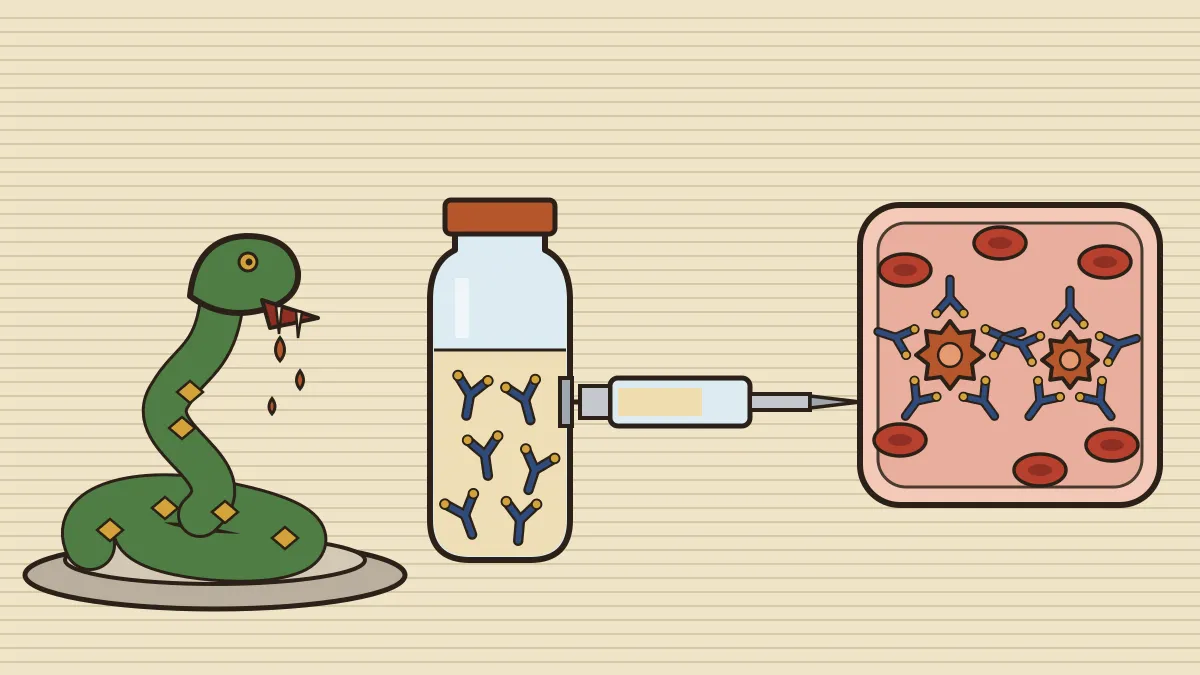
- Collect venom from healthy snakes.
- Immunise horses with tiny, safe, rising doses of the venom. The horse's immune system treats the venom as an antigen and makes large amounts of antibody. This is active immunity for the horse.
- Collect the plasma from the horse's blood; the animal is not harmed.
- Purify the antibodies. Often the enzyme pepsin is used to cut away the stem (the Fc region) of the Y-shaped antibody, leaving the F(ab')2 fragments that hold the antigen-binding tips. These fragments cause fewer allergic reactions and pass more easily into tissues. The PIB release describes the new antivenom as an "equine F(ab)2" product, meaning exactly this.
- Test, vial and store the product; it is given to the patient through a vein.
An antibody has four chains, two heavy and two light, joined to form a Y. The two tips of the Y recognise one specific shape on the antigen; the stem decides how the body handles the antibody. Because the tips are shaped for one venom, antivenom is specific, which is the whole reason a north-east pit viper needed its own product. The wider immune system is explained in our immunity and vaccination chapter and the HIV article.
Keep the person calm and still, immobilise the bitten limb, and get to a hospital that has antivenom. Do not cut the wound, suck out venom, apply a tight tourniquet or rely on herbal remedies. These waste the short time before venom spreads. Antivenom dose is decided by the severity of poisoning, not the person's weight, because the snake injects the same venom into a child and an adult.
Active and Passive Immunity
Antivenom works because it is passive immunity: the patient receives ready-made antibodies instead of building them. A vaccine gives active immunity: it trains the body to make its own antibodies and memory cells. Venom can paralyse or cause bleeding within hours, far faster than the immune system can respond to a first meeting with it, so passive protection is the only option.
| Point | Active immunity | Passive immunity |
|---|---|---|
| Who makes the antibodies | The person's own B lymphocytes | Another person or animal |
| Speed | Slow: days to weeks | Immediate |
| Memory | Yes: memory cells remain, so a second exposure is met quickly | No: the antibodies are used up or cleared, so protection lasts weeks |
| Natural examples | Recovering from measles or chickenpox | Colostrum (rich in IgA, the first milk) and antibodies (IgG) crossing the placenta |
| Artificial examples | Vaccines: BCG, polio, measles, hepatitis B, mRNA vaccines | Antivenom, anti-tetanus serum, rabies immunoglobulin, monoclonal antibodies |
Edward Jenner introduced the idea of immunisation in 1796, using cowpox material to protect against smallpox. Rabies shows both kinds together: after a bite, the patient gets the vaccine (active, slow) and rabies immunoglobulin (passive, immediate) to cover the gap. Vaccine platforms are in our vaccine platforms article.
Ask "who made the antibodies?" If you did, it is active. If someone else did and they were handed to you, it is passive. A vaccine can never be passive, and antivenom can never be active.
How UPSC Has Asked It: Past Papers Solved
These are real CDS and NDA questions. UPSC returns to the same ideas: who makes antibodies, what comes from the mother, the role of blood factors, and the occasional news item on a snake.
Which one among the following cells produces antibodies against a foreign antigen?
(a) Lymphocytes (b) Erythrocytes (c) Eosinophils (d) Platelets
Answer: (a). B lymphocytes make antibodies. Erythrocytes carry oxygen, and platelets help in clotting.
Which one of the following is the special type of milk produced by a lactating mother, essential for the development of immune response of newborn baby in human?
(a) Breast milk produced after a month of childbirth (b) Transitional milk (c) Colostrum (d) Mineralized milk
Answer: (c). Colostrum, the yellowish first milk, is rich in IgA antibodies. It is a case of natural passive immunity for the baby.
Who among the following scientists introduced the concept of immunization to the medical world?
(a) Edward Jenner (b) Robert Koch (c) Robert Hooke (d) Carl Linnaeus
Answer: (a). Jenner used cowpox to protect against smallpox in 1796. Koch is linked to germ theory and the tubercle bacillus, Hooke to the cell, and Linnaeus to classification.
A new species of pit-viper was discovered in 2019 and named after the State in which it was found. Identify the State from among the following:
(a) Kerala (b) Arunachal Pradesh (c) Andaman and Nicobar Islands (d) Assam
Answer: (b). The Arunachal pit viper was described in 2019. This is the same north-eastern pit viper family for which the new antivenom has been developed.
From which among the following are blood clotting factors released?
(a) RBCs (b) Eosinophils (c) Platelets (d) Monocytes
Answer: (c). Platelets release the factors that start clotting. Many viper venoms upset exactly this chain, which is why bite victims bleed.
Clotting of blood involves which one among the following clotting proteins?
(a) Pathogen (b) Fibrinogen (c) Macrophage (d) Phagocytes
Answer: (b). Fibrinogen is converted into fibrin to form the clot. A pathogen is a disease-causing organism, and macrophages and phagocytes are cells, not clotting proteins.
Every question here is a one-fact recall. The two that give a fresh news hook, the pit viper and the clotting protein, are exactly the points the new antivenom story revolves around. Learn the clotting chain (platelets, then fibrinogen to fibrin) and the cell that makes antibodies (lymphocytes), and four of these six are done.
Practice MCQs (with answers)
- Venom of the common krait acts mainly on
- blood clotting
- the kidneys only
- the nerve-muscle junction
- the skin only
- Which of the following is an example of passive immunisation?
- Antivenom injection after a snakebite
- Measles vaccine
- BCG vaccine
- Recovery from chickenpox
- Which of the following is NOT one of India's "Big Four" venomous snakes?
- Russell's viper
- Common krait
- Saw-scaled viper
- Pope's pit viper
- In making antivenom, the enzyme pepsin is used to
- increase the dose of venom
- cut away the Fc stem of the antibody, leaving F(ab')2 fragments
- make the horse's immunity active
- make the plasma clot
- Heat-sensing pits between the eye and the nostril are a feature of
- cobras
- pit vipers
- kraits
- Russell's viper
- Antibodies that pass from a mother to the foetus through the placenta provide
- natural active immunity
- artificial active immunity
- artificial passive immunity
- natural passive immunity
- Emil von Behring received the first Nobel Prize in Physiology or Medicine (1901) for
- serum therapy against diphtheria
- the smallpox vaccine
- discovery of penicillin
- discovery of insulin
- Which statement about active immunity is correct?
- It is immediate and leaves no memory
- Ready-made antibodies are injected
- The body makes its own antibodies and memory cells, but slowly
- It is produced only by antivenom
1-c, 2-a, 3-d, 4-b, 5-b, 6-d, 7-a, 8-c. Q2: the other three give or involve active immunity. Q3: the Big Four are the spectacled cobra, common krait, Russell's viper and saw-scaled viper; Pope's pit viper is one of the two species the new antivenom targets. Q4: pepsin removes the Fc stem, so the product is safer and more easily absorbed. Q6: the antibodies are made by the mother and only handed over, so the immunity is passive, and it is natural because no injection is involved. Q7: Jenner (smallpox) and Fleming (penicillin) are common distractors.
Quick Revision
- Neurotoxic venom (cobra, krait): blocks the nerve-muscle junction, paralysis, breathing failure. Haemotoxic venom (Russell's, saw-scaled and pit vipers): clotting failure, bleeding, kidney damage.
- Big Four: spectacled cobra, common krait, Russell's viper, saw-scaled viper. Indian antivenom is polyvalent against these; it works poorly on north-east pit vipers.
- New (25 Nov 2026): bivalent equine F(ab)2 antivenom against T. popeiorum and T. erythrurus, by IASST Guwahati (DST); preclinical stage.
- Antivenom = horse antibodies: immunise horse, collect plasma, cut with pepsin to F(ab')2, purify. It is passive immunity: immediate, no memory.
- Passive examples: antivenom, anti-tetanus serum, rabies immunoglobulin, colostrum (IgA), placental IgG. Active: infection and vaccines (Jenner, 1796).
- Clotting: platelets, then fibrinogen to fibrin. Antibodies are made by B lymphocytes.
- Arunachal pit viper described 2019. WHO lists snakebite as a neglected tropical disease; India's national action plan (2024) targets halving deaths by 2030.
Frequently asked questions
What is antivenom made of?
Antivenom is made of antibodies. Horses are injected with small doses of venom, their blood plasma is collected, and the antibodies are purified. Often the stem of each antibody is cut off with pepsin, leaving F(ab')2 fragments that cause fewer allergic reactions.
Why is antivenom called passive immunity?
The patient receives ready-made antibodies produced by a horse instead of making their own. It works immediately but gives no memory, so protection does not last. Vaccines give active immunity, because the body makes its own antibodies and memory cells.
What is the difference between neurotoxic and haemotoxic venom?
Neurotoxic venom, mainly from cobras and kraits, blocks signals between nerves and muscles and can stop breathing. Haemotoxic venom, mainly from vipers, disturbs blood clotting and damages tissue and kidneys, leading to bleeding and shock.
Why was a new antivenom needed for the north-east?
India's standard antivenom is made against the Big Four snakes, and it has limited effect on several north-eastern snakes such as the Pope's pit viper and the red-tailed bamboo pit viper. The new bivalent antivenom is made against these two pit vipers and has shown better protection in laboratory and preclinical tests.
What should be done after a snakebite?
Keep the person calm, immobilise the limb and take them quickly to a hospital with antivenom. Do not cut the wound, suck out venom or tie a tight tourniquet. The antivenom dose depends on how severe the poisoning is, not on body weight.
Related CDS / OTA Science topics
Science is a big slice of the CDS GS paper
Cavalier's CDS/OTA batches teach physics, chemistry and biology from first principles, with weekly PYQ tests.