India observes National Energy Conservation Day on 14 December. The Ministry of Power and the Bureau of Energy Efficiency (BEE), set up in 2002 under the Energy Conservation Act, 2001, use the day to hand out the National Energy Conservation Awards and to push star-rated appliances, LED lamps and efficient motors. Behind every slogan is plain school physics: a bulb's rating in watts, a meter reading in units, a bill in rupees. This article follows that chain from the first idea, work, to the last, your monthly bill, so that every formula appears once, with a numerical beside it. UPSC asks this chapter almost every year, usually as a one-step sum or a unit trap, and it rewards anyone who can calculate quickly and avoid the usual slips.
Work: When a Force Really Does Something
By Abhishek Thakur · Science faculty, The Cavalier · 15 years teaching NDA and CDS Science
In everyday speech, a student who studies for hours is "working hard". In physics, work is done only when a force moves its point of application. If a constant force F acts on a body while the body moves a distance s, the work done by that force is the force component along the displacement, multiplied by the displacement:
One joule is the work done when a force of 1 N moves a body through 1 m in its own direction. The angle θ decides everything:
| Angle θ | cosθ | Work | Everyday picture |
|---|---|---|---|
| 0° | +1 | Positive, the maximum | Pushing a stalled car along the road; gravity acting on a falling stone |
| 90° | 0 | Zero | Carrying a bag along a level platform; the Earth's pull on the Moon; the string's pull on a whirled stone |
| 180° | −1 | Negative, the minimum | Brakes slowing a car; friction on a sliding box; gravity on a ball thrown upwards |
Three traps recur. No displacement, no work: pushing a wall achieves nothing in physics. Perpendicular force, no work: a porter on level ground holds the load up, but the load moves sideways, so that force does zero work. Circular motion at constant speed: the string's pull is always at 90° to the stone's motion, so it does no work and the speed does not change (CDS 2025-II asked this). Our page on circular motion and centripetal force explains why.
Work by gravity. Lifting a mass m through height h at steady speed takes +mgh from the lifter, while gravity does −mgh. Only the vertical height matters, not the path.
A box is dragged 10 m along a floor by a rope that pulls with 50 N at 60° above the horizontal. How much work does the rope do?
If the force varies, work is the area under the F-s graph. For a spring (F = kx) that area is a triangle, so stretching it by x stores ½kx².
Kinetic Energy, Potential Energy and the Work-Energy Theorem
Energy is the capacity to do work, measured in the same unit, the joule. Two forms appear in nearly every numerical.
| Form | Formula | What to remember |
|---|---|---|
| Kinetic energy (motion) | KE = ½mv² | Depends on the square of speed. Double the speed and KE becomes four times; triple it and KE becomes nine times. Never negative. |
| Gravitational potential energy (position) | PE = mgh | Measured from a chosen reference level. Depends only on height, not on the path taken. |
| Elastic potential energy (stretched or compressed spring) | PE = ½kx² | Energy of a drawn bow, a wound watch spring, a compressed shock absorber. |
| Link between KE and momentum | KE = p² ÷ 2m | Useful when momentum is given. See our page on momentum and conservation laws. |
Where does ½mv² come from? Take a body of mass m that a constant net force F pushes through a distance s, so that its speed changes from u to v. Newton's second law gives F = ma, and the equation of motion gives v² = u² + 2as. Multiply the second by m/2:
This one line is the quickest tool in the chapter. It lets you skip the time and the acceleration altogether. Two applications come up again and again.
A car of mass 1,000 kg travels at 20 m/s. The brakes apply a steady retarding force of 5,000 N. How far does it travel before stopping?
The last line carries a road-safety lesson: stopping distance grows as the square of the speed. A driver doing 80 km/h needs four times the braking distance of one doing 40 km/h.
Doubling the speed doubles momentum (mv) but makes KE four times. And if the momentum is doubled, KE again becomes four times, because KE = p² ÷ 2m. Momentum is a vector and KE a scalar: momentum can cancel in a collision, but KE is never negative.
Conservation of Energy: The Roller-Coaster and the Pendulum
Energy is never created or destroyed. It is only changed from one form to another, and the total stays the same. In a system with no friction or air resistance, the sum of kinetic and potential energy, called the mechanical energy, stays constant. This is the reason a roller-coaster can climb its second hill only if that hill is lower than the first.
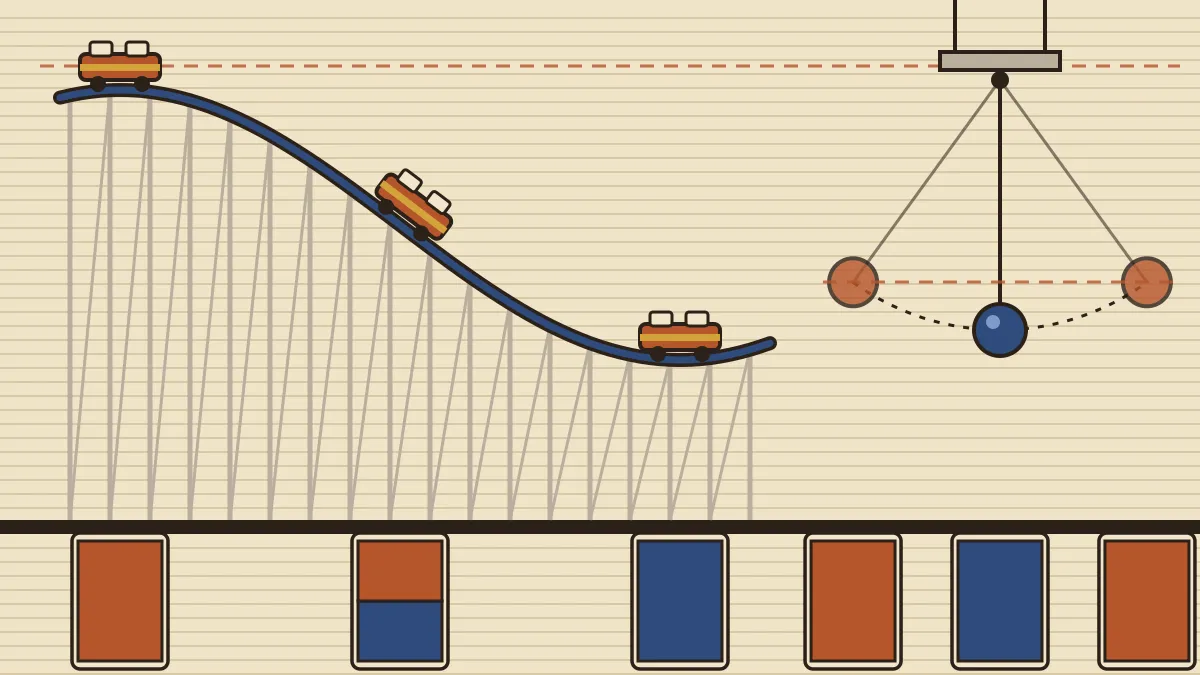
A simple pendulum swaps the two forms continuously: at each end of its swing KE is zero and PE greatest; at the lowest point PE is least and speed greatest (CDS 2023-II asked this with a diagram). A ball dropped from a height gives clear numbers. Take a 2 kg ball released from 20 m, with g = 10 m/s²:
| Height above ground | PE = mgh | KE | Total | Speed |
|---|---|---|---|---|
| 20 m | 400 J | 0 J | 400 J | 0 |
| 15 m | 300 J | 100 J | 400 J | 10 m/s |
| 10 m | 200 J | 200 J | 400 J | 14.1 m/s |
| 5 m | 100 J | 300 J | 400 J | 17.3 m/s |
| 0 m | 0 J | 400 J | 400 J | 20 m/s |
Setting PE lost equal to KE gained, mgh = ½mv², the mass cancels: v = √(2gh). A heavy and a light stone dropped together land together at the same speed (NDA 2025-I). See our page on gravity and the variation in g.
(a) A pendulum bob is pulled aside until it is 0.2 m higher than its lowest point, then released. What is its speed at the lowest point? (b) A frictionless coaster car starts from rest at the top of a 45 m hill. What is its speed at the bottom?
Where does the "lost" energy go? A bouncing ball rises less each time because, at each impact, some of its mechanical energy becomes heat and sound. Total energy is always conserved; mechanical energy is conserved only when friction and drag can be ignored.
Power and the Units You Must Not Mix Up
Power is the rate of doing work, or the rate at which energy is transferred: P = W ÷ t. When a force F moves a body at constant speed v in its own direction, the same idea gives P = F × v, which is how engineers rate engines. The SI unit is the watt (1 W = 1 J/s), named after James Watt. Two bulbs can do the same total work, but the 100 W bulb transfers energy ten times faster than the 10 W one.
| Unit | Measures | Value |
|---|---|---|
| Joule (J) | Work, energy | 1 N × 1 m |
| Watt (W) | Power | 1 J per second |
| Kilowatt (kW), megawatt (MW) | Power | 10³ W; 10⁶ W |
| Horsepower (hp) | Power | 1 hp = 746 W (about ¾ of a kW) |
| Kilowatt-hour (kWh) | Energy, not power | 1 kWh = 1 kW × 3,600 s = 3.6 × 10⁶ J = 3.6 MJ. This is the "unit" on your bill. |
The kilowatt-hour has "watt" in its name, yet it is energy: power multiplied by time. NDA 2020-I asked which option is NOT a unit of energy, and the answer was kg·m/s², which is a newton. Joule, watt-hour and newton-metre are all energy units.
Efficiency measures how much of the input energy turns into useful output: η = (useful output ÷ total input) × 100%. No machine reaches 100%, because some energy always escapes as heat or sound.
A pump lifts 600 kg of water per minute from a well 20 m deep. Its electric motor is 80% efficient. What power does the motor draw? Convert the useful power into horsepower.
Electrical power, P = VI = I²R = V²/R, is covered on our page on circuits and power consumption.
The Electricity Bill: Where Units Meet Rupees
A household meter counts in kilowatt-hours. One unit of electricity = 1 kWh. The recipe never changes:
Take a small home over a 30-day month. The tariff differs from state to state, so assume a flat rate of ₹6 per unit for the sum:
| Appliance | Power | Use per day | Units in 30 days |
|---|---|---|---|
| 4 LED bulbs | 10 W each | 5 hours | 4 × 10 × 5 × 30 ÷ 1000 = 6.0 |
| 3 ceiling fans | 70 W each | 8 hours | 3 × 70 × 8 × 30 ÷ 1000 = 50.4 |
| Refrigerator | (average draw) | 1 unit a day | 30.0 |
| Water heater | 2,000 W | 30 minutes | 2 × 0.5 × 30 = 30.0 |
| Total | 116.4 units; bill = 116.4 × 6 = ₹698.40 | ||
The four LED bulbs above replace four 60 W filament bulbs that burned for the same 5 hours a day. How many units and how much money are saved in 30 days?
That is the arithmetic behind the BEE's LED and star-label drives: energy saved is energy that need not be generated.
Divide watts by 1,000 before multiplying by hours; use 0.5 h for 30 minutes; and never call the kWh a unit of power.
How UPSC Has Asked It: Past Papers Solved
These are actual CDS and NDA questions since 2018. They are mostly one-step: pick the formula, put in the numbers, mind the unit. The bulb question returned in CDS 2023-I with 3 days instead of 30 (answer 3.00 units): UPSC recycles its sums.
A 100 W electric bulb is used for 10 hours a day. How many units of energy are consumed in 30 days?
(a) 1 (b) 10 (c) 30 (d) 300
Answer: (c). Energy = 0.1 kW × 10 h × 30 days = 30 kWh = 30 units. The tempting option is (d) 300, which comes from forgetting to convert 100 W into 0.1 kW.
If the linear momentum of a moving object gets doubled due to application of a force, then its kinetic energy will
(a) remain same (b) increase by four times (c) increase by two times (d) increase by eight times
Answer: (b). KE = p² ÷ 2m. With the mass fixed, doubling p multiplies p² by 4. The tempting option is (c), which treats KE as proportional to momentum.
When a stone tied to a string is whirled in a circle, the work done on it by the string:
(a) is positive. (b) is negative. (c) is zero. (d) depends on the mass of the stone.
Answer: (c). The string's pull points to the centre, at 90° to the stone's velocity, so W = Fs cos 90° = 0. The speed stays constant and the kinetic energy does not change.
The cost of energy to operate an industrial refrigerator that consumes 5 kW power working 10 hours per day for 30 days will be (Given that the charge per kWh of energy = ₹4)
(a) ₹600 (b) ₹6,000 (c) ₹1,200 (d) ₹1,500
Answer: (b). Energy = 5 kW × 10 h × 30 = 1,500 kWh, and cost = 1,500 × ₹4 = ₹6,000. Option (d) 1,500 is the energy in kWh before the rate is applied.
A tennis ball of mass 350 g is thrown vertically upwards at a speed of 4 m/s. If M is the maximum gravitational potential energy of the ball and H is the maximum height it reaches, then which one of the following is correct? (Take g = 10 m/s²)
(a) M = 5.6 J, H = 1.6 m (b) M = 2.8 J, H = 1.6 m (c) M = 5.6 J, H = 0.8 m (d) M = 2.8 J, H = 0.8 m
Answer: (d). At the top all the KE has become PE: M = ½ × 0.35 × 4² = 2.8 J. Then mgH = M gives H = 2.8 ÷ (0.35 × 10) = 0.8 m. Options with 5.6 J forget the ½ in the kinetic energy formula, and 1.6 m is v²÷g, again missing a factor of 2.
Five relationships cover everything here: W = Fs cosθ, KE = ½mv², PE = mgh, P = W ÷ t and 1 kWh = 3.6 × 10⁶ J. Every wrong option is a slip: a missing ½ or square root, watts not turned into kilowatts, or minutes used as hours.
Practice MCQs (with answers)
- A porter carries a 20 kg load along a level platform at a steady speed. The work done by the upward force that supports the load is
- mg times the distance walked
- zero
- negative
- dependent on the walking speed
- A force of 40 N acts at 60° to the horizontal and drags a box 5 m along the floor. The work done by the force is
- 200 J
- 346 J
- 173 J
- 100 J
- The speed of a car is tripled. Its kinetic energy becomes
- 9 times
- 3 times
- 6 times
- 27 times
- A 2 kg ball is dropped from a height of 20 m (g = 10 m/s²). Its speed when it is 5 m above the ground is nearest to
- 10 m/s
- 14.1 m/s
- 17.3 m/s
- 20 m/s
- One horsepower is equal to
- 74.6 W
- 746 W
- 7.46 kW
- 1 kW
- A 1,500 W water heater is used for 20 minutes every day. The energy it uses in 30 days is
- 7.5 units
- 10 units
- 45 units
- 15 units
- An electric motor of efficiency 80% draws 2.5 kW from the supply. Its useful output power is
- 3.125 kW
- 0.5 kW
- 2.0 kW
- 2.5 kW
- A rubber ball dropped on the floor bounces to a smaller height each time. Which statement is correct?
- The total energy stays constant, but some of the ball's mechanical energy becomes heat and sound
- Energy is destroyed at each bounce
- The mechanical energy of the ball is created again on the way up
- Only the kinetic energy is lost, the potential energy is unchanged
1-b, 2-d, 3-a, 4-c, 5-b, 6-d, 7-c, 8-a. Q2: 40 × 5 × cos 60° = 100 J; (a) forgets the cosine. Q4: the ball has fallen 15 m, so v² = 2 × 10 × 15 = 300 and v = 17.3 m/s; 14.1 m/s is the speed after 10 m. Q6: 1.5 kW × ⅓ h = 0.5 kWh a day, so 15 units. Q7: useful power = 0.8 × 2.5 = 2.0 kW; 3.125 comes from dividing by 0.8.
Quick Revision
- W = F s cosθ (scalar, joule). θ = 0°: positive; 90°: zero (circular motion, porter on level ground); 180°: negative (brakes, friction). No displacement, no work.
- KE = ½mv² = p²/2m: double the speed, 4 times the KE. PE = mgh; spring PE = ½kx². Work-energy theorem: net work = change in KE.
- Stopping distance goes as speed squared. Free fall: v = √(2gh), independent of mass.
- Total energy is always conserved; mechanical energy only without friction or drag. A pendulum: PE greatest at the ends, KE greatest at the bottom.
- P = W/t = Fv; watt = J/s; 1 hp = 746 W; efficiency = useful output ÷ input × 100%.
- 1 kWh = 1 unit = 3.6 × 10⁶ J, an energy unit. Bill = kW × hours × rate; convert W to kW and minutes to hours first.
- National Energy Conservation Day: 14 December. BEE: 2002, under the Energy Conservation Act, 2001.
Frequently asked questions
When is work said to be done in physics?
Work is done when a force moves its point of application, and it equals force times displacement times the cosine of the angle between them. If there is no displacement, or the force is at right angles to the motion, the work is zero.
What is the work-energy theorem?
The net work done on a body equals the change in its kinetic energy. It follows from Newton's second law and v² = u² + 2as, and it is the quickest route to stopping-distance and bullet-penetration sums because it avoids time and acceleration.
Is a kilowatt-hour a unit of power or energy?
It is a unit of energy, because it is power multiplied by time. One kilowatt-hour equals 3.6 × 10⁶ joules and is called one unit on an electricity bill. The watt and kilowatt are units of power.
How many watts make one horsepower?
One horsepower equals 746 watts, a little under three-quarters of a kilowatt. James Watt introduced it to compare steam engines with draught horses, and the SI unit of power is named after him.
Why is National Energy Conservation Day observed on 14 December?
The Ministry of Power and the Bureau of Energy Efficiency use 14 December to promote energy saving and to present the National Energy Conservation Awards. The Bureau was set up in 2002 under the Energy Conservation Act, 2001.
Related CDS / OTA Science topics
Physics numericals are quick marks in the CDS GS paper
Cavalier's CDS/OTA batches teach physics from first principles, with a numerical drill after every concept and weekly PYQ tests.